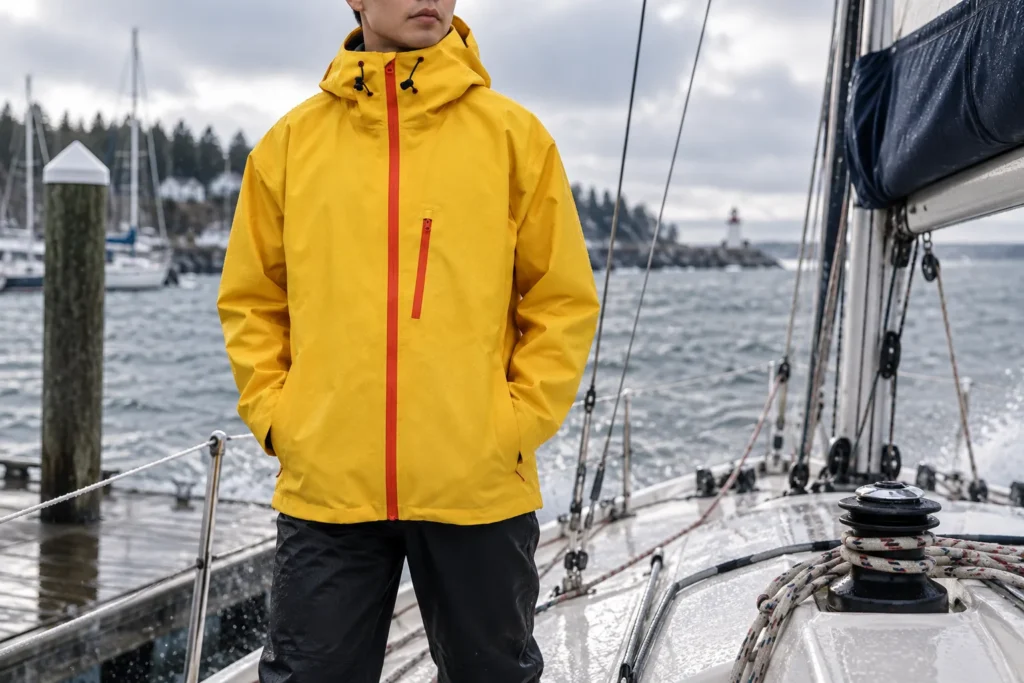
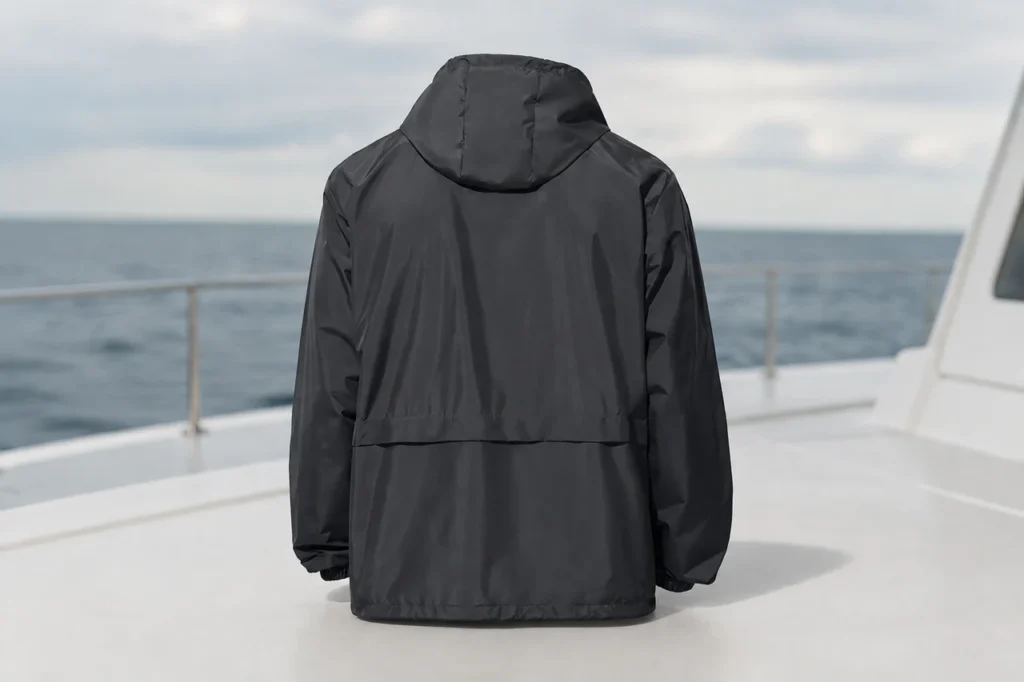
 Xiamen Yuelei Sports Co., Ltd

When a technical engineer in Auckland encountered sizing problems before a coastal-to-offshore rollout, he ordered one medium sample, wore it over a fleece midlayer during a harbor trial, and saw sleeve lift and neck leakage within twenty minutes of spray. The first reaction was to reject the jacket. Route and fit records reversed that conclusion: the sample was a coastal day-sailing SKU, but the purchase brief expected overnight watchkeeping and occasional green-water exposure.
Summary: Select a waterproof sailing jacket by exposure duration, route consequence, and access to shelter—not by an “offshore” label or one headline rating. ISO 811:2018 can compare fabric resistance to hydrostatic pressure, while ISO 11092:2026 can compare thermal and water-vapour resistance; neither certifies a finished jacket for a sailing category. Define the route, require method-matched reports, and fit-test every approval sample with its intended PFD, harness, gloves, layers, and salopettes.
The decision is not simply “light versus heavy.” A coastal crew with a reliable two-hour return window needs different coverage and redundancy from a crew standing night watches without rapid diversion. World Sailing’s Offshore Special Regulations frame event risk around distance from help and self-sufficiency; they do not certify a waterproof sailing jacket. Buyers must convert the itinerary into a waterproof sailing jacket specification.
Your Shelter and Return-to-Port Options Determine Whether Coastal Protection Is Enough
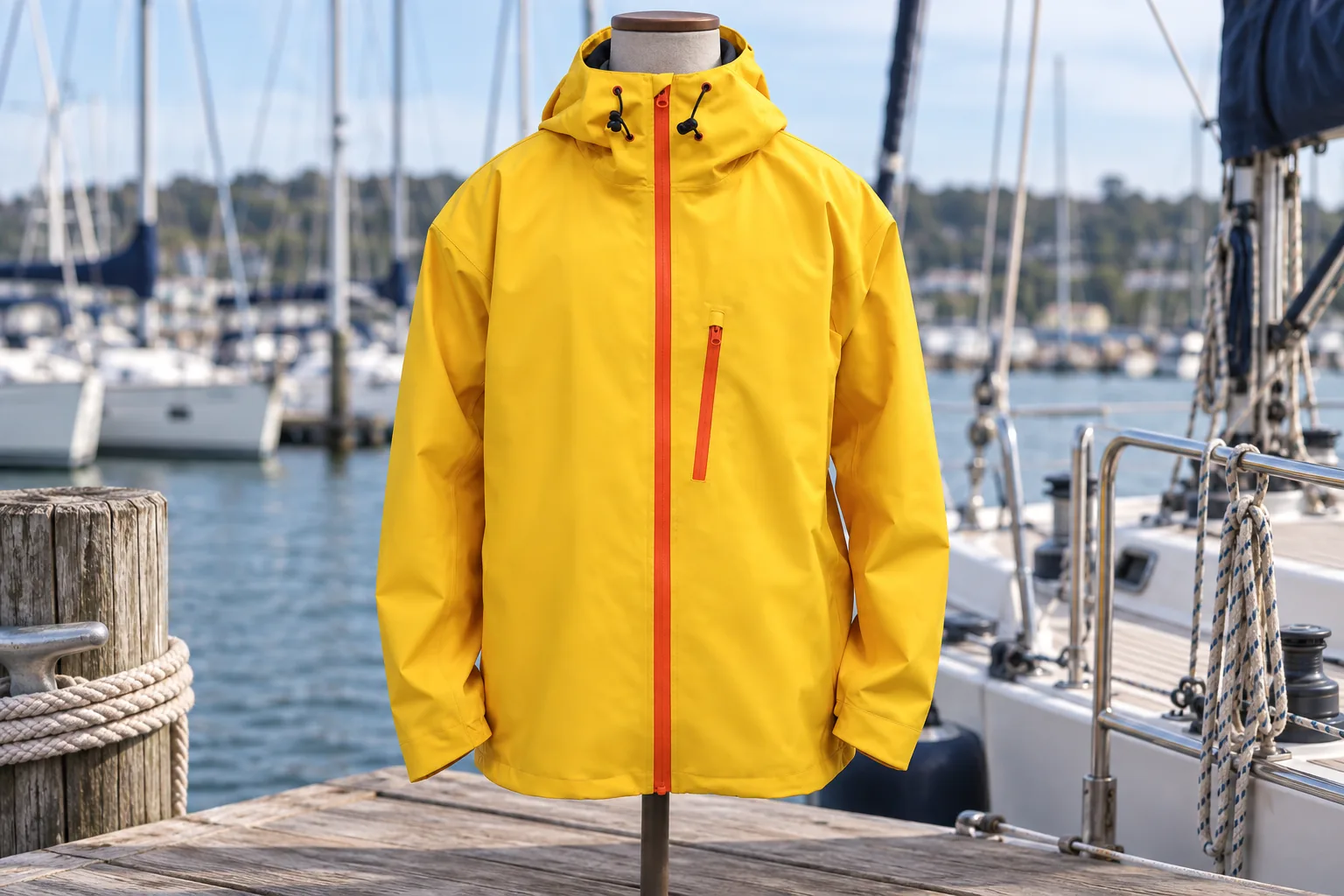
Start with the longest credible exposure, not the average trip. Record continuous time on deck, rain and spray, temperature, wind, night work, abrasion, and whether a wet wearer can change below. Then state the escape condition: marina, sheltered cockpit, support vessel, or no practical return. A coastal waterproof sailing jacket can become a poor offshore choice when a leak means hours of cooling and distraction.
| Route and exposure profile | Shelter or return logic | Likely jacket priority | Decision trigger |
|---|---|---|---|
| Protected-water or coastal day use; intermittent rain and splash | Enclosed shelter is available, or return to port is reasonably prompt | Low bulk, packability, clear vision, easy care, reliable seam sealing | A lighter 2-layer or 2.5-layer design may be sufficient after garment checks |
| Exposed coast or overnight passage; repeated wet and dry periods | Shelter exists but watch changes or diversion delay access | Stable hood and collar, longer coverage, durable laminate, ventilation | Move toward offshore features when a wet wearer cannot reset promptly |
| Offshore passage; sustained spray, cold watches, possible green water | No reliable rapid return; the crew must remain functional until conditions change | Robust 3-layer shell, high-protection closures, double cuffs, secure pockets | Specify the complete closure system and post-care performance, not fabric alone |
| Mixed fleet or charter program | Routes and crew experience vary | Separate coastal and offshore SKUs with unambiguous use-case language | Do not average unlike routes into one compromise specification |
“Coastal,” “inshore,” and “offshore” are use-case labels, not certifications. Attach exposure assumptions and pass criteria to each. Without shelter time, spray duration, and worn-equipment details, the category name cannot guide defensible construction or claims.
A Fabric Rating Answers One Waterproof Question, While Breathability Requires a Method-Matched Comparison
ISO 811:2018 measures textile resistance to water penetration under hydrostatic pressure. Compare only aligned specimens, conditioning, pressure rate, and reporting. Even the best offshore sailing jacket presents seams, zippers, hood openings, cuffs, and wear points that this fabric test does not cover. Hydrostatic head is useful fabric evidence, not proof of passage-long protection.
Surface wetting is another question. ISO 4920 assesses how a textile surface resists wetting in a spray test and explicitly does not predict rain penetration. When durable water-repellent treatment weakens, the face can wet out and feel colder or less breathable even when the waterproof barrier has not leaked. QA teams should distinguish outer-face saturation, condensation, seam ingress, and membrane penetration before assigning corrective action.
Breathability figures mislead when unlike methods or units are ranked together. ISO 11092:2026 reports steady-state thermal and water-vapour resistance, often expressed as Ret, using a sweating guarded hotplate. ASTM E96/E96M reports water-vapour transmission under specified procedures. Lower Ret and higher WVTR can each indicate more transfer within their method, but they are not interchangeable scores.
| Performance question | Relevant method | What buyers may compare | What buyers should not infer |
|---|---|---|---|
| How does fabric resist water pressure? | ISO 811:2018 | Results from the same method, conditioning, and agreed specimen state | Finished-garment offshore certification or leak-free closures |
| How does the face resist surface wetting? | ISO 4920 | Like-for-like spray ratings before and after stated preconditioning | Resistance to rain penetration |
| What is the textile’s water-vapour resistance? | ISO 11092:2026 | Ret results under the same method and test conditions | Direct equivalence to an ASTM E96 WVTR value |
| What survives care? | ISO 6330:2021 preconditioning plus an agreed retest | Results tied to named wash, dry, cycle count, and retest procedure | An unspecified “wash-tested” durability claim |
Request the method, edition, units, conditions, construction, laboratory, and specimen state. Never convert Ret to WVTR with a generic multiplier. If methods differ, use method-matched benchmarks and settle the decision through controlled wear and garment-level checks.
Offshore Protection Depends on Hood, Collar, Cuff, Coverage, and Equipment Interfaces
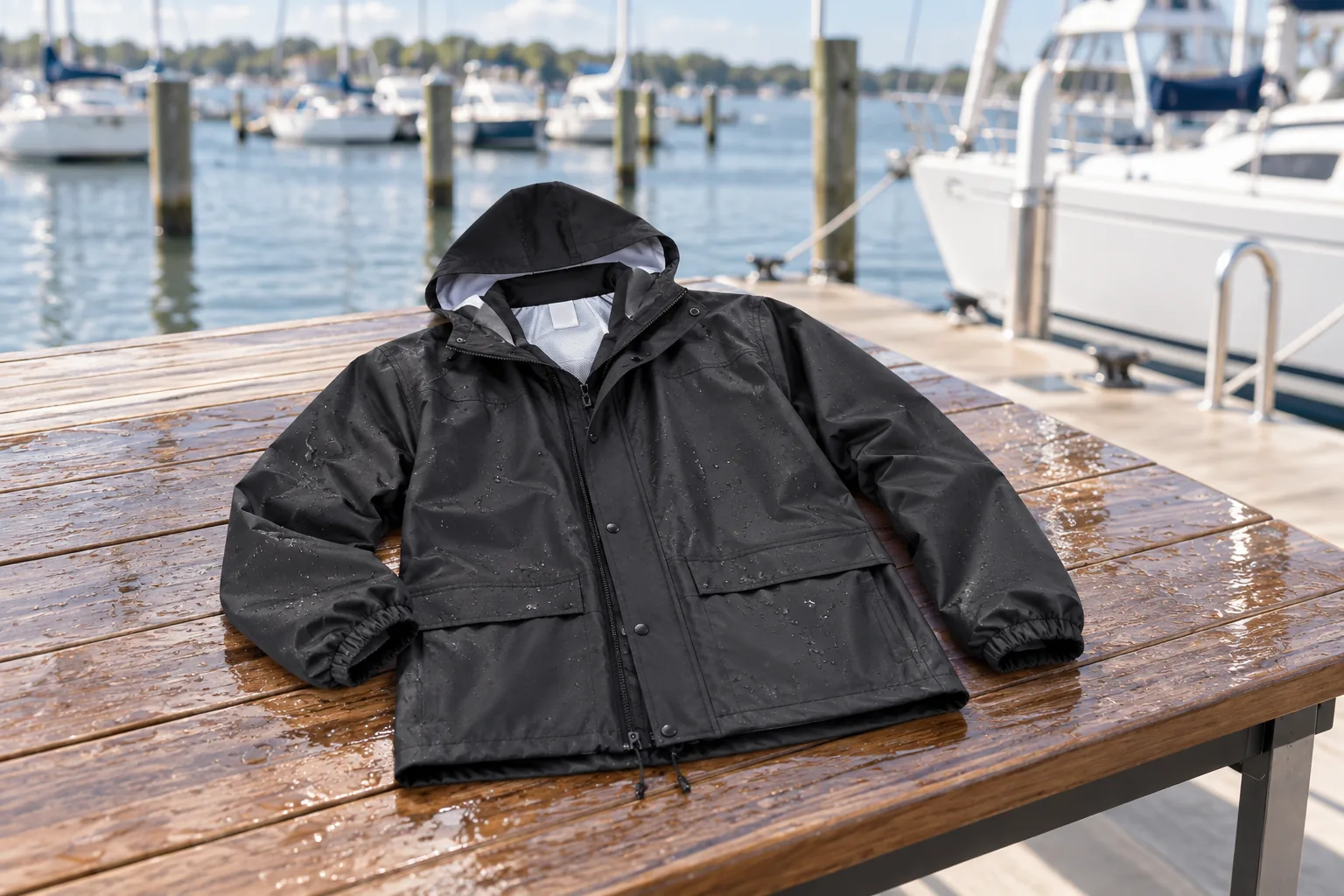
The practical distinction appears at openings. A coastal hood can emphasize packability and peripheral vision; an offshore hood often needs a firm brim, multiple adjustments, drainage, and stable head tracking. A high collar must close over layers without lifting the chin, obscuring vision, or colliding with a PFD. Review any soft facing for drying and water retention.
Single adjustable cuffs may suit day use. For longer spray exposure, an inner seal plus outer cuff can improve the glove interface if cold hands can operate both. Sleeves must still cover wrists at a wheel, winch, or grab point. The hem should overlap salopettes while bending without bunching beneath a harness.
| Component | Coastal decision tendency | Offshore decision tendency | Approval-sample check |
|---|---|---|---|
| Hood | Packable, simple adjustment, open peripheral view | Structured brim, multi-point adjustment, drainage, wind stability | Turn the head fully and look upward while wearing the PFD |
| Collar and front closure | Comfortable rain protection with low bulk | Higher spray coverage and controllable storm flap or water-resistant zipper system | Close fully over layers; check chin comfort, drainage, and zipper operation |
| Cuffs | Single outer adjustment may meet brief | Inner seal and glove-compatible outer adjustment often reduce ingress risk | Grip a line and operate every closure while wearing wet-weather gloves |
| Hem and coverage | Shorter cut may improve mobility and packability | Longer overlap with salopettes protects during bending and seated watches | Raise both arms, crouch, and rotate without exposing wrists or lower back |
| Pockets and attachment points | General storage can remain accessible without a harness | Raised pockets, drainage, tethered pulls, and low snag risk matter more | Load the PFD and harness; confirm buckles do not block pockets or trap hardware |
A full-kit trial needs the intended PFD, harness, tether, gloves, layers, and salopettes. Test head rotation, zipper and pocket access, tether clipping, winch posture, and seated steering. The best waterproof sailing jacket for the route must not hide hardware, push the PFD upward, cause pressure, or lose coverage. Record failures by size because grading changes interfaces.
Layer Construction Affects Total Cost Only When the RFQ Captures Use, Care, and Returns
A 2-layer shell pairs face and membrane with a separate lining, often supporting comfort, low bulk, and coastal price targets. A 3-layer laminate bonds face, membrane, and backer; it is often preferred for abrasion, repeated use, drying, and offshore stability. Neither wins without equal-method data and an agreed duty cycle.
TCO includes landed cost, sampling, testing, care communication, warranty handling, returns, replacements, and usable trips. An illustrative calculation is program TCO divided by accepted wear occasions; it is not a universal price claim. Over-specifying a coastal SKU can slow sell-through, while under-specifying offshore gear can increase returns and damage trust.
| RFQ or TCO field | Minimum decision-ready entry | Commercial reason |
|---|---|---|
| Route and duty cycle | Exposure duration, shelter/return window, climate, watches per trip, trips per season | Prevents one vague “offshore” brief from covering unlike risks |
| Construction and closures | Layer build, seam tape, zipper system, hood, collar, cuffs, hem, pocket drainage | Connects fabric performance to actual leak paths |
| Test evidence | Method edition, units, conditions, specimen state, laboratory, pass criteria | Stops unmatched headline numbers from driving award decisions |
| Care durability | Named ISO 6330 wash/dry procedure, agreed cycle count, and post-care retest | Makes durability claims auditable without inventing a cycle target |
| Fit and compatibility | Body chart, finished-garment measurements, layer stack, PFD/harness model, dynamic test sizes | Reduces avoidable sizing and access returns |
| After-sales inputs | Care insert, repair route, replaceable parts, failure coding, warranty assumptions | Exposes lifecycle cost before purchase-order approval |
ISO 811:2018, ISO 4920, ISO 11092:2026, and ISO 6330:2021 are methods or care procedures, not jacket certifications. World Sailing rules provide route-safety context; they do not approve garments. A certification claim needs a verified scheme, product scope, issuer, and current documentation. Keep use-case labels separate from tests and certifications.
Approve the Jacket Only After the Route Brief, Reports, and Full-Kit Sample Agree
- Classify the worst credible route by exposure duration, weather, deck work, available shelter, and return-to-port time.
- Write coastal and offshore pass criteria separately; the buyer phrases “sailing jacket waterproof” and “sailing waterproof jacket” are not substitutes for garment-opening and interface checks.
- Compare waterproofness and breathability only under the same named method, units, conditions, and sample state; flag any gap for a controlled retest.
- Fit-test representative sizes over the real layer stack with PFD, harness, gloves, and salopettes; retain measurements and movement notes.
- Model landed cost together with testing, returns, care, repair, and replacement assumptions before selecting the 2-layer or 3-layer program.
Yuelei Sports is a China-based B2B outdoor sportswear solutions supplier that can discuss configurable waterproof outdoor apparel and the documentation needed for sourcing review. Buyers mapping adjacent protection categories can review waterproof sailing jacket sourcing, compare dry suits, or assess a kayak dry suit when the hazard changes from weather exposure to possible immersion. These categories are not substitutes; each needs its own use case and evidence.
Buyers Should Resolve These Six Questions Before Approving Coastal or Offshore Supply
Is a waterproof sailing jacket different from a regular rain jacket?
Yes, when its specification addresses wind-driven spray, hood stability, glove-compatible cuffs, collar sealing, equipment interfaces, and movement over layers. A regular rain shell may still work for short sheltered trips, but it should not inherit an offshore claim without supporting construction and verification.
Is a 20,000 mm rating enough for an offshore sailing jacket?
Not by itself. The number needs a named method such as ISO 811:2018, aligned conditions, and clear specimen status; the finished garment still requires seam, closure, cuff, hood, and post-care checks. Treat any threshold as one input to the route brief, not a certification boundary.
How can buyers compare breathability claims from different suppliers?
Compare results only when the method, units, conditions, and sample construction match. ISO 11092:2026 Ret data should be compared with equivalent Ret data, while ASTM E96 WVTR data stays within its stated procedure. When methods differ, request method-matched retesting rather than ranking the headline values.
When is a 2-layer sailing rain jacket a better choice than a 3-layer shell?
The best sailing rain jacket for shorter coastal use can be a 2-layer design when packability, comfort, and accessible cost outweigh sustained abrasion and drying demands. A 3-layer shell is often the stronger candidate for repeated offshore work, but the final choice should follow the agreed duty cycle, test evidence, and TCO model.
How should the jacket fit with a PFD and safety harness?
The PFD should remain correctly positioned, harness buckles and tether points should stay visible and reachable, and neither system should block essential pockets or pulls. Test arm reach, head rotation, crouching, and seated work in every approval size; Yuelei’s guide to sailing base layers and midlayers can help define the underlying layer stack.
How should a buyer verify wash and reproofing claims?
State the wash and drying procedure, cycle count, detergent conditions, and performance test to be repeated after care. ISO 6330:2021 provides standardized domestic washing and drying procedures, but it does not set a universal number of cycles for every product claim. The supplier and buyer must agree that target explicitly.
Primary Sources Define the Test Boundaries Behind This Comparison
- ISO 811:2018 — hydrostatic-pressure resistance test for textiles.
- ISO 11092:2026 — steady-state thermal and water-vapour resistance test method.
- ISO 4920:2012 — textile surface-wetting spray test, which does not predict rain penetration.
- ISO 6330:2021 — domestic washing and drying procedures used for textile testing.
- World Sailing Offshore Special Regulations — route and event safety context, not garment approval.
The durable sourcing rule is simple: define how long the sailor is exposed and how quickly shelter can be reached, then demand evidence for every feature that must keep working until that point.
For distributors and product teams comparing a coastal waterproof sailing jacket with an offshore program, Yuelei Sports can help review the route brief, fabric construction, fit block, interface checks, and care language. Start with related waterproof sailing jacket sourcing or contact Yuelei Sports to discuss a method-matched specification and RFQ.