 Xiamen Yuelei Sports Co., Ltd

A runner can finish a rainy outing with damp sleeves and a wet back even when the jacket’s fabric has resisted the rain. Perspiration may be accumulating faster than moisture can escape. That does not rule out a leak, but it explains why buying a higher waterproof number alone may not solve the problem. A running shell has to be considered while the wearer is working hard, with arms moving, pockets loaded and a hood that needs to stay out of the way.
A women’s waterproof jacket for running needs a workable balance of rain protection, ventilation and moving fit. An uninsulated shell usually allows more adjustment than a warm lined jacket during sustained effort. It still cannot guarantee a dry interior. Start with the expected exposure and layers, then check the hood, cuffs, pocket movement and carrying arrangement at a running pace.
Is the jacket leaking, or is sweat collecting inside?
Both are possible. Broad internal dampness can be consistent with perspiration or condensation; moisture near an opening or seam may suggest water entry. Location alone does not prove the cause, because water can spread through clothing and collect at contact points.
Record the weather, effort, layers and fastening positions before drawing a conclusion. Inspect the garment using its supplier’s guidance. A description such as “wet across the back after a hard climb” is more useful than assuming that any moisture means the whole waterproof barrier has failed.
A shell can resist external water while still feeling clammy. That is an important limitation for runners, rather than a reason to dismiss either the waterproof test or the discomfort.
Why is breathability different from ventilation?
Moisture transfer through a fabric is not the same as air moving through an opening. Transfer depends on the material and conditions on either side, and it is not unlimited. During sustained running, sweat production can exceed what the garment can transfer.
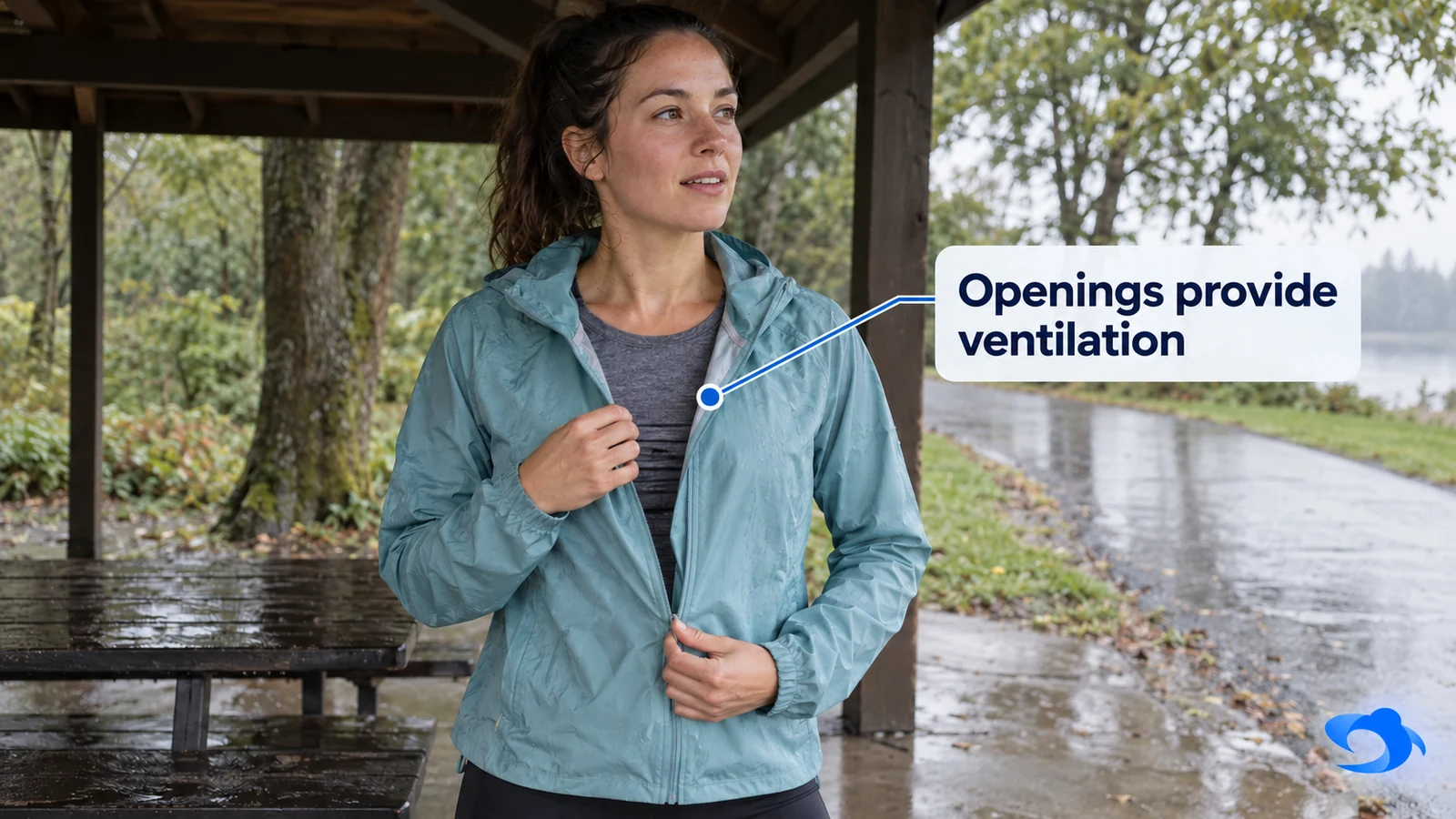
Ventilation exchanges warm, humid air more directly. Opening the front zipper may help with that exchange, but it can also admit rain. Check which openings can be used under the expected exposure, rather than assuming a vent is useful whenever it exists.
ISO 11092 measures thermal and water-vapour resistance under controlled steady-state conditions. Its results need a method and specimen description. They do not establish how comfortable a complete jacket will feel during every run.
Will the hood and sleeves stay put at a running pace?
Adjust the hood, jog and look over each shoulder. Check bounce and side vision. Tightening until it stops moving is not a satisfactory fix if the opening then blocks the wearer’s view.
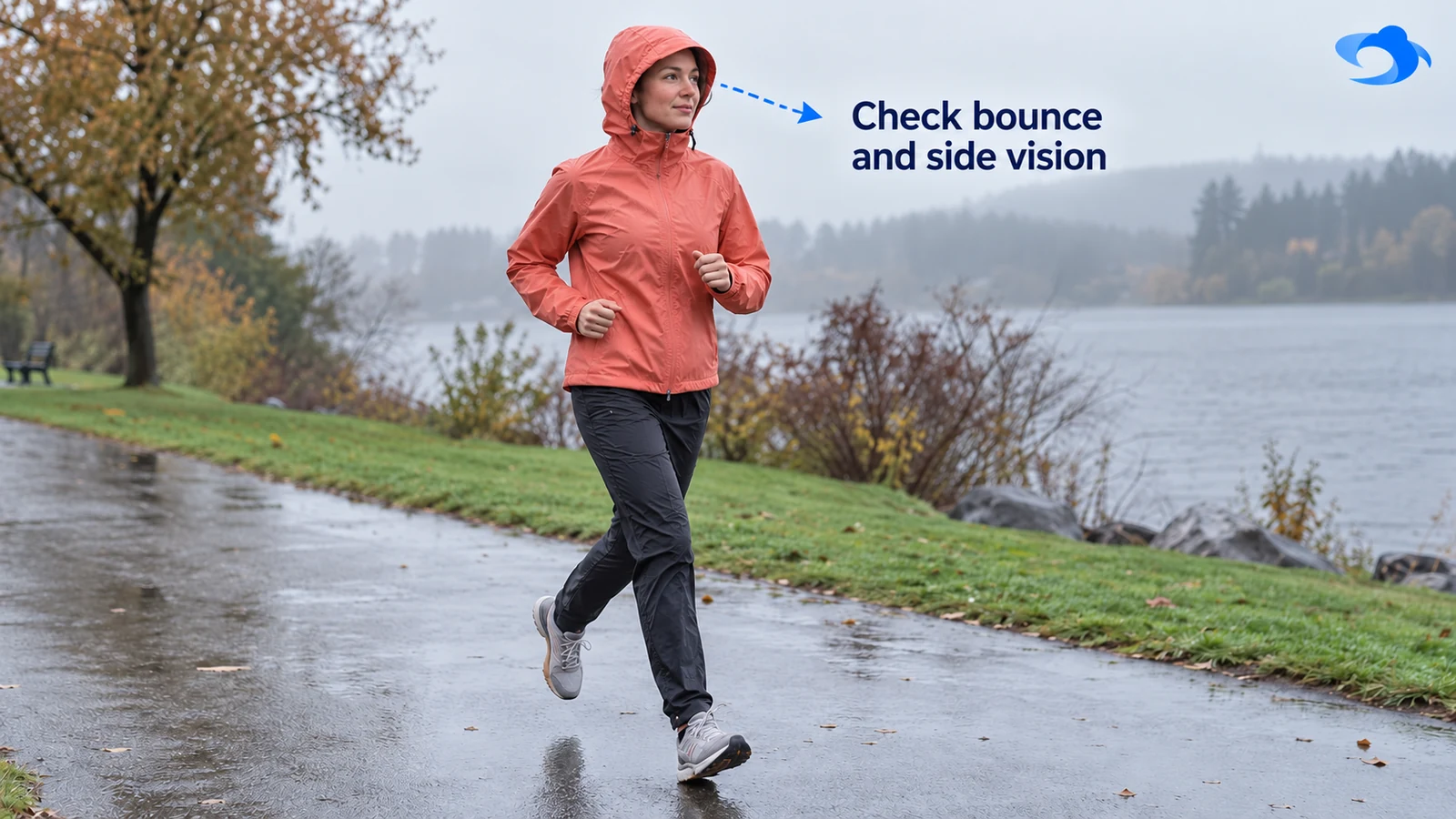
Run with the elbows bent and the arms moving naturally. The sleeves should maintain useful wrist coverage, and the hem should not pull upward with every swing. Cuffs need to close without interfering with that movement.
Load the pockets with the items normally carried. Bouncing contents can distort the fit in a way an empty-pocket fitting does not reveal. If a running vest is used, check pocket and adjustment access with it on.
Should a running rain jacket have a warm lining?
A women’s fleece-lined waterproof jacket adds warmth that stays with the shell. It may suit colder, lower-output use, but offers less adjustment when effort rises. More warmth is not automatically more comfort in rain.
A lightweight waterproof jacket for women allows the underlayers to change without replacing the shell. Check the intended active layers rather than assuming the jacket needs room for a thick everyday sweater. Excess volume can flap, bunch or allow loaded pockets to move.
| Conditions and activity | Option to try | Check during use |
|---|---|---|
| Mild rain and sustained running | Uninsulated shell | Heat buildup and usable ventilation |
| Cold rain and easier run-walk activity | Shell with adjustable layers | Comfort when effort drops as well as rises |
| Intermittent showers | Shell that can be carried conveniently | Packed bulk and access when rain starts |
| Mixed hiking and running | A shell assessed for both activities | Pack access, arm swing and hood movement |
Adjust layers and openings to the conditions. Removing rain protection is not a universal solution to overheating in cold, exposed weather; the assessment should include slower periods and stops.
Can a hiking rain jacket also be used for running?
It may work for occasional easy runs if the fit and heat management are acceptable. The difference is what needs checking. A shell that works well under a hiking pack may still bounce or feel cumbersome while running.
| Detail | Running check | Hiking check |
|---|---|---|
| Hood | Stability under repeated impacts | Coverage while turning and looking down |
| Sleeves and hem | Natural arm swing without excessive movement | Reach and coverage with a backpack |
| Pockets | Bounce with normal contents | Access around pack straps and a hip belt |
| Carrying | Fit in the intended belt or vest | Space in the walking pack |
For everyday crossover use, the everyday rain-jacket guide covers basic fit and opening checks. Add the running assessment rather than treating “lightweight” as proof that it is ready for faster movement.
What should the waterproof claim establish?
ISO 811:2018 tests resistance to water penetration in the specimen submitted. A fabric result does not establish the performance of the whole jacket. Confirm seam sealing and the construction around the front opening, pockets and neckline.
Waterproofness also establishes neither reflective visibility nor compliance with a race’s mandatory-kit requirements. If either matters, check it separately. Ordinary private-use rainwear is not automatically certified PPE.
For a custom range, Yuelei Sports’ custom rain-jacket options provide a construction starting point. Its customizable 20,000 mm target needs confirmation for the proposed material; it is not a running-use approval.
The lightweight waterproof shell is publicly positioned for travel and walking. Assess a proposed running version in motion rather than inferring suitability from the photograph. Confirm final materials, care instructions and, for EU retail, matching fibre-composition labels.
Can one shell work for running and everyday rain?
What makes a rain jacket suitable for running?
Rain-protective construction needs to work with a stable hood, unrestricted movement and manageable heat buildup. Check the whole garment at the intended pace.
Is a shell better than an insulated jacket for running?
A shell offers more layering flexibility during sustained effort. Insulation may suit cold, lower-output activity but can become unwanted as effort increases.
What waterproof rating is enough for a rainy run?
There is no number that guarantees a comfortable, dry interior. Compare relevant fabric evidence with seams, openings, exposure and moisture management.
How should the hood and cuffs fit?
The hood should stay positioned without blocking side vision. Cuffs and sleeves should maintain coverage with the arms moving naturally.
How much space should be left for layers?
Enough for the intended active layers and full movement, without unnecessary loose volume. Check the fit with loaded pockets and any running vest.
Can a hiking shell replace a running jacket?
Sometimes, particularly for easy crossover use. Confirm ventilation, bounce, arm swing and carrying bulk rather than relying on its hiking label.
References
- ISO 811:2018: resistance to water penetration
- Regulation (EU) No 1007/2011: textile labelling
- Regulation (EU) 2016/425: protective-equipment scope
What is worth checking before the first wet run?
Try the jacket as it will be worn: with the planned layers, normal pocket contents and any belt or vest. Jog, turn the head and use the adjustments before judging the fit. Then consider the rain-protection evidence separately from the expectation of staying completely dry inside. Sweat and condensation still need managing, even in a shell that resists rain. For a custom running range, Yuelei Sports’ waterproof jacket options can begin the discussion. Confirm the proposed construction and assess a moving sample before describing a walking-oriented shell as suitable for running.