 Xiamen Yuelei Sports Co., Ltd
When a technical engineer in Bergen checks a hooded rain-jacket sample, the body size seems right. In this illustrative outdoor fitting, a breeze pushes the peak over the wearer’s eyes. Tightening the cords around the face makes the opening uncomfortable but leaves loose fabric at the back. The problem is not necessarily the jacket size: face opening and hood volume are different adjustments.
Summary: A waterproof jacket with hood should keep the peak above the eyes and turn with the head. Start by identifying the garment’s controls, then adjust rear volume, face opening and peak position where those controls exist. Check left, right and downward vision. Stop tightening if the hood restricts sight, breathing or a helmet’s correct fit.
Search discussions repeatedly describe hoods falling forward, blowing back or staying still when the wearer turns. These are fitting problems that a waterproof fabric rating cannot resolve. REI’s rainwear guidance identifies hood adjustability and compatibility as useful features; the practical issue is whether those features work for the intended wearer and activity.
Why does a rain-jacket hood keep falling over the eyes?
The hood may have more volume than the wearer’s head needs, especially if it was designed to accommodate a helmet. A loose rear adjustment can allow the peak to drop forward. Tightening only the face opening sometimes leaves the excess volume in place while pressing the edge against the cheeks.
Identify three possible control functions: rear volume, face opening and peak positioning. Not every jacket has all three or uses separate controls. The supplier’s instructions should explain the actual arrangement; counting drawcords is not a reliable way to infer how the hood works.
ISO 811 measures fabric resistance to water penetration, not hood fit or vision. A buyer can therefore receive a satisfactory fabric report and still reject the hood during a fitting trial. Keep those acceptance decisions separate so a higher waterproof rating does not distract from an unresolved pattern problem.
How should the hood be adjusted without over-tightening?
Begin in a sheltered place with the normal base layers and headwear. Fasten the front closure to its comfortable intended position. Locate the cord locks or tabs before pulling; hidden controls should be found through the maker’s instructions rather than by forcing fabric or guessing at an internal cord route.
- Release excessive tension so the hood sits naturally.
- Reduce rear volume, if an appropriate control is provided, until the peak sits above the eyes.
- Adjust the face opening enough to remain stable without pressing tightly around the face.
- Position the peak and turn the head in both directions, then look down.
This four-step sequence is a practical starting point, not a universal manufacturer procedure. Follow the instructions for the exact garment when its mechanism differs. ISO 811 cannot establish the operation of a cord lock, so sample approval should include a short, understandable adjustment demonstration.
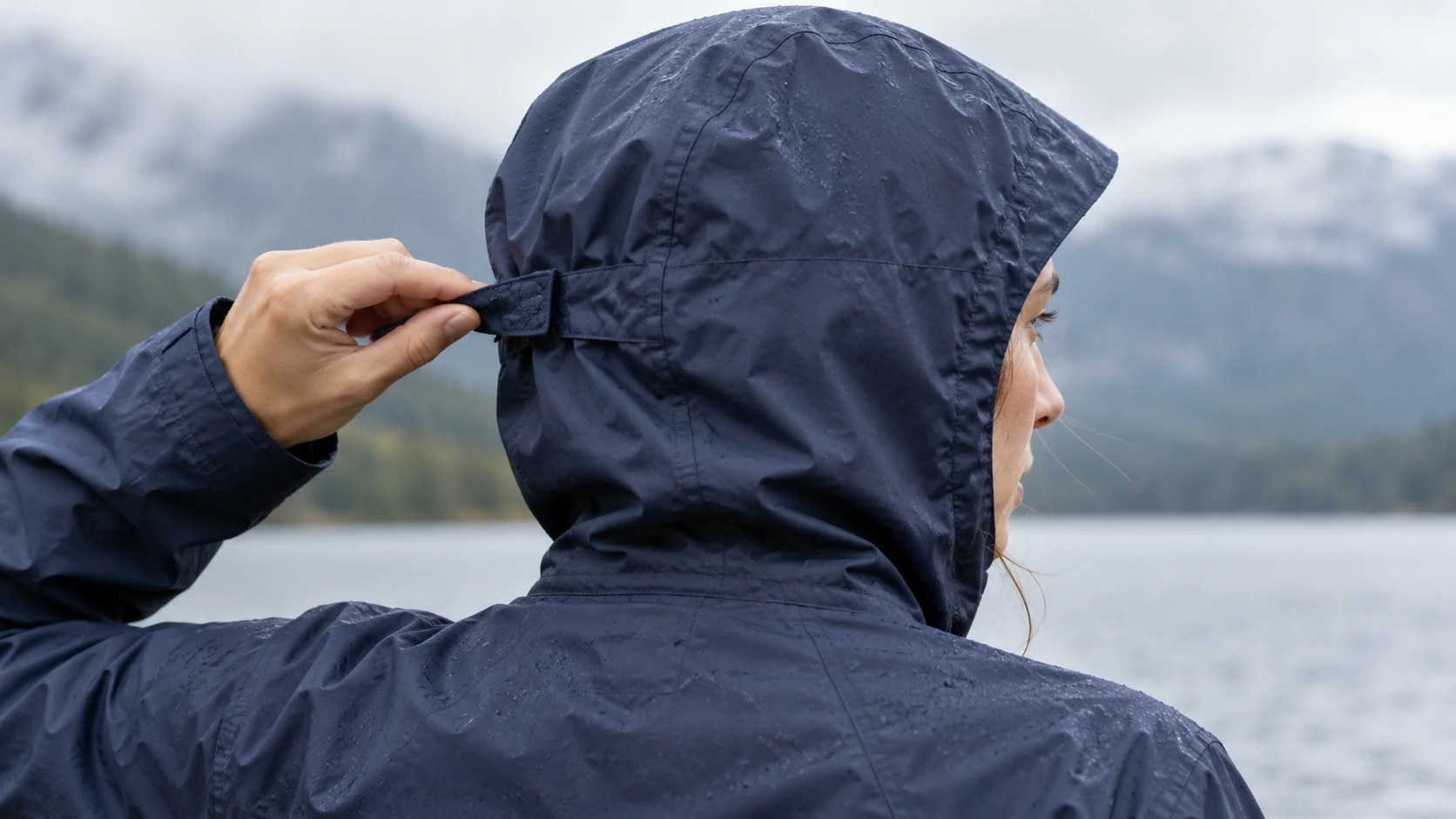
Keep loose cord ends controlled as designed. Do not add knots, replacement toggles or improvised loops without checking suitability. An adjustment that will not hold may indicate a damaged or incorrectly operated component; ask the supplier for guidance rather than continually pulling harder.
Should a waterproof hood fit over a helmet?
Only when helmet use forms part of the intended activity and the combination works correctly. A generous hood can be useful with some helmets yet unnecessarily large for walking in a cap. A close-fitting everyday hood may not accommodate a helmet without pulling the collar upward.
Check two conditions: the intended helmet configuration and any planned use without it. Follow the helmet manufacturer’s instructions and ensure the hood does not alter fit or obstruct sight. “Helmet compatible” needs a defined use and suitable evidence; it should not imply compatibility with every bicycle, climbing or work helmet.
For a hooded waterproof jacket, specify the headwear during product development. A waterproof jacket hoodie search may describe ordinary casual clothing, but a sweatshirt hood alone does not provide the same rain protection or adjustment features as a purpose-designed shell hood.
Are wired peaks and fixed hoods better in wind?
A shaped or stiffened peak can help keep the opening clear and direct runoff away from the face. A wire may permit adjustment, while another design uses a flexible stiffener. Neither feature guarantees stability on every head. Fit, material stiffness and the rest of the hood pattern work together.
Compare two samples with the same wearer, headwear and movements. Check whether the peak remains clear when looking down and whether the hood follows a shoulder glance. This is a comparative usability check, not an ISO 811 performance rating or proof of protection at a particular wind speed.
A fixed hood avoids a detachable junction but may be inconvenient when unused. A removable hood offers flexibility while adding a fastening and overlap to inspect. Examine the actual junction and collar rather than assuming either type is leakproof. Stowed hoods should also be checked for uncomfortable bulk behind the neck.
What should happen when the wearer turns the head?
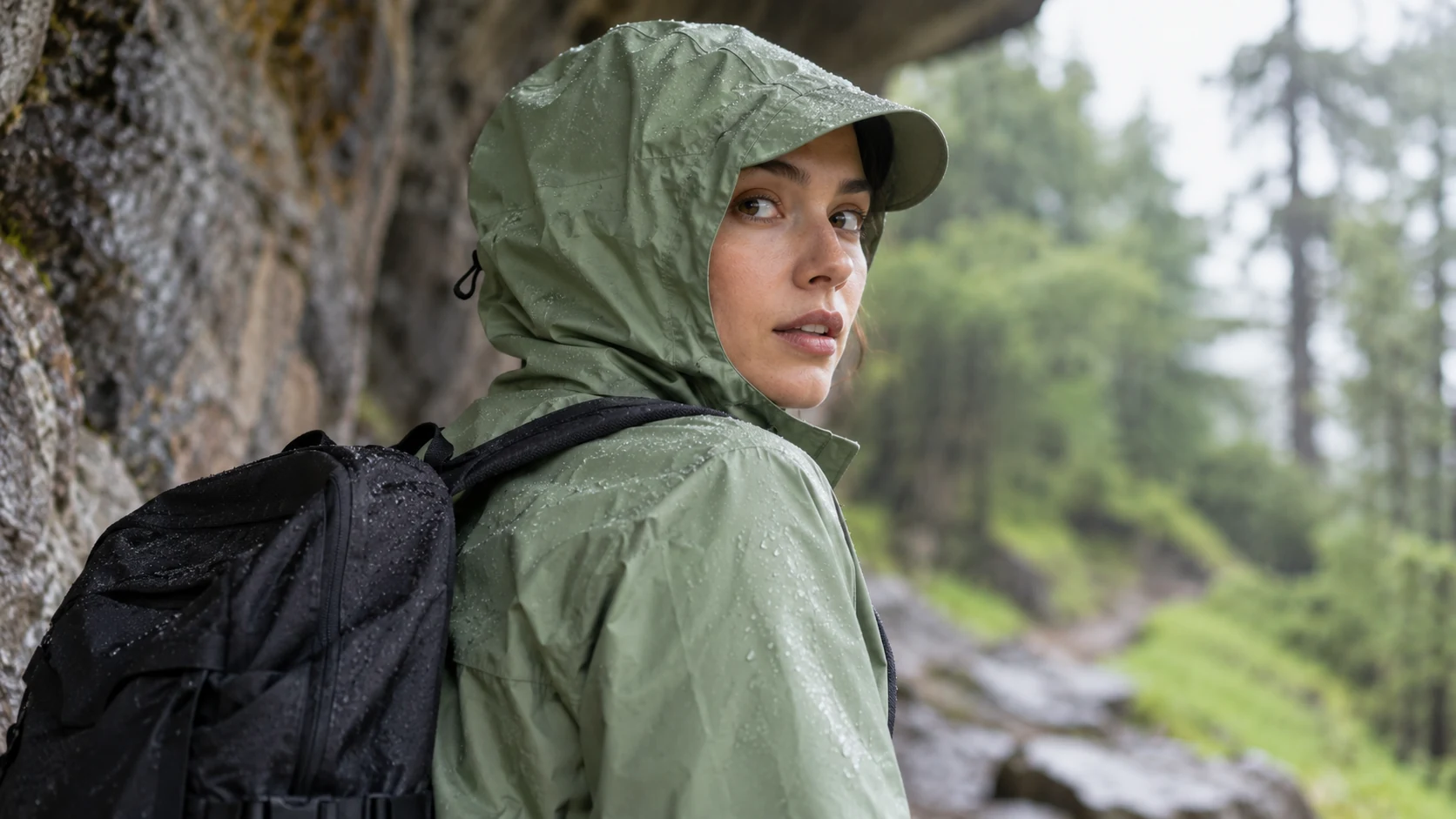
The hood should follow normal head movement without leaving the wearer looking into its side. A small fit correction may help, but tightening is not always the answer. If the face opening must become uncomfortably small to achieve stability, the pattern or volume may be unsuitable.
Check the collar with the zip closed. The chin guard should feel comfortable, and the collar should not drag across the throat during movement. For purchasers approving several sizes, include different head sizes and intended layers. Body grading does not automatically establish that the hood works equally well for every wearer.
The waterproof jacket buying guide covers body fit and construction. A hood trial should be a separate part of that assessment because changing the body size to fix a hood can introduce loose sleeves or an oversized torso.
Which hood features solve which problems?
| Observed problem | Feature or check to consider | Limit |
|---|---|---|
| Peak falls forward | Rear volume adjustment and suitable peak shape | May require a different hood pattern |
| Hood blows back | Stable face opening and rear fit | No universal wind-speed guarantee |
| Side vision is blocked | Head-turn fitting and controlled volume | Over-tightening can make it worse |
| Neck feels crowded | Collar height and stowed-hood bulk | Body size changes may not solve the cause |
| Helmet changes the fit | Trial with the exact head protection | Do not compromise helmet instructions |
The hidden cost of a poor hood is often a return recorded simply as “wrong size.” Ask for more specific feedback: where the hood slips, whether a helmet is worn and which movement fails. That information can guide a pattern change more effectively than ordering a larger size range.
How should the hood brief change by application?
| Use | Priority | Sample check |
|---|---|---|
| Everyday walking | Stable fit around ordinary headwear | Turn, look down and open the front comfortably |
| Hiking with a backpack | Movement with collar and shoulder straps | Reach and turn with the loaded pack |
| Cycling | Helmet compatibility and peripheral vision | Stationary on-bike shoulder checks |
| Workwear | Compatibility with required PPE | Assess the complete approved outfit |
Do hood cords need special safety consideration?
Yes, particularly for children’s clothing. US CPSC guidance identifies hood and neck drawstrings in children’s upper outerwear sizes 2T through 12 as a substantial product hazard. Adult adjustment advice should not be copied into a children’s design without checking the applicable market rules.
For adult rainwear, water-resistance testing such as ISO 811 addresses the tested material, while fit and compatibility need their own evaluation. Do not describe a hood as certified safe for all equipment or activities without evidence. Buyers should confirm relevant product requirements for the market and intended user group.
What should a supplier demonstrate on the sample?
- Show the function and release method of every adjustment control.
- Fit the hood with the intended cap or helmet and normal layers.
- Check head turns, downward vision and comfortable collar closure.
- Confirm care, replacement components and any restrictions on modification.
Yuelei Sports offers outdoor rainwear for B2B enquiries. A custom waterproof jacket with hood brief should include headwear and movement requirements, not just a drawing of the silhouette. A plus size waterproof jacket with hood also needs an actual hood trial; increasing body dimensions alone does not establish good head fit.
Frequently asked questions
What makes a waterproof jacket with hood effective in wind-driven rain?
Suitable fabric and seams, stable adjustment, clear vision and a well-designed collar work together. No single peak or cord provides a universal weather guarantee.
Should a rain jacket hood be helmet compatible?
Only if the intended activity requires it. Check the exact helmet and follow its instructions; extra volume may be inconvenient for ordinary walking.
How do I adjust a hood so it moves with my head?
Identify the controls, reduce excess rear volume where possible and then adjust the face opening. Turn both ways and look down. If comfortable adjustment cannot clear vision, reconsider the fit.
Are wired peaks and storm flaps worth having on a hood?
They can help manage shape and rain entry, but the complete design matters. Test the peak and closures rather than judging value from a feature list alone.
Can a detachable hood leak more than a fixed hood?
It introduces another junction to manage, but a well-designed detachable hood may perform well. Compare the actual overlap, fastening and supporting evidence.
How should a hooded waterproof jacket fit around the neck and chin?
The collar should close comfortably without pressing across the throat or chafing the chin. Check it while turning the head and wearing planned layers.
References
- REI: rainwear features, including hood adjustment
- ISO 811: water-resistance test scope
- CPSC: children’s upper-outerwear drawstrings
A good hood stays useful when the wearer looks away from the rain. Contact Yuelei Sports with the intended headwear, size range and application to discuss a waterproof jacket with a hood sample.