 Xiamen Yuelei Sports Co., Ltd

When a gear manager in Portsmouth finds a jacket that will not close before a crew handover, the temptation is to pull harder. In this illustrative scenario, the jacket dried after a saltwater trip, and a pale deposit surrounds the slider. The immediate problem is deciding whether this is removable contamination, trapped lining, or damage that takes the jacket out of rotation.
Summary: Stop forcing a stuck sailing jacket zipper. Inspect for trapped fabric, rinse accessible salt deposits with fresh water, and dry according to the garment label. Use a cleaner or lubricant only when compatibility is confirmed. Persistent resistance, damaged teeth, or a closure that separates calls for repair assessment rather than another hard pull.
Find the obstruction before treating every white deposit as corrosion.
Lay the jacket flat with the zipper supported and the fabric relaxed. Examine the slider, puller, teeth or coil, lower insertion area, and zipper tape. Note whether resistance occurs at one point or along the whole track. A photograph before cleaning helps distinguish what disappears from what remains.
If a fold of lining is caught beside the slider, hold the surrounding fabric slack and gently ease the lining away while moving the slider back toward its last free position. Stop if the cloth stretches, the slider will not retreat, or the tape starts distorting. Do not use the puller as a lever.
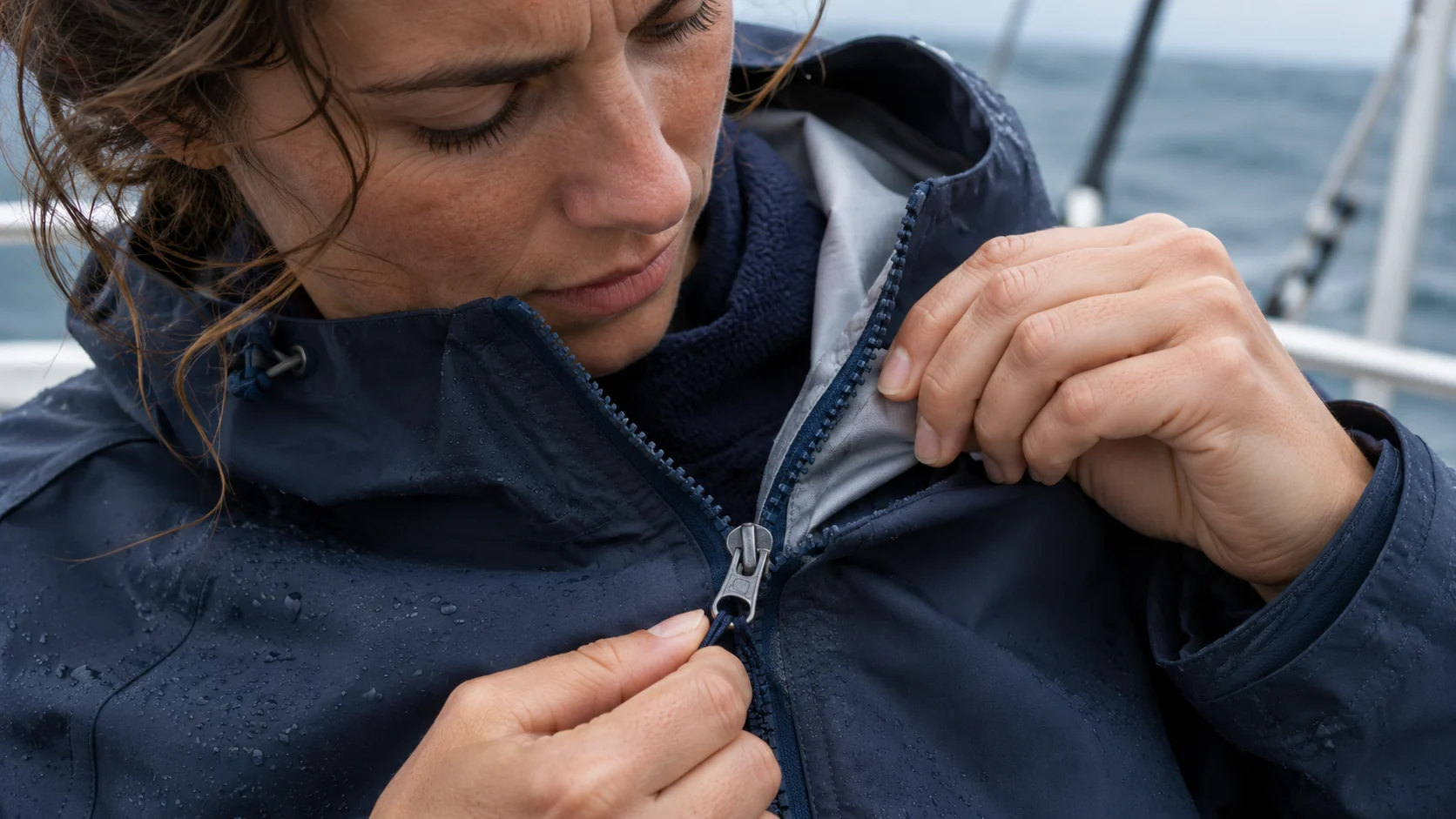
Salt crystallization and zipper corrosion are different problems. Dried deposits may dissolve during freshwater rinsing; corrosion involves deterioration of metal components and cannot be reversed by washing. Residue alone does not establish which problem you have. Inspect again after cleaning for persistent roughness, pitting, flaking, or misshapen parts.
A broken puller is not automatically a failed closure, while an intact puller does not prove that the slider works correctly. Missing teeth, damaged coil, or separation behind the slider are stronger reasons to stop using the jacket for its intended weather protection. Do not squeeze the slider with pliers as an improvised adjustment.
Rinse accessible salt away without forcing the zipper open.
Support the jacket over a basin and gently rinse an opened zipper with fresh water, letting water carry loosened deposits away. If it is stuck closed, rinse the accessible track instead of forcing it open to copy this action. Keep the tape supported and avoid aggressive scraping around coatings or stitching.
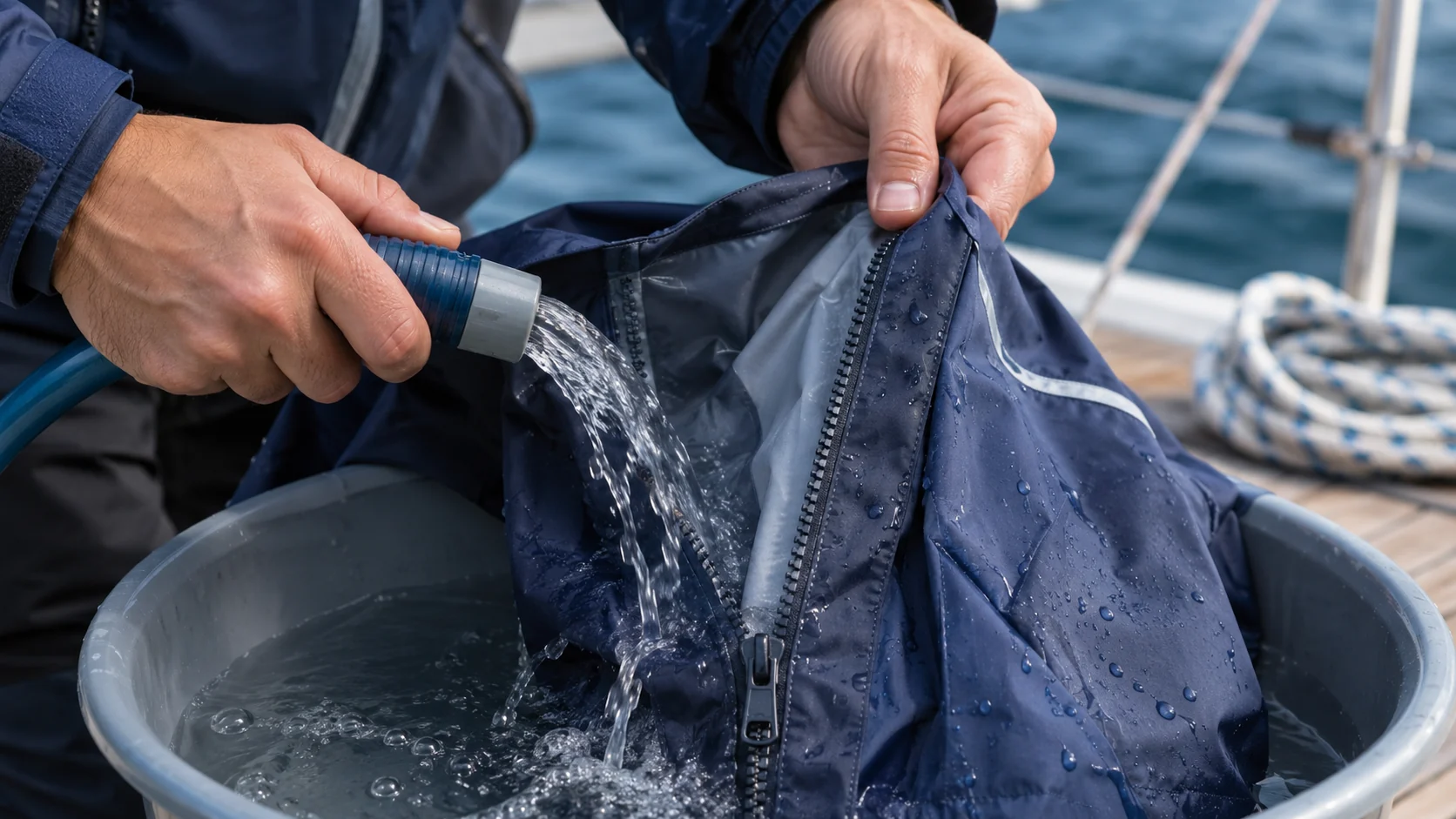
Check movement gently as deposits clear. If resistance remains at the same location, look again for trapped fabric or distorted components rather than repeatedly pulling through it. Fresh water can remove soluble contamination; it cannot rebuild a damaged tooth or restore metal lost to corrosion.
Drain and dry the garment according to its label before storage and final assessment. Do not accelerate the process with an improvised heat source. Whole-garment laundering is a separate decision: a local zipper rinse does not establish which detergent, machine cycle, or drying treatment the jacket permits.
For broader garment care, consult washing a waterproof jacket alongside the jacket’s own care label. Published care procedures differ between fabric systems, so transferring another jacket’s washing temperature or heat-reactivation routine can be inappropriate. A stuck zipper should not be forced shut merely to satisfy a general instruction to close zips before laundering.
Choose zipper treatments by compatibility rather than convenience.
A product described as a marine zipper lubricant is not automatically suitable for every waterproof jacket. Ask whether it is compatible with the zipper construction, surrounding fabric, coatings, and any sealing surfaces. Where compatibility is unclear, leave it unapplied and request guidance from the garment maker or zipper specialist.
Cleaning, lubrication, and restoring fabric water repellency serve different purposes. A water-repellent treatment is not a zipper lubricant, and lubricant does not repair corrosion. Follow the approved product’s application directions rather than inventing a quantity or interval. Avoid household oils, solvent treatments, or wax remedies without explicit compatibility confirmation.
For a shared kit store, record the treatment name and which jacket it is approved for. Keep unidentified bottles away from routine maintenance. If an approved treatment leaves the sailing jacket zipper difficult to operate, stop escalating the amount: the remaining problem may be mechanical rather than a lack of lubricant.
Separate temporary recovery from a jacket that is ready to issue.
A zipper moving once after rinsing is a useful observation, not proof of dependable closure. Once dry, operate it gently through its intended travel and inspect whether both sides engage without local resistance or separation. This is a functional check, not a waterproofness test or a demonstration of offshore suitability.
After every saltwater trip, make accessible freshwater rinsing, label-directed drying, and a brief closure inspection part of the return routine. Record recurring sticking by jacket identifier. Recurrence at the same point after compatible care deserves assessment rather than repeated emergency freeing before each departure.
Quarantine a jacket with damaged teeth, split tape, significant metal deterioration, or a closure that reopens behind the slider. A professional may distinguish a replaceable slider from a complete zipper replacement. Request an assessment of the surrounding fabric and seam construction too; successful closure movement alone does not establish restored weather protection.
Use the visible symptom to choose the next action.
| Observation | First action | Stop or escalate when |
|---|---|---|
| Loose lining beside slider | Relax fabric and ease it clear gently. | Fabric stretches or tape distorts. |
| Pale deposits on track | Rinse accessible areas with fresh water. | Resistance or roughness persists. |
| Closure separates behind slider | Remove from issue and seek assessment. | Do not treat lubricant as a repair. |
| Missing teeth or torn tape | Request professional repair advice. | Do not force continued operation. |
Compare return-to-use options by the whole operational cost.
| Option | Appropriate situation | Buyer check |
|---|---|---|
| Clean and reassess | Deposits clear; components appear intact. | Confirm smooth operation after drying. |
| Professional repair | Localized mechanical damage; garment worth retaining. | Obtain scope, cost, turnaround, and limitations. |
| Replace garment | Repair is unsuitable or operationally uneconomic. | Compare replacement suitability and downtime. |
| Return for seller assessment | Unexpected early failure or uncertain fault. | Preserve photos and check return terms before treatment. |
For illustration, a £45 repair quote plus £15 transport totals £60, compared with a £120 suitable replacement. Repair is financially attractive only if the jacket’s remaining condition and turnaround justify it. Add actual staff handling and spare-kit costs where relevant; these figures are a decision example, not prices or a service-life promise.
Care guidance supports cleaning decisions, not performance claims.
Published outerwear guidance emphasizes following the garment manufacturer’s label and using compatible cleaning methods. One membrane-care procedure specifies two rinses within its own washing process; that is not a universal zipper treatment. The available guidance does not establish a salt-exposure endurance rating, a lubricant compatibility result, or a validated repair for this particular jacket.
Turn the diagnosis into a purchase or return decision.
- Record the jacket identifier, exposure history, visible damage, and care already attempted. Check seller terms before adding treatments to an item being considered for return.
- Ask Yuelei Sports about the intended use, zipper construction, approved care, and available repair support. Compare waterproof jackets against the conditions and maintenance resources your crew actually has.
- For a team order, use custom waterproof rain jacket to frame questions about closure access, lining clearance, and documented care rather than assuming customization proves suitability.
- Agree a receiving check and return process before committing quantities. Issue a sailing jacket zipper care record with each jacket, and keep damaged garments separate until the repair or replacement decision is documented.
Frequently asked questions
How do you unstick a sailing jacket zipper after saltwater exposure?
Stop pulling and inspect for trapped lining or distorted components. Support the jacket, rinse accessible salt deposits with fresh water, and gently reassess movement. Dry according to the garment label. If resistance persists, or teeth, tape, or the slider appear damaged, seek professional assessment.
Does salt water cause zipper corrosion?
Saltwater exposure can contribute to corrosion of susceptible metal zipper components, but dried white deposits may simply be salt residue. Rinse first, then inspect for persistent pitting, flaking, roughness, or distortion. Cleaning can remove deposits; it cannot replace material already lost through corrosion.
How do you remove dried salt crystals from a marine zipper?
Gently rinse the accessible zipper track with fresh water over a basin, supporting the surrounding fabric. Do not force a closed zipper open or scrape deposits aggressively. Recheck for trapped fabric as residue clears, then dry as directed before deciding whether further attention is needed.
What lubricant is safe for a waterproof jacket zipper?
Use only a zipper treatment whose compatibility with the jacket’s zipper, coatings, fabric, and sealing surfaces has been confirmed. Follow its application directions. A marine label alone is insufficient, and fabric water-repellent treatments are not substitutes for zipper lubricants. Ask the garment maker when uncertain.
When should a corroded sailing jacket zipper be replaced?
Seek replacement assessment when corrosion leaves damaged components, teeth are missing, tape is torn, or the closure separates behind the slider. A specialist may recommend a slider repair instead of full replacement. Compare the repair scope, surrounding garment condition, turnaround, and total cost before deciding.
How can you prevent a sailing jacket zipper from sticking again?
After each saltwater trip, rinse accessible zipper areas with fresh water, dry the jacket according to its label, and inspect operation before storage. Keep lining clear during use. Record recurring sticking, use only approved treatments, and remove damaged jackets from circulation rather than repeatedly forcing them.
References
- How to Choose a Sailing Jacket: Complete Buyer’s Guide
- Outerwear Care Instructions | GORE-TEX Brand
- How to Wash a Waterproof Jacket | Berghaus
A salt-stuck zipper earns its return to the kit rack through careful inspection, not a harder pull.
Discuss your crew’s intended use, care routine, and closure requirements with Yuelei Sports while exploring the waterproof jacket range.