 Xiamen Yuelei Sports Co., Ltd

When a gear manager in Southampton discovers peeling tape inside jackets before a sailing course, the immediate problem is allocation: which shells need inspection, which might be repairable, and which should leave the issue rack? This illustrative scenario calls for a documented decision, not a quick pass with an iron.
Summary: Peeling seam sealing tape needs assessment of both the adhesive bond and the underlying fabric. Isolate affected jackets, photograph the damage, check garment-specific care and repair guidance, and distinguish a lifted end from widespread failure. Approve repair only when compatibility and a verification method are established; otherwise seek a return assessment or replacement.
Map the lifting before deciding what caused it.
Lay the dry jacket inside out without stretching it. Examine a short, visibly lifted tape end and the intact nearby fabric; photograph both together so the repair assessor can see the transition. Do not pull the strip to discover how far it will peel: that can enlarge the repair area.
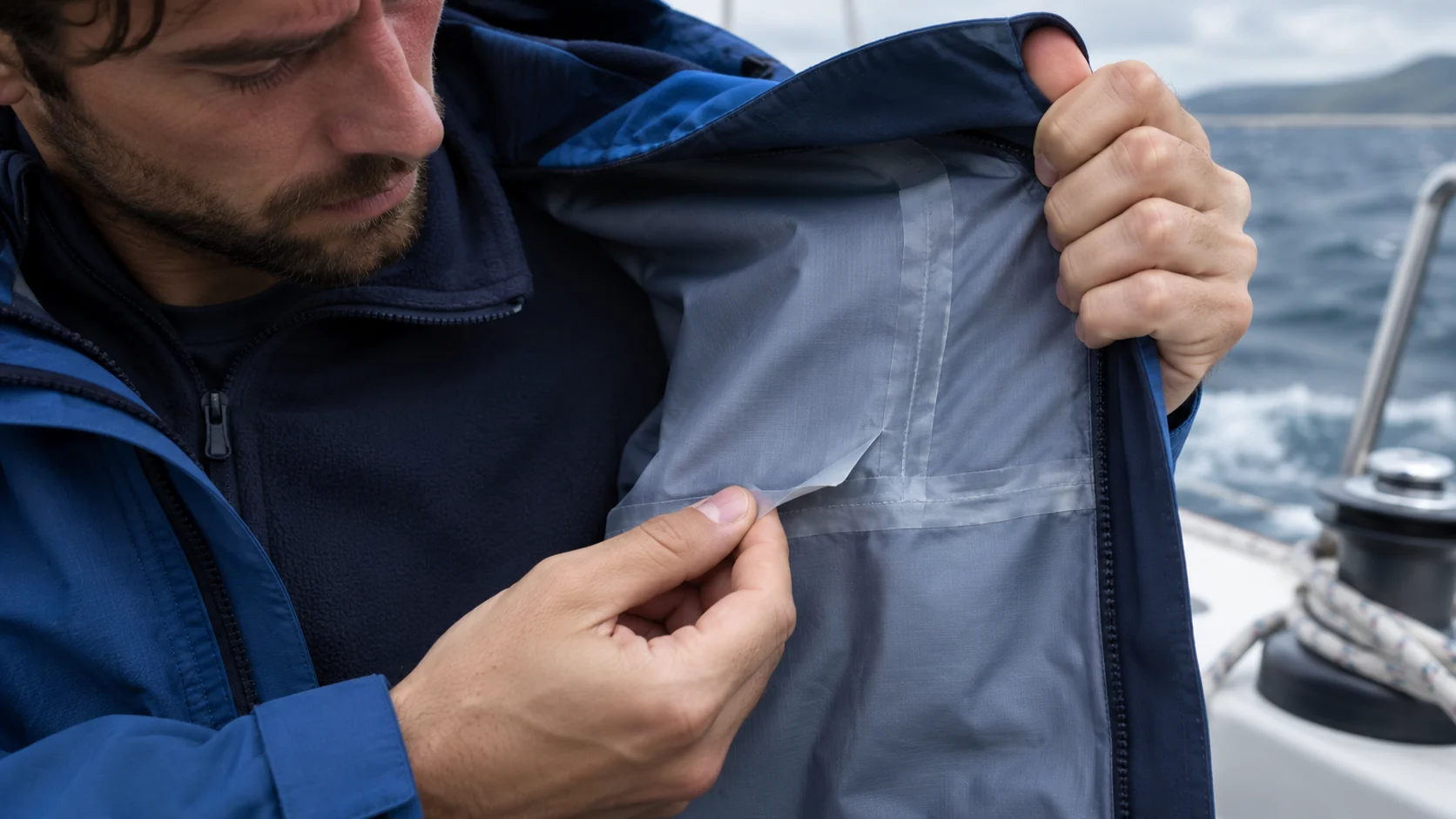
Record the seam location, jacket identifier and condition of surrounding panels. Look for isolated edge lifting, several detached strips, sticky residue, cracking, or bubbling beyond the taped seam. These observations help separate a local bonding problem from damage that may involve the wider laminate.
Heat exposure, unsuitable cleaning products, adhesive ageing associated with moisture-driven degradation such as hydrolysis, and repeated flexing are possible explanations, not diagnoses established by appearance alone. Compare care records, storage conditions and wear locations. A shoulder repeatedly flexed during use presents a different investigation from several stored jackets developing similar failures.
Do not attribute every damp patch to tape. Sweat, condensation, closures and a wet outer face can complicate diagnosis; understanding moisture inside a waterproof jacket helps prevent a needless seam repair. DWR supports surface water repellency, while the waterproof barrier and sealed construction perform different jobs.
Separate a repairable edge from a reason to stop issuing the jacket.
A localized lift with apparently intact surrounding material is a candidate for assessment, not automatic permission to repair. Widespread lifting, continuing bond loss, or panel-level separation should stop a routine patch decision. Quarantine affected jackets until their condition and intended use have been reviewed.
Have the repair technician examine intersecting taped seams in diffuse window light. Ask them to inspect the junction and adjacent panels, rather than treating only the most visible loose edge. Photograph the junction before work so later movement can be compared with its original condition.
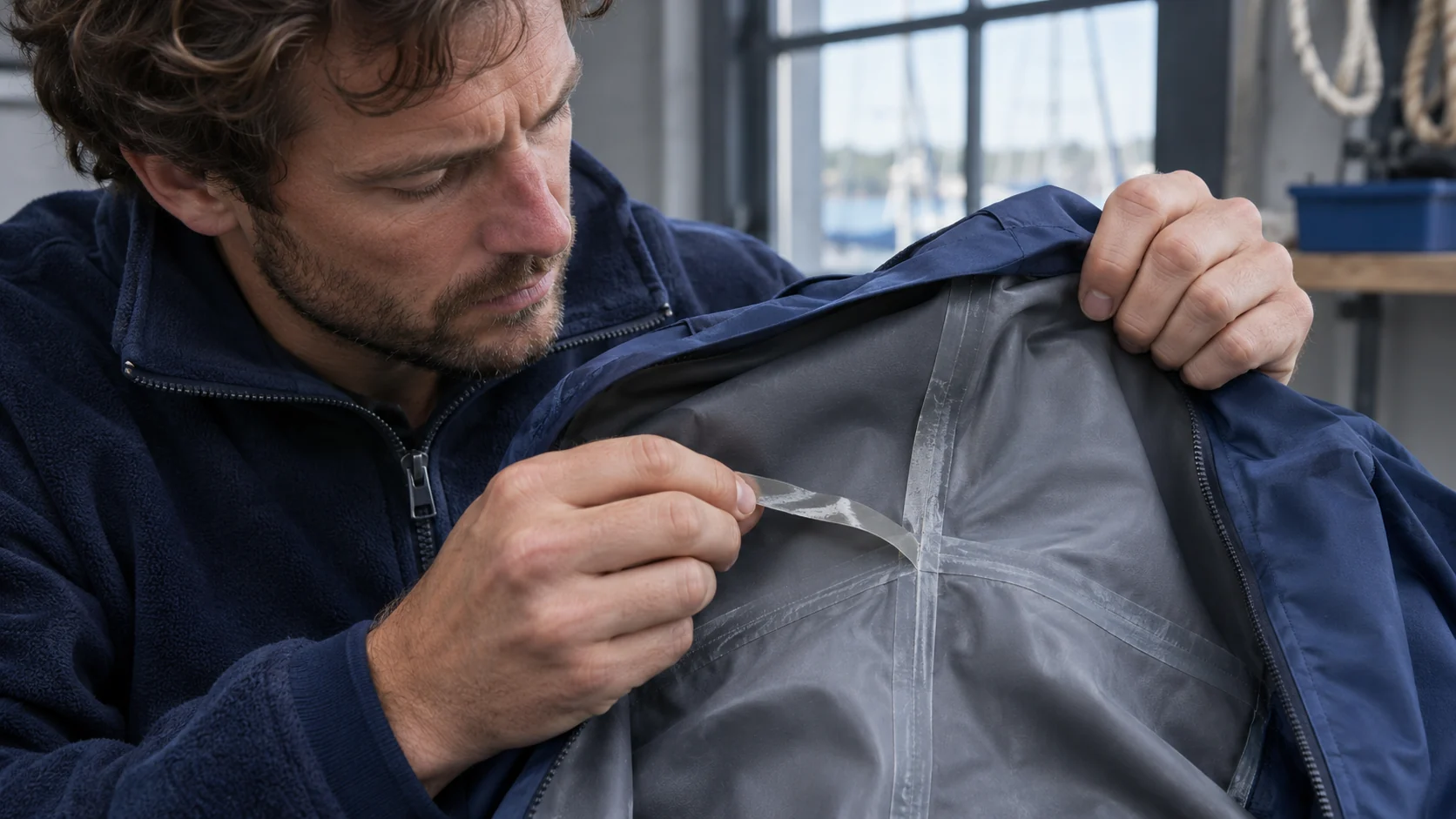
Peeling waterproof jacket seam tape is not necessarily fabric delamination. The first concerns the tape bond; the second involves separation within the fabric construction. They can coexist, and a newly bonded strip cannot establish that the surrounding laminate remains sound.
For recently purchased stock, preserve labels, receipts and photographs, then request a return or warranty assessment before attempting work. Do not assume coverage. For older rental stock, compare repair feasibility with downtime and replacement availability; reject an unsupported fix when the garment’s required condition cannot be established.
Choose a repair system before choosing a tool.
Effective seam sealing tape repair depends on the shell’s inner surface, its construction, the existing adhesive and the proposed repair material. Similar-looking tapes are not automatically interchangeable. Ask for confirmation covering the specific garment or construction, including preparation, application and any required curing conditions.
Glue and heat-applied tape are not interchangeable shortcuts. A liquid adhesive may be inappropriate for a particular backing, while a heat-bonded system may require controlled pressure and temperature. Household equipment can apply uneven heat, and additional heating may damage the surrounding laminate instead of restoring the bond.
Do not borrow ironing directions intended to reactivate DWR as a seam-bonding recipe. Likewise, avoid improvised solvent cleaning or unknown glues. If an approved seam tape repair procedure is unavailable, use a qualified repair service or request manufacturer guidance rather than guessing at settings.
For wearer reports, request photographs and the care-label details before recommending treatment. For fleet work, retain the repair material identification and service record. That makes a later failure traceable without claiming that every jacket needs the same repair process.
Price the decision around usable jackets, not adhesive alone.
A sailing jacket seam repair quotation should identify the affected area, assessment findings, proposed method and verification offered. Ask what happens if surrounding material proves unsuitable once work begins. A low initial quote is less useful if it excludes diagnosis or leaves return-to-service decisions unresolved.
For an illustrative budget, suppose assessment and repair cost £30, handling costs £10, and a replacement costs £120. The apparent saving is £80 only if the repaired jacket meets the agreed acceptance criteria. These are planning figures, not market prices or a forecast of remaining service life.
Compare records across the fleet before committing to batch repairs. Similar failures may justify inspecting comparable jackets, but they do not prove a shared manufacturing defect. Keep unaffected stock distinguishable from assessed, repaired and rejected stock.
Use visible condition to choose the next action.
| Observed condition | Next action | Decision boundary |
|---|---|---|
| One lifted end; adjacent material appears intact | Document and request compatibility assessment. | Appearance alone does not authorize reissue. |
| Several seams lifting or adhesive deteriorating | Quarantine and request broader assessment. | A small patch does not address widespread failure. |
| Bubbling or separation beyond tape | Investigate possible laminate damage. | Retaping cannot establish panel integrity. |
Compare purchasing routes by responsibility and verification.
| Route | What to obtain | What remains uncertain |
|---|---|---|
| Manufacturer-authorized repair | Compatible method and acceptance criteria | Remaining garment life unless specifically assessed |
| Specialist repair service | Construction assessment and written work scope | Suitability if material identity is unresolved |
| Return assessment | Eligibility decision before alteration | Coverage until the claim is evaluated |
| Replacement purchase | Documented construction and support information | Performance of an unassessed product |
Interpret leak checks without overstating what they establish.
After repair, follow the approved inspection and leak-check procedure, including any required curing period. Record the method, location checked and result. If a controlled water check is authorized, perform it on the unoccupied garment; do not use a wearer or an immersion exercise to investigate leakage.
ISO 811:2018 describes a hydrostatic-pressure method for fabric water penetration. A household spray check is not that test, and a fabric result does not establish whole-jacket performance at seams, closures or repaired junctions. Ask whether any reported result covers fabric, a seam assembly or the finished garment.
Care guidance also has limits. GORE-TEX guidance emphasizes garment-manufacturer directions and includes construction-specific exceptions; it is not a universal repair schedule. A passing localized check supports only that observation under those conditions, not certification, guaranteed future dryness or offshore suitability. A shell never substitutes for a lifejacket.
Make the purchasing brief resolve the next repair decision.
- Define the intended use. Tell Yuelei Sports who wears the jackets, the expected conditions and how the fleet is cleaned, stored and inspected.
- Request construction details. When comparing waterproof jackets, ask how seams are sealed and what care and repair guidance accompanies the particular item.
- Clarify customization support. Discuss a custom waterproof rain jacket alongside access to construction information, compatible repair options and return-assessment procedures; do not infer those services from the product name.
- Set acceptance and records. Agree how repaired seam sealing tape will be assessed, who authorizes reissue, and how unresolved failures trigger replacement rather than repeated trial repairs.
Frequently asked questions
Why does seam tape peel inside a waterproof jacket?
Tape can lift when its adhesive bond deteriorates or is stressed. Possible contributors include excessive heat, unsuitable cleaning products, moisture-related ageing and repeated flexing. Appearance alone rarely identifies the cause, so compare the damage pattern with care records, storage history and the condition of nearby fabric.
Can peeling seam tape on a sailing jacket be repaired?
A localized lift may be repairable when the underlying material remains suitable and a compatible repair method is available. Widespread bond failure or laminate separation needs broader assessment. Request manufacturer or specialist advice before attempting work, particularly when a return or warranty assessment may still be available.
Should waterproof seam tape be glued or heat-applied?
Use the method approved for the particular garment construction and repair material. Some systems use controlled heat; others use compatible adhesives. They are not interchangeable. Do not treat DWR-reactivation ironing guidance as seam-repair guidance, and avoid guessing at temperatures, pressure, solvents or glue compatibility.
Can washing cause waterproof jacket seam tape to come loose?
Unsuitable washing products or care conditions may contribute to bond problems, but lifting noticed after washing does not prove washing caused it. Follow the garment label and construction-specific guidance. Preserve the care history so an assessor can distinguish possible cleaning damage from ageing or pre-existing weakness.
Is peeling seam tape the same as fabric delamination?
No. Tape peeling concerns separation at the tape bond, while fabric delamination means layers within the fabric construction are separating. Both problems can occur together. Bubbling or separation beyond the taped area warrants assessment because replacing tape cannot demonstrate that the surrounding waterproof laminate remains sound.
How do you test a taped seam after repairing it?
Follow the approved post-repair inspection and leak-check procedure after any specified curing period. Record the checked area, method and result, using an unoccupied garment for authorized water checks. A localized check is not an ISO 811 fabric test or proof of whole-jacket waterproof performance.
References
- ISO 811:2018 — Textiles — Determination of resistance to water penetration — Hydrostatic pressure test
- How to Choose Rainwear
- Outerwear Care Instructions | GORE-TEX Brand
A lifted tape end is a reason to investigate the whole repair decision, not permission to reach for an iron.
Discuss your intended sailing use, fleet care routine and repair-support needs with Yuelei Sports when exploring the waterproof jacket range.