 Xiamen Yuelei Sports Co., Ltd
When Elena, a technical engineer in Hamburg, encountered repeated complaints during an illustrative paddling-school trial, she moved the crew into thicker wetsuit samples and ran a short cold-water drill. Within minutes, restricted shoulders, poor fit, and visible shivering disrupted rescues. The reversal came during the specification review: the garments were not simply “bad”; a wet thermal system had been selected for a program that expected long surface exposure, repeated capsize practice, and variable staff sizing.
Summary: A dry suit for kayaking generally provides the warmer, more adaptable system when immersion or rescue may be prolonged because its shell keeps external water away from adjustable dry layers. A well-fitted wetsuit can be warm and efficient for active, shorter exposures, especially when frequent swimming makes a close, streamlined system useful. The U.S. National Weather Service (NWS) notes that cold shock at 10–15°C (50–60°F) can be as severe as at 2°C (35°F); this is planning guidance, not a universal garment cutoff. Buyers should specify water, air, wind, immersion time, activity, rescue capability, and user fit before choosing either system.
Which System Keeps a Kayaker Warmer—and Why?
The honest answer is conditional because the two systems slow heat loss differently. A wetsuit admits water, then relies on close-fitting neoprene to restrict circulation and reduce further heat transfer. Body heat warms the small amount of retained water, but flushing at the neck, wrists, ankles, or loose panels repeatedly replaces it. A dry suit blocks external water at the shell and seals; the air trapped in dry clothing beneath supplies most of the thermal resistance. The shell is therefore a waterproof and windproof platform rather than a heater.
That mechanism explains why a thicker wetsuit is not automatically warmer in every kayaking task and why an unlayered dry shell may still feel cold. In cold-water kayaking, warmth belongs to the complete clothing system: coverage, fit, hood and hand protection, underlayers, PFD, footwear, workload, and exposure time all interact. NWS guidance to dress for water rather than air is especially relevant on sunny spring days, when warm air can mask dangerously cold water.
How Do Water, Air, Wind, and Rescue Time Change the Winner?
Water temperature establishes the immersion challenge, but it does not describe the whole duty cycle. A paddler who rolls successfully may be wet for seconds; a separated paddler awaiting an assisted re-entry may be immersed far longer. After exit, wind strips heat from wet neoprene and from any damp outer surface. A waterproof shell limits direct evaporative cooling from the underlayers, although sweat inside the shell can still reduce comfort and thermal performance.
Procurement teams should write a credible exposure sequence rather than a single temperature: launch, normal paddling, capsize, swim, re-entry, stationary wait, and return to shelter. For a shore-based class with immediate support, a fitted wetsuit may cover the assessed window. For winter touring, offshore fishing, a remote crossing, or a session in which rescue could take tens of minutes, the adjustable dry system usually creates more margin. NWS’s 10–15°C (50–60°F) cold-shock statement is a useful conservative trigger for this review, not proof that every user needs the same garment at one number.
What Do Cold Shock, Swimming, and Re-entry Mean for Warmth?
Cold shock can cause involuntary gasping, rapid breathing, and lost breathing control immediately after entry. Clothing does not eliminate that response, and neither garment replaces a correctly worn PFD, practiced rescue, communications, route planning, or conservative go/no-go judgment. Thermal protection supports the movement and cognition needed to leave the water.
A wetsuit’s close profile can aid swimming, but poor fit can flush cold water and tight shoulders can shorten the stroke. A dry suit needs correct volume and footwear that does not compress circulation. Operators should test a 25–50 m supervised swim, wet exit, assisted rescue, self-rescue, and shore movement; the distance is a protocol, not a survival claim.
Repeated capsize practice needs separate assessment: ten brief immersions may cause cumulative flushing, while waiting between students adds low-activity exposure. Whitewater schools should test rolling, torso rotation, and bank access. Judge warmth after the complete session, not while dry in a changing room.
When Does Wetsuit Fit and Thickness Produce More Warmth?
Wetsuit performance is highly size-sensitive. Neoprene should contact the body without large voids, yet it must permit full inhalation, forward reach, rotation, and hip movement. A loose back or neck promotes flushing; an undersized suit can restrict breathing and paddling mechanics. Thickness such as 3 mm or 5 mm is only one specification. Panel mapping, stretch, seam construction, hood coverage, wrist and ankle fit, and wear at the seat and knees all affect the real outcome.
For paddlers, mechanical compression from sitting, footwear, a PFD, and bent joints can reduce trapped gas locally. ISO 11092 uses a sweating guarded hotplate to measure steady-state thermal and water-vapour resistance. It supports controlled material comparison but does not simulate flushing, moving water, compression, or paddling posture; one value cannot justify an immersion-time promise.
A wetsuit may be warmer when users stay active, swim repeatedly, have controlled sizing, and can end exposure quickly. It is less adaptable across diverse body shapes, alternating workloads, or several seasons.
When Do Dry Layers Provide More Adaptable Warmth?
A dry suit for kayaking separates water protection from thermal tuning. A wicking layer manages skin moisture, lofted midlayers add warmth, and the shell controls external water and wind. The package can change by route or season, but the benefit disappears if the suit leaks, seals fit poorly, or layers are inadequate.
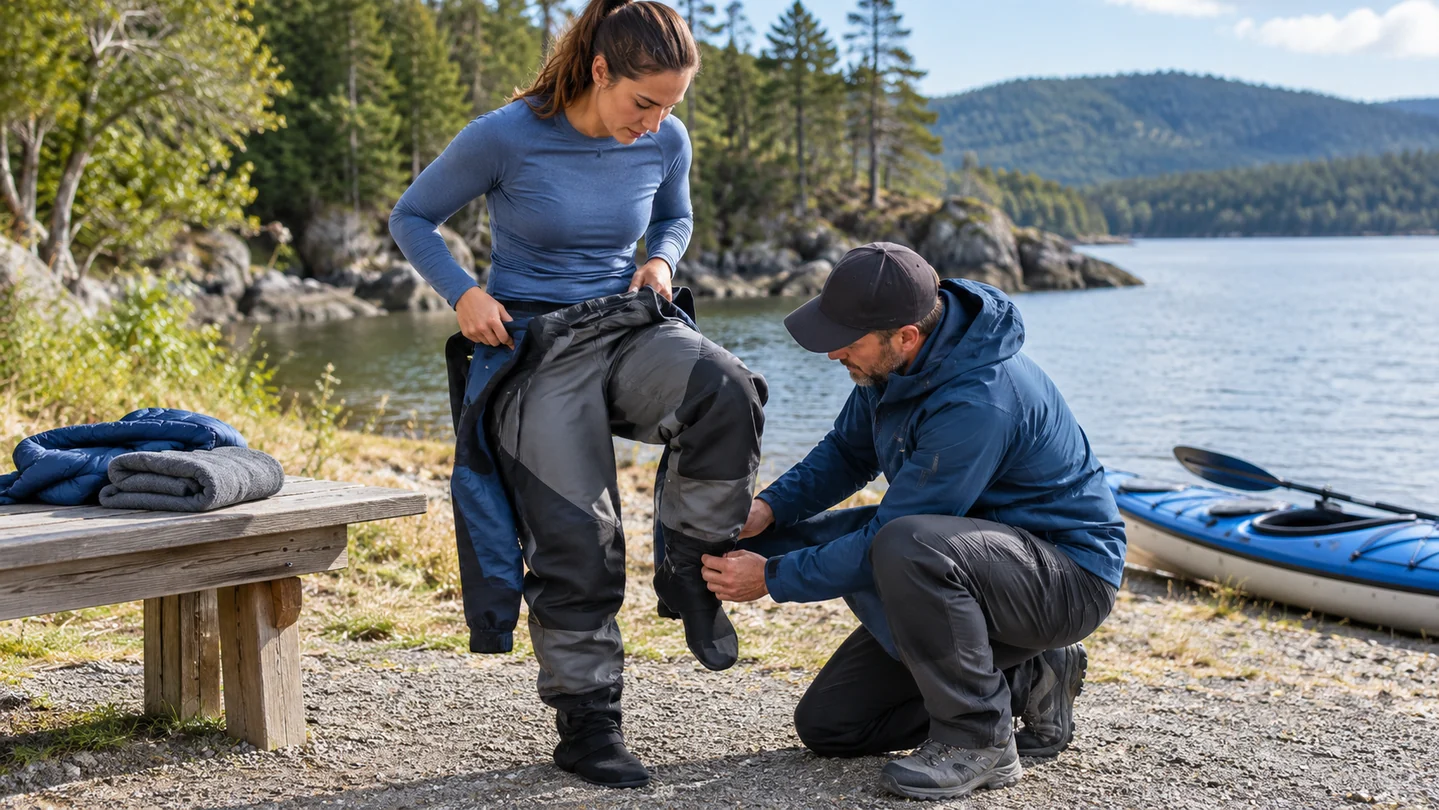
Layer space is technical: the shell, PFD, seat, and spray skirt can compress overfilled clothing and restrict reach, while excess space creates bulky folds. Hard paddling can also outpace moisture transfer, leaving damp clothing that cools during a rescue pause.
ISO 811 specifies hydrostatic-pressure testing for textile resistance to water penetration. It compares fabric specimens under stated conditions; it does not certify an entire paddling suit or cover every seam, zipper, seal, sock interface, abrasion point, or production variation. A buyer therefore needs both method-specific fabric evidence and agreed finished-garment inspection. For warmth, the key question is whether the shell reliably preserves the intended insulation through the credible capsize and rescue window.
Which Feels Warmer During Hard Paddling, Portage, and Pauses?
During a high-output upstream run or whitewater approach, either system can overheat. A wetsuit retains heat and can be difficult to vent without opening the neck or removing part of the garment. A dry shell may allow moisture vapour to pass, but “breathable” is not an absolute comfort promise: fabric area, vapour-pressure gradient, seam tape, PFD coverage, humidity, workload, and clothing beneath all affect moisture transfer. ISO 11092 water-vapour resistance results are meaningful only when the method, specimen, conditioning, and unit are comparable.
Portage adds abrasion, walking heat, and compressed shoulders. For mixed routes, start slightly cool, manage head and hand coverage, avoid cotton, and adjust before heavy sweating. During fishing, instruction, or delayed rescue, activity drops and adjustable dry layers usually regain the advantage. Trial both the hardest work and longest pause.
Wetsuit vs Dry Suit: Which Delivers Better Operational Value?
The wetsuit vs dry suit choice becomes clearer when buyers score warmth together with fit, rescue use, maintenance, and downtime. The table shows tendencies, not universal rankings.
| Procurement dimension | Wetsuit system | Dry-suit system | Warmth consequence |
|---|---|---|---|
| Heat-loss strategy | Close neoprene restricts water exchange after wetting | Waterproof shell protects adjustable dry layers | Fit drives the wet system; layer selection and dryness drive the dry system |
| Fit sensitivity | Very high; gaps flush and tight panels restrict | Seals must fit, with space for movement and layers | Either sizing error can erase the expected advantage |
| Immersion and rescue delay | Fixed coverage and thickness | Thermal package can be scaled for the scenario | Adaptability favors longer or variable exposure |
| Hard activity | Simple system but limited venting | Moisture can accumulate beneath the shell | Workload trials are essential for both |
| Swimming and rolling | Close profile when correctly fitted | Requires correct volume, footwear, and movement pattern | Test in the complete PFD and spray-skirt setup |
| Maintenance | Rinse, disinfect as appropriate, dry, inspect neoprene and seams | Rinse, dry, lubricate or care for components as directed, inspect seals, zipper, and seams | Unnoticed damage can reduce protection in either system |
| Fleet sizing | More sizes may be needed for close contact | Layer allowance adds complexity, but one shell can cover seasonal layer changes | Representative-user fitting reduces cold spots and returns |
| TCO tendency | Can suit short, frequent, size-controlled programs | Can suit seasonal, remote, or longer-exposure programs | The lowest unit price is not necessarily the lowest cost per protected session |
Which System Is Warmer for Touring, Whitewater, Rentals, Fishing, and Remote Trips?
This application matrix converts the temperature discussion into operational logic. It intentionally avoids a universal cutoff: local rules, weather, health, skill, product instructions, and rescue resources remain controlling.
| Use case | Dominant exposure | Likely warmer system | Decision and validation |
|---|---|---|---|
| Recreational touring near shore | Moderate work, occasional capsize, short planned rescue | Either, depending on water and fit | Use the assessed swim and re-entry time; trial PFD, skirt, and footwear together |
| Winter kayaking | Cold water, wind after exit, low seasonal margin | Dry shell with scenario-matched layers usually offers more adaptability | Plan from water temperature and rescue delay, then manage sweat during hard sections |
| Whitewater instruction | Repeated wet exits, rolling, swimming, high output | Depends on session length and controlled fit | Compare flushing against sweat buildup; run repeated-capsize and bank-mobility drills |
| Rental or paddling-school fleet | Many body shapes, hygiene turnover, variable competence | No automatic winner | Model size inventory, disinfection, drying capacity, user briefing, damage checks, and spare availability |
| Kayak fishing or photography | Long stationary periods and wind exposure | Adjustable dry layers often retain warmth more effectively | Check seated compression, relief access, hooks or sharp tools, and long-pause comfort |
| Remote touring or crossings | Delayed outside assistance and changing weather | Dry system commonly provides the broader operating envelope | Pair clothing with PFD, communications, spare layers, route limits, and practiced rescue |
Water above 15°C (60°F) does not make immersion irrelevant. At 10–15°C (50–60°F), apply NWS cold-shock evidence as planning guidance; below that range or with delayed rescue, escalate the whole control package. Document a scenario decision, never a guaranteed safe-temperature band.
How Should Standards and Test Evidence Support the Warmth Choice?
- ISO 15027-1: covers requirements, including safety, for constant-wear immersion suits. Its scope is not automatically identical to every recreational paddling garment, and citing the number does not prove that a specific product conforms.
- ISO 11092: is a textile test method for steady-state thermal and water-vapour resistance. It is useful for controlled material comparison, not for predicting comfort, cold shock, or survival time in a kayak incident.
- ISO 811: is a hydrostatic-pressure test method for textile resistance to water penetration. A fabric result does not replace finished-garment checks at seams, seals, zippers, socks, and production interfaces.
- NWS cold-water guidance: is public safety information rather than a conformity or certification scheme. It supports risk planning around cold shock, flotation, weather, communications, and rescue.
Ask who tested what, under which edition and conditions, and whether the report represents the ordered construction. Requirements vary by destination, intended use, operator duties, and claims. Unsupported “certified,” “survival,” or temperature-guarantee language creates commercial and regulatory risk without adding warmth.
How Can Buyers Select the Warmer System at a Sustainable Total Cost?
- Define the exposure case. Record water and air conditions, wind, activity, capsize frequency, swim distance, credible rescue delay, and local operating rules.
- Fit representative users. Test forward reach, torso rotation, breathing, seated compression, rolling, swimming, re-entry, PFD, spray skirt, footwear, gloves, and hood together.
- Specify evidence and inspection. Request method-specific fabric reports, seam and component details, size tolerances, production inspection criteria, care instructions, and order traceability.
- Pilot the duty cycle. Run hard paddling, stationary waiting, repeated wet exits, and post-session drying; log flushing, sweat, cold areas, restriction, leakage, and user error.
- Model seasonal TCO. Include acquisition, size exchanges, cleaning, disinfection, drying space and labor, inspections, consumable care items, repair freight, spare stock, and sessions lost while equipment is unavailable.
For an illustrative 100-garment fleet, compare cost per available session without inventing service life: combine allocated acquisition, measured maintenance, repairs, exchanges, and downtime. Wetsuits may need more close-fit sizes and disciplined hygiene; dry suits add seals, zippers, leakage checks, layers, and repair coordination. Either must remain correctly sized, clean, inspected, and available.
For procurement teams evaluating Yuelei Sports, the useful discussion begins with configurable construction, size strategy, test documentation, inspection terms, and sourcing support. Buyers can also review a lightweight waterproof shell when considering how outer-fabric choices interact with underlayer insulation.

Frequently Asked Questions About Kayaking Warmth
Which is better for kayaking, a wetsuit or a drysuit?
Neither is universally better. A wetsuit can suit active, shorter exposures with dependable close fit; a dry suit offers adjustable layers for longer, colder, or more variable exposure. Choose from the credible capsize and rescue sequence, then validate swimming and re-entry in the complete equipment system.
What water temperature requires a dry suit for kayaking?
There is no universal temperature that legally requires the same garment for every paddler. Use the 10–15°C (50–60°F) NWS cold-shock evidence as a conservative planning signal, then account for wind, route, rescue time, local rules, user capability, and the product’s documented scope.
Does a kayaking dry suit keep you warmer than a wetsuit?
It often can when correctly selected dry layers remain protected through a longer exposure, but the shell itself supplies limited thermal resistance. Seal fit, leakage control, garment space, moisture management, workload, and compressed loft determine whether the complete system delivers its expected warmth.
Can I wear a wetsuit for cold-water kayaking?
Yes, within an appropriately assessed operating envelope and with correct thickness, coverage, fit, flotation, and rescue planning. For a deeper look at overheating and seasonal tradeoffs, review this guide to cold-water kayaking decisions and validate the final choice in supervised local conditions.
What should I wear under a kayaking dry suit?
Wear a moisture-managing base layer and thermal midlayers selected for the water, air, workload, and expected rescue time. Avoid cotton, preserve enough space for loft and movement, and test the layers with the PFD, spray skirt, footwear, and garment supplier’s instructions.
Is a dry suit worth it for recreational kayaking?
It may justify the added care when paddling spans seasons, rescue could be delayed, or adjustable layers reduce the need for multiple outer garments. For occasional use in milder assessed conditions, compare utilization, fit reliability, maintenance capability, and the consequences of the credible capsize—not purchase price alone.
What Evidence Supports This Wetsuit vs Dry Suit Conclusion?
- U.S. National Weather Service — Cold Water Hazards and Safety
- ISO 15027-1 — Constant-wear immersion suits: requirements, including safety
- ISO 11092 — Sweating guarded-hotplate test for thermal and water-vapour resistance
- ISO 811 — Hydrostatic-pressure test for resistance to water penetration
The durable principle is simple: specify the person, exposure, and rescue window before specifying the garment.
To discuss construction options, documentation, sizing, and an order-specific evaluation plan, explore Yuelei Sports dry-suit solutions and contact the team.