 Xiamen Yuelei Sports Co., Ltd
When a technical engineer in Hamburg checks a fleece-lined rain-jacket sample for a commuter range, the soft interior feels comfortable during a short fitting. In this illustrative trial, the wearer then walks briskly with a bag and becomes too warm. Removing the jacket also removes the rain barrier. The issue is not that fleece is unsuitable; the insulation is fixed to a shell the wearer still needs.
Summary: A fleece lined waterproof jacket can suit cool, wet everyday use when convenient dressing matters. A separate shell and fleece allow more temperature adjustment because either garment can be removed independently. Compare the complete outfit in at least two activity states: walking and resting. Waterproofness depends on the shell construction, not the presence of fleece.
Cotswold Outdoor’s layering guidance separates moisture management, insulation and weather protection into different jobs. Combining insulation and rain protection in one garment does not remove those jobs; it reduces the wearer’s ability to change them independently. That trade-off should be clear in both a retail description and a B2B purchasing brief.
Is fleece lining the same as a waterproof membrane?
No. Fleece provides insulation by holding air within its structure. The jacket’s rain resistance comes from the specified outer construction and relevant seams or openings. A fleece-lined softshell may be water-resistant without meeting the intended requirement for sustained rain protection.
Ask for two separate descriptions: what provides insulation, and what provides the water barrier. ISO 811 assesses textile resistance to water penetration. A report for the shell fabric does not establish that the fleece is waterproof or that every seam and closure in the assembled garment keeps water out.
Listings sometimes use “waterproof fleece jacket” loosely. Buyers should resolve whether that means fleece-backed waterproof fabric, a fleece lined waterproof jacket with a separate sewn lining, or a removable fleece inside a shell. Those arrangements can differ in movement, drying and care, so the wording should match the actual sample.
When is a fleece lined waterproof jacket the more convenient choice?
It can work well when the wearer usually needs insulation whenever rain protection is needed: a cool commute, a short outdoor errand or low-intensity activity. A single garment is quick to put on, and the lining stays with the shell. There is no separate fleece to remember or coordinate.
The limitation appears when effort or weather changes. Consider two states: walking briskly and standing still. A comfortable amount of insulation during a wait may be excessive during the walk. ISO 11092:2026 can support thermal and water-vapour resistance comparison under controlled conditions, but it cannot assign a universal comfort temperature to every fleece-lined design.
A waterproof jacket with fleece therefore needs a clearly defined audience. Fixed warmth may be a benefit for one range and a restriction for another. Avoid describing the garment as suitable for every season merely because the outer shell protects against rain.
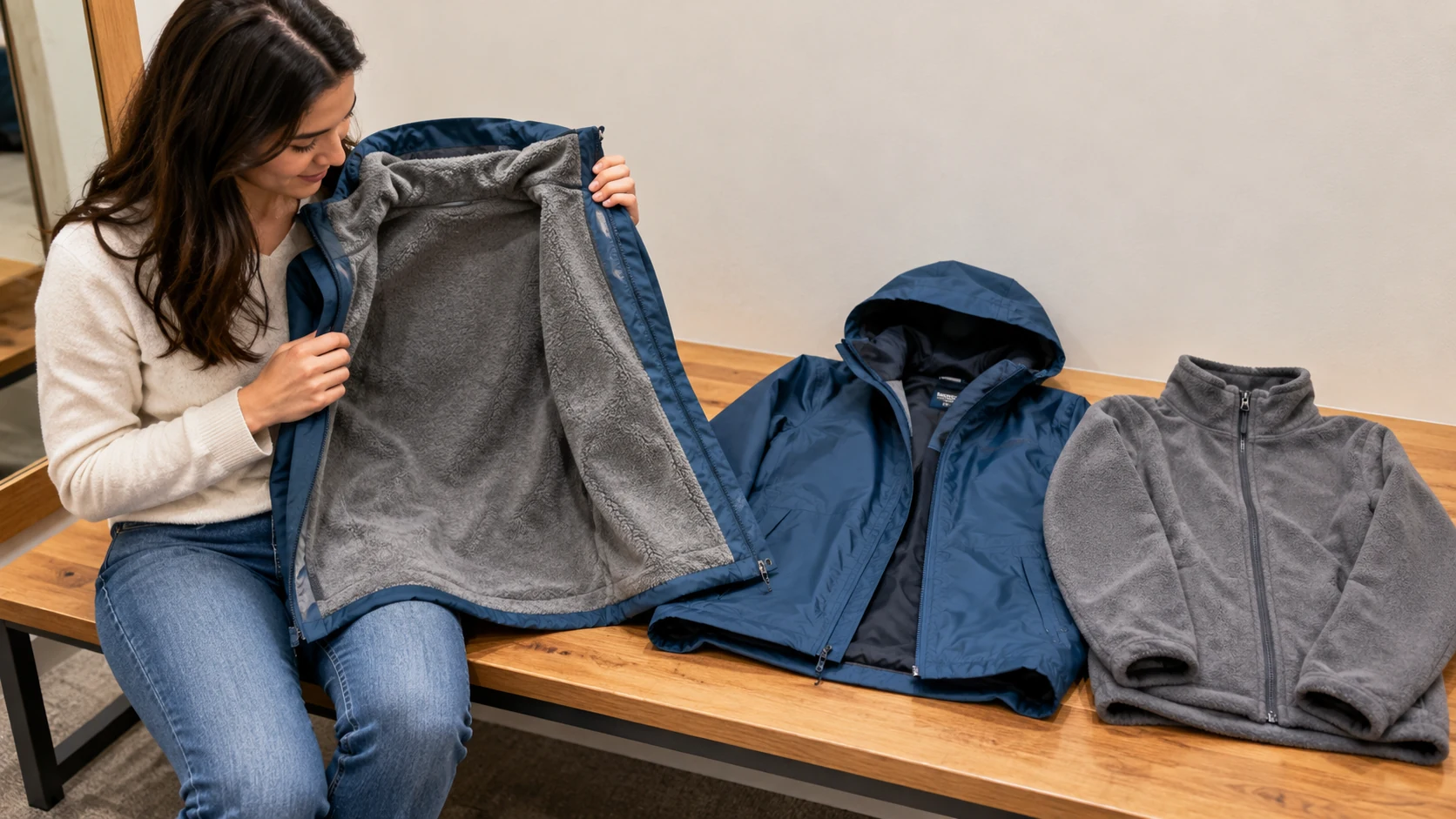
Why are separate layers often better for active walking?
Independent pieces allow the wearer to keep the rain shell on while removing insulation. In dry conditions, the fleece can be worn without the shell. The choice is especially useful when walking speed, gradients or weather change throughout the day.
Separate layers do require a compatible fit. A bulky fleece under a narrow shell can restrict shoulders or compress the insulation. Try three movements: reaching forward, raising the arms and sitting. This is a suggested fitting check, not an ISO 11092 requirement; thermal testing alone does not establish movement comfort.
A fixed lining can also change sleeve friction and dressing. Check whether cuffs pull back, the inner fabric catches on the base layer or the outer body rises during arm movement. The comparison of insulated and fleece-lined jackets explains why the lining’s name alone does not establish warmth.
How waterproof is a fleece-lined jacket in heavy rain?
As waterproof as its evidenced shell construction and condition permit; the fleece does not supply a separate universal rating. A quoted 10,000mm result describes a 10-metre water-column pressure equivalent in a specified fabric test. It is not a forecast of hours spent dry or proof of the finished garment’s performance.
For ISO 811 evidence, request the tested material, method and conditioning details. Examine seams, front closure, hood junction and pocket openings separately. Lining can make some interior details harder to inspect, so ask the supplier how construction quality is checked rather than assuming hidden seams have been sealed.
If the inside feels wet, record where and when. Moisture from perspiration, water entering at the neck and leakage through a damaged seam have different causes. Reproofing the outside may help restore surface repellency when appropriate, but it does not repair holes or failed construction.
Will a fleece-lined jacket take longer to dry?
It can, depending on how much moisture the lining holds, the garment’s construction and the drying conditions. A quick-drying outer face does not establish that the cuffs, pocket bags and lining are dry. Avoid promising an exact drying time without a defined test and conditions.
Inspect at least two areas before storage: the outer shell and the inner lining, including cuffs. This is a practical care check rather than a standard test. Open the garment as instructed and provide airflow. Do not assume direct radiator heat is safe for coatings, seam tape or lining materials.
Independent shell and fleece pieces can be dried separately, which may simplify care. With a fixed lining, follow the single garment’s approved method. Where care instructions conflict with a generic rainwear tip, the instructions for the actual garment should guide cleaning and drying.
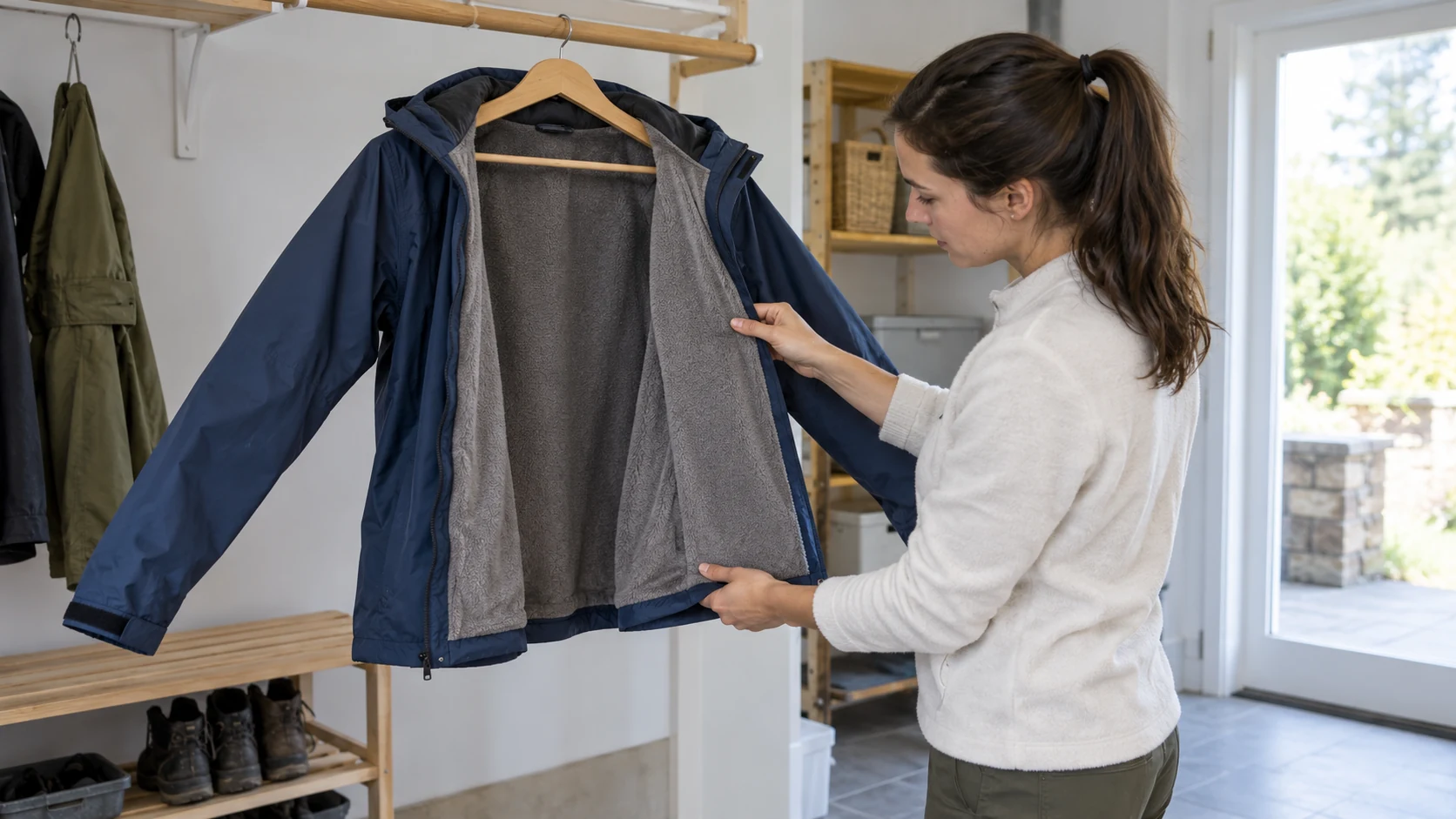
How do the two options compare in everyday use?
| Buying factor | Fixed fleece lining | Separate shell and fleece |
|---|---|---|
| Getting dressed | One coordinated garment | Two pieces to manage |
| Changing warmth | Insulation stays with the shell | Fleece can be removed independently |
| Fit | Combined pattern needs approval | Both pieces must fit together |
| Drying and washing | Follow the complete garment label | Each piece can receive its own care |
| Replacement | Lining wear affects the whole garment decision | Replace the worn component when practical |
Neither approach has an automatic cost advantage. Compare the initial price with the user’s existing wardrobe, care facilities, repair possibilities and likely replacement pattern. A waterproof jacket and fleece bought separately may cost less when a suitable midlayer is already owned. A fleece lined waterproof jacket may be more convenient for a predictable daily routine.
Which users are most likely to prefer each construction?
| Use pattern | Starting option | Reason to trial it |
|---|---|---|
| Cool, short daily journeys | Fleece-lined shell | Convenience and familiar warmth |
| Fast walking with frequent stops | Separate layers | Independent control of insulation |
| Mild, humid rain | Light shell with optional fleece | Avoid unnecessary fixed insulation |
| Low-activity cold conditions | Evaluate the complete insulation system | Fleece alone may not provide enough warmth |
What should buyers verify in labels and test reports?
Check shell and lining composition separately where the product documentation distinguishes them. EU Regulation 1007/2011 governs textile fibre names and related composition labelling. Accurate composition information should not be confused with waterproof or thermal certification.
ISO 811 addresses water penetration, while ISO 11092 addresses thermal and water-vapour resistance. A fabric result is not automatically a complete-garment approval. If a supplier quotes a specific warmth, breathability or waterproof claim, ask what was tested and under which conditions before repeating it in a listing.
“Warm for winter” is incomplete without context. Climate, wind, time outside, activity and the rest of the outfit all matter. Retail copy can describe the lining and intended use clearly without promising a universal temperature limit or inventing a comfort score.
How should a buyer approve a fleece-lined sample?
- Define the user’s activity and whether insulation is needed whenever the shell is worn.
- Check the complete garment over the intended base layer, including cuffs and shoulders.
- Request separate evidence for rain protection and any thermal claims.
- Review laundering, drying space and replacement options before comparing total cost.
Yuelei Sports accepts outdoor rainwear development enquiries. A custom lined rain jacket brief should identify fixed or removable insulation and the intended use. Availability and performance of a particular lining configuration need confirmation against the proposed sample, rather than inference from a generic product category.
A fleece lined waterproof jacket is a useful choice when its fixed warmth matches the routine. If the user repeatedly needs to remove that warmth while keeping rain protection, independent layers deserve priority during sampling.
Frequently asked questions
Is a fleece lined waterproof jacket warm enough for winter?
It depends on the lining, conditions, activity and other layers. The construction name alone does not establish a safe or comfortable temperature range.
How does a fleece-lined jacket compare with a shell plus fleece?
A fixed lining is convenient, while separate pieces allow independent adjustment, care and replacement. Both approaches need a comfortable combined fit.
Is fleece lining too warm for active walking or commuting?
It can be in mild conditions or during strenuous movement. A separate fleece lets the wearer remove insulation while retaining the rain shell.
How waterproof is a fleece-lined jacket in heavy rain?
That depends on the shell, seams, openings and condition. Fleece lining itself does not establish waterproofness or compensate for an unsuitable outer construction.
Can I wear a fleece-lined waterproof jacket in mild weather?
Possibly, if the activity and conditions remain comfortable. For warm, humid rain, an uninsulated shell may provide more useful flexibility.
How should I wash a jacket with both fleece lining and a waterproof shell?
Follow the complete garment’s care label, using compatible cleaning and drying methods. Check the lining and cuffs are dry before storage; do not assume shell-care advice suits every lining.
References
- Cotswold Outdoor: the roles of clothing layers
- ISO 811: textile resistance to water penetration
- ISO 11092: thermal and water-vapour resistance
- EU Regulation 1007/2011 on textile fibre labelling
The right amount of warmth is the amount the wearer can comfortably use. Contact Yuelei Sports with the target activity, lining preference and care requirements to discuss a fleece and waterproof jacket development brief.