 Xiamen Yuelei Sports Co., Ltd

When a technical engineer in Rotterdam encountered restricted movement during an illustrative fleet fitting, she approved a medium sample from height and weight alone, then watched the suit pull sharply at the crotch and shoulders within minutes of the first crouch test. The shell was not inherently defective; the selection process had ignored torso length, hip circumference and the planned cold-water layers.
Summary: Selecting a dry suit for women should be a two-stage decision: capture repeatable body measurements, then validate the chart choice in a fully layered sample. Use ISO 8559-1 terminology to standardize measurement capture, but treat it as an anthropometric reference—not a dry-suit certification. Record at least height, bust, waist, hip, torso girth, inseam, reach and relevant interface dimensions; release a fleet allocation only after a two-layer fit trial and exception review.
Why a size label cannot tell you the right size
Nominal sizes are supplier-specific. Two products marked “M” may use different body ranges, built-in ease, torso patterns, sleeve geometry and boot interfaces, so transferring a size from a wetsuit, work suit or another dry-suit brand is not a controlled decision. The buying record must connect one wearer, one measurement method, one style, one chart revision and one approved layer configuration.
ISO 8559-1 describes anthropometric measurements, but it does not create universal dry-suit sizes or prescribe insulation allowance. A disputed fit cannot be resolved by matching letters across brands; the defensible evidence is the measured value, applicable range, exception rule and sample result.

Capture every wearer with one repeatable measurement protocol
Use a trained measurer, flexible non-stretch tape and level floor. The wearer stands naturally in close-fitting base clothing. Measure every critical dimension twice; if readings exceed the buyer’s repeatability tolerance, take a third and correct the technique. Log the date, measurer, units and posture.
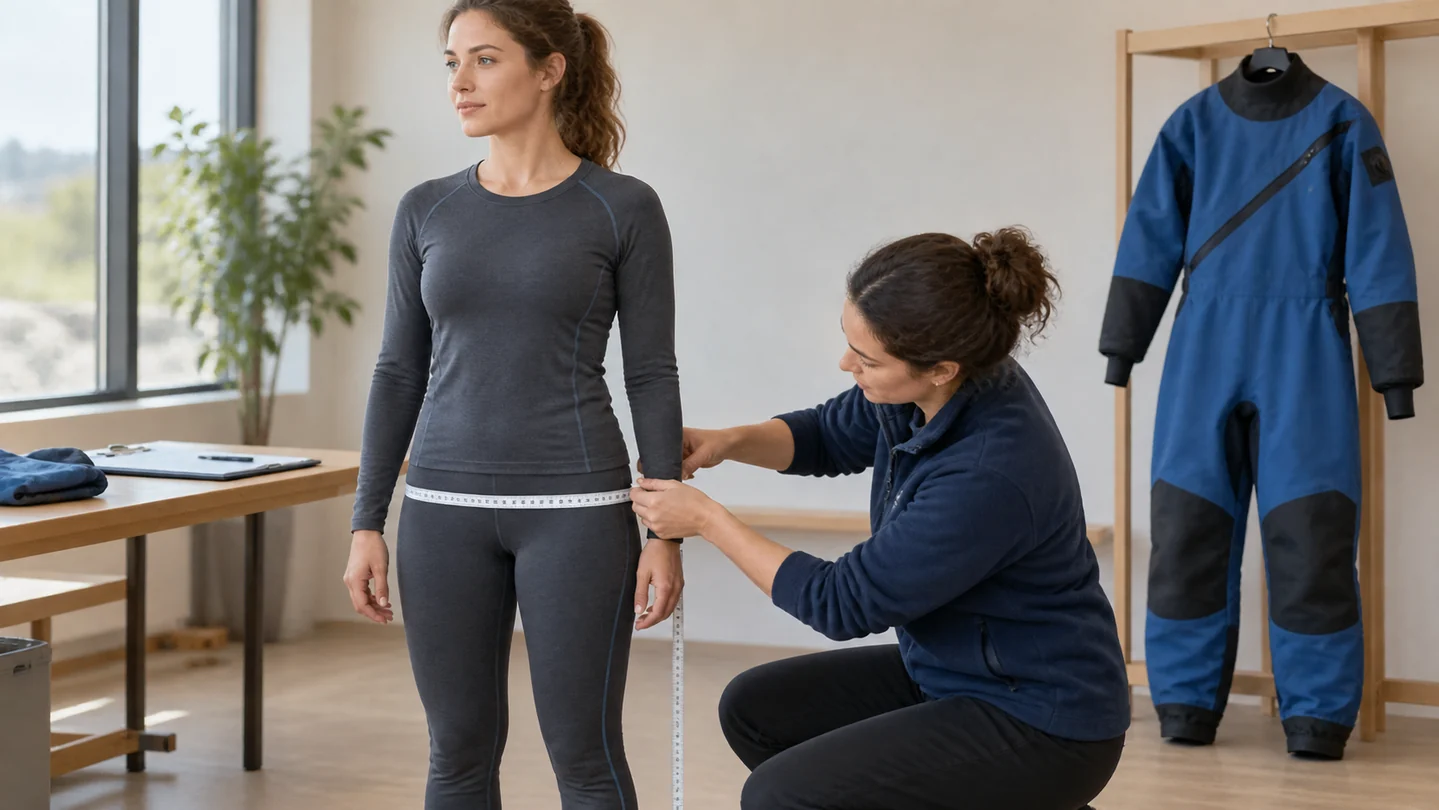
The body measurements record should cover the following inputs, with the supplier’s written landmark instructions taking priority:
- Height or stature: barefoot, upright and measured from the floor to the top of the head.
- Bust or chest: around the fullest level, with the tape horizontal and the arms relaxed.
- Waist: at the supplier-defined natural-waist landmark, not automatically at the trouser waistband.
- Hip or seat: around the fullest seat, checked from the side to keep the tape level.
- Torso girth: on the exact shoulder-through-crotch loop or other route specified for that chart.
- Inseam: from the crotch reference to the specified ankle or floor point, not copied from trousers.
- Sleeve and reach: shoulder-to-wrist or centre-back-to-wrist as defined, plus an overhead-reach observation.
- Neck and wrist: where seals are selected or trimmed by circumference; do not infer them from nominal suit size.
- Foot: actual foot length and the relevant sock or boot size where integrated footwear is offered.
A shoulder-to-crotch straight length is not interchangeable with a full girth loop. A shoe label is also not a foot measurement because sizing systems, thermal socks and integrated boots vary. Obtain the supplier’s illustrated method instead of inventing a proxy.
Map wearer values to the supplier chart without averaging conflicts
Confirm the style, chart issue date and units, then place every value beside the supplier’s minimum and maximum. Identify sizes that contain the wearer and flag the dimension closest to a boundary. Never average a small bust result and large hip result into a “medium”; the chosen pattern may accommodate neither area.
An illustrative rule is remaining margin = chart maximum minus wearer value. A 104 cm hip against a 106 cm upper limit leaves 2 cm on the chart, but not necessarily 2 cm of garment ease: the range may describe wearers, not finished garments. Add no allowance until the supplier defines the chart basis.
Boundary management should also be consistent. When a wearer is exactly on a chart limit, or when bust, waist, hip, torso and inseam point to different sizes, flag the allocation for a layered sample or pattern review. Worksheets—including files labeled “dry suit womens”—should preserve the original numbers instead of reducing the record to a single letter size.
Account for women’s fit through distribution, not assumptions
A useful fit review considers the individual distribution of bust, waist, hip or seat, rise and torso length; it assumes no universal female ratio. People with the same height and hip can need different patterns because torso, inseam and bust position interact differently with zippers and articulated panels.
Evaluate short and tall options as proportional patterns, not just leg-length changes. A tall wearer may need more sleeve and torso reach without extra hip volume; a shorter wearer may need correct knee placement without torso compression. Reaching, squatting and sitting must remain compatible with seals, zippers, footwear and load-bearing equipment.
Flag bust-to-hip range conflicts, long girth with standard inseam, and seals outside the nominal offering. The result may be a stock size, short/tall option, component change or custom review—not an automatic move to the largest size.
Separate undergarment allowance from automatic sizing up
Charts may already allow for clothing, while undergarment thickness varies. Moving up can relieve compression but create long sleeves, a wandering crotch, displaced knees and boot movement. State the planned layers, confirm what the chart assumes and test the actual system.
Trial A uses the lightest approved set; Trial B uses the thickest. The light set must not leave uncontrolled folds, while the thick set must not be crushed at bust, hip, elbow, knee or torso. If one stock size cannot pass both, document seasonal allocations or a pattern solution.
Record each layer identifier in the approval sheet. “Winter layers” is not reproducible because replacement garments can distribute bulk differently; allowance is a controlled system input.
Diagnose too-small and too-large symptoms before approving a sample
Fit symptoms are causal clues, not a substitute for remeasurement. A pull may come from insufficient torso length, sleeve geometry or trapped undergarment; surplus at the waist may reflect excess overall volume or simply necessary articulation. Use the table to decide what to recheck before approving, altering or changing size.
| Observed symptom | Likely too small or short | Likely too large or long | Required check |
|---|---|---|---|
| Crotch and torso | Crotch pull in squat or high step; shoulder tension | Low, wandering crotch; surplus torso folds | Repeat supplier-defined girth and movement trial |
| Sleeves and reach | Cuff pulls back, elbow binds or zipper area strains overhead | Hands retract into sleeves or fabric bunches at controls | Check sleeve method, reach posture and wrist-seal position |
| Bust, waist and hip | Insulation compresses; zipper or seam area is loaded | Large folds collect under harness, PFD or spray skirt | Compare chart ranges and inspect under intended equipment |
| Gas and shell management | Restricted flexion can prevent normal posture changes | Excess volume and folds become harder to manage | Use the intended operating orientation and trained procedures |
| Boots and lower leg | Toe compression or restricted ankle flexion | Heel lift, foot rotation or displaced knee articulation | Verify foot length, thermal sock, boot and outer-footwear interface |
| Seals and zipper | Seal displacement, closure tension or stressed entry | Seal location wanders; folds interfere with closure path | Separate component sizing from overall shell size |
Turn the layered fitting into a full movement and interface test
Wear the intended undergarments, gloves and footwear. Complete overhead and cross-body reach, deep squat, high step, kneeling, seated knee bend and a realistic task reach; operate entry and secondary zippers. Record pass, fail or conditional pass for every action.
Add the operational interface: PFD and spray skirt, work harness, or dive harness and buoyancy system. Tighten it as used. A waist belt can trap torso folds, shoulder straps can load the zipper, and boots can move inside fins or protective footwear.
Escalate crotch pull, sleeve retraction, seal shift, unreachable zippers, compressed insulation, displaced knees or obstructive folds. This buyer check is not proof of ISO testing or certification. For pattern context, see the separate guide to women’s fit.
Compare measurement-to-order workflows by risk and total cost
| Workflow | Fit evidence | Fleet efficiency | Compatibility control | Returns and TCO tendency |
|---|---|---|---|---|
| Height and weight only | Misses bust, hip, torso, inseam and reach constraints | Fast intake, weak exception visibility | Equipment conflicts appear after delivery | Low front-end effort; potentially high rework |
| Current supplier chart only | Traceable if methods and revision are controlled | Efficient for wearers well inside one range | Does not prove layered movement | Moderate control; boundary cases remain exposed |
| Chart plus two-layer sample test | Links ranges to observed task performance | More work before purchase-order release | Tests clothing, seals, boots, zippers and equipment together | Higher validation effort; lower avoidable-return tendency |
| Standard allocation plus managed custom exceptions | Preserves evidence for mixed proportions and outliers | Requires clear approval ownership and lead-time planning | Targets interface review where standard patterns fail | Extra cost is directed at documented exceptions |
Total cost includes measurement labor, samples, freight, alteration, returns, replacement, lost availability and unusable stock. Illustratively, 12 second shipments plus 5 alterations equal 17 rework events. Multiply events by verified internal labor, freight and downtime values, then compare with sampling or custom-exception costs; no universal price is implied.
Use a dimension decision sheet to prevent ambiguous orders
The following sheet converts body measurements into allocation evidence. It is a control layer between measurement capture and the purchase order; the supplier’s own written method remains controlling wherever its landmarks differ.
| Decision field | Record | Escalation trigger | Approval evidence |
|---|---|---|---|
| Chart identity | Supplier, style, revision, date and units | Missing revision or proposed substitution | Controlled chart attached to allocation |
| Controlling dimensions | Bust, waist, hip, girth, inseam and reach ranges | Split-size result or boundary value | Layered stock-size pass or pattern review |
| Interface dimensions | Neck, wrist, foot and integrated-boot requirement | Component falls outside nominal-size offering | Approved seal or boot configuration |
| Layer configuration | Light and maximum approved sets by identifier | Only one configuration passes | Two-trial record or seasonal allocation |
| Operational interfaces | PFD, harness, spray skirt, dive system or outer footwear | Fold, access or movement conflict | Full-system acceptance checklist |
| Final disposition | Stock, short/tall, component change or custom | Unresolved failure or unsupported assumption | Named approver, date and sample reference |
Keep sizing standards and claims within their proper scope
- ISO 8559-1:2017: defines anthropometric terminology and measurement procedures useful for consistent wearer data. It does not approve a size chart, prescribe dry-suit ease or certify a garment.
- ISO 13688:2013: sets general protective-clothing requirements, including ergonomics, size designation, marking and manufacturer information; it is intended for use with standards containing specific protective-performance requirements.
- ISO 15027-1:2026: addresses safety and performance requirements for constant-wear immersion suits and suit systems within its stated scope.
- ISO 15027-3:2026: contains test methods for immersion suits. A buyer’s movement checklist is not a substitute for those tests and does not create a certification claim.
Applicability depends on the destination market, intended use, product classification and claims made in tender, labeling and sales material. Before repeating a compliance statement, verify the exact product, standard edition, test scope and supporting report. Unsupported wording can lead to tender rejection, relabeling, retesting or a dispute that a sound sizing file could otherwise help prevent.
Release fleet sizes only after samples, exceptions and records agree
Allocate one row per wearer, then group people comfortably inside the same ranges. For staged hiring or distributor stock, label percentage allocations as forecasts, retain the source population and date, and plan exchanges instead of presenting estimates as individual fit evidence.
- Freeze the supplier chart, measurement instructions and approved light and maximum layer sets.
- Approve representative samples for core proportion groups, not merely the most common nominal size.
- Route split-range, boundary and interface cases to a named reviewer before order release.
- Trigger custom review when no stock or short/tall option passes torso, reach, lower-body and equipment tests together.
- Store wearer measurements, selected size, controlling dimension, sample identifier, test outcome, exception decision and approver.
- After delivery, code returns and alterations by cause so the next allocation improves rather than repeats the same rework.
Custom sizing is most defensible when the standard pattern repeatedly fails a documented critical dimension or operational interface—not simply because a wearer is near a boundary. Yuelei Sports can review measurement sheets, layer assumptions, size allocations and sample feedback before production. Teams evaluating a configurable dry suit for women or another dry suit womens style should send the intended-use brief with the chart request; product pages do not replace sample acceptance.
Frequently asked questions
How should a dry suit for women fit?
It should allow the intended base and insulation layers without compressing them, while preserving reach, squatting, stepping and seated movement. The crotch should not pull, seals should stay correctly positioned, and surplus shell should not obstruct equipment. Judge the complete system in planned task positions rather than by standing appearance alone.
What body measurements are needed for a women’s dry suit?
Most programs need height, bust, waist, hip or seat, torso girth, inseam and sleeve or reach data. Foot, neck and wrist values may also be required when integrated boots, socks or seals have separate ranges. Follow the exact landmarks and units on the current supplier chart, and repeat critical readings.
Should women size up for dry suit undergarments?
Not automatically. Choose the size or pattern that contains the wearer and validated layer set without restricted movement; moving up can add folds, boot movement or misplaced articulation. Test both the lightest and thickest approved configurations before allocation.
How much room should a dry suit have in the torso?
There should be enough functional length for a deep squat, high step and overhead reach without crotch, zipper or shoulder tension. There is no universal extra-length figure because torso methods, materials and patterns differ. Use the supplier’s girth definition and record the layered movement result.
Are women’s dry suits shaped differently from men’s models?
They can use different bust, waist, hip, rise and torso relationships, but patterns vary by supplier and style. A women’s label alone does not prove suitability for a particular wearer. Review the range distribution and validate women’s fit in the complete layer-and-equipment system.
How do I know if a women’s dry suit is too large?
Warning signs include uncontrolled folds, a low or wandering crotch, displaced knees, heel lift, sleeves that cover the hands and surplus shell that interferes with equipment or gas management. Confirm the symptoms with intended layers, then compare the chart and measurement record; a loose shell may have been designed for insulation omitted during the check.
References
- ISO 8559-1:2017, Size designation of clothes—Part 1: Anthropometric definitions for body measurement
- ISO 13688:2013, Protective clothing—General requirements
- ISO 15027-1:2026, Immersion suits—Part 1: Safety and performance requirements for constant wear suits
- ISO 15027-3:2026, Immersion suits—Part 3: Test methods
The durable sizing rule is simple: measure the person, test the layered system and preserve the evidence behind every allocation.
For an upcoming fleet, distributor line or private-label program, review Yuelei Sports’ dry suit solutions and contact the team with the wearer matrix, intended layers, destination market and sample acceptance plan.