 Xiamen Yuelei Sports Co., Ltd
When a technical engineer in Copenhagen encountered restricted movement during a travel-jacket fitting, she had already packed a slim shell that looked ideal over a T-shirt. With a sweater underneath, the front zip pulled and the cuffs rode up. This illustrative problem came from planning for luggage space without planning for changing layers.
Summary: A lightweight waterproof jacket for travelling should fit the itinerary as well as the suitcase. Plan three clothing functions: moisture management, adjustable warmth and weather protection. REI and Cotswold Outdoor describe these separately. Check the shell over the thickest intended layer, keep it accessible during travel and dry it before repacking.
A city break with occasional showers, a rail journey across climates and a walking holiday create different demands. This guide focuses on those transitions. Weight and packed size matter, but the travel shell also needs to work while sitting, carrying a bag and moving between heated interiors and wet streets.
How should the itinerary determine a waterproof jacket for travelling?
Start with the wettest and coldest realistic parts of the journey, then consider how much time is spent outside. A traveller walking between covered stations has a different exposure from someone taking an all-day coastal excursion. Shelter, daily walking time and drying access are more useful than a destination name alone.
Cotswold Outdoor describes three clothing roles: a base layer manages moisture, a midlayer provides warmth and an outer shell protects against weather. A thin waterproof jacket usually supplies the third role. It should not be advertised as winter insulation merely because it blocks rain and wind.
Prepare the layers for the itinerary rather than carrying a different outer jacket for every forecast. A sweater or suitable insulated layer can add warmth beneath the shell, provided the combination fits. On a warm, wet day, the same shell may be worn over a lighter base layer.
The existing packable waterproof jacket travel guide helps with general shell selection. The additional question here is whether the clothing system can handle the journey’s transitions without requiring an entire change of luggage.
How should a travel shell fit over a sweater or insulated layer?
Try the jacket with the thickest combination that will actually be packed. The front should close without pulling across the chest, and the inner insulation should retain its normal loft. A larger size can help, but only if sleeve length, shoulder shape and hood fit remain suitable.
Use four practical movements during fitting: reach toward a luggage handle, raise the arms, sit down and turn the head with the hood adjusted. These are suggested sample checks, not a formal standard. Record where cuffs and hems finish rather than relying on a standing mirror view.
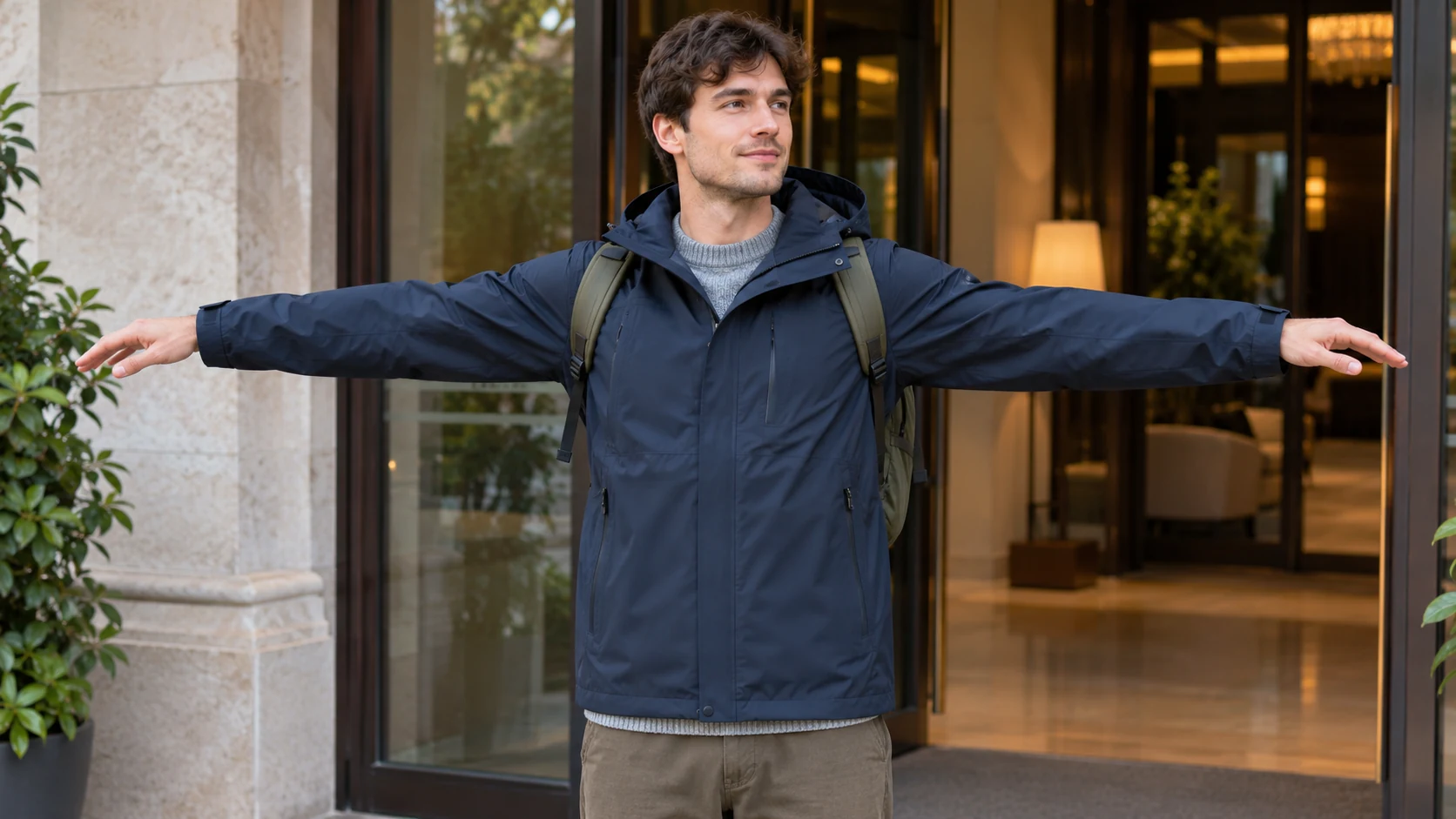
REI’s rainwear guidance highlights hood, wrist and hem adjustment because these details control openings. For travel, also check whether the collar remains comfortable when a sweater or inner jacket has its own high neck. Several overlapping collars can become awkward even when the chest has enough room.
A lightweight waterproof jacket should allow a small bag to sit naturally. Shoulder straps can pull the garment back and cover pockets. Check those interactions with the actual style of bag, especially if the traveller will wear it throughout the day.
When approving a retail size range, include body-length and sleeve information rather than translating a single “regular fit” label across markets. Clear fit guidance can prevent avoidable exchanges when customers expect room for winter layers in a deliberately slim travel style.
Is a longer rain jacket better for a city trip?
Additional length can protect more of the upper legs and reduce the gap between jacket and trousers while sitting. A shorter shell may be easier for stairs, cycling or a long walking stride. The choice depends on movement and coverage, not on whether a garment is called a coat or a jacket.
Compare two positions: upright and seated with the front closed. A hem that is comfortable when standing may pull across the thighs on a train seat. Check whether the garment’s intended fastening arrangement allows sitting comfortably without opening the front so far that rain protection is lost outdoors.
REI explains that closures and adjusters help keep wind and rain from entering openings. A longer hem cannot compensate for an unadjustable hood or poorly protected front fastening. A good lightweight waterproof jacket balances coverage with usable movement across the actual travel day.
Pockets deserve a practical check too. Passport and phone storage should not rely on an assumed waterproof pocket. Request the pocket specification, and use separate protective storage for valuables where necessary. A body fabric rating does not automatically apply to every pocket or zip.
How should the shell be packed, dried and reused during a trip?
Keep the jacket in an accessible compartment rather than underneath the whole suitcase. A compact shell offers little benefit if retrieving it requires unpacking in the rain. Fold or roll it according to its construction and instructions, without forcing hard creases through stiff components.
REI describes packable jackets that store in a pocket or supplied sack. That storage method is intended for convenience, not proof that permanent compression is harmless. Unpack the garment at the destination and allow air to circulate, particularly after use.
Use two storage states: compact while travelling and open while drying. This is a practical routine, not a laboratory requirement. If the jacket must be packed damp briefly, separate it from clean clothing and remove it as soon as drying space becomes available.
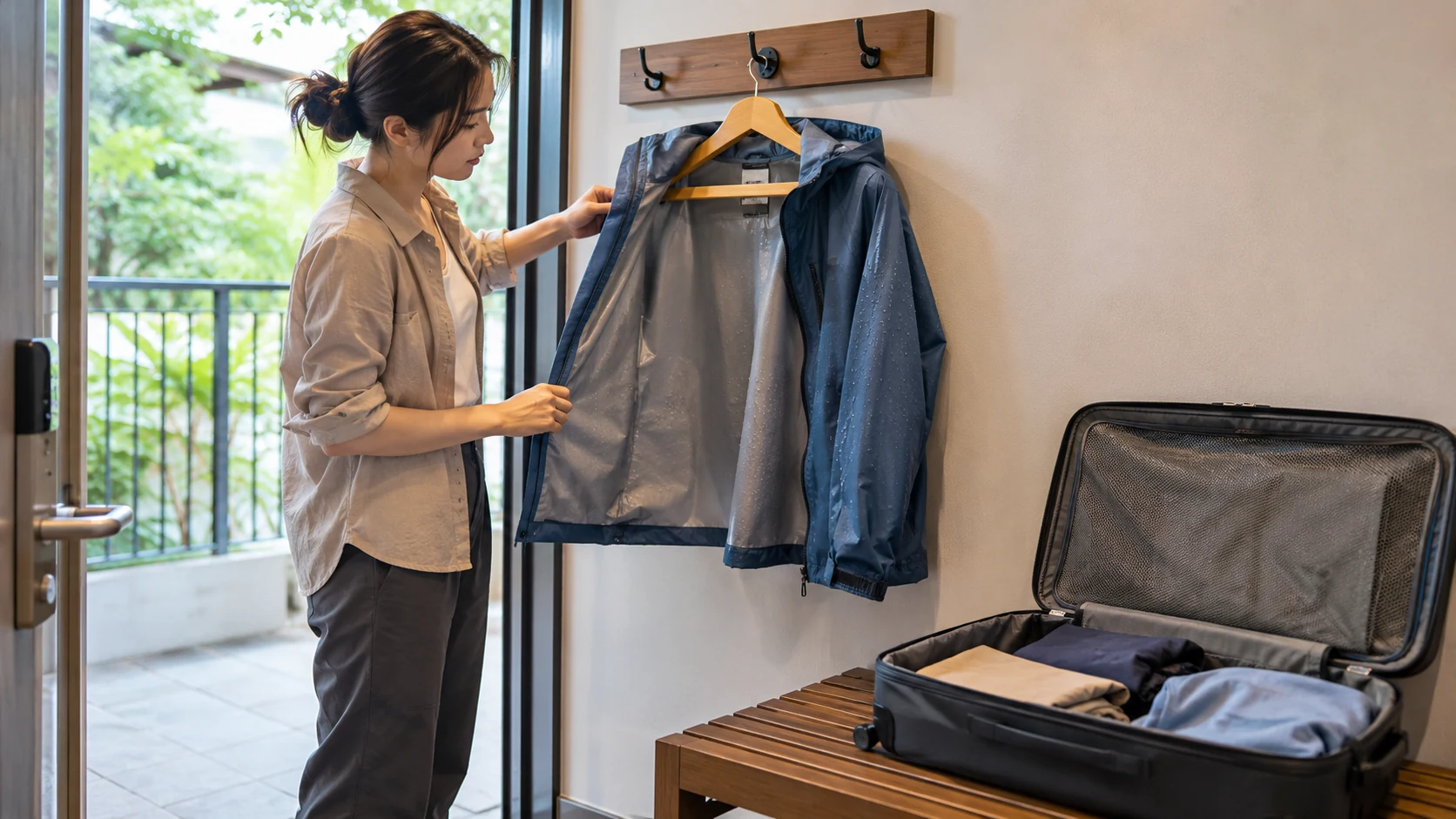
Follow the care label rather than placing a laminated shell on a hot radiator or improvising high-heat drying. Dirt and body oils can affect performance, but washing methods and approved treatments vary. A retailer should provide clear care information instead of advising every customer to use the same detergent or heat setting.
The best travel waterproof jacket is easier to live with when its care needs match the trip. For a multi-stop itinerary, inspect how readily the lining and pockets can air out. Overnight drying access can matter more than a small difference in listed garment weight.
Which travel design fits the planned journey?
| Design | Useful benefit | Trade-off | Check before packing |
|---|---|---|---|
| Short packable shell | Compact carry and freedom of movement | Less upper-leg coverage | Hem position when seated |
| Longer lightweight raincoat | More coverage for city walking | More fabric and possible stride restriction | Steps, stairs and chair comfort |
| Shell with separate warm layer | Adaptable across climates | More pieces to organize | Combined fit and collar overlap |
For distributors, the hidden costs are often fit-related returns, unclear care instructions and a mismatch between product descriptions and customer routines. Compare those factors alongside unit cost. A travel range with distinct use cases is easier to explain than several nearly identical jackets separated only by vague “premium” labels.
What should change between city breaks and walking holidays?
| Journey | Priority | Question to answer |
|---|---|---|
| City break with indoor stops | Easy carrying and removal | Can it be stowed without emptying the bag? |
| Rail travel across climates | Flexible layering | Does it fit both a shirt and the packed sweater? |
| Walking holiday | Ventilation and bag compatibility | Do vents and pockets work with the daypack? |
| Repeated wet travel days | Drying practicality | Can the lining and pockets dry between uses? |
Which waterproof and breathability claims are meaningful?
ISO 811:2018 measures fabric resistance to water penetration, while ISO 11092:2026 measures thermal and water-vapour resistance under specified conditions. Ask for the material and method behind the result. Neither a fabric number nor a “breathable” label guarantees comfort in every city climate.
A complete travel shell also needs suitable seam and opening protection. Buyers should keep consumer claims consistent with the approved construction and destination-market requirements. No certification is implied merely by citing a test method or offering a waterproof style.
What should a buyer include in a travel-jacket brief?
- Describe the itinerary, outdoor exposure and expected layers.
- Specify useful length and movement requirements, not just chest size.
- Request sample weight and packed dimensions for a named size.
- Confirm care instructions and practical pocket protection.
Yuelei Sports lists a breathable lightweight shell that can serve as a starting point for a travel-apparel discussion. Buyers should confirm the current sample’s fit, construction and performance documents against their own itinerary brief.
Frequently asked questions
What should I look for in a lightweight waterproof jacket for travelling?
Check rain protection, fit over intended layers, practical packed size and comfortable movement with a bag. Accessible storage and clear care instructions matter during a multi-stop trip.
Is a packable shell enough for unpredictable weather on a trip?
It may provide rain protection, but an uninsulated shell supplies little warmth by itself. Plan suitable layers and reassess outdoor activities when conditions exceed the clothing system’s intended use.
How waterproof should travel rainwear be for a city break?
Match it to exposure and access to shelter rather than a universal number. Verify waterproof construction, seam sealing and hood fit; a fabric rating alone does not describe the whole jacket.
Can a lightweight jacket fit over a sweater or down layer?
Yes, if its cut provides sufficient room without excessive looseness. Try the actual combination and check that sleeves move freely and the inner insulation is not compressed.
What is the best way to pack a waterproof jacket without creasing it?
Follow the manufacturer’s packing guidance and avoid forcing stiff components into sharp folds. Use its storage pocket or pouch where supplied, then unpack and air it at the destination.
Should I choose a longer travel rain jacket for better coverage?
A longer hem can help during city walking and sitting, but it may affect stride or pack size. Compare movement and seated fit before choosing length solely for coverage.
References
- REI: How to Choose Rainwear
- Cotswold Outdoor: The Layering System Guide
- ISO 811:2018: water penetration resistance
- ISO 11092:2026: thermal and water-vapour resistance
A travel shell is useful when it is easy to carry, ready when rain starts and comfortable with the layers already packed. Contact Yuelei Sports to discuss waterproof jackets for travelling around those everyday requirements.