 Xiamen Yuelei Sports Co., Ltd
When a technical engineer in Montauk, New York, encountered a sizing decision for a surf-fishing range, he watched fitting tutorials, approved the chart, and entered the field trial confidently. Within 30 minutes, the boot felt cramped and the crotch pulled with every wave. The wader was not defective—the specification had ignored insulating layers, boot volume, and surf mobility.
Summary: Anglers rarely need a “saltwater-only” label; they need a correctly fitted fishing chest wader with sealed seams, corrosion-resistant hardware, suitable traction, and rinse-ready materials. A 10,000 mm hydrostatic-head target is a practical B2B starting point, but the finished design must be tested. Waders are not flotation devices. The U.S. National Weather Service listed 36 preliminary 2026 surf-zone fatalities at the time of writing, so conservative wading guidance is essential.
Wave pressure, sand, salt crystals, and deep flexing make surf casting harder on waterproof fishing waders than calm freshwater use. “Special” should therefore describe verified construction—not a marketing label.

1. What Makes a Wader Suitable for Salt Water?
A saltwater-ready design includes shell, membrane or coating, seam tape, feet, fasteners, belt, and outsole. ISO 811 measures resistance to water penetration but sets no universal pass value. We recommend defining a project target—often at least 10,000 mm H2O—then testing initial and aged samples.
- Shell: A 3-layer breathable laminate balances mobility and durability; a 5-layer lower leg can add abrasion resistance.
- Seams: Require 100% waterproof-seam coverage and inspect intersections, knee shaping, and the boot or stockingfoot joint.
- Hardware: Acetal components or marine-suitable stainless steel reduce salt-corrosion risk; decorative plated metal is a poor default.
- Fit: The wearer should reach at least a 90-degree knee bend without crotch tension, while the boot still accommodates the intended sock system.
ASTM D751 includes hydrostatic, seam, adhesion, and low-temperature procedures for coated fabrics. A brief for waterproof fishing waders should identify the procedure, conditions, pass value, and current edition.
2. Bootfoot vs. Stockingfoot Waders
Bootfoot has one integrated footwear system; stockingfoot has two components—the waterproof garment and separate wading boots. The better choice depends on substrate and walking distance, not fashion.
| Dimension | Bootfoot | Stockingfoot |
|---|---|---|
| Sand entry | Fewer openings; fast to put on | Gravel guards and laces require cleaning |
| Rock mobility | Less precise fit | Better ankle support and replaceable boots |
| Cold-water sizing | Boot volume must include thick socks | Boot can be sized around 3–5 mm neoprene feet |
| Inventory | More body/boot SKU combinations | Modular garment and boot inventory |
| TCO | Simple for casual users; whole unit may be affected by boot damage | Higher initial complexity; boots replace separately |
ASTM F3445 addresses slip resistance for protective footwear using a whole-shoe method, but fishing boots do not automatically fall within its certification scope. Specify the test surface, contaminant, outsole, and edition rather than promise “non-slip.” The bootfoot vs. stockingfoot guide covers cold and mud.
3. Key Feature Requirements and Hidden Cost
| Requirement | Practical Brief | Commercial Risk if Missed |
|---|---|---|
| Water resistance | State an ISO 811 or equivalent method and a 10,000–20,000 mm project target | Leak claims without comparable evidence |
| Lower-leg durability | Reinforced 3- or 5-layer zone; test abrasion after flexing | Pinholes from sand and shell beds |
| Belt | Adjustable belt, commonly 25–38 mm wide, positioned near the waist | Poor fit control; belt must never be presented as flotation |
| Corrosion control | Salt-tolerant components plus rinse instructions | Frozen zippers, staining, and warranty returns |
| Production inspection | Agree ISO 2859-1 sampling and AQL levels before the PO | Buyer and factory apply different acceptance rules |
In an illustrative 1,000-unit order, reducing returns from 6% to 3% prevents 30 cases; at a hypothetical $35 per return, that preserves $1,050 before reputation cost. The honest ROI equation is unit price + inspection + returns + warranty + support.
4. Which Wader Fits Each Saltwater Application?
| Application | Recommended Configuration | Priority |
|---|---|---|
| Warm sandy beach | Light 3-layer stockingfoot or bootfoot fishing chest wader | Mobility and sand control |
| Cold surf | Breathable shell with layered insulation; roomy boot or 4–5 mm stockingfoot | Fit without insulation compression |
| Rock ledge or jetty | Stockingfoot plus task-specific boots | Traction; avoid wading when waves make footing uncertain |
| Shallow flats | Lightweight wade fishing chest configuration | Heat and long-walk comfort |
| Marsh hunting | Insulated hunting chest wader with abrasion panels | Warmth, mud release, and camouflage requirements |
No configuration makes rough surf safe. NOAA advises checking forecasts and never assuming calm weather means safe water. A wader is apparel—not a PFD or permission to enter hazardous water.
5. Standards, Compliance, and Buyer Evidence
Standards are evidence frameworks, not badges. A technical file should name the current edition, laboratory, conditioning, procedure, and pass criteria.
- ISO 811: hydrostatic-pressure resistance of textile fabrics; report the measured result, not just “pass.”
- ASTM D751: relevant coated-fabric methods, including hydrostatic resistance and seam-related testing; select only applicable procedures.
- ASTM D1683/D1683M: seam failure in woven apparel fabrics; agree the required seam performance against the base fabric.
- ISO 2859-1: sampling plans for lot-by-lot inspection; the buyer must define AQL and defect classes.
- EU REACH, Regulation (EC) No 1907/2006: restricted-substance duties may apply to materials and components entering the EU.
If sold as protective equipment in the EU, Regulation (EU) 2016/425 must be assessed; recreational waders should not carry unsupported CE claims. Noncompliance can cause customs delay, relabeling, recalls, or chargebacks.
6. How Should Buyers Select the Right Size?
- Measure chest, waist, hip, inseam, and foot length using ISO 8559-1 definitions where applicable; do not grade from shoe size alone.
- Fit the planned insulation layers, then squat, climb a step, and raise each knee to 90 degrees.
- Allow toe movement without heel lift; compressed socks reduce warmth, while excess volume reduces control.
- Run a size-set trial across at least three body profiles before bulk approval, then record outliers.
- Lock the approved measurement method and tolerances into the purchase specification.
The chest wader size guide provides the workflow. Yuelei Sports provides OEM/ODM fishing chest wader programs with buyer-specified materials, grading, and third-party testing support; claims should be confirmed by model and market.
7. Mandatory Post-Trip Maintenance
Dried salt becomes abrasive and can bind hardware. After every saltwater trip, the user should complete a 5-step routine:
- Rinse the outside with cool fresh water, including seams, buckles, gravel guards, boots, and outsole channels.
- Remove sand by gentle flow; do not grind it into the laminate with a stiff brush.
- Clean only as the care label allows; avoid bleach, fabric softener, and unapproved solvents.
- Dry inside and outside completely in shade with airflow, away from direct heaters.
- Store loose and dry; inspect seam tape, punctures, and hardware before the next trip.
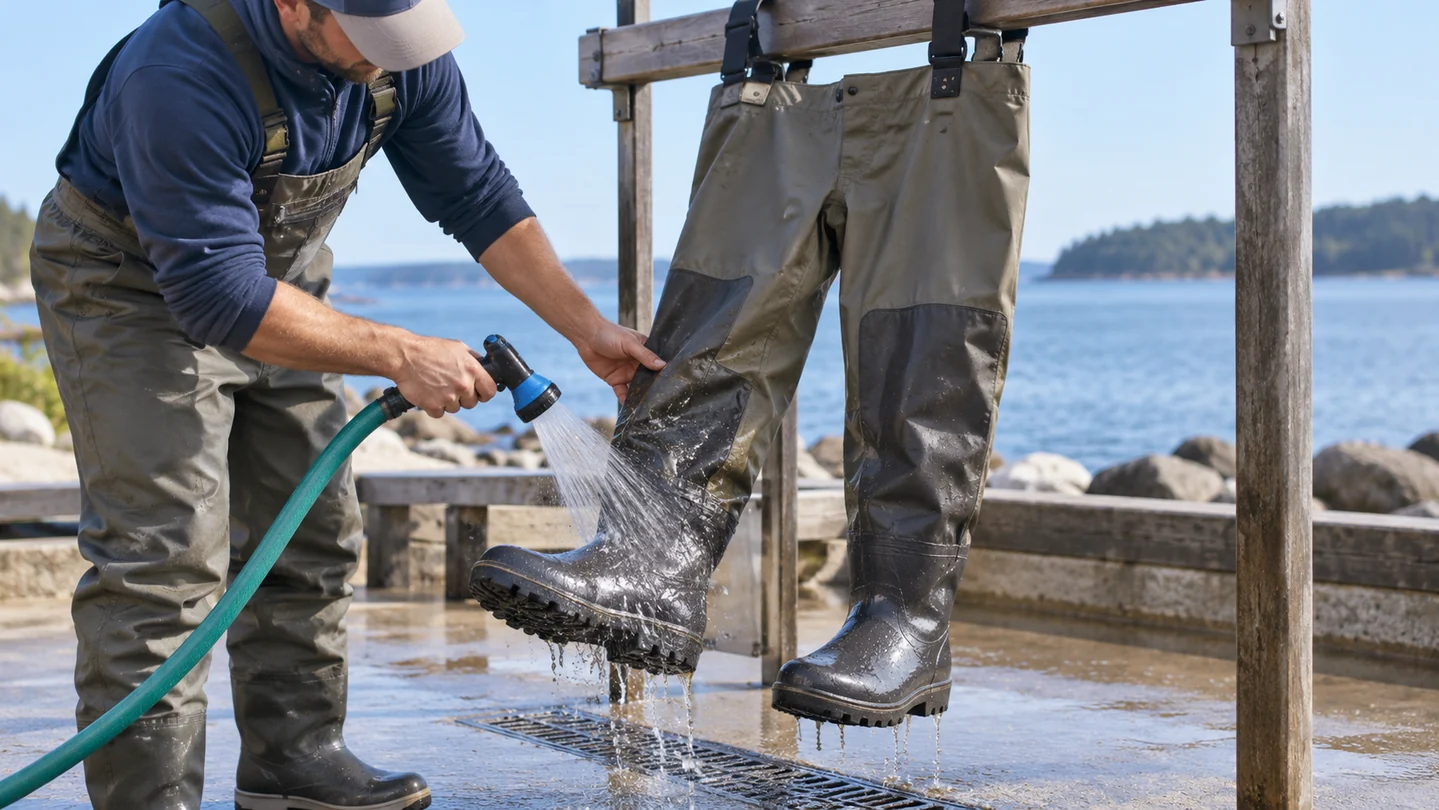
Validate care instructions under ISO 3758 and wash claims with an agreed ISO 6330 procedure. Maintenance cannot rescue a poor seam, but it prevents salt damage from being mistaken for manufacturing failure.
FAQ
Should you wear waders for surf fishing?
Waders improve dryness in shallow, controlled conditions. They do not make rough surf safe; the user should check forecasts, fish with a partner, use appropriate flotation, and retreat before footing fails.
Can you use waders in salt water?
Yes. Waterproof fishing waders work in salt water when materials, seams, hardware, fit, and footwear match the environment. Fresh-water rinsing and complete drying are mandatory.
What are the two types of waders?
The two main footwear constructions are bootfoot and stockingfoot. Waders are also classified by height—hip, waist, or chest—and by shell type, such as breathable laminate, neoprene, PVC, or rubber.
Can I use wading boots without waders?
Yes, for wet wading in suitable temperatures. The boots should be paired with neoprene socks or guards designed to occupy the boot correctly and limit abrasion; bare feet are a poor fit and blister risk.
What are the differences between waders and wading boots?
Waders keep the lower body dry; wading boots provide traction and support. Stockingfoot waders require separate boots, while bootfoot waders integrate both functions into one product.
What to wear if you don’t have waders?
In warm, shallow water, quick-drying clothing and secure wet-wading footwear may work. Cold water, breaking surf, sharp ground, or strong currents may require not entering.
What are the different types of hunting waders?
A hunting chest wader may be breathable, neoprene, or coated; bootfoot models dominate cold marsh use, while uninsulated breathable versions favor mobility. Buyers should segment by temperature, abrasion, camouflage, boot insulation, and expected mud depth.
References
- U.S. National Weather Service — Rip Current Safety
- U.S. National Weather Service — Preliminary Surf-Zone Fatalities
- ISO 811:2018 — Textiles: Resistance to Water Penetration
- ASTM D751 — Standard Test Methods for Coated Fabrics (verify the current edition at specification release)
- EUR-Lex — Regulation (EC) No 1907/2006 (REACH)
The right surf wader is not the one with the loudest saltwater claim; it is the one whose fit, materials, tests, and care plan still make sense after the first hard season.
Yuelei Sports builds each wade fishing chest program for that moment—from size sets and salt-ready components to inspection planning. Buyers developing a private-label range can contact the team to review environment, target price, and test brief.