 Xiamen Yuelei Sports Co., Ltd

When a technical engineer in Brooklyn received a fast local sample for a school outdoor program, she approved it after one fitting and assumed bulk sewing would follow the same process. The production partner later outsourced key seams, missed the delivery window, and returned a different size block. The lesson was simple: local proximity does not remove the need to map the full clothing manufacturers in USA supply chain.
Summary: New York has valuable design, sampling, and garment-center expertise, but buyers must distinguish sample rooms, decorators, factories, and sourcing agents. A ten-name shortlist should be tested through a graded size set, a written production map, compliance checks, and a landed-cost model that includes domestic and overseas steps.
The phrase clothing manufacturers in USA may describe a fully domestic factory, a New York development studio, or a U.S. company coordinating imported production. The buyer should state which model is required for origin claims, speed, labor expectations, and price; otherwise two quotations that look comparable may not be comparable at all. Buyers should document clothing manufacturers in USA in the specification so that sampling, testing, and replenishment use the same acceptance criteria. Buyers should document clothing manufacturers in USA in the specification so that sampling, testing, and replenishment use the same acceptance criteria. Buyers should document clothing manufacturers in USA in the specification so that sampling, testing, and replenishment use the same acceptance criteria. Buyers should document clothing manufacturers in USA in the specification so that sampling, testing, and replenishment use the same acceptance criteria. Buyers should document clothing manufacturers in USA in the specification so that sampling, testing, and replenishment use the same acceptance criteria. Buyers should document clothing manufacturers in USA in the specification so that sampling, testing, and replenishment use the same acceptance criteria. Buyers should document clothing manufacturers in USA in the specification so that sampling, testing, and replenishment use the same acceptance criteria. Buyers should document clothing manufacturers in USA in the specification so that sampling, testing, and replenishment use the same acceptance criteria.

1. What Does This Search Term Really Cover?
New York production often begins with design, pattern, sample, and fit approval, then moves to cut-and-sew, finishing, packing, or a disclosed offshore partner. Technical outerwear adds seam sealing, water testing, and trim compatibility. Buyers should document each operation, who owns defects, and where final inspection occurs.
The honest answer is that a buyer is comparing a complete supply system, not a logo or a single fabric swatch. A credible brief separates design intent, material behavior, factory process, testing evidence, order economics, and post-delivery support; this prevents a low sample price from hiding a high total cost.
2. Which Technical Variables Decide the Result?
- Origin model: Domestic cut-and-sew, imported components, or full import
- Sample speed: Pattern, fitting, and revision cycle
- Capacity: Monthly units and peak-season plan
- Compliance: Labor, fiber, care, and product-safety file
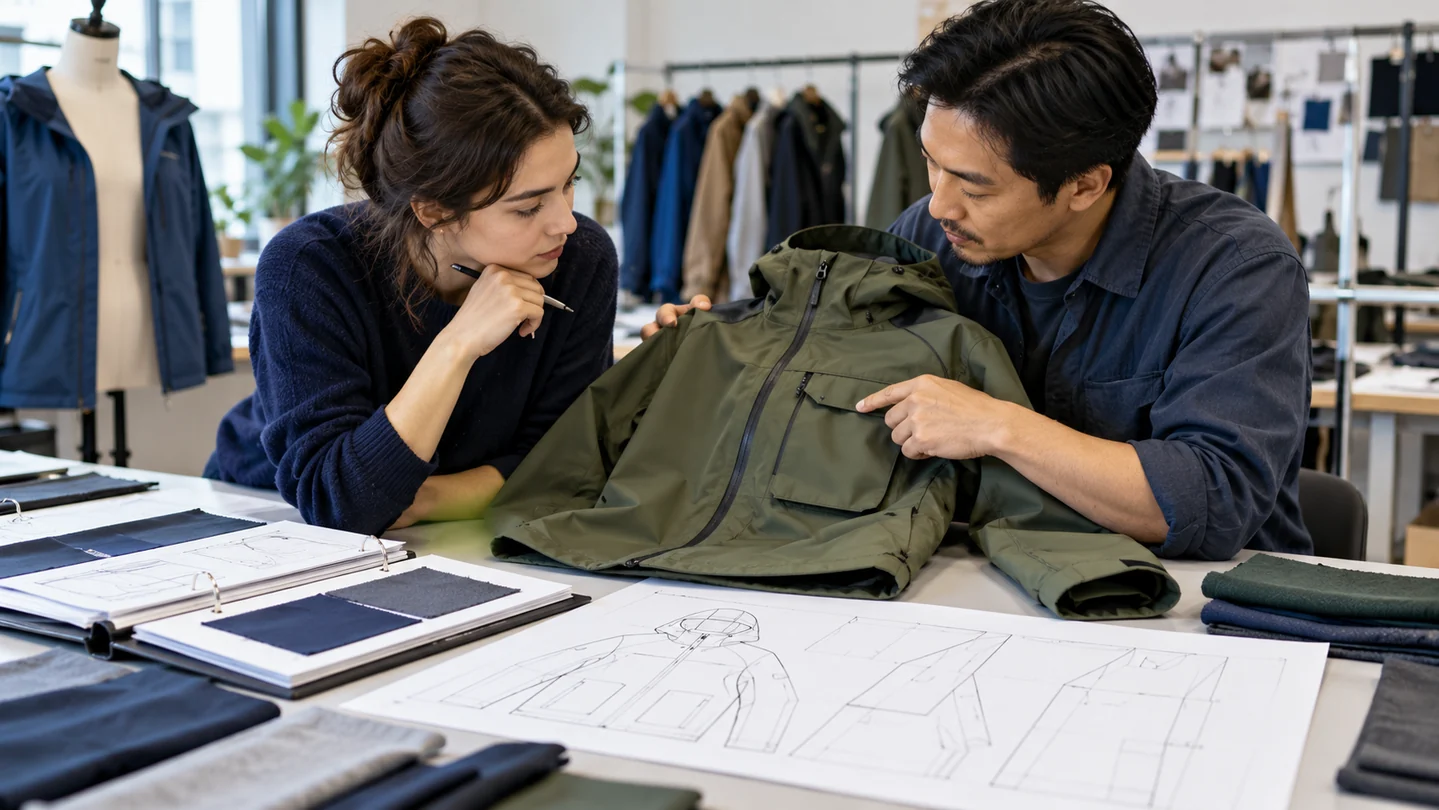
For a technical clothing program, we recommend setting an acceptance range before the first sample. ISO 13688:2013 provides a useful general framework for protective-clothing ergonomics and labeling, while ISO 9001 controls the quality-management process; neither standard replaces product-specific testing.
3. How Should Buyers Measure Performance?
Use a small, repeatable scorecard rather than a subjective “looks premium” review. The numbers below are starting controls, not universal pass/fail limits; the buyer should adjust them for end use, target market, and risk.
| Control | Practical starting point | Why it matters |
|---|---|---|
| Sample turn | 5-15 working days for a simple sample | Measures collaboration |
| Fit set | At least 3 sizes and one movement trial | Finds grading problems |
| Domestic run | Pilot lot before scale | Checks operator and process |
| Inspection | 100% critical-point check on first lot | Protects launch |
Testing at least three sizes and two production lots exposes grading, seam, and trim variation earlier than a single showroom sample. A 30-minute wear trial, a wash-and-dry cycle, and a documented measurement sheet are inexpensive compared with a relabeling or rework campaign.
4. Where Do Hidden Costs and ROI Appear?
Unit price is only one line in the business case. Buyers should model development samples, pattern changes, minimum order quantities, inspection, freight, duty, care-label revisions, claims, and the cost of tying cash in slow-moving sizes. The useful ROI question is: how many avoidable returns or production hours does a better specification remove?
| Cost or value lever | Low-control approach | Controlled approach | |
|---|---|---|---|
| NY sample studio | Fast fittings and communication | May not run bulk | Confirm production handoff |
| Domestic factory | Origin and short freight | Higher unit cost | Check capacity and machinery |
| U.S. sourcing office | Broad factory access | Origin and accountability vary | Name the actual exporter |
A practical example: in a 1,000-piece order, reducing a 4% fit-related return rate to 2% prevents 20 returns. At a conservative USD 35 handling, inspection, and markdown cost per return, the direct saving is USD 700 before the value of customer trust and repeat orders. The same logic applies when comparing clothing manufacturers in USA suppliers.
5. How Do Common Options Compare?
Procurement teams often compare options that serve different jobs. The table keeps the trade-offs visible and helps the engineering, merchandising, and finance teams approve the same decision.
| Option | Strength | Trade-off | Typical buyer |
|---|---|---|---|
| Sample room | Fast development | Limited bulk | Design-led brands |
| Garment factory | Domestic production control | MOQ and labor cost | Uniform and premium runs |
| Decorator | Print, embroidery, and finishing | Not a full factory | Promotional apparel |
| Sourcing coordinator | Broader supply chain | Needs transparency | Multi-country programs |
For a Top 10 search, the following is a research shortlist rather than an endorsement; current capacity, ownership, and certifications must be verified before a purchase order.
| Candidate | Core advantage to verify | Typical buyer | Price position |
|---|---|---|---|
| Fashion-Enter | Sampling and small-batch route to verify | Emerging labels | Mid |
| New York Embroidery Studio | Embroidery and finishing to verify | Decorated apparel | Mid-high |
| Make It In America | Domestic production route to verify | Origin-sensitive buyers | High |
| MCM Enterprises | New York production route to verify | Private labels | Mid |
| Custom Clothing Company | Custom apparel development to verify | Corporate and fashion | Mid |
| NY Custom Apparel | Small-run customization to verify | Local brands | Mid |
| The Sample Room NYC | Pattern and fit development to verify | Design studios | Mid-high |
| Lefty Production Co. | Development and production coordination to verify | Contemporary brands | Mid-high |
| CFDA production referrals | Industry-network supplier discovery | Designer labels | Varies |
| Garment Center specialists | Local cut-and-sew capacity to verify | Small wholesale runs | Mid-high |
There is no universal winner. The correct choice is the one whose performance, documentation, capacity, and replenishment plan match the user scenario and the commercial forecast.
6. Which Market or Application Matrix Fits?
Regional rules, climate, labor requirements, and channel expectations change the specification. A matrix is more reliable than copying a factory brief from one market into another.
| Market or use case | Specification emphasis | Commercial checkpoint |
|---|---|---|
| New York City | Design, fitting, and brand access | Studio and labor rates |
| New York State | Larger space and production options | Transport and workforce |
| Northeast network | Specialist mills and trims | Subcontractor traceability |
| U.S. plus offshore | Scale and cost balance | Origin, duty, and QA |
Where a retailer sells across borders, the technical file should identify the country of origin, fiber content, care symbols, restricted substances position, and responsible economic operator. This is also where a responsive supplier earns its value: the same base pattern can be adapted without losing traceability.
7. Which Standards and Compliance Checks Apply?
Standards do not make an untested product safe by themselves, but they give buyers a common language for risk and evidence.
- FTC Textile and Wool Acts plus the Care Labeling Rule for U.S. labeling and care information.
- U.S. CPSC flammability requirements for applicable apparel and children’s products.
- ISO 9001:2015 as a supplier quality-management reference.
- ISO 13688:2013 for relevant protective or technical clothing general requirements.
Non-compliance can lead to customs holds, marketplace delisting, forced relabeling, recalls, contract penalties, or insurance disputes. We recommend keeping a technical file with the bill of materials, approved sample, test reports, size chart, care label, packaging marks, and change-control record; every revision should have an owner and date.
8. How Should a Buyer Select a Supplier and Avoid Mistakes?
- Ask whether the quoted company cuts, sews, finishes, and inspects the garment at its stated address.
- Clarify domestic-content and country-of-origin wording before using “Made in USA” language.
- Approve a fit set, measurement tolerance, and movement test before bulk cutting.
- Separate development fees, domestic labor, imported components, freight, duty, and inspection in the cost sheet.
- Name the defect owner and change-approval process when work moves between New York and an offshore partner.
Yuelei Sports provides B2B outdoor clothing programs with configurable fabrics, patterns, trims, waterproof constructions, and inspection checkpoints; the buyer should request the finished-model evidence and target-market labeling before approving a purchase order. For outdoor programs, a relevant starting point is the ski-jacket collection or the dry-suit platform, depending on the brief.
9. FAQ and References
Are there clothing manufacturers in USA that can handle small orders?
Yes, sample rooms and small factories may accept lower volumes, but the MOQ, color minimum, and development fee must be confirmed by style.
How do I find a New York garment factory?
Use a vetted industry directory or referral, then verify the operating address, machinery, capacity, sample room, and current production references.
Is New York manufacturing more expensive?
Often the unit cost is higher, but faster fittings and shorter feedback loops can reduce travel, rework, and launch risk for small technical programs.
Can a New York factory make waterproof jackets?
Some can, but seam sealing, membrane handling, and water testing require dedicated equipment; verify the exact finished construction.
What does “Made in USA” require?
The claim has specific FTC substantiation expectations; review the current guidance and document domestic content before marketing it.
References
- FTC – Made in USA standard
- FTC – care labeling and textile guidance
- CPSC – clothing and textile safety
- Council of Fashion Designers of America
A New York address can shorten the feedback loop, but only a transparent production map protects the final delivery.
When a purchasing team treats this product phrase as a measurable system rather than a buzzword, every later decision becomes easier to audit. Yuelei Sports builds that complete B2B specification around the real use case; buyers can review the product range or contact the team to convert performance, sizing, compliance, and delivery requirements into a repeatable program.