 Xiamen Yuelei Sports Co., Ltd
When a product developer in Munich encounters complaints after approving a visually strong ski capsule, the failure can become visible within the first fitting: shorter wearers feel excess fabric at the torso, taller wearers cannot squat comfortably, and buyers discover that restroom access was never evaluated. The immediate response may be to blame the zipper, insulation, or fabric. Yet the underlying risk is often a format-and-fit decision made before wear trials—one-piece and two-piece systems distribute ease, openings, ventilation, and size tolerances differently. Selecting the silhouette first and engineering the body movement later can turn an attractive range into avoidable returns, alterations, and fragmented inventory.
Quick Answer: Neither format is universally better. A one-piece usually offers continuous coverage at the waist and a simple complete-look purchase, while a jacket-and-pants set offers easier restroom access, more ventilation combinations, and separate sizing. For a full ski day, warmth depends on the complete system—base layers, insulation, shell, seam construction, openings, activity level, and weather—not the silhouette alone. Buyers should compare one-piece and two-piece prototypes using the same fabric tests, layer package, movement routine, and care cycles. The decisive B2B question is which design produces the best fit coverage and lowest total cost for the intended consumer group.
Which Is Better for Women: One-Piece or Two-Piece?
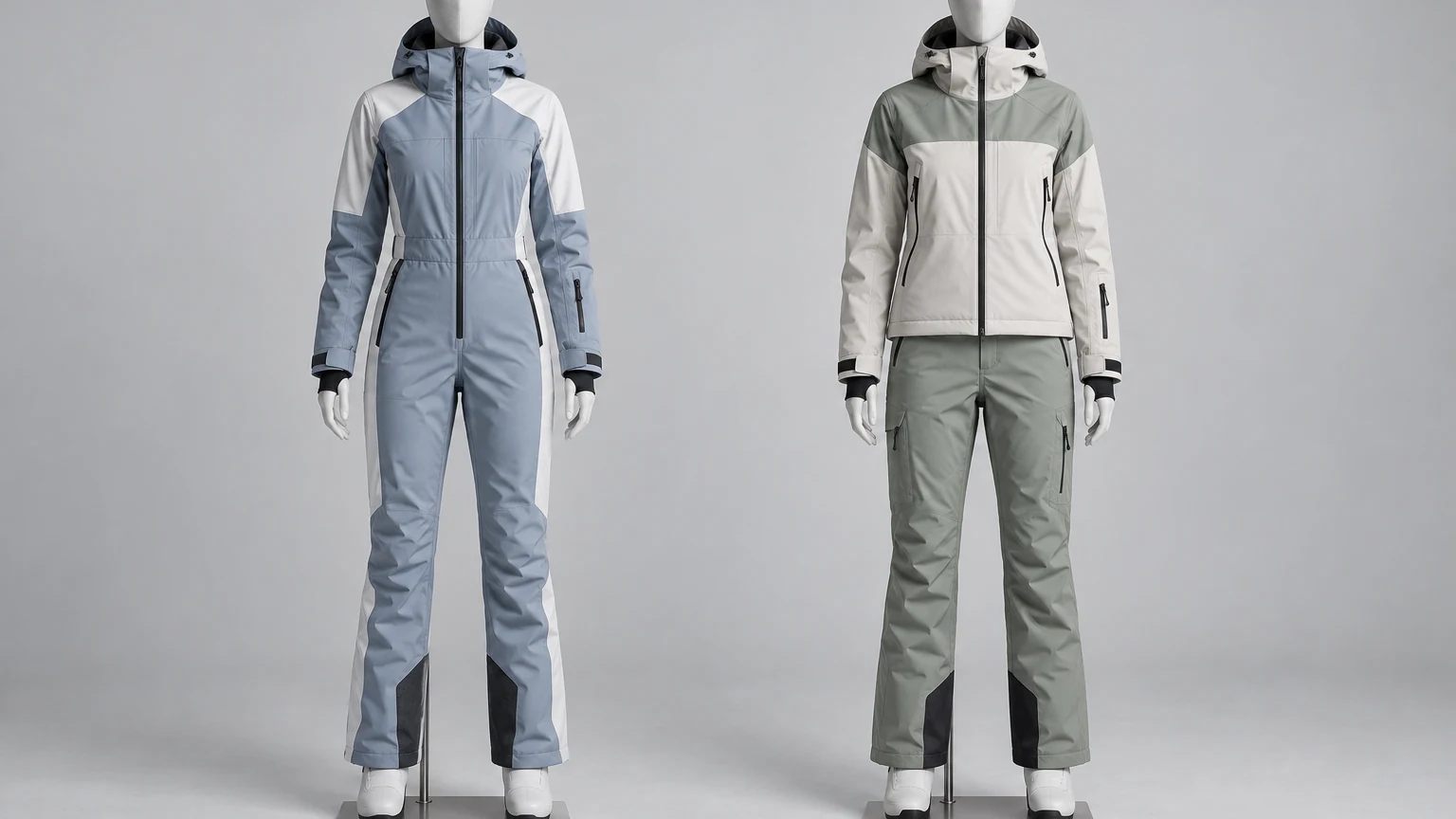
For a consumer, the practical trade-off is continuity versus modularity. A one piece ski suit ladies program can reduce the chance of a jacket hem separating from pants during a fall or deep bend. A two-piece set lets the wearer remove the jacket indoors, change insulation by zone, and combine different jacket and pant sizes. Neither advantage guarantees better weather protection; fabric resistance, seam sealing, closure design, cuff interfaces, and hood construction still require separate specifications.
| Decision dimension | Women’s one-piece suit | Two-piece set | Buyer check |
|---|---|---|---|
| Warmth continuity | No jacket-to-pant gap; fewer overlap decisions | Waist overlap depends on jacket length, bib height, and movement | Test seated, bent, and fallen positions with intended layers |
| Ventilation | Needs well-placed vents because the upper and lower garment remain connected | Jacket and pants can be vented or removed independently | Record vent location, opening length, and mesh or storm-flap construction |
| Mobility | Torso length and crotch rise interact strongly during reach and squat | Upper- and lower-body ease can be tuned separately | Run reach, binding-adjustment, chairlift, and squat checks |
| Fit flexibility | One size must accommodate bust, waist, hip, rise, and total body length | Separate top and bottom sizes support more body combinations | Review grading across every size, not only the fit sample |
| Restroom access | Depends on zipper path, hood management, and whether sleeves touch the floor | Generally simpler because the jacket remains separate | Conduct a clothed access trial before bulk approval |
| Layering | Continuous internal volume; bulky layers can pull through the torso | Different upper and lower layer weights are easier to accommodate | Fit with the declared base and midlayer package |
| Care | Large single item can need more washer and drying space | Pieces may be washed separately but care compatibility still matters | Validate instructions after repeated care procedures |
| Repair | One failed major component can remove the complete outfit from use | A damaged piece can be repaired or replaced independently | Confirm access to zippers, seam tape, cuffs, and replaceable parts |
| Unit-cost tendency | Integrated construction may simplify the consumer purchase but uses long closures and more continuous panels | Two finished garments create duplicated components and packing | Compare costed bills of materials, not silhouette assumptions |
| Returns and TCO | Higher exposure to torso-length mismatch; fewer mix-and-match SKUs | More SKU combinations; potentially better fit matching | Model returns, markdowns, spare parts, and inventory fragmentation together |
How Should a Ski Suit Keep Warmth and Weather Protection in Balance?
A one piece ski suit womens design can feel warm for a full day because continuous waist coverage limits one common opening, but warmth also changes with activity, wind, moisture, lift time, and insulation. ISO 11092 measures thermal and water-vapour resistance under steady-state conditions; it supports material comparison but does not reproduce garment openings, movement, or mountain weather.
Waterproof labels need context. ISO 811 measures fabric resistance to water penetration under hydrostatic pressure. A result in millimetres of water column is not automatically a whole-garment claim when seams, zippers, vents, and wear are excluded. Breathability figures in g/m²/24 h are comparable only under the same method and conditions. No single rating is “best” for every skier; specify the method, preconditioning, sample state, and acceptance threshold.
During high-output skiing, ventilation can matter as much as insulation. One-piece vents must remain accessible without conflicting with pockets or seams. Two-piece systems release heat independently, yet a short jacket can expose the waist. For either format, knee and elbow articulation, gussets, sleeve rotation, and controlled ease reveal more than a standing photo.
How Should a Women’s One-Piece Ski Suit Fit?
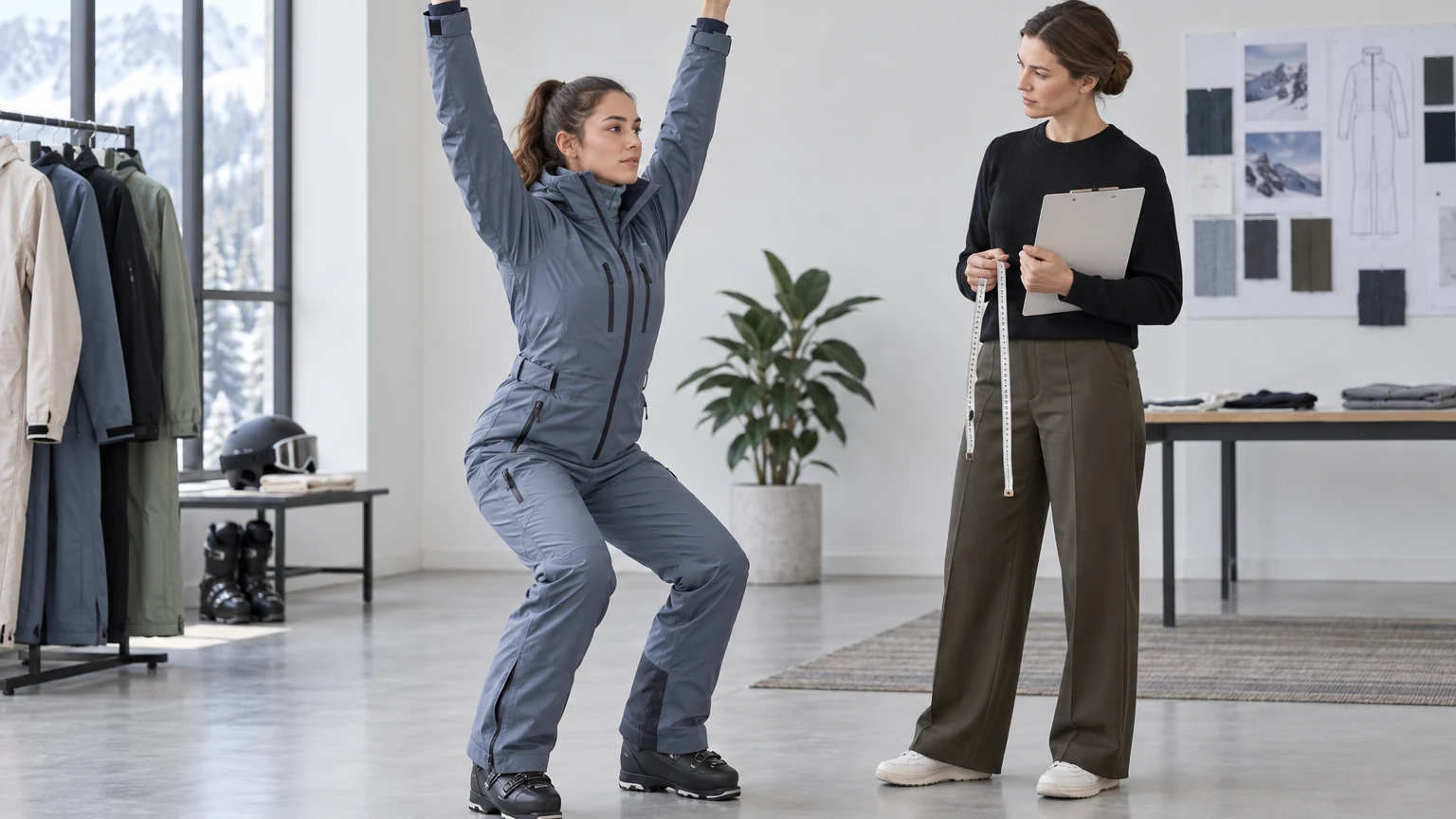
The critical one-piece measurement is not only bust or hip circumference; it is the relationship among shoulder, waist, rise, and crotch. For one piece ski suit women assortments, one fit model cannot validate the grade. Excess torso length can create folds, while insufficient length restricts reach or pulls at the crotch. Request body and garment dimensions, tolerances, and circumference and length grade rules.
Check fit over the intended base layer and midlayer. The wearer should raise both arms, rotate, fasten boots, sit, and squat without collar lift, crotch pressure, or cuff withdrawal. Extra volume can bunch and impede movement. Two-piece sets suit consumers needing different top and bottom sizes, but jacket hem and pant rise must still overlap through motion.
Restroom practicality deserves formal approval. A long front opening may still require the upper body to be peeled down, exposing sleeves and hood to a wet floor. Rear access can reduce undressing but adds zipper, sealing, and comfort considerations. Evaluate it with gloves and base layers, documenting how loose fabric is controlled.
How Do Care, Repairs, and Inventory Affect Cost?
Care instructions must follow the verified construction. Close fasteners, remove permitted parts, use the specified detergent and temperature, and follow the drying label. Softener, bleach, heat, or dry cleaning may damage some membranes, seam tapes, coatings, or finishes, but restrictions must be product-specific. Store the garment clean, dry, and uncompressed.
ISO 6330 provides domestic washing and drying procedures for textile testing; it does not promise finished-suit durability. After defined care cycles, recheck appearance, dimensions, delamination, seam tape, closures, and relevant water resistance. One-pieces may need more machine capacity; two-piece components can have conflicting care needs.
Total cost of ownership can be modelled as: landed cost + expected return handling + markdown exposure + repair or warranty handling + inventory carrying cost. A one-piece avoids split sets, but torso-fit returns may be costly. A two-piece permits size matching and component replacement, yet multiplies color-size combinations. Search demand such as best one piece ski suit womens or one piece ski suit women sale cannot replace fit evidence or a channel margin model.
| Use case or buyer priority | Likely starting format | Why | Validation needed before order |
|---|---|---|---|
| Cold, lift-served resort use with frequent sitting | One-piece or high-overlap two-piece | Coverage continuity is valuable during low-output periods | Thermal system, seat area, waist exposure, and chairlift mobility |
| High-output or variable spring conditions | Two-piece, or highly vented one-piece | Independent heat management becomes more important | Vent access, breathability method, and wet-weather closure design |
| Fashion-led coordinated capsule | One-piece | Creates a complete silhouette in one SKU | Torso-length coverage, access trial, and repair plan |
| Broad body-shape coverage | Two-piece | Separate top and bottom sizing expands combinations | Mix-and-match rules, color consistency, and SKU depth |
| Rental, team, or serviceable fleet | Two-piece often has an operational advantage | A single damaged component can be isolated | Spare-part availability, labeling, cleaning capacity, and tracking |
What Do Waterproof and Breathability Tests Actually Tell You?
- ISO 811: a hydrostatic-pressure method for resistance of fabrics to water penetration. It does not, by itself, certify a finished ski suit as waterproof.
- ISO 11092: a steady-state sweating guarded-hotplate method for thermal and water-vapour resistance of textile materials and assemblies. It is not a blanket warmth or comfort certification.
- ISO 6330: standardized domestic washing and drying procedures for textile testing. It supplies repeatable care conditions, not a durability certification.
- FTC Care Labeling Rule: for apparel sold in the United States, manufacturers and importers within scope must provide care instructions supported by a reasonable basis. This is a legal labeling rule, not a performance endorsement.
Unsupported “waterproof,” “breathable,” or care-durability claims can create disputes, returns, and relabeling. Requirements depend on destination market, fiber content, use, and the exact claim. Purchase orders should identify the method and acceptance criteria rather than saying only “tested” or “ISO compliant.”
What Should Buyers Check Before Choosing a Format?
- Define the skier and climate. State activity intensity, expected weather, base and midlayers, sales channel, and target body-size coverage.
- Prototype both formats on equal terms. Compare the same shell concept, insulation zones, and intended care route; Yuelei Sports can support development discussions through its design one-piece ski suit and custom one-piece ski suit options.
- Approve movement and access. Use multiple wearers across the size range and record reach, squat, chair sitting, boot fastening, vent use, and restroom access.
- Match evidence to claims. Fix the test method, conditioning, care cycles, seam scope, and acceptance limits before testing.
- Model assortment economics. Compare return sensitivity and one-piece SKU simplicity with the mix-and-match flexibility of a ski jacket and pants program.
The phrase one piece ski suit ladies may describe the search demand, but a B2B specification needs more precise language: body-measurement range, torso grades, closure path, ventilation, layer package, seam construction, care route, and testing scope. That detail turns a style decision into a manageable development program.
FAQs
Is a women’s one piece ski suit warm enough for a full day on the slopes?
It can be, provided the complete system matches the weather, activity level, and wearer. Continuous waist coverage helps, but insulation distribution, base layers, wind exposure, moisture management, seam construction, and vent use are equally important. Review material test data and complete a wear assessment in representative conditions.
How should a women’s one piece ski suit fit over thermal base layers?
A one piece ski suit womens fit should allow overhead reach, trunk rotation, boot fastening, chair sitting, and a deep squat without crotch pressure or collar lift. Fit the prototype over the intended base and midlayers; do not add uncontrolled ease to compensate for an incorrect torso length.
What waterproof and breathability ratings are best for skiing?
There is no single best rating for all skiing or a reliable comparison without the test method and conditions. Specify the hydrostatic-pressure method, water-vapour method, sample conditioning, care history, seam scope, and acceptance threshold; ISO 811 and ISO 11092 address material testing, not automatic whole-garment certification.
Is a one-piece ski suit more practical than a jacket and pants?
A one piece ski suit women program is practical when continuous coverage and a coordinated outfit outweigh the need for separate sizing and quick restroom access. Jacket-and-pants sets are often easier to vent, remove indoors, repair by component, and fit across different upper- and lower-body sizes.
Can I wear a ski suit for snowboarding as well as skiing?
Potentially, but the garment must accommodate the intended stance, deeper flexion, repeated sitting, glove interface, and binding movement. Validate the range of motion and abrasion exposure for snowboarding rather than assuming a skiing fit transfers unchanged.
How do I wash and dry a ski suit without harming the waterproof coating?
Follow the sewn-in care label for that exact garment, close fasteners, and use only the specified wash and drying conditions. Avoid assuming that generic advice applies to every membrane, coating, seam tape, or finish; dry the suit completely before storage and inspect for delamination or loose tape.
References
- ISO 811:2018 — Textiles — Determination of resistance to water penetration — Hydrostatic pressure test
- ISO 11092:2026 — Textiles — Physiological effects — Measurement of thermal and water-vapour resistance
- ISO 6330:2021 — Textiles — Domestic washing and drying procedures for textile testing
- Federal Trade Commission — Clothes Captioning: Complying with the Care Labeling Rule
The strongest ski assortment aligns its format, fit, evidence, and service plan.
To compare development routes for one piece ski suit ladies, one piece ski suit womens, and one piece ski suit women programs, review Yuelei Sports’ ski-suit category and contact the team with your target market, size range, layer package, test requirements, and order plan.