 Xiamen Yuelei Sports Co., Ltd
A rain jacket that stays in the hotel is little help when the weather changes halfway through a walk. Travel rainwear has to be easy enough to carry that taking it along becomes routine. Yet the smallest-looking bundle is not always the most useful jacket: it may lack room for a sweater, have an unstable hood or be awkward to unpack with luggage in hand. The choice is less about finding the lightest label and more about fitting a working rain layer into the way the trip will actually unfold.
A women’s packable waterproof jacket should combine a manageable packed size with useful rain protection and a comfortable fit over travel clothing. Check weight and folded dimensions for the actual size being bought. Then look at the hood, seams, closures and storage arrangement. A thin shell usually gives more flexibility across changing temperatures; built-in insulation makes more sense when cold conditions dominate the journey.
Will it fit the bag that is actually being carried?
“Packable” does not give a measurement. Ask for the garment’s dry weight and packed dimensions, including its pouch if one is supplied. Compare those with the space available in the day bag, not just the larger suitcase that may remain at the accommodation.
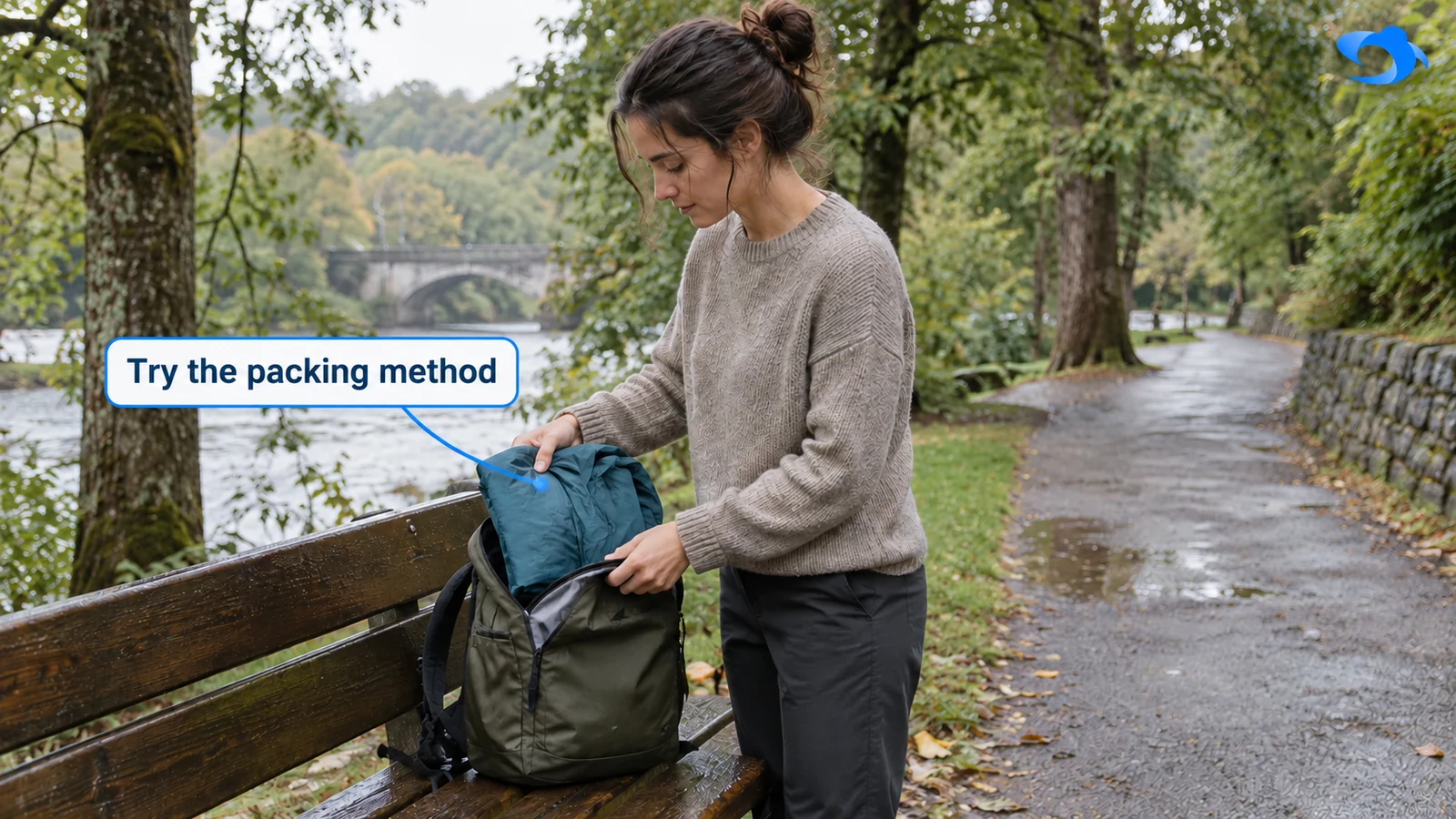
Check how the jacket reaches that packed size. Does it fold into a pocket, go into a separate bag or simply roll up? A self-stowing pocket removes one loose item but may make that pocket unavailable while packed. A separate pouch can be convenient, provided it is easy to keep with the jacket.
Try the packing method rather than judging the finished bundle in a photograph. It should not require forcing the zipper shut. Unpacking should also be manageable when the bag is full and the wearer is standing at a station or on a wet pavement.
| Packing arrangement | Useful feature | Potential inconvenience |
|---|---|---|
| Into its own pocket | No separate pouch to keep track of | The pocket may be unavailable while packed |
| Into a supplied pouch | A dedicated place for the folded shell | The pouch is another item to retain |
| Folded directly into a bag | No special storage component | The jacket needs enough accessible bag space |
Is a shell or a lined jacket better for travel?
A women’s lightweight waterproof jacket can be worn over a T-shirt on a mild wet day or over a sweater when it turns cooler. The shell stays the same while the warmth underneath changes. This is useful on journeys that move between walking outdoors, trains and heated buildings.
A fixed insulated jacket is more convenient when most of the trip will be cold and relatively inactive. Its disadvantage is that the insulation cannot be left behind separately when only rain protection is needed. A three-in-one gives that option, but the complete system still occupies space when both pieces are carried.
| Travel pattern | Option to consider | Check before choosing |
|---|---|---|
| Mixed temperatures and regular walking | Shell with separate layers | Fit over the warmest planned midlayer |
| Mostly cold weather and outdoor waiting | Insulated rain jacket | Comfort during indoor transitions |
| Changing conditions with both pieces needed | Three-in-one system | Packed bulk of the whole set |
| City trips where coverage takes priority | Longer raincoat | Actual packed size and seated movement |
A longer coat can cover more of a skirt or trouser seat. That does not automatically make it too bulky for travel, just as a short jacket is not automatically compact. Compare dimensions for the actual garments.
What can a compact jacket still get wrong in the rain?
A small packed size says nothing about seam sealing. Look at how rain is kept out around stitching, the front closure, pockets and the neck. A fabric’s hydrostatic-pressure result under ISO 811:2018 measures the tested specimen; it does not establish the performance of every opening in a finished jacket.
The hood deserves a moving check. Fasten the jacket and turn the head to both sides. The opening should remain positioned without covering the eyes or leaving the head exposed. Test the adjustment with the headwear or hairstyle normally used when travelling.
Try the cuffs over the intended sleeves, then reach for a bag. A closure that looks neat with the arms down may expose the wrist when reaching. The hem should also stay comfortable when sitting, especially if the jacket will be worn on transport.
How should it fit over a sweater and under a daypack?
Wear the bulkiest planned midlayer during the fitting. The jacket should fasten without pulling across the shoulders or hips, and the sleeves should permit a forward reach. Buying a larger size without checking the hood and sleeve fit can exchange one problem for another.
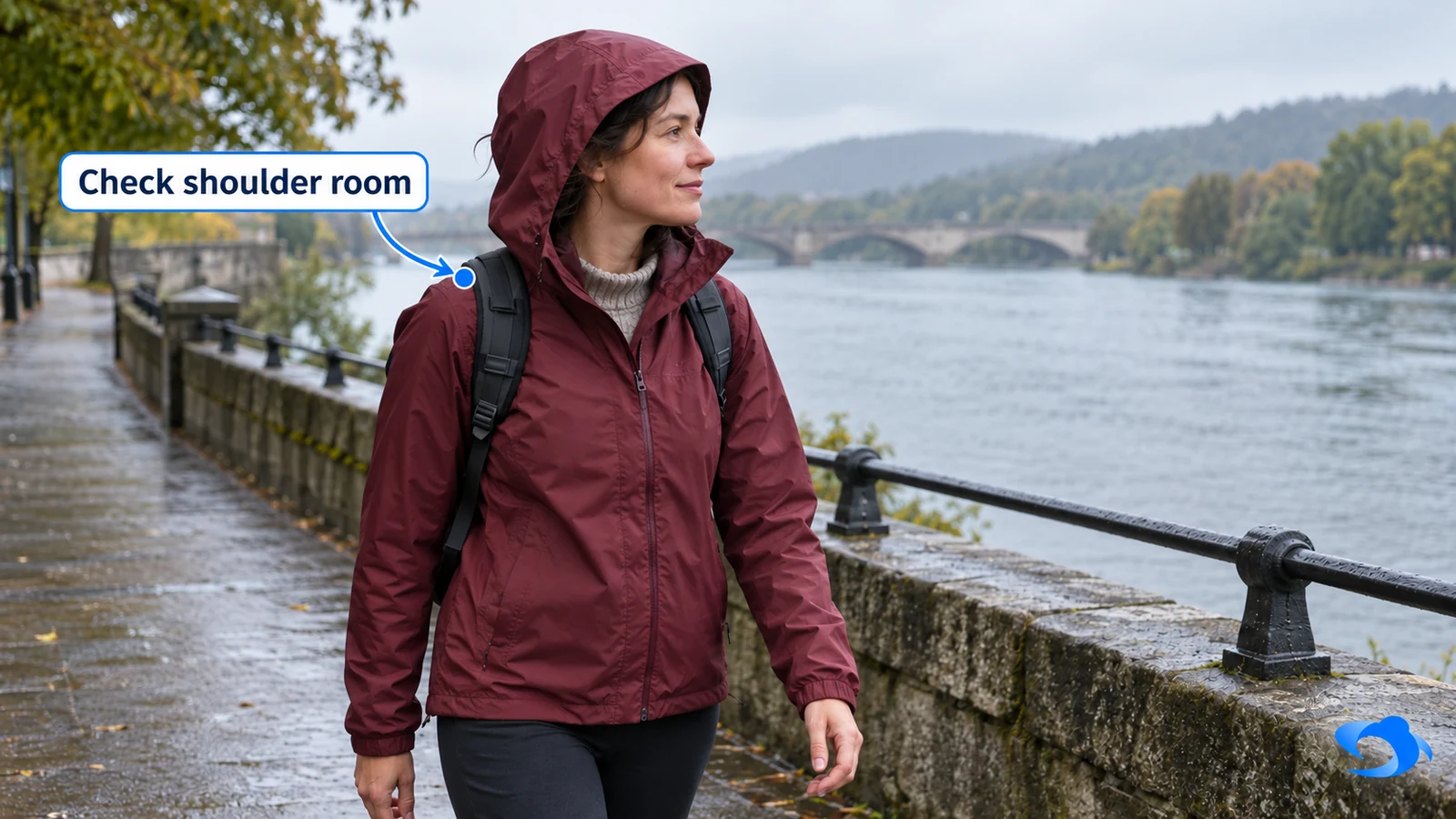
Put on the daypack with its usual contents. Check that pockets and adjustments remain accessible and that the hem does not lift excessively. A useful travel fit works while carrying luggage as well as while standing in front of a mirror.
The women’s commuting rain-jacket guide covers similar checks for stations, streets and everyday layers. Those are often the less glamorous parts of a trip where a jacket spends most of its time.
What happens when the jacket has to be packed wet?
A wet shell needs somewhere to go without soaking dry clothing. Keep it separate while travelling, then unpack it for drying at the next suitable opportunity. A tightly packed wet jacket should not be treated as ready for long-term storage.
Follow the garment’s care label for washing, drying and any approved treatment. Instructions for another waterproof fabric may not apply. The travel purchase should include this practical detail: where the jacket will dry, how it will be packed afterwards and whether a lost pouch can be replaced.
What should a supplier sample show before a travel range is ordered?
Yuelei Sports’ lightweight waterproof shell is positioned for travel and walking. The public photograph can show visible construction details, but it cannot establish packed dimensions or garment weight. Those need to be measured for the proposed sample and size.
The custom rain-jacket options provide another route for discussing fit and closures. The listed 20,000 mm target is customizable and needs confirmation, rather than being a fixed result for every order. Compare quotations with the same pouch, materials and size requirements included.
For EU retail, confirm fibre-composition labels against the supplied material. A fabric test is separate from any PPE claim; ordinary private-use rainwear is not automatically protective equipment.
Can a packable rain jacket replace a regular travel coat?
What makes a waterproof jacket suitable for travel?
It needs to fit the bag, work over the intended layers and be useful when rain starts. Low weight is helpful only if the hood, seams and closures are also suitable.
Should a travel jacket have insulation?
Consider insulation for mostly cold, less active trips. A separate shell is easier to adapt when the journey includes warm transport and active walking.
Is a packable jacket waterproof enough for everyday showers?
Packability does not answer that question. Check the fabric evidence and finished construction, including seams and openings, against the likely exposure.
Which hood and cuff adjustments are worth checking?
Check whether the hood stays positioned during head turns and whether the cuffs remain closed while reaching. The adjustments should work over normal travel clothing.
Should it fit over a thick sweater?
Yes, if that sweater is part of the planned wardrobe. Test that combination directly instead of assuming a regular fit or a larger size will work.
Is a packable jacket better than a full-size raincoat?
It is usually chosen for carrying convenience; a longer raincoat offers more coverage. Compare actual size, weight and movement rather than the category names.
References
- ISO 811:2018: resistance to water penetration
- Regulation (EU) No 1007/2011: textile labelling
- Regulation (EU) 2016/425: PPE scope
Which jacket is most likely to leave the hotel?
The most useful women’s packable waterproof jacket is one that can be carried without much thought and worn without awkward compromises. Check the day bag first, then the packed dimensions, layering fit and rain-protection details. Include a realistic plan for carrying it wet and drying it afterwards. There is little value in saving a small amount of luggage space if the jacket is uncomfortable on the walk it was bought for. For a custom travel range, Yuelei Sports’ waterproof jackets offer a starting point. Request a sample, pack it in the intended bag and wear it with the intended layers before approving the order.