 Xiamen Yuelei Sports Co., Ltd.
Typischer Beschaffungsszenario: When a product manager in Rotterdam moved a new custom jacket from sketch to bulk request, the team approved a stylish sample over a T-shirt; during a dockside trial, sleeves pulled, the hood turned with the head and rain entered at the zipper. The root cause was a missing brief, untested layer plan and no acceptance checks. This guide shows how a buyer can turn an idea into an outdoor-ready specification and control fabric, branding, samples, grading and quality before committing inventory.
Zusammenfassung: Treat a custom jacket as a controlled product-development project. Start with end use, exposure, layers, size range and destination market; then specify shell and trims, approve movement and rain checks, grade the size set and document tolerances. ISO 8559-1 aligns body-measurement language, while ISO 811 tests water penetration rather than certifying a product.
What belongs in a custom jacket design brief?
A useful brief answers five questions before a factory quotes or patterns the garment: who wears it, where, for how long, over which layers and under what care routine? Record activity, weather, abrasion, mobility, pocket loads, closure and size range. Add the destination market and whether the garment is ordinary apparel or PPE.
Describe the intended result in observable terms. “Keep spray out during a 20-minute deck task” is a better starting point than “premium waterproof.” List the hood adjustment, cuff interface, hem coverage, vent locations, seam construction, zipper type and pocket access that make that result possible. A Men’s jacket brief should also state whether the block is for a straight, athletic or relaxed fit and what base and mid layers sit underneath.
When the brief covers wind and spray, buyers can compare a individuelle wasserdichte Regenschale reference with the women’s sailing jacket feature guide before freezing layer allowance.
How do you prevent a sketch from hiding the real cost?
Map cost drivers before approving styling: fabric construction, seam tape, zippers, cord locks, labels, decoration, reinforcement and packaging. A low quote can create higher total cost when trims fail, logos bleed in care or late size corrections strand stock. Keep styling separate from claims; a panel line is not evidence of waterproofing or durability.
Which fabrics and trims fit waterproof outdoor use?
Choose the fabric architecture from the activity. A coated woven shell may suit a light Windbreaker or intermittent rain layer; a membrane laminate may be selected when moisture-vapour management and a defined layer system matter. A Raincoat for prolonged wet exposure needs the whole water path reviewed: face fabric, coating or membrane, seam treatment, zipper, hood, cuffs and pocket openings. ISO 811 can compare water penetration under declared hydrostatic conditions, but a fabric result does not certify the finished garment.
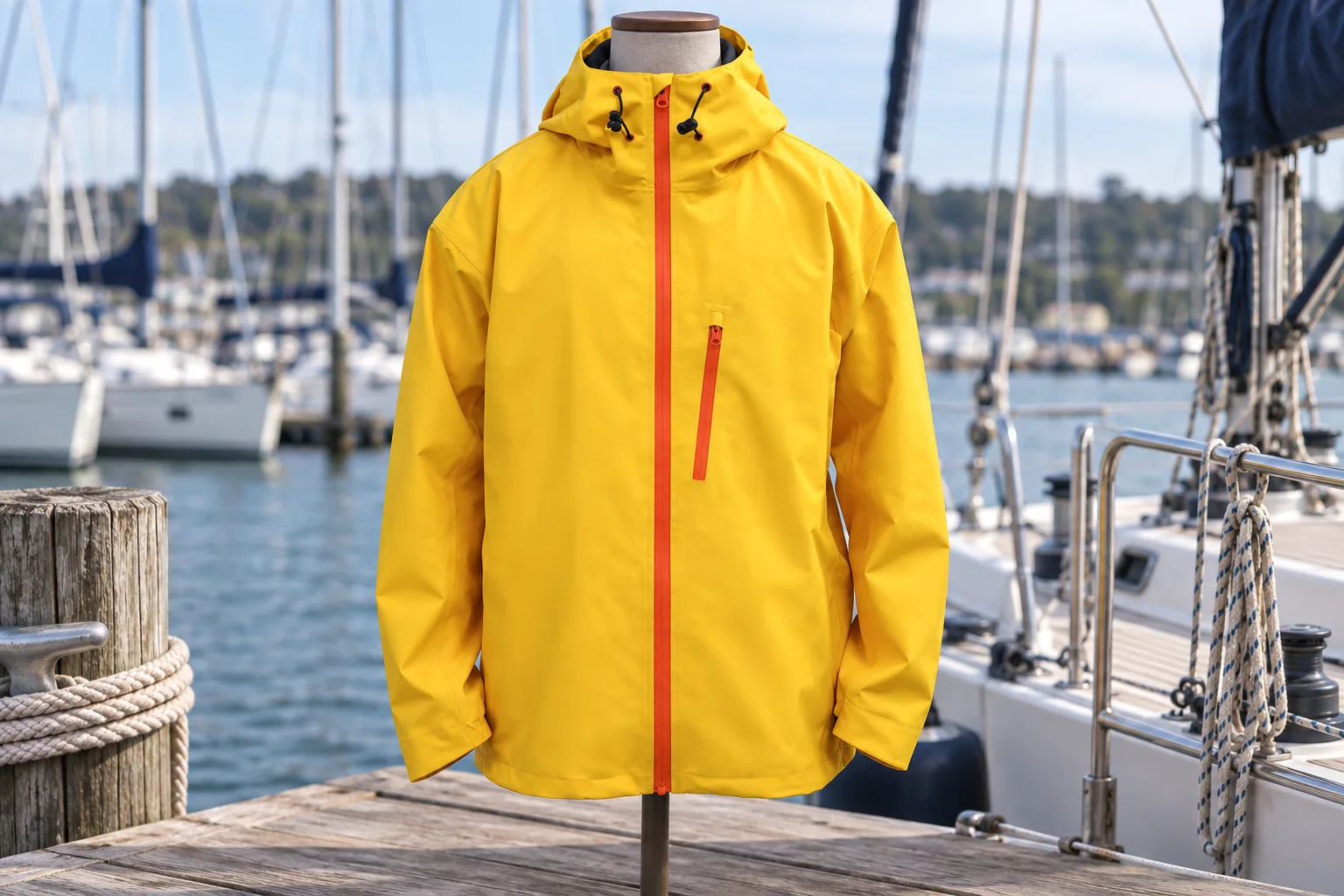
Ask for construction and care instructions with the material. ISO 11092 covers steady-state thermal and water-vapour resistance; compare results only when method, specimen and conditioning match. ISO 6330 provides domestic washing and drying procedures, but the buyer must state the selected procedure and properties to recheck.
| Design choice | What it can support | What procurement must verify |
|---|---|---|
| Coated woven shell | Simple wind and rain protection with familiar handling | Coating continuity, seam sealing, surface wetting and care response |
| Membrane laminate | More structured moisture-management specification | Layer construction, test method, seam tape compatibility and repair route |
| Lightweight knit or stretch panel | Reach and comfort in selected zones | Placement, snag risk, water-path interruption and recovery after care |
| Heavy reinforcement | Protection at elbows, seat, cuffs or pack contact points | Mobility, added weight, stitch density and colorfastness at joins |
How should logos, colours and branded trims be specified?
Branding is a production specification, not a late artwork upload. Supply vector artwork, approved color references, placement coordinates, maximum logo size, thread or ink preference and a wash-care expectation. A Design jacket range may use embroidery for a textured mark, heat transfer for fine detail, or woven labels where a removable component is useful; the right choice depends on fabric, stretch, abrasion and care.
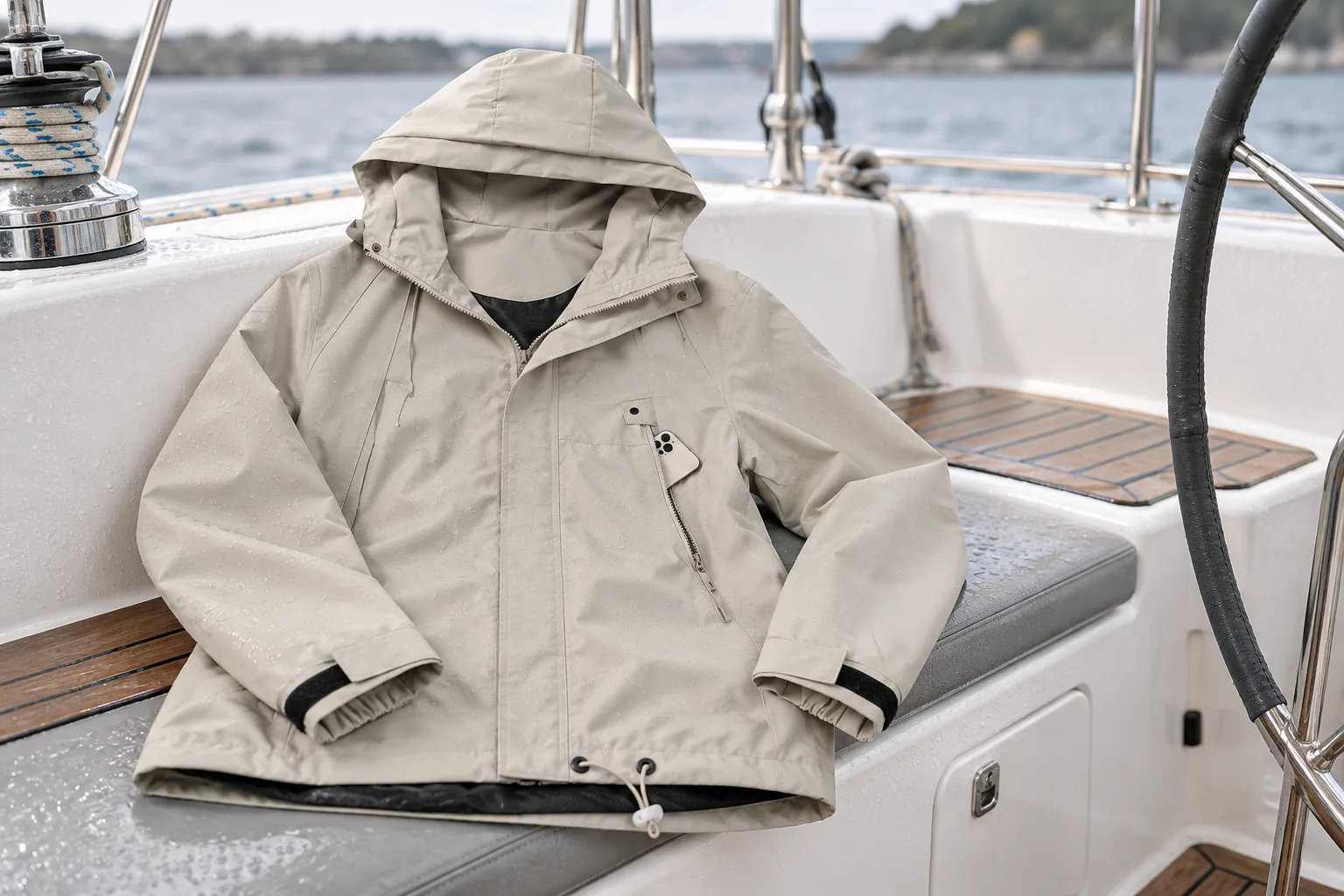
Request a trim card and decorated strike-off before the full sample. Check contrast, edge definition, registration, hand feel and placement over seams. Approve each color on the actual shell, and make no reflective, waterproof or abrasion-proof claim without finished-application evidence.
How do sample approval and size grading work?
Use gates rather than a single “looks good” approval. Gate one checks the paper pattern, measurement chart and construction callouts. Gate two checks a decorated sample on the intended layers. Gate three checks the pre-production sample, care label, packaging and inspection plan. Record every change by revision, photograph the approved details and identify the sample that controls production.
Fit testing should include reach, cross-body movement, bend, seated posture and head turn with the hood adjusted. Review sleeve, shoulder, hem, cuff and pocket access. ISO 8559-1 gives shared measurement terminology but does not replace a chart or wearer trial. Grade from a validated base size and inspect the full size set.
What quality checks protect the buyer after approval?
Translate the approved sample into a control plan: incoming fabric identity, shade and width; trim and logo verification; cut-panel matching; seam and tape workmanship; measurement tolerances; function of zippers, snaps and cords; final visual inspection; and packing count. Define sampling level and defect classes with the supplier. If waterproof performance is a requirement, state whether testing covers fabric, seams or the finished jacket and whether care or aging is included.
Which procurement dimensions change the right jacket?
| Dimension | Lower-complexity program | Higher-complexity program | Evidence to request |
|---|---|---|---|
| Use profile | Short, sheltered exposure | Long exposure, spray, abrasion or frequent movement | Scenario brief and movement list |
| Markenbildung | One label or restrained mark | Multiple placements, colors and trims | Artwork pack and strike-offs |
| Size range | One core block | Several body shapes and layer allowances | Measurement chart and graded set |
| Validation | Visual and measurement approval | Declared textile or finished-garment tests | Method, specimen, conditioning and report scope |
Which standards and rules apply to a custom jacket?
Match each standard to its scope: ISO 8559-1 for measurement terminology; ISO 811 for water penetration; ISO 11092 for thermal and water-vapour resistance; and ISO 6330 for domestic washing and drying procedures. These are methods, not automatic product certifications.
EU Regulation 2016/425 applies when the garment is placed on the EU market as PPE. The manufacturer or importer must determine risk category, conformity route, technical file and marking obligations. An outdoor Men’s jacket should not borrow PPE language from a fabric report; unsupported claims can trigger relabelling, withdrawal or returns.
What should a buyer do before approving production?
- Freeze the use case. Write exposure, movement, layers, care, destination and claim boundaries in the brief.
- Build a component map. Identify shell, lining, tape, zipper, cord, logo method and every water or abrasion interface.
- Approve evidence with the sample. Tie reports and observations to the exact material, construction and revision.
- Grade and inspect the range. Review the measurement chart and full size set, then set tolerances and defect classes.
- Protect the commercial file. Keep artwork, trim approvals, care labels, test scope and change history together.
Yuelei Sports presents itself as a B2B outdoor-apparel supplier; its public site shows Intertek tested and Alibaba verified badges. Those badges should be treated as company-level sourcing signals, while product-specific claims still require the relevant sample, construction and report evidence. Buyers can start with the Yuelei products directory, review the waterproof jackets range and send a technical brief for a sourcing discussion.
Custom jacket design FAQ
What information do I need before starting a custom jacket project?
Provide the use case, exposure, activity, layer plan, users, size range, artwork, care route, destination market and required evidence. State what the jacket must not claim. A complete brief reduces revisions and makes quotations comparable.
What is the difference between custom jacket design and private-label production?
Custom jacket design changes the brief, pattern, construction or components for a defined program. Private-label production may use an existing style with your label, colors or packaging. Ask which elements are configurable before comparing samples.
Which fabrics work best for waterproof or outdoor custom jackets?
There is no universal “best” fabric. Coated woven shells can suit intermittent rain; laminates may suit a controlled moisture-management specification. Select after reviewing water path, movement, abrasion, care and the supporting test method.
How do sample approval and size grading work for a custom jacket?
Approve the pattern and chart, then a sample on intended layers and a pre-production sample with trims and labels. Grade from the validated base size, inspect the full set and document tolerances; one sample cannot prove range-wide fit.
Can I add custom logos, colours and branded trims to a jacket?
Usually, subject to fabric, placement, artwork clarity and care requirements. Supply vector artwork and color references, then approve strike-offs on the actual shell. Confirm evidence for any reflective, waterproof or durability claim.
What should I ask a manufacturer about minimum order quantities and quality control?
Ask how order quantities vary by fabric, color, trim and size split, and request written assumptions. Also ask for the inspection plan, tolerances, defect classes, substitution controls and report scope. Yuelei Sports can review a defined brief through its contact page.
Hinweise
- ISO 8559-1, Größeangabe von Kleidung – anthropometrische Definitionen für die Körpergröße.
- ISO 811, Textilien – Bestimmung der Wasserdurchlässigkeit – hydrostatische Druckprüfung.
- ISO 11092, Textiles — physiological effects — thermal and water-vapour resistance under steady-state conditions.
- ISO 6330, Textilien – Hausmittel zur Wäsche- und Trocknung von Textilien für Prüfungen.
- EU-Verordnung 2016/425 on personal protective equipment, where the intended use makes it applicable.
Fazit
An outdoor-ready custom jacket follows a traceable chain from use case to fabric, trim, pattern, sample, graded measurements and inspection record. Confirm exposure and layers, choose construction and branding, validate movement and water-path details, then release against tolerances. Keep test methods distinct from certification and company badges distinct from style evidence. A Design jacket concept can become a repeatable range. Yuelei Sports can support the conversation through its products directory; send the market, size range and verification needs.