 Xiamen Yuelei Sports Co., Ltd.
When a representative procurement manager in Innsbruck approved a mixed order of ski jackets and trousers, the first fitting exposed a fast failure: sleeves rode up, trouser cuffs fought the boot, and a light snowfall became a returns queue. The reversal was useful. The issue was not simply a “bad brand”; the specification had not defined layer allowance, fit blocks, test conditions, care instructions or the buyer’s return process. For a distributor, resort operator or private-label team, the practical question is therefore not which logo looks most credible, but which supply model creates the lowest risk over its service life.
Summary: The best value in best skiing clothes brands is the combination of consistent fit, verified weather protection, repairability, manageable care, usable documentation and controlled returns. Ask suppliers how water penetration was measured (ISO 811), how breathability or thermal resistance was measured (ISO 11092), and under what conditions the garment was evaluated. A premium global label may make sense for technical staff; a mid-market line, private-label program or rental specification may create better total cost of ownership (TCO) for repeatable resort demand. Compare a sample, a size set and a care/repair workflow before committing.
Value is the operating result a buyer can verify, not a logo premium
Brand recognition can reduce search time, but it does not prove that a jacket will fit a particular customer group or leave room for layers. For B2B buying, define value across the garment’s life: first-pass fit, weather protection, care, repair options, documentation, return exposure and replacement cost.
Searches for reputable names, “top five” lists or the best skiing clothes brands often collapse several decisions into one label. A higher price may pay for design, distribution, marketing, retailer margin or after-sales support; it does not independently prove stronger fabric, better seam sealing or a more suitable fit. The same brand may also use different constructions across product lines and seasons. Treat reputation as a reason to investigate, not as performance evidence, and compare the exact style offered against the same written brief.
Waterproof and breathability figures are not interchangeable marketing scores. ISO 811 describes a hydrostatic-pressure approach to water penetration, while ISO 11092 describes measurements of thermal and water-vapour resistance under specified laboratory conditions. The method, specimen preparation, seam construction and finished-garment context matter. A fabric result cannot, by itself, describe a pocket, zipper, hood or stitched seam in wind-driven snow.
Surface wetting is a separate question. ISO 4920’s spray test addresses how a fabric surface wets; it does not replace hydrostatic testing or prove that a complete jacket is waterproof. Buyers should request the method, test date, laboratory identity where available, and whether results apply to fabric, a panel or a finished garment. That evidence is more valuable than an unqualified “10K” or “20K” label.
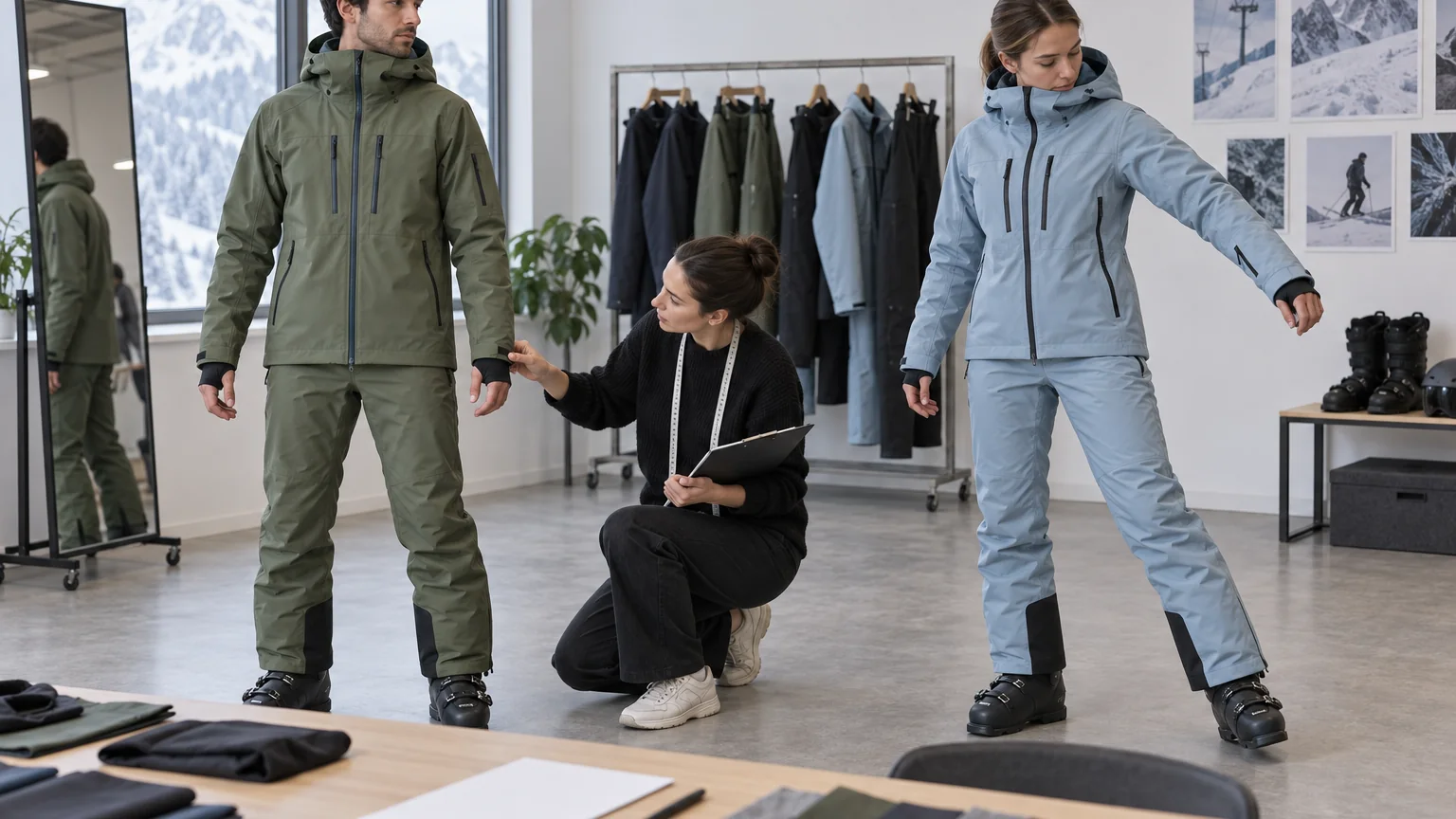
Fit consistency determines whether protection survives movement and layering
Fit is a performance variable because a shell that pulls open at the cuff, seat or front closure creates exposure even when its fabric test is strong. Use a repeatable size set rather than one approval sample. For each size, check four movements—reaching forward, crouching, rotating the torso and lifting a knee—with the intended base and mid-layer underneath. Record where the hem, sleeve and snow skirt migrate.
Fit blocks vary even when two garments carry the same nominal size. One range may be straighter through the torso, another more shaped at the waist, while sleeve length, rise and inseam grading can change independently. Consistency must therefore be checked both within a style and across repeat orders. Retailers should publish garment measurements and explain how to measure the body; distributors should also compare pre-production and bulk measurements against the approved specification before stock reaches the return channel.
Jacket and pant blocks should be evaluated separately. A jacket needs shoulder mobility, sleeve length over gloves and enough chest ease for insulation; a pant needs a boot-compatible hem, seated comfort, waistband security and room for a thermal layer without creating pressure points. Ask how the supplier maps body dimensions to sizes. EN 13402 provides a common language for body-measurement and size designation, but a label still needs a brand-specific measurement chart and graded pattern review.
For a distributor, fit consistency also means documentation. Keep a signed measurement chart, graded spec, tolerance ranges and approved “golden sample” photographs. When a factory changes fabric, seam tape or insulation, repeat the critical movement checks; small construction changes can alter drape and layer allowance. This process reduces avoidable returns and gives customer service a fact-based answer when a buyer compares two skiing clothes brands.
Repairability is part of fit economics. Replaceable pulls, accessible seam-tape repair, documented wash limits and a route for defective components can extend usable stock. A cheaper garment may cost more when repairs delay fleet turnaround.
Set and modular systems solve different demand patterns
A jacket-and-pant set simplifies merchandising, grading and first-time outfitting. It also makes color, branding and size coordination easier for a resort program. The risk is compromise: a customer may fit the jacket but need a different pant rise, inseam or protection level. Sets are less efficient when only one piece needs replacement.
The shell-versus-insulated choice is equally practical. An insulated jacket reduces the number of decisions for an occasional resort user and can simplify rental handover, but its warmth is less adjustable and a damaged outer may remove the insulation from service too. A shell paired with separate insulation supports changing activity and weather and allows individual pieces to be replaced; it also depends more heavily on correct sizing, layer education and compatible cuffs, hems and hoods. Neither architecture is automatically the higher-value choice.
Modular layers separate the shell from insulation and base-layer choices. That approach can serve distributors selling across climates, because the same shell can be paired with different mid-layers. It usually increases SKU complexity and requires clearer care instructions. Buyers should model the inventory effect: two shell colors, three sizes and two insulation options already create twelve combinations before gender, youth sizing or spare units are added.
Thermal claims need the same discipline as waterproof claims. ASTM F2732 is a practice for determining thermal ratings of cold-weather protective clothing under defined conditions; it is not a promise that every user will feel the same warmth. NOAA and CDC cold-stress guidance both emphasize exposure, wind, moisture, activity and individual condition. A modular system can manage these variables better, but only if the sales documentation explains when to add or remove a layer.
Supply model changes the risk profile more than the advertised performance tier
Premium global brands may provide mature size charts, service policies and dealer support. Their value can be strongest where staff need predictable replacement and a visible consumer proposition. Buyers should still verify the season, construction and regional return terms rather than assume every line shares one specification.
Older-season and outlet stock can improve acquisition cost, but only after checking continuity risk. A discontinued colour, changed fit block or unavailable replacement pant can fragment a staff fleet or leave a retailer with unmatched sizes. Warranty eligibility, authorized-channel status, return windows and access to care instructions may also differ by seller or region. Before treating a discount as value, confirm exact style and season identifiers, spare inventory, replacement compatibility, repair route and the documents that will remain available after the stock clears.
Mid-market outdoor brands often balance recognizable design with broader price accessibility. They can suit distributors serving mixed ability levels, provided the buyer checks whether a “waterproof” claim refers to a tested finished garment or a fabric description. A value or private-label supplier can be more adaptable on colors, labels, pack ratios and minimum order quantities, but the buyer must put test methods, tolerances, change control and corrective action into the purchase specification.
Rental and resort programs optimize for repeat handling, fast drying, cleanability and repair workflow rather than fashion-season novelty. A rental manager should log damage by location, wash cycles, lost accessories and average days out of service. Those operating data are usually more useful than a headline brand ranking. No category is objectively best; the right choice is the one whose evidence and service process match the use case.
Comparison should expose the cost drivers a brand page leaves out
The table below is a decision framework, not a ranking. It compares where value can appear and what evidence a B2B buyer should request before approval.
| Supply model | Where value may come from | Typical watch-outs | Evidence to request |
|---|---|---|---|
| Premium global brand | Established fit blocks, service network, recognizable sell-through story | Seasonal changes, regional returns, premium logo cost | Current size chart, garment-level test context, repair and warranty terms |
| Mid-market outdoor brand | Balanced assortment, accessible retail story, broad applications | Claims may vary by collection; fewer customization options | Style-specific construction sheet, care label, seam and closure details |
| Value or private-label supplier | Specification control, label/colour flexibility, direct sampling | Documentation gaps, change-control risk, minimum-order exposure | Approved sample, graded spec, test plan, defect and corrective-action process |
| Rental or resort program | Fleet standardization, repair loop, predictable replacement planning | High wash and abrasion load; inventory loss and hygiene costs | Wash protocol, repair workflow, spare ratio assumptions, usage log template |
The best application choice depends on weather exposure, layer allowance and service cost
Use the second table to turn a broad search for the best skiing clothes brands into a scenario decision. “Cost” refers to the cost drivers that should be modelled; it does not imply a universal price band or performance guarantee.
| Application | Fit and layer priority | Protection and care questions | TCO focus |
|---|---|---|---|
| Occasional resort skier | Forgiving jacket ease; pant waist and boot hem that tolerate borrowed layers | Can the user wash and reproof it correctly? Are instructions clear? | Returns, rental alternative, low-use storage and resale value |
| Frequent resort staff | Movement allowance for repeated bending, lifting and radio use | Are high-wear panels repairable? Is the finished garment tested? | Downtime, spares, repairs, laundering and replacement cycle |
| Distributor or private label | Consistent graded blocks across a range; documented tolerances | Can claims be traced to ISO 811, ISO 11092 or another stated method? | MOQ, sample approval, change control, claims handling and returns |
| Rental fleet | Simple size architecture; room for base layers and varied body shapes | Wash-cycle limits, drying time, seam inspection and hygiene process | Utilization, repair labour, lost accessories and stock availability |
The decision fork should be explicit. An occasional skier can prioritize forgiving fit, clear care and low return risk for a small number of resort days. A frequent skier should give more weight to movement, modular layering, repair access and replacement continuity. A rental or resort buyer needs fast inspection, laundering and spare-stock routines, while a retailer or distributor must also control grading, seasonal continuity, claim documentation and the commercial cost of unsold or returned sizes.
Standards protect the comparison only when their scope and conditions are stated
ISO 811, ISO 11092 and ISO 4920 are test methods or measurement standards with defined scopes; they are not Yuelei certifications, and they do not make a garment universally waterproof, breathable or warm. EN 343 is a protective-clothing framework for rain protection and breathability classes in the applicable European context. A buyer should confirm the current edition, intended market and whether a claimed class applies to the exact finished product.
Commercial documents should distinguish a laboratory result, supplier declaration and certification issued under a conformity scheme. Unsupported claims can create chargebacks, advertising exposure, customs questions or returns. Destination market, product category, labelling and marketing wording determine the obligations. Keep the specification, test reports, fibre and care information, risk review and version history; never copy a standard number without verifying its scope.
Weather guidance is also part of responsible selling. NOAA’s cold-weather guidance and CDC/NIOSH cold-stress resources make clear that wind, moisture, exposure time and activity alter risk. A clothing description should explain intended use and layering boundaries rather than imply a single temperature guarantee.
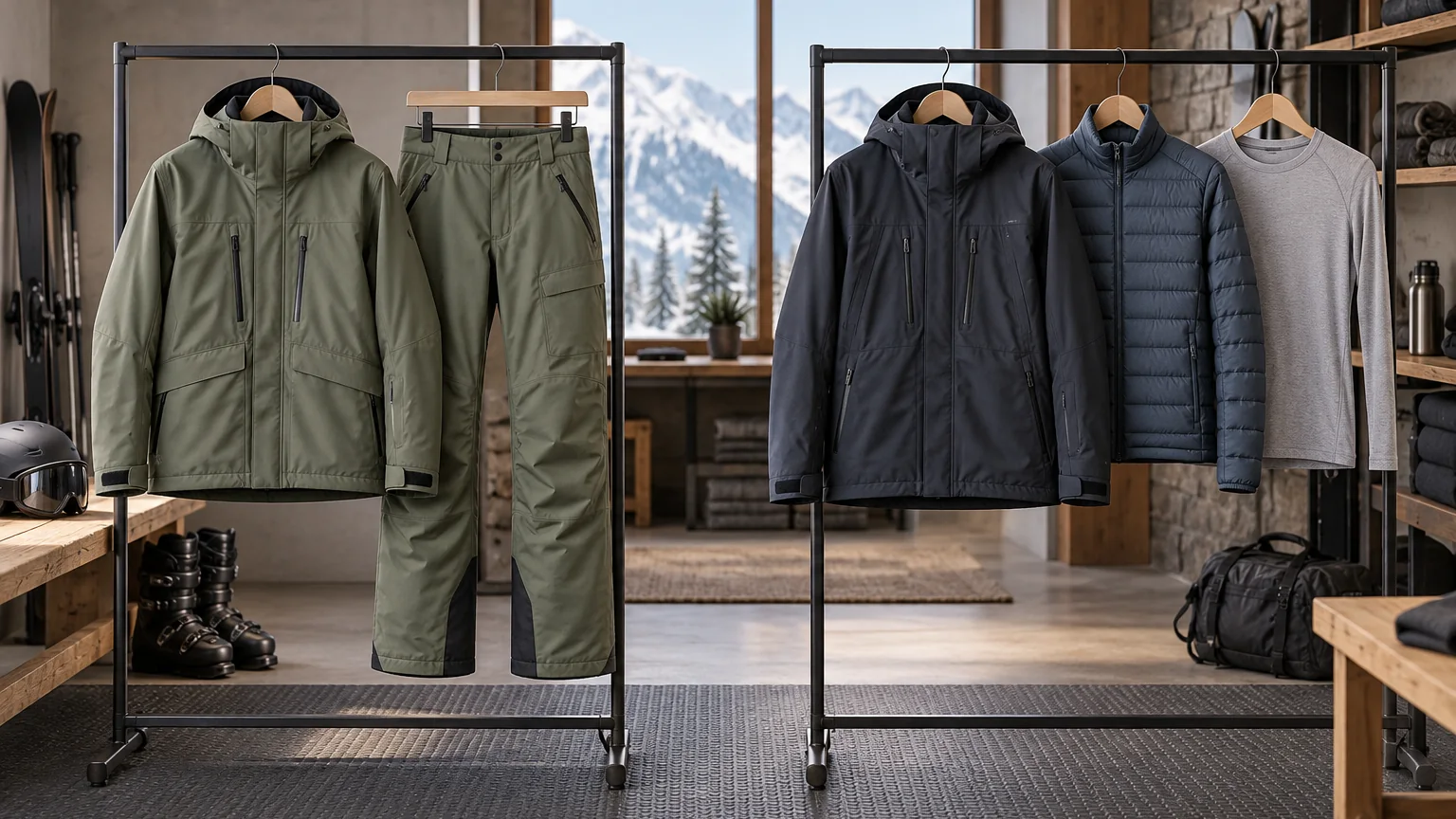
A disciplined sample process makes a brand comparison actionable
- Write the use case first. State resort, backcountry, staff, rental or retail use; expected weather; base and mid-layer; care route; and target replacement cycle.
- Request comparable evidence. Ask for the method, conditions and specimen or garment scope behind water, vapour and thermal claims. Reject a spreadsheet that lists numbers without test context.
- Approve a size set, not a single sample. Check the smallest, middle and largest planned sizes through the four movements, boot interaction and layer allowance. Record tolerances and sign a golden sample.
- Model service cost. Include freight, inspection, returns, washing, repairs, spare parts, downtime and disposal. For a rental fleet, use a simple log before expanding the range.
- Put changes under control. Require written approval before changing fabric, seam tape, trims, insulation, labels or grading. Retest any change that could affect protection, fit or care.
For buyers evaluating best skiing clothes brands for private label or distribution, Yuelei Sports can be included at this evidence stage rather than treated as an automatic winner. Its range can be reviewed through the ski suits category and ski jackets category. A skiing clothes outlet may emphasize clearance price, while a B2B shortlist must compare continuity, documents and change control. The best brand for skiing clothes is therefore the one that meets the approved brief and service model—not a universal name.
Where a buyer needs a defined brief, a custom waterproof ski suit discussion can clarify which elements are configurable and which claims still require project-specific verification. This is a sourcing conversation, not a certification claim.
Buyers get a clearer answer when they ask six practical questions
Which skiing clothes brands are best for beginners?
For beginners, the most suitable option is usually the one with a forgiving fit, clear care instructions, easy returns and enough weather protection for the planned resort conditions. A familiar premium label may help with retail confidence, but a well-documented mid-market or rental option can be better value. Compare the size chart, layer allowance and support policy before the logo.
What should I compare besides the brand name when buying ski clothing?
Compare finished-garment construction, fit blocks, test methods, care burden, repair route, documentation, minimum order, lead time and returns. Ask whether water and vapour results are fabric or garment results and whether the stated method is ISO 811, ISO 11092 or another named procedure. These details expose TCO risk more reliably than reputation alone.
Are expensive ski brands always more waterproof and breathable?
No. Price can reflect design, distribution, warranty or brand positioning rather than a directly comparable test result. Waterproofness and breathability depend on method, conditions, seams, closures and garment construction, so request comparable evidence before inferring performance from price.
Which ski clothing features matter most for occasional resort skiing?
Prioritize a comfortable layer allowance, a boot-compatible pant hem, a hood and cuff system that work with the user’s helmet and gloves, and care instructions that will actually be followed. For occasional use, return risk, storage and cleanability can matter more than an extreme-performance specification. Weather and activity should set the minimum protection brief.
How can I compare jacket and pant fit across different brands?
Use the same base and mid-layer, body measurements and movement checklist for every sample. Compare shoulder reach, sleeve coverage, waist security, seated comfort, boot interaction and hem movement, then record measurements against each brand’s chart. A signed size set is more reliable than comparing labels such as “large” or “regular.”
Is it better to buy ski clothing as a set or build layers separately?
A set can simplify assortment planning and first-time outfitting, while modular layers can adapt to more climates and replacement events. Choose a set when coordination and simple replenishment dominate; choose modular layers when users vary in activity, insulation need or geography. Model the added SKU and care complexity before selecting modularity.
References and the decision principle that holds up after the first season
- ISO 811:2018, Textiles — Determination of resistance to water penetration — Hydrostatic pressure test.
- ISO 11092:2014, Textiles — Physiological effects — Measurement of thermal and water-vapour resistance under steady-state conditions.
- ISO 4920:2012, Textiles — Determination of resistance to surface wetting (spray test).
- ASTM F2732, Standard Practice for Determining the Thermal Rating of Cold Weather Protective Clothing.
- CDC/NIOSH, Cold Stress; see also NOAA/National Weather Service cold-weather safety guidance.
The memorable rule is simple: best skiing clothes brands are not the brands with the loudest promise; they are the options whose fit, test context and service costs remain understandable after the first wash, first repair and first return. Confirm the use case, compare like-for-like evidence, approve the size set, then price the whole service life. To review a supplier brief or discuss a controlled range, contact Yuelei Sports with the target market, size architecture, layer plan and documentation required.