 Xiamen Yuelei Sports Co., Ltd.
Consider a realistic but hypothetical buying case. When a menswear buyer in Munich encountered a spike in fit returns, he added torso room to the next one-piece sample and approved it after a standing try-on. The revised suit looked correct on the rack, yet the sample immediately pulled at the crotch when the fit model reached for a binding and squatted. The apparent garment defect was actually a specification problem: chest ease had been increased, but back length, rise, seat volume and articulated movement had not been checked together. For a buyer, the real decision is therefore not whether an all-in-one silhouette looks warmer. It is whether one continuous garment can fit the intended body range, activity level and service expectations with fewer commercial failures than two separable pieces.
Quick Answer: A one-piece can reduce waist-level snow entry and eliminate the jacket-to-pant overlap decision, while a jacket-and-pants system usually offers easier venting, restroom access, mixed sizing and component replacement. The better choice depends on use, fit architecture and after-sales economics. Compare hydrostatic-pressure evidence under ISO 811, water-vapour resistance under ISO 11092, full-kit movement trials and an illustrative total-cost calculation per 100 units sold. Do not select the best men’s one piece ski suit from a membrane number alone; approve it only after checking torso length, rise, layering, access, wash durability and repair policy.
Does a One-Piece Reduce the Waist Gap Without Overheating?
The strongest functional argument for a one-piece is continuity. There is no jacket hem separating from the waistband when the wearer bends, falls or sits on a lift, so the system removes one common path for loose snow and drafts. That benefit matters in deep snow, windy lift rides and frequent falls. It does not prove that a suit is warmer overall: insulation mass, air permeability, cuff and hood adjustment, base-layer moisture and garment volume all influence comfort.
Active skiing and snowboarding create a variable heat load: the wearer may move hard, then remain still on a lift. Vent position and usable area therefore deserve the same attention as insulation. A continuous torso also prevents the upper shell from being removed separately. For a one piece ski suit mens program, specify vents that remain accessible with gloves and do not conflict with a pack belt.
ISO 11092 uses a sweating guarded-hotplate method to measure thermal resistance and water-vapour resistance under steady-state conditions. Its Ret result can help compare materials when the test setup is consistent; it is not a temperature guarantee for a finished suit in moving wind. Ask whether the report covers the shell laminate, a multilayer package or the finished garment, and record the test edition used.
How Should a Men’s One-Piece Ski Suit Fit When Moving?
A two-piece outfit lets the jacket and pants shift independently. A one-piece links shoulder reach to the seat and crotch, so an error in back length or rise can create tension elsewhere. Extra chest width may hide a standing-fit problem without solving dynamic reach.
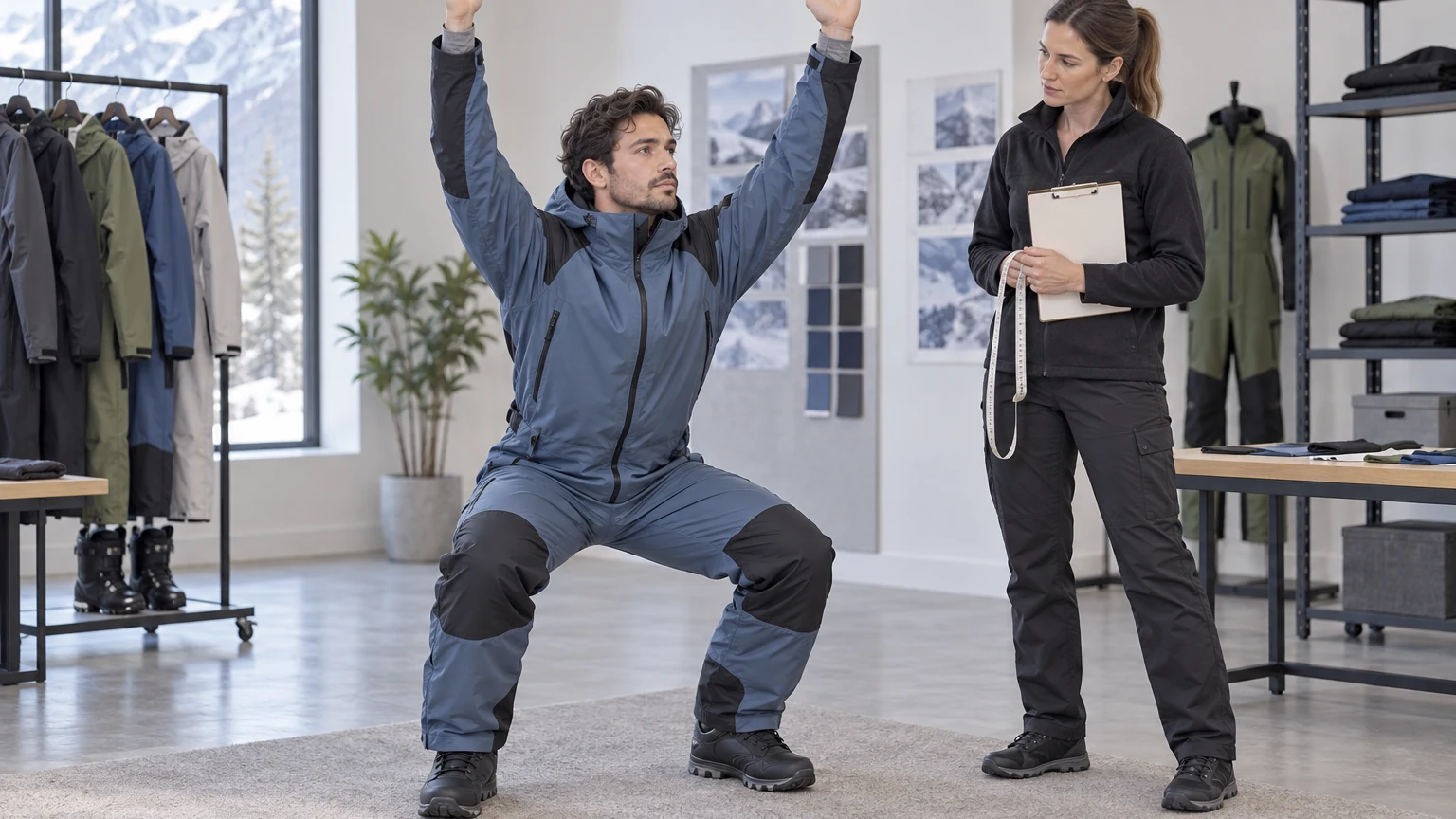
Run four full-kit checks over the intended base layers: arms overhead, binding reach, deep squat and seated knee lift. Inspect shoulder lift, sleeve withdrawal, crotch pressure, seat tension and hem position. Size approval should record chest, waist, hip, back length, body rise, inseam and sleeve, then link them to a defined body chart rather than a generic S–XL label.
The search phrase ski suit mens one piece may suggest a single fit answer, but men with the same chest can have different torso-to-leg proportions. Mixed or split sizing is easier with separate garments; a one-piece range may need more considered grading, long/regular options or a clearly limited target body profile. Base layers should sit smoothly without compressing insulation or preventing the wearer from completing all four movements.
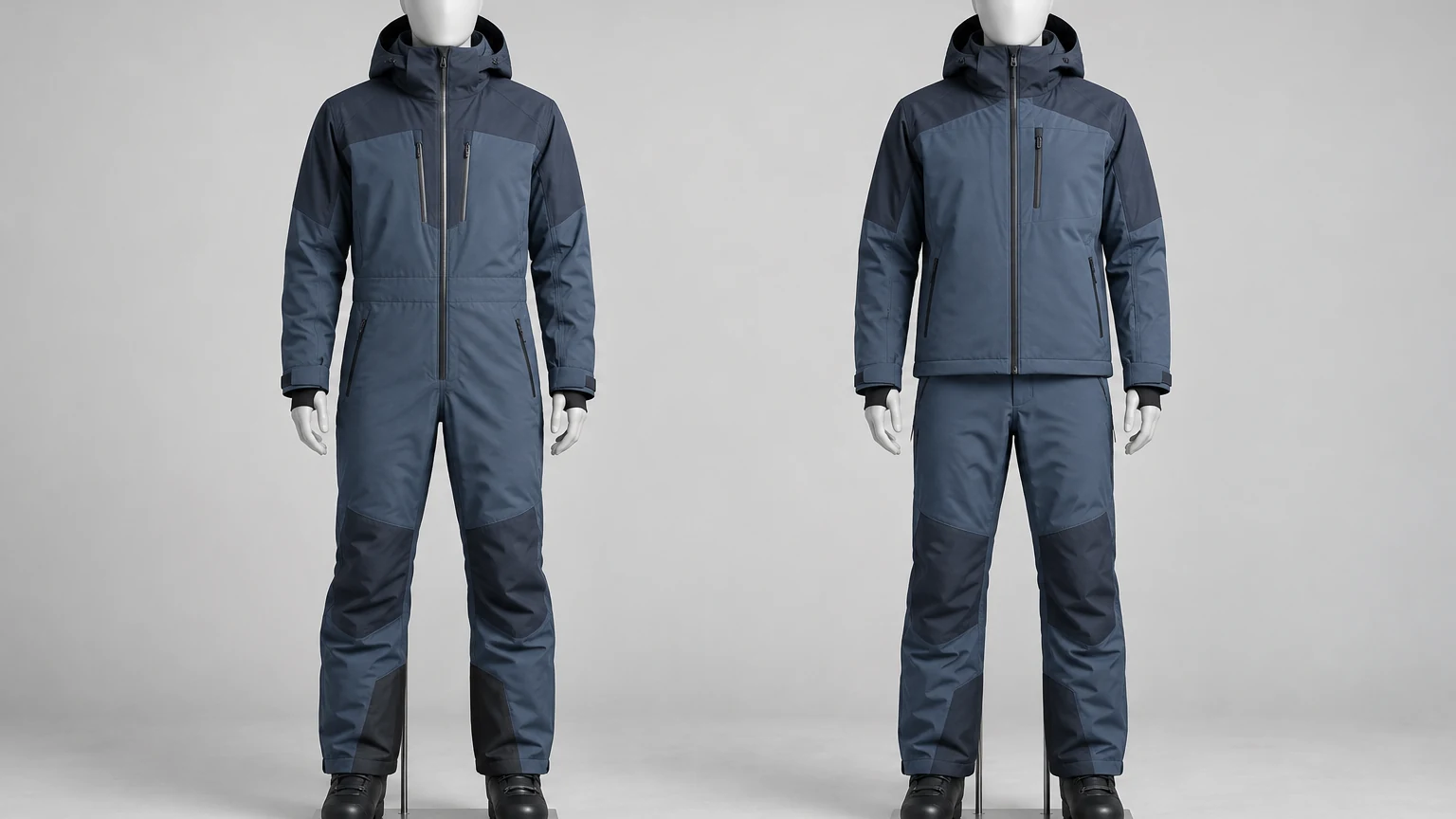
One-Piece vs. Two-Piece: Which Is Easier to Use and Service?
No format wins every dimension. The table separates physical trade-offs from commercial ones against an agreed use case.
| Dimension de la decisión | Men’s one-piece suit | Jacket plus pants | Verificación del comprador |
|---|---|---|---|
| Snow and draft continuity | No waist opening between jacket and pants | Depends on hem overlap, gaiter and bib/waist construction | Dynamic bend, fall-position and seated checks |
| Ventilación | Can vent well, but the upper shell cannot be removed separately | Upper and lower pieces can be adjusted independently | Map vent length, location, backing and pack interference |
| Mobility | Torso, rise and articulation operate as one pattern system | Pieces shift independently; overlap must remain adequate | Four-movement, full-kit fit protocol |
| Restroom and lodge access | More of the garment may need to be opened or lowered; internal straps and two-way openings can affect handling | Usually simpler because the jacket remains separate | Timed access trial with gloves and base layers; check fabric contact with wet floors |
| Size compatibility | One size must serve torso and lower body together | Different jacket and pant sizes can be paired | Review body-data distribution and grading tolerances |
| Repair and replacement | One damaged zone can place the whole garment out of service | One component may be repaired or replaced independently | Define spare trims, repair limits and component policy |
| Unit-cost tendency | One complex garment, long zippers and integrated construction | Two SKUs and two packaging/stock positions | Compare landed system cost, not ticket price alone |
| Returns and TCO | Potentially simpler outfit choice, but higher torso/rise fit sensitivity | More combinations, but easier mixed sizing and partial replacement | Calculate cost per 100 units sold using actual return and repair data |
Buyers can also review the separate Colección de chaquetas de esquí. Compare systems: one complete suit against a jacket and compatible pants, including packaging, size depth, markdown exposure and service handling.
Which Ski Suit Format Fits Your Application?
| Application or buyer profile | Likely starting format | Priority checks before approval | Main commercial risk |
|---|---|---|---|
| Deep-snow consumer line | One-piece worth sampling | Waist continuity, venting, hood, cuff and boot interface | Overheating or narrow torso/rise fit window |
| High-output snowboard or ski capsule | Either; ventilation decides | Reach, squat, seat, vent access and moisture-management evidence | Heat retention exceeding activity needs |
| Rental or team program | Two-piece often easier operationally | Mixed sizing, identification, wash cycles and replaceable parts | Whole-unit downtime after local damage |
| Fashion-led limited drop | One-piece can create a distinct silhouette | Target-body fit, access usability and honest performance claims | Returns driven by appearance-first size selection |
| Broad distributor assortment | Carry both if demand supports the size depth | Sell-through by climate, use and body profile | Fragmented inventory across color and size |
El best men’s one piece ski suit is not the style with the longest feature list; its use case, grading and service model must match the assortment. A buyer searching for the best one piece ski suit mens option should decide whether waist continuity justifies integrated sizing and whole-garment service exposure.
What Do Waterproof and Breathability Ratings Actually Prove?
ISO 811 determines a textile’s resistance to water penetration using hydrostatic pressure. A millimetres-of-water result is useful only when the method, specimen preparation, conditioning and endpoint are stated. A fabric value does not demonstrate that seams, zippers and pocket entries in the complete suit resist leakage; request fabric reports and a construction verification plan.
Breathability numbers are easy to miscompare. ISO 11092 reports water-vapour resistance (Ret), while other methods may report moisture-vapour transmission in mass per area per time. Ret and MVTR are not interchangeable. For the one piece ski suit mens specification, keep the method, units, laboratory, sample description and date beside every claim.
These are test methods, not product certifications. ISO 6330 specifies domestic washing and drying procedures used in textile testing; it can support a pre/post-care test plan but does not provide a universal consumer wash instruction. In the United States, the FTC Care Labeling Rule at 16 CFR Part 423 requires covered apparel to carry care instructions supported by a reasonable basis. Destination market, fibre content, trims and intended claims determine what additional rules apply.
What Should Buyers Check Before Approving a Sample?
- Congelar el caso de uso. Define climate exposure, activity intensity, expected layering, pack use and whether skiing, snowboarding or both are in scope.
- Approve movement and access together. Test the graded-size sample over full base layers, including the four movements and a restroom-access sequence. A custom men’s one-piece ski suit reference can frame the supplier discussion, but the purchase specification must state the required construction and evidence.
- Build a care protocol from verified components. Follow the final label, close fasteners and dry only as directed. Finish reactivation or renewal must follow the fabric/finish supplier’s instructions. Store the garment dry, clean, uncompressed and away from heat or sharp edges.
- Define repairability. Identify replaceable pulls, snaps, cuffs or panels; document which waterproof repairs need specialist equipment. A factory-custom ski jumpsuit discussion should include spare-trim availability, repair documentation and acceptable cosmetic variation after service.
- Model total cost. For each 100 units sold, use actual inputs: landed product cost + inbound inspection + return freight and handling + repairs + markdowns + replacements. This illustrative formula avoids invented prices and exposes whether mixed-size flexibility or component replacement changes the result.
Yuelei Sports is a China-based B2B outdoor sportswear solutions supplier. Translate the search taxonomy one piece ski suit mens into a tech pack covering pattern, venting, evidence, care labeling and service expectations; no test report is a blanket certification. Apply the same discipline when reviewing a ski suit mens one piece sample.
Preguntas frecuentes
Is a men’s one piece ski suit warm enough for active skiing and snowboarding?
It can be, but the one-piece format alone does not establish warmth. Match insulation, base layers, venting and wind/water resistance to the activity and conditions; active users may prioritize controllable vents over maximum insulation. ISO 11092 material results can inform comparison, while a full-garment field-use protocol remains necessary.
How should a men’s one piece ski suit fit over thermal base layers?
It should allow overhead reach, binding reach, a deep squat and seated knee lift without crotch pressure, shoulder restriction or sleeve withdrawal. Fit the intended base layers, and check torso length and rise as carefully as chest and hip circumference. The ski suit mens one piece size should not use extra width to compensate for insufficient vertical length.
¿Qué valores de impermeabilidad y transpirabilidad son los mejores para esquiar?
There is no universal best pair of numbers. The best evidence uses a named method, clear units, comparable conditioning and a sample description that distinguishes fabric from finished garment; ISO 811 hydrostatic pressure and ISO 11092 Ret address different properties. Higher claimed values do not replace seam, zipper, vent and wear-area review.
Is a one-piece ski suit more practical than a jacket and pants?
It is more practical when continuous waist coverage and a single coordinated garment outweigh mixed sizing, independent venting and partial replacement. A two-piece system is usually easier for restroom breaks and for replacing only a damaged jacket or pant. The best men’s one piece ski suit decision should therefore include returns and repair costs, not appearance alone.
¿Puedo usar un traje de esquí tanto para hacer snowboard como para esquiar?
Yes, provided the fit and construction support snowboard-specific reach, deep flexion and frequent seated contact with snow. Test the complete kit with boots, gloves and expected pocket loads. Check that vents and openings remain usable in riding posture.
¿Cómo puedo lavar y secar un traje de esquí sin dañar el revestimiento impermeable?
Follow the permanent care label and the validated instructions for the actual laminate, insulation, trims and water-repellent finish. Do not assume one detergent, temperature or dryer setting suits every garment; ISO 6330 is a laboratory procedure framework, not a consumer recipe. Close fasteners, rinse as directed, dry fully and renew finishes only when the responsible supplier’s instructions permit it.
Referencias
- ISO 811:2018 — Textiles — Determination of resistance to water penetration — Hydrostatic pressure test
- ISO 11092:2026 — Textiles — Measurement of thermal and water-vapour resistance under steady-state conditions
- ISO 6330:2021 — Textiles — Domestic washing and drying procedures for textile testing
- U.S. Government Publishing Office — 16 CFR Part 423, Care Labeling of Textile Wearing Apparel and Certain Piece Goods
Choose the garment architecture only after the body, movement, evidence and service model agree.
To develop or compare a B2B program, review Yuelei Sports’ ski suit category and contact the team with your target user, size range, test methods, layering plan and repair expectations.