 Xiamen Yuelei Sports Co., Ltd.

When a technical engineer in Portland ordered samples after watching a Micro Puff versus Nano Puff review, he expected the lighter jacket to win every test. During a windy stop, the team discovered that packability, warmth, shell feel, and layering space were different jobs; the failure was not the jacket. The selection model had compared a headline instead of a use case.
Resumen: Micro Puff and Nano Puff are designed around different insulation and use priorities; no universal winner exists. Buyers should compare warmth-to-weight, wet-weather behavior, shell durability, movement, pack size, care, and landed cost, then test the complete layer system in the intended climate.
A search for Men’s jacket options often collapses insulation, weather resistance, and style into one score. Patagonia’s published product pages are useful references, but model specifications can change by season; any B2B buyer should record the exact season, fill, shell, size, and care instructions before copying a benchmark into a private-label brief. Buyers should document Jaqueta para hombre in the specification so that sampling, testing, and replenishment use the same acceptance criteria. Buyers should document Jaqueta para hombre in the specification so that sampling, testing, and replenishment use the same acceptance criteria. Buyers should document Jaqueta para hombre in the specification so that sampling, testing, and replenishment use the same acceptance criteria. Buyers should document Men’s jacket in the specification so that sampling, testing, and replenishment use the same acceptance criteria. Buyers should document Men’s jacket in the specification so that sampling, testing, and replenishment use the same acceptance criteria. Buyers should document Men’s jacket in the specification so that sampling, testing, and replenishment use the same acceptance criteria. Buyers should document Men’s jacket in the specification so that sampling, testing, and replenishment use the same acceptance criteria. Buyers should document Men’s jacket in the specification so that sampling, testing, and replenishment use the same acceptance criteria.

1. What Does This Search Term Really Cover?
The Micro Puff family is known for a synthetic PlumaFill-style insulation concept that mimics down loft, while Nano Puff uses a more established synthetic insulation platform. The practical comparison is not the name; it is how each jacket handles wind, moisture, compression, abrasion, and repeated laundering within a planned layering system.
The honest answer is that a buyer is comparing a complete supply system, not a logo or a single fabric swatch. A credible brief separates design intent, material behavior, factory process, testing evidence, order economics, and post-delivery support; this prevents a low sample price from hiding a high total cost.
2. Which Technical Variables Decide the Result?
- Insulation: Warmth, loft retention, wet recovery, and compression
- Shell: Denier, weave, coating, and tear resistance
- Pattern: Arm mobility, hem drop, hood, and pocket access
- Care: Wash, dry, repair, and storage instructions
For a technical clothing program, we recommend setting an acceptance range before the first sample. ISO 13688:2013 provides a useful general framework for protective-clothing ergonomics and labeling, while ISO 9001 controls the quality-management process; neither standard replaces product-specific testing.
3. How Should Buyers Measure Performance?
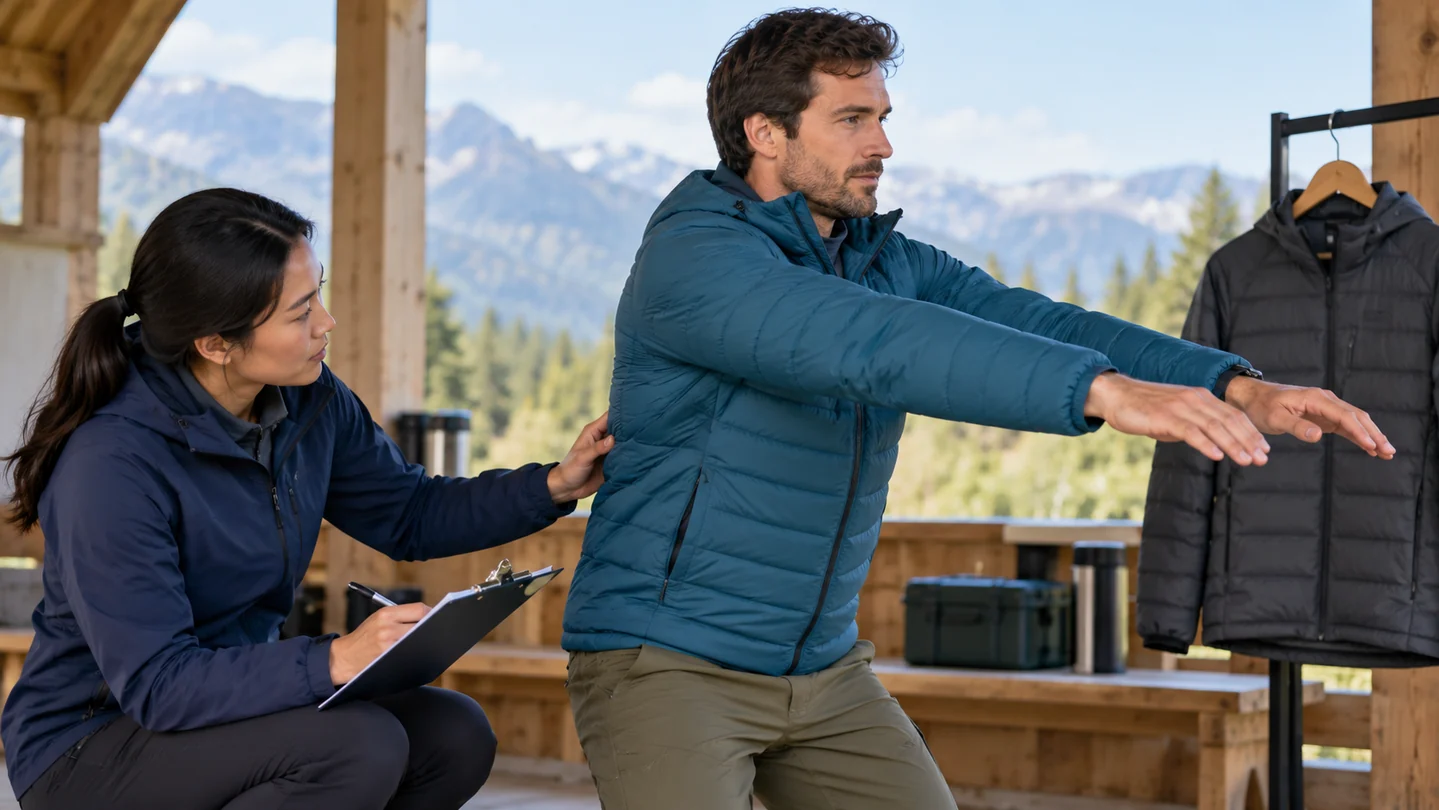
Use a small, repeatable scorecard rather than a subjective “looks premium” review. The numbers below are starting controls, not universal pass/fail limits; the buyer should adjust them for end use, target market, and risk.
| Control | Practical starting point | Por qué es importante |
|---|---|---|
| Warm-up test | 30-minute low-output stop in target wind | Shows cold spots |
| Pack test | Compress, unpack, and loft three times | Shows travel practicality |
| Wash test | At least 5 care cycles for pilot fabric | Finds insulation migration |
| Fit test | Three sizes with base and shell layers | Prevents return-heavy grading |
Testing at least three sizes and two production lots exposes grading, seam, and trim variation earlier than a single showroom sample. A 30-minute wear trial, a wash-and-dry cycle, and a documented measurement sheet are inexpensive compared with a relabeling or rework campaign.
4. Where Do Hidden Costs and ROI Appear?
Unit price is only one line in the business case. Buyers should model development samples, pattern changes, minimum order quantities, inspection, freight, duty, care-label revisions, claims, and the cost of tying cash in slow-moving sizes. The useful ROI question is: how many avoidable returns or production hours does a better specification remove?
| Cost or value lever | Low-control approach | Controlled approach | |
|---|---|---|---|
| Micro Puff-style brief | Very light, high packability | Requires careful shell and loft validation | Fast-moving outdoor capsules |
| Nano Puff-style brief | Familiar synthetic warmth and styling | May be heavier or less lofty | Everyday insulated layers |
| Down alternative | High warmth-to-weight potential | Wet recovery and sourcing controls | Dry cold climates |
A practical example: in a 1,000-piece order, reducing a 4% fit-related return rate to 2% prevents 20 returns. At a conservative USD 35 handling, inspection, and markdown cost per return, the direct saving is USD 700 before the value of customer trust and repeat orders. The same logic applies when comparing Men’s jacket suppliers.
5. How Do Common Options Compare?
Procurement teams often compare options that serve different jobs. The table keeps the trade-offs visible and helps the engineering, merchandising, and finance teams approve the same decision.
| Opcion | Strength | Trade-off | Typical buyer |
|---|---|---|---|
| Micro Puff benchmark | Lightness and packability | Verify abrasion and wet recovery | Fast-and-light users |
| Nano Puff benchmark | Versatile synthetic insulation | Check exact season specs | General outdoor users |
| Heavy insulated jacket | Stationary cold protection | Bulk and overheating | Belay or expedition stops |
| Shell plus mid-layer | Flexible weather system | More pieces to manage | Guide and fleet programs |
There is no universal winner. The correct choice is the one whose performance, documentation, capacity, and replenishment plan match the user scenario and the commercial forecast.
6. Which Market or Application Matrix Fits?
Regional rules, climate, labor requirements, and channel expectations change the specification. A matrix is more reliable than copying a factory brief from one market into another.
| Market or use case | Specification emphasis | Commercial checkpoint |
|---|---|---|
| Wet shoulder season | Synthetic insulation and fast drying | Test loft after wash |
| Dry cold | Warmth-to-weight and wind seal | Check layer volume |
| Urban commute | Pocket, hem, and style consistency | Retail price architecture |
| Guided outdoor fleet | Repairability and size range | Spare-part and care plan |
Where a retailer sells across borders, the technical file should identify the country of origin, fiber content, care symbols, restricted substances position, and responsible economic operator. This is also where a responsive supplier earns its value: the same base pattern can be adapted without losing traceability.
7. Which Standards and Compliance Checks Apply?
Standards do not make an untested product safe by themselves, but they give buyers a common language for risk and evidence.
- ISO 13688:2013 for general protective-clothing ergonomics and information where applicable.
- ASTM D5034 or an equivalent tensile method for textile material comparison where specified by the buyer.
- ASTM D1424 or an equivalent tear method for shell development where abrasion and tear risk matter.
- FTC Care Labeling Rule for U.S. care instructions when selling into the United States.
Non-compliance can lead to customs holds, marketplace delisting, forced relabeling, recalls, contract penalties, or insurance disputes. We recommend keeping a technical file with the bill of materials, approved sample, test reports, size chart, care label, packaging marks, and change-control record; every revision should have an owner and date.
8. How Should a Buyer Select a Supplier and Avoid Mistakes?
- Record the exact benchmark model and season; do not copy a retailer description into a factory tech pack.
- Specify insulation weight, shell fabric, quilting, seam construction, and target base-layer thickness.
- Run wet, wind, pack, wash, and movement trials with the same test panel.
- Compare total cost of ownership, including repair kits, replacement trims, returns, and warranty handling.
- Use a clear market statement: warm layer, wind layer, or complete cold-weather jacket; avoid unsupported universal claims.
Yuelei Sports provides B2B outdoor clothing programs with configurable fabrics, patterns, trims, waterproof constructions, and inspection checkpoints; the buyer should request the finished-model evidence and target-market labeling before approving a purchase order. For outdoor programs, a relevant starting point is the ski-jacket collection or the dry-suit platform, depending on the brief.
9. FAQ and References
Which is warmer, Micro Puff or Nano Puff?
Warmth depends on the exact model, insulation weight, fit, wind, and layers. Buyers should compare published specifications and then test both systems in the target conditions.
Is synthetic insulation better than down?
Synthetic insulation usually recovers better after moisture, while down can deliver high warmth-to-weight in dry conditions. The channel, climate, and care plan decide.
Can these jacket designs be private labeled?
A buyer may develop a comparable performance brief, but trademarks, protected designs, and proprietary materials must be respected; use an original pattern and documented bill of materials.
How should an insulated jacket fit?
It should allow the planned base and mid layers without compressing insulation, while keeping cuffs, hem, and hood close enough to reduce drafts.
What makes a good B2B jacket benchmark?
A good benchmark has a recorded model, test conditions, measurement sheet, care cycles, target cost, and a clear reason the buyer wants to reproduce the user experience.
Referencias
- Patagonia – Men’s Micro Puff product reference
- Patagonia – Nano Puff product reference
- FTC Care Labeling Rule
- ISO 13688 protective clothing
The best jacket comparison is a controlled field test with a known layer system, not a louder product adjective.
When a purchasing team treats Men’s jacket as a measurable system rather than a buzzword, every later decision becomes easier to audit. Yuelei Sports builds that complete B2B specification around the real use case; buyers can review the product range or contact the team to convert performance, sizing, compliance, and delivery requirements into a repeatable program.