 Xiamen Yuelei Sports Co., Ltd.
When a technical engineer in Minnesota encountered a wader selection dilemma for a winter fishing and marsh-use product line, he had already reviewed size charts, compared supplier quotations, and approved samples that looked reliable in a clean showroom test. Within the first cold-weather retail cycle, however, field users reported cold feet, boots pulling loose in mud, inconsistent fit, and higher-than-expected returns from customers using the products in freezing bank-fishing conditions. The twist was that the waders were not simply poor-quality products; the technical specification had not been matched to the real terrain, temperature, and user behavior.
Summary: For mud and freezing temperatures, bootfoot waders are usually the more practical choice because integrated boots reduce mud suction problems, simplify sizing, and can support insulated boot construction. Stockingfoot waders are often better for rocky streams, long-distance walking, and flexible boot replacement. We recommend choosing by environment, user skill level, boot insulation, seam construction, and total cost of returns. Buyers should verify waterproof performance through standards such as AATCC TM127, ISO 811, ASTM D751, and ASTM D1683.Outdoor waders are not only apparel; they are waterproof performance systems. A chest wader with boots combines garment, boot, seam sealing, outsole, insulation, and size grading into one product. A stockingfoot wader separates the waterproof body from the external boot system, giving users more mobility and boot choice but also increasing sizing and usage complexity.According to the Outdoor Industry Association, outdoor recreation continues to represent a large consumer market with strong participation across fishing, paddling, hunting, and cold-weather outdoor activities. For B2B buyers, this matters because waders are not purchased only for comfort; they are purchased to reduce field complaints, prevent retail returns, and protect distributor reputation.
1. What Is the Technical Difference Between Bootfoot and Stockingfoot Waders?
The main difference is the lower-leg and footwear structure. A bootfoot chest wader has waterproof boots permanently attached to the wader body, while a stockingfoot wader has soft waterproof or neoprene sock-style feet that require separate wading boots.
Bootfoot wader structure
A bootfoot system usually includes:
- Waterproof upper body fabric
- Seam-taped or welded construction
- Integrated rubber, PVC, EVA, or composite boot
- Internal boot lining or insulation
- Outsole pattern for mud, sand, or mixed terrain
- Boot-to-leg joint reinforcement
In mud and freezing conditions, the integrated design removes one common failure point: the separate boot. When a user steps into sticky mud, the boot and wader move as one piece, which reduces the chance of footwear pulling loose.
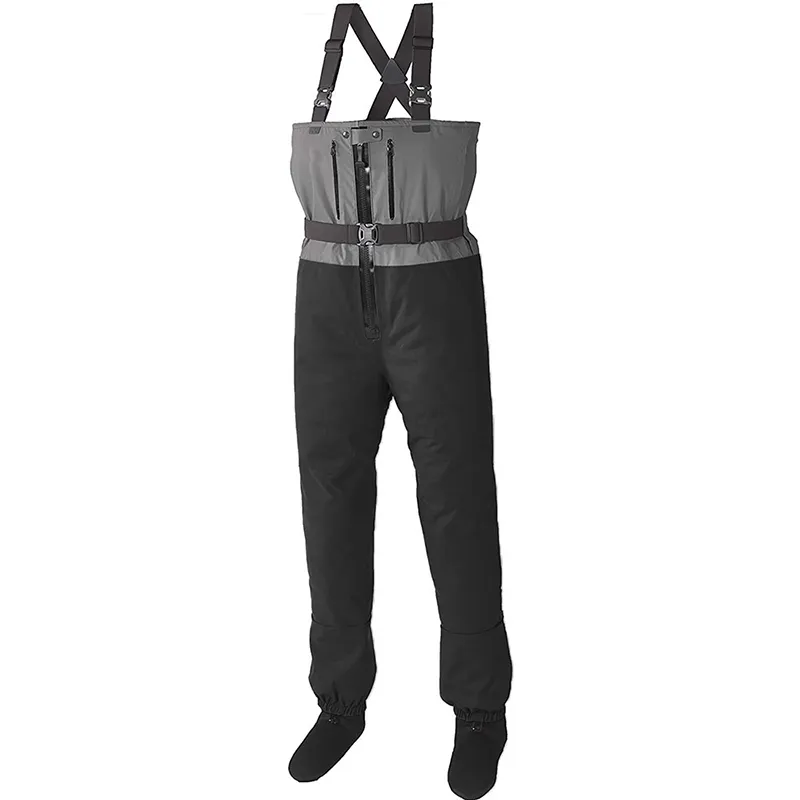
Stockingfoot wader structure
A stockingfoot system usually includes:
- Waterproof upper body fabric
- Attached neoprene or waterproof stocking feet
- Separate wading boots
- External lacing or BOA-style closure depending on boot type
- Optional gravel guards
- Separate sock and insulation layers
This system gives advanced anglers better control over traction, ankle support, and boot replacement. However, it also creates more variables. For cold or muddy retail customers, the wrong boot size, wrong sock thickness, or poor lacing can cause discomfort and returns.
Technical standard reference
Waterproof textile performance is commonly evaluated through standards such as:
- AATCC TM127 for hydrostatic pressure water resistance
- ISO 811 for resistance to water penetration under hydrostatic pressure
- ASTM D751 for coated fabric performance
- ASTM D1683 / D1683M for seam strength
These standards do not decide whether bootfoot or stockingfoot is better, but they help buyers verify whether the fabric, coating, and seams are suitable for demanding waterproof applications.
2. Why Bootfoot Waders Usually Perform Better in Mud
Mud creates suction. In ankle-deep to calf-deep mud, approximately 6–12 inches / 15–30 cm, every step can generate pulling force around the boot. This is one of the main reasons bootfoot waders are often preferred for marshes, muddy riverbanks, duck hunting areas, pond maintenance, and freezing bank fishing.
Why integrated boots help
A chest wader with boots reduces mud-related failure because the boot cannot separate from the wader. There is no loose wading boot to pull off, no lace system to clog with mud, and no gap between the stockingfoot and external boot where mud can enter.
For distributors, this matters because mud complaints are rarely simple comfort complaints. They often become:
- Return requests
- Retail staff complaints
- Negative product reviews
- Warranty disputes
- Repeat-purchase loss
Outsole and boot stiffness
Mud performance also depends on outsole geometry and boot stiffness. A soft boot may feel comfortable in the store but may collapse or twist in mud. A more structured boot may help users pull free more safely.
| Boot Feature | Mud Benefit | Buyer Risk if Ignored |
|---|---|---|
| Deeper tread pattern | Better grip in soft mud | Slipping and instability |
| Wider sole base | Better weight distribution | Foot sinking and fatigue |
| Reinforced ankle zone | Improved pulling support | Boot deformation |
| Easy-clean outsole | Faster mud removal | Poor retail after-use experience |
| Integrated boot design | Lower separation risk | Fewer mud-related returns |
Technical buying implication
For muddy use, the question is not only “Is the fabric waterproof?” It is also “Can the footwear system survive repeated suction, bending, and cleaning?” A bootfoot chest wader is often the safer default for mud because it reduces user assembly mistakes.

3. Why Bootfoot Waders Often Work Better in Freezing Temperatures
When temperatures approach 32°F / 0°C, the foot area becomes one of the most important performance zones. Cold feet are a leading reason users stop fishing, hunting, or working in wet outdoor conditions.
Boot insulation and internal volume
Bootfoot waders can be designed with boot insulation more directly integrated into the product. Common cold-weather boot constructions in the market may use insulation ranges such as 600g, 800g, or 1000g insulation-style builds, depending on the target temperature and use case.
This does not mean every bootfoot wader is automatically warm. It means bootfoot designs make it easier to control the boot volume, lining, insulation, and waterproof boot connection as one system.
Stockingfoot waders require the user to manage warmth through:
- Base socks
- Thermal socks
- Neoprene stockingfoot thickness
- External boot size
- Air space inside the boot
- Walking or standing activity level
If the external boot is too tight, insulation compresses and the foot may feel colder. If the boot is too loose, stability decreases. This creates a higher fitting burden for retailers and distributors.
Waterproofness is not insulation
AATCC TM127 and ISO 811 can help evaluate resistance to water penetration, usually measured through hydrostatic pressure such as mmH2O. However, a high waterproof rating does not automatically mean high thermal comfort. Warmth depends on insulation, air space, sock layering, moisture management, and time of exposure.
Practical technical recommendation
For freezing bank fishing, ice fishing support, and winter marsh use, we recommend evaluating bootfoot first. For long walking routes where users generate heat through movement, stockingfoot may still work well if the boot and sock system is correctly sized.
4. Why Stockingfoot Waders Still Matter for Mobility and Replacement
Stockingfoot waders are not inferior; they are designed for a different performance logic. They are often favored by experienced anglers who walk long distances, fish rocky rivers, travel with compact gear, or prefer specific wading boots.
Mobility advantage
Separate wading boots usually provide better ankle structure and more outsole options. In rocky trout streams or long-distance walk-in fishing, this can matter more than integrated warmth. A user may choose:
- Felt-style soles where legally allowed
- Rubber soles for mixed terrain
- Studded soles for traction
- Lightweight boots for travel
- High-ankle boots for support
A bootfoot wader can feel heavier, bulkier, and less precise underfoot, especially when walking over uneven stones.
Replacement advantage
Stockingfoot systems allow users to replace boots separately. If the boot wears out, the wader body may still remain usable. With bootfoot waders, damage to the integrated boot may affect the entire unit.
This can change total cost of ownership. For a professional user walking rocky terrain every week, stockingfoot may be more economical over time. For a casual winter bank-fishing customer, bootfoot may reduce mistakes and returns.
Inventory advantage and disadvantage
Stockingfoot systems can simplify some distributor planning because waders and boots can be stocked separately. However, they also require more customer education. A buyer must decide which cost is higher:
- More combined bootfoot size SKUs
- Or more retail training and fitting complexity for stockingfoot systems
5. Hidden Cost and ROI Framework for B2B Buyers
For distributors and OEM/ODM buyers, the lowest unit price is rarely the lowest real cost. Waders fail commercially when they create returns, staff confusion, or field dissatisfaction.
A technical engineer should evaluate ROI through total cost of use, not only FOB price.
Key hidden cost drivers
| Cost Driver | Bootfoot Risk | Stockingfoot Risk | Commercial Impact |
|---|---|---|---|
| Sizing returns | Combined boot/body size must be accurate | Wader, boot, and sock sizing must match | Higher return handling cost |
| Cold-weather complaints | Poor insulation spec can fail | Tight boots compress socks and reduce warmth | Lower customer satisfaction |
| Mud performance | Outsole must be suitable | Boots may pull loose or fill with mud | Higher refund risk |
| Repair cost | Boot damage may affect full unit | Boots can be replaced separately | Different warranty strategy |
| Retail training | Easier to explain | Requires boot-pairing education | Staff time and sales conversion |
| Inventory planning | More fixed SKU combinations | More modular inventory | Forecasting complexity |
| Long-term user loyalty | Strong in mud/cold if specified well | Strong in technical fishing if fitted well | Repeat purchasing |
ROI interpretation
For mud and freezing temperatures, a chest wader with boots can reduce the cost of wrong pairing. For advanced fishing channels, stockingfoot models can improve user satisfaction because buyers can choose their preferred boot system.
The best procurement strategy is often not one product type. It is a segmented assortment: bootfoot for mud and cold, stockingfoot for mobility and technical fishing.
6. Bootfoot vs Stockingfoot Waders Comparison Table
| Dimensión | Bootfoot Waders | Stockingfoot Waders | Better Choice for Mud and Freezing Temps |
|---|---|---|---|
| Warmth | Integrated boot can support insulation and internal volume | Depends on sock and separate boot setup | Bootfoot usually performs better |
| Mud performance | Boot cannot pull off separately | External boot may loosen in sticky mud | Bootfoot is usually safer |
| Sizing complexity | One combined size | At least 3 variables: wader, boot, sock thickness | Bootfoot is simpler for retail buyers |
| Walking mobility | Bulkier for long routes | Better ankle support and walking comfort | Stockingfoot for long-distance use |
| Repair and replacement | Boot damage can affect the whole wader | Boots can be replaced separately | Stockingfoot may reduce long-term replacement cost |
| Retail training | Easier product explanation | Requires fitting education | Bootfoot is easier for mass retail |
| Inventory complexity | More combined SKUs | More modular inventory | Depends on buyer channel |
| TCO | Lower return risk in mud/cold | Lower replacement cost for advanced users | Bootfoot for mud/cold; stockingfoot for technical mobility |
This table shows the central buying logic: bootfoot is often better for environmental simplicity, while stockingfoot is often better for user customization.
7. Application Matrix by Use Scenario
| Use Scenario | Recommended Wader Type | ¿Por qué? | Buyer Note |
|---|---|---|---|
| Muddy riverbank fishing | Bootfoot waders | Integrated boots reduce mud suction problems | Prioritize grip and easy-clean outsole |
| Freezing bank fishing | Insulated bootfoot waders | Better foot warmth and simpler layering | Check boot insulation and internal volume |
| Ice fishing support | Bootfoot waders | Standing comfort matters more than mobility | Avoid overly tight boot fit |
| Duck hunting marshes | Bootfoot waders | Mud, reeds, and cold water favor integrated boots | Reinforced knees may help |
| Rocky trout streams | Stockingfoot waders | Better ankle support and traction options | Pair with suitable wading boots |
| Long-distance walk-in fishing | Stockingfoot waders | More comfortable for walking | Train users on boot sizing |
| Commercial pond work | Bootfoot waders | Fast on/off and easier cleaning | Useful for workwear-style use |
| Cold coastal flats | Depends on walking distance | Bootfoot for standing; stockingfoot for walking | Consider saltwater hardware and outsole |
Para un wade fishing chest product assortment, buyers should avoid treating all fishing environments as one category. Mud, ice, rocks, saltwater, and walking distance create different technical requirements.
8. Standards and Compliance: What Buyers Should Verify
Since no brand certification has been specified, buyers should avoid unsupported claims and focus on testable performance documentation.
Relevant standards
- AATCC TM127 — evaluates water resistance through hydrostatic pressure.
- AATCC TM22 — evaluates water repellency by spray test.
- ISO 811 — evaluates resistance to water penetration under hydrostatic pressure.
- ASTM D751 — covers test methods for coated fabrics.
- ASTM D1683 / D1683M — evaluates sewn seam strength.
- ISO 3758 — provides care labeling symbols for textile products.
- REACH awareness — important for EU textile chemical compliance.
- California Proposition 65 awareness — relevant for products distributed in California.
Commercial consequences of poor compliance control
If standards and documentation are ignored, buyers may face:
- Failed private-label customer audits
- Higher return rates
- Batch rework
- Retailer complaints
- Chemical compliance disputes
- Delayed shipments
- Long-term brand reputation loss
For waterproof apparel, compliance is not only about legal risk. It is also a trust signal that helps distributors explain why one product is technically better matched to a use case than another.
9. Selection Guide: How to Choose Without Overbuying or Under-Specifying
1. Start with terrain, not product style
If the main terrain is mud, marsh, pond, or freezing bank fishing, bootfoot should be evaluated first. If the main terrain is rocky water or long walking routes, stockingfoot deserves priority.
2. Match warmth to activity level
Standing users need more foot warmth than walking users. In cold regions, buyers should evaluate boot insulation, internal boot volume, sock space, and outsole stiffness before approving a bulk order.
3. Control the sizing system
A bootfoot chest wader reduces end-user pairing mistakes but requires careful SKU forecasting. Stockingfoot waders allow flexible boot selection but need stronger retail fitting support.
4. Request construction documentation
Buyers should ask suppliers for fabric structure, seam sealing method, boot junction design, outsole material, waterproof testing references, care label details, and packaging specifications.
5. Build a channel-specific SKU matrix
A northern winter-fishing distributor should not use the same product mix as a mountain trout retailer. Mud and cold channels need more bootfoot models; technical fishing channels need more stockingfoot options.
Yuelei Sports provides chest wader solutions with buyer-required documentation support for fabric structure, seam construction, boot integration, sizing, and packaging specifications. Buyers building a full waterproof outdoor assortment may also review related categories such as gafas de pecho, trajes secos, chaquetas impermeables, and fishing suits.
FAQ
Do you wear shoes with chest waders?
It depends on the wader type. Bootfoot chest waders already include integrated boots, so separate shoes are not needed. Stockingfoot chest waders have soft feet and must be worn with separate wading boots.
Do chest waders come with boots?
Some chest waders come with boots, and some do not. A chest wader with boots is usually called a bootfoot wader or bootfoot chest wader. A stockingfoot wader does not include hard boots and requires separate wading boots.
Are waders with boots better?
Waders with boots are often better for mud, freezing temperatures, marshes, pond work, and beginner retail customers. Stockingfoot waders may be better for rocky streams, long walking routes, and users who want specific boot traction or ankle support.
What should you wear under chest waders?
Users should wear moisture-wicking base layers and insulating layers based on the temperature. In cold weather, thermal socks, fleece layers, or synthetic insulation are common. Cotton is generally not recommended because it holds moisture and can make the user feel colder.
Can I wear normal boots with waders?
Normal boots are generally not recommended with stockingfoot waders because they may not drain well, may damage the neoprene foot, and may not provide proper water traction. Stockingfoot waders should be worn with proper wading boots. Bootfoot models already include chest wader boots.
What are stockingfoot chest waders?
Stockingfoot chest waders are waders with soft waterproof or neoprene sock-style feet instead of built-in boots. Some buyers may search “chester wade,” but the standard product term is “chest wader.” Stockingfoot designs require separate wading boots and are often preferred for mobility and boot customization.
{ "@context": "https://schema.org", "@type": "FAQPage", "mainEntity": [ { "@type": "Question", "name": "Do you wear shoes with chest waders?", "acceptedAnswer": { "@type": "Answer", "text": "It depends on the wader type. Bootfoot chest waders already include integrated boots, so separate shoes are not needed. Stockingfoot chest waders have soft feet and must be worn with separate wading boots." } }, { "@type": "Question", "name": "Do chest waders come with boots?", "acceptedAnswer": { "@type": "Answer", "text": "Some chest waders come with boots, and some do not. A chest wader with boots is usually called a bootfoot wader or bootfoot chest wader. A stockingfoot wader does not include hard boots and requires separate wading boots." } }, { "@type": "Question", "name": "Are waders with boots better?", "acceptedAnswer": { "@type": "Answer", "text": "Waders with boots are often better for mud, freezing temperatures, marshes, pond work, and beginner retail customers. Stockingfoot waders may be better for rocky streams, long walking routes, and users who want specific boot traction or ankle support." } }, { "@type": "Question", "name": "What should you wear under chest waders?", "acceptedAnswer": { "@type": "Answer", "text": "Users should wear moisture-wicking base layers and insulating layers based on the temperature. In cold weather, thermal socks, fleece layers, or synthetic insulation are common. Cotton is generally not recommended because it holds moisture and can make the user feel colder." } }, { "@type": "Question", "name": "Can I wear normal boots with waders?", "acceptedAnswer": { "@type": "Answer", "text": "Normal boots are generally not recommended with stockingfoot waders because they may not drain well, may damage the neoprene foot, and may not provide proper water traction. Stockingfoot waders should be worn with proper wading boots. Bootfoot models already include chest wader boots." } }, { "@type": "Question", "name": "What are stockingfoot chest waders?", "acceptedAnswer": { "@type": "Answer", "text": "Stockingfoot chest waders are waders with soft waterproof or neoprene sock-style feet instead of built-in boots. Some buyers may search 'chester wade,' but the standard product term is 'chest wader.' Stockingfoot designs require separate wading boots and are often preferred for mobility and boot customization." } } ] }
Referencias
- AATCC — American Association of Textile Chemists and Colorists
https://www.aatcc.org/ - Outdoor Industry Association — Outdoor Market and Participation Resources
https://outdoorindustry.org/ - ASTM International — Textile and Coated Fabric Testing Standards
https://www.astm.org/ - ISO — International Standards for Textile Testing and Product Information
https://www.iso.org/ - European Chemicals Agency — Understanding REACH
https://echa.europa.eu/regulations/reach/understanding-reach