 Xiamen Yuelei Sports Co., Ltd.

When a technical engineer in Southampton encountered fit complaints from a dinghy program, he approved samples while the sailors stood upright in light clothing. During the first rough-water trial, the crotch pulled while hiking, the PFD blocked the entry zipper, and oversized legs snagged inside the cockpit. The suits were waterproof—the fit test had ignored sailing posture, thermal layers, and rescue movement. The real procurement question became: how should a dry suit for sailing fit in rough weather?
Resumen: A sailing drysuit needs enough ease for base layers, crouching, hiking, winch or tiller work, swimming, and self-rescue, but excess torso or leg volume creates snagging and water drag. ISO 8559-1 supports consistent measurement; ISO 15027-1 applies to constant-wear immersion suits where relevant. Buyers should fit-test the complete system with PFD, harness, boots, gloves, spray gear, and at least 30 minutes of task movement.
A sailing drysuit is not sized like a casual shell. It must maintain seal contact and zipper clearance while the sailor sits, kneels, crawls across a deck, hikes with hips flexed, reaches overhead, and re-enters a boat.

1. What Does Correct Sailing Fit Look Like?
ISO 8559-1 defines body-measurement landmarks, but functional ease must be validated in the real task. The suit should not pull at the crotch when squatting or hiking, compress insulation at the shoulders or feet, or create large folds that catch deck hardware.
- Shoulders allow overhead and cross-body reach;
- Torso permits crouching without zipper strain;
- Seat and knees remain articulated under deep flexion;
- Legs stay clear of pedals, straps, and cockpit edges;
- Seals remain flat after repeated head and wrist rotation.
2. How Should the Complete System Be Tested?
- Dress in the thickest intended base and midlayer;
- Fit the PFD and sailing harness over the suit;
- Sit, hike, kneel, crawl, and reach for 30 minutes;
- Operate zipper, relief opening, pockets, and cuffs;
- Perform supervised swimming and re-entry drills;
- Inspect pressure points, seal marks, and fabric folds.
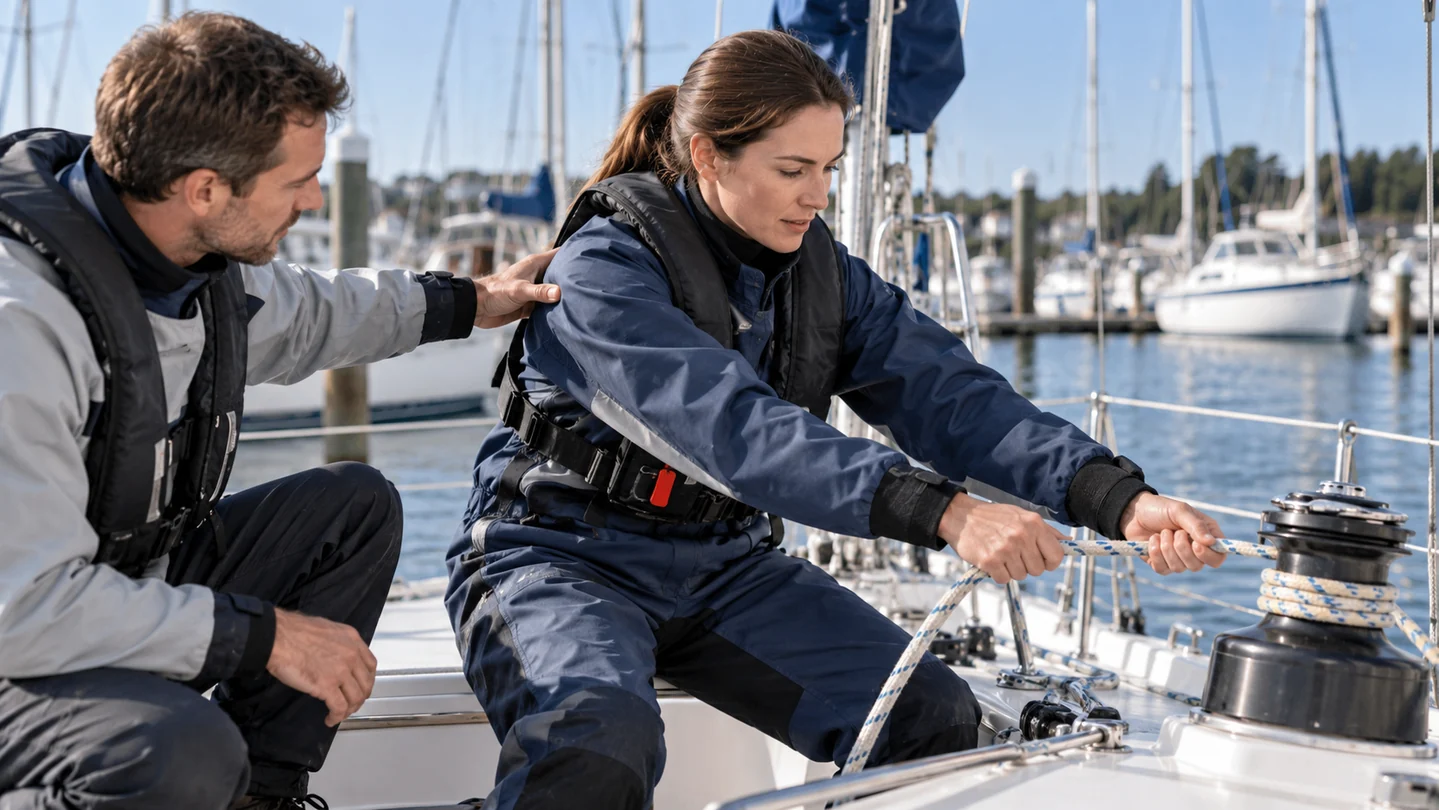
One static chest measurement cannot predict sailing mobility. We recommend trials at the lower, median, and upper boundary of every commercial size.
3. Where Should Ease Be Added?
| Zone | Needed ease | Too little | Too much |
|---|---|---|---|
| Torso | Layering and crouch length | Zipper and crotch strain | Bulky folds under PFD |
| Shoulders | Articulation | Restricted sail/tiller reach | Material bunching |
| Seat/knees | Deep flexion | Seam overload | Snagging on fittings |
| Feet | Sock and insulation volume | Cold from compression | Boot slip |
4. Sailing Drysuit vs. Paddling and Diving Suits
| Dimensión | Sailing drysuit | Paddling suit | Diving drysuit |
|---|---|---|---|
| Primary motion | Hiking, deck work, re-entry | Paddle rotation, cockpit sitting | Finning and valve reach |
| Buoyancy gas | None | None | Inflation/exhaust valves |
| Over-equipment | PFD and harness | PFD and spray deck | BCD and cylinders |
| Reinforcement | Seat, knees, deck-contact zones | Seat, knees, socks | Knees, boots, valve areas |
5. Rough-Weather Application and TCO
| Usos | Fit priority | Hidden cost |
|---|---|---|
| Dinghy racing | Hiking mobility, low bulk | Seam fatigue and snagging |
| Offshore watch | Layer space and harness access | Long-duration pressure points |
| Training fleet | Broad sizing and simple closures | Returns and slow changeovers |
| Rescue support | Swimming and re-entry | Unsupported PPE claims |
For an illustrative 400-suit program, reducing fit returns from 7% to 4% prevents 12 cases. At an $85 landed handling and write-down cost, direct loss falls by $1,020.
A dry suit for sailing should pass a documented sample trial rather than a showroom inspection. Each size should be worn by at least three profiles near the lower, midpoint, and upper boundary; testers should record height, chest, waist, hip, inseam, neck, footwear size, layer thickness, and PFD model. Buyers should photograph the deepest crouch, overhead reach, hiking posture, and re-entry movement so pattern comments are reproducible instead of subjective.
Rough-weather durability also depends on care. After salt-water use, the shell, socks, seals, and zipper should be rinsed with fresh water; both sides must dry in shade before storage. Deck grease, fuel, sunscreen, hook-and-loop edges, and metal fittings can damage coatings or seals. A fleet log should separate abrasion, seam failure, zipper misuse, seal damage, and condensation complaints because each requires a different corrective action.
For procurement, the lowest quotation may conceal costly pattern changes, replacement seals, zipper service, returns, and missed sailing days. A useful TCO model includes sample qualification, test reports, spare-part stock, repair turnaround, seasonal storage, and end-user instructions alongside unit price.
6. Standards and Compliance
- ISO 15027-1: constant-wear immersion suits where applicable;
- ISO 811: resistance to water penetration;
- ISO 11092: thermal and water-vapor resistance;
- ISO 8559-1: body-measurement definitions;
- EU Regulation 2016/425: relevant PPE conformity duties.
A drysuit does not replace an approved PFD or harness. Unsupported flotation, survival-time, or CE claims create recall, customs, insurance, and distributor risks.
7. How Should Buyers Select a Sailing Model?
- Define boat type, water temperature, wind, exposure time, and rescue method;
- Specify PFD, harness, footwear, and layering compatibility;
- Use task trials—not only measurement charts—to approve sizes;
- Agree seam, zipper, seal, abrasion, and finished-garment tests;
- Publish care, inspection, and repair instructions for the actual model.
Yuelei Sports provides OEM/ODM dry suit sailing platforms with buyer-defined breathable shells, patterns, reinforcement, socks, seals, and closures. Evidence must be confirmed for the final market.
FAQ
Which is better for kayaking, a wetsuit or a drysuit?
A drysuit usually provides stronger cold-water and long-exposure protection; a wetsuit can suit warmer, lower-consequence conditions.
Why don’t surfers wear dry suits?
Many surfers prioritize flexibility, board contact, and simple swim performance; drysuits add seals, air space, and zipper complexity.
Can you scuba dive in a sailing drysuit?
No—unless the exact model was designed, tested, and approved for diving with suitable valves and training.
What should you wear for dinghy sailing?
Use a PFD plus clothing matched to water temperature, wind, activity, and rescue time; a drysuit may be part of that system.
What should buyers check in a sailing dry suit for sale?
Check functional fit, PFD compatibility, seam and zipper evidence, reinforcement, care information, and destination-market compliance.
Referencias
- ISO 15027-1 — Constant-wear immersion suits
- ISO 811 — Resistance to water penetration
- U.S. National Weather Service — Cold Water Safety
- EUR-Lex — Regulation (EU) 2016/425
Rough-weather fit is not extra fabric everywhere; it is controlled mobility exactly where sailing posture demands it.
Yuelei Sports builds each dry suit for sailing program around that controlled mobility. Buyers can contact the team to translate boat type, climate, fit, and compliance into a repeatable production brief.