 Xiamen Yuelei Sports Co., Ltd.
Cuando un ingeniero técnico en Róterdam tuvo problemas con el tallaje, Mark, el ingeniero de producto de un programa de uniformes para puertos deportivos, aprobó un pecho más ancho y mangas más largas. Durante una prueba de veinte minutos en el muelle con rociones fríos, el agua se acumuló en el cuello, los puños absorbieron humedad hacia la capa intermedia y el usuario perdió alcance al fijar un arnés de seguridad. La rápida marcha atrás importaba: no se trataba simplemente de una prenda defectuosa. Se había seleccionado un patrón general para ropa de lluvia antes de que el equipo definiera la exposición, el resguardo, la duración de la guardia y el equipo llevado puesto.
Resumen: Elige uno chaqueta de navegación a través de cuatro preguntas sobre la ruta: qué tan grave y continua es la exposición, qué tan rápido el usuario puede llegar a un refugio o puerto, cuánto dura cada guardia y cómo funciona la chaqueta con un PFD, un arnés, guantes, capas y un peto. Las normas ISO 811:2018 y ISO 11092:2026 proporcionan evidencia de tejidos específica para cada método; ninguna asigna una categoría de navegación en aguas interiores, costera o de altamar. Registre esas cuatro entradas, apruebe una muestra de ajuste de equipamiento completo y adjunte criterios de aceptación mensurables a la solicitud de cotización (RFQ) antes de comparar el precio.
Esta guía de chaquetas de navegación es la página de decisión del comprador, no otra comparación de características. Las etiquetas de búsqueda como chaquetas de navegación, chaqueta navegación, chaquetas para navegar, chaqueta de navegación tribord, chaquetas de navegación para hombres, chaqueta de velero y chaqueta de marinero no definen clases técnicas; pueden indicar categoría, orden de palabras, minorista o intención de ajuste. Los compradores deben traducir cada una en requisitos de ruta, ajuste, evidencia e inventario.
Utilice cuatro preguntas de ruta para elegir protección costera, litoral o de mar abierto
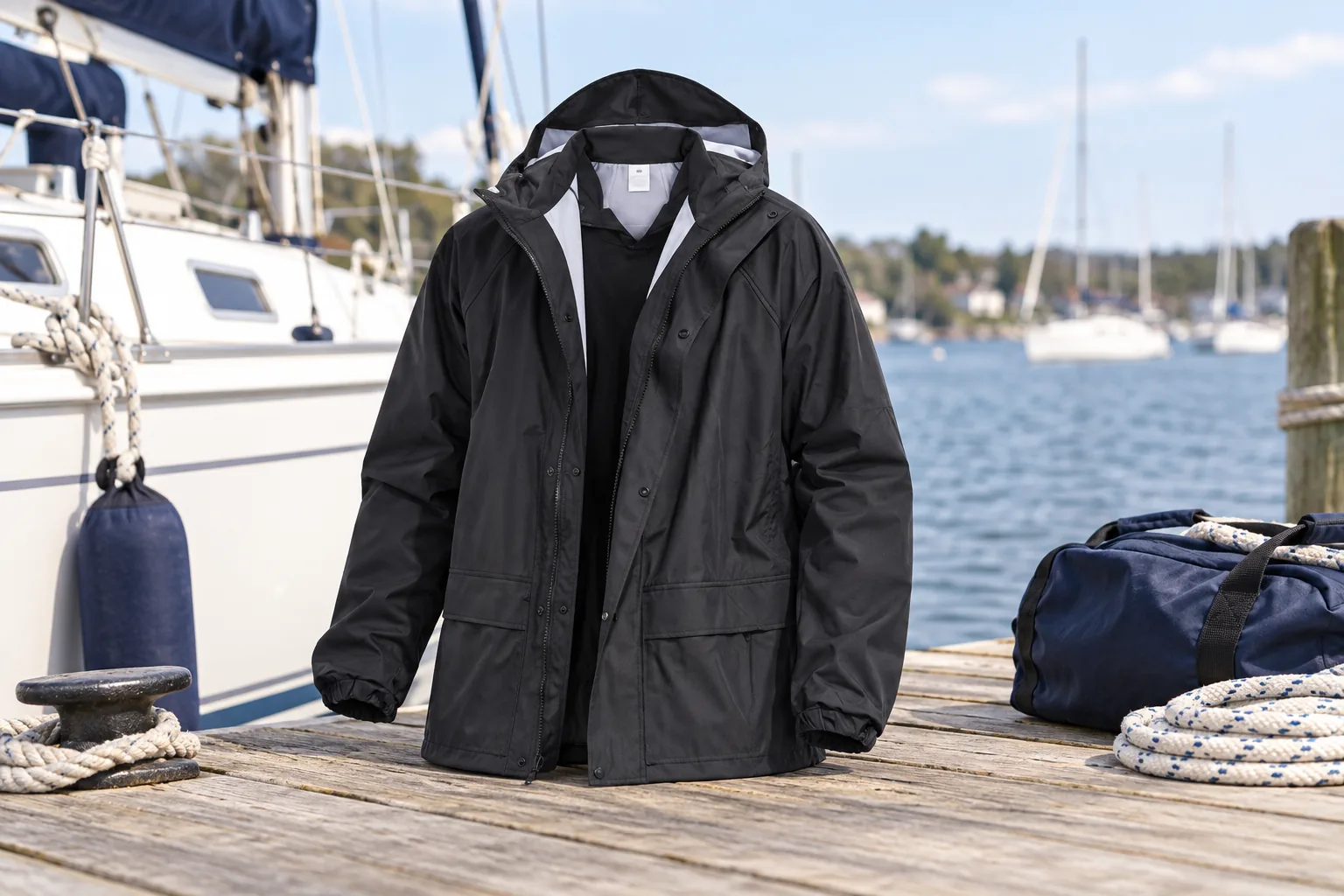
Una etiqueta de zona costera, de bajura o de altura es una hipótesis de partida, no una certificación. Comience con el periodo de servicio creíble más largo. Una lección breve junto a un puerto deportivo, una travesía de un día completo con refugio intermitente y una guardia nocturna en un paso expuesto generan consecuencias diferentes, incluso cuando los tres pronósticos mencionan lluvia.
Primero decide cuánta agua impulsada por el viento y exposición a la cubierta debe absorber la tripulación
Lluvia récord, rocío repetido, agua en cubierta, viento, temperatura, contacto con superficies mojadas y abrasión por herrajes. Intensificar cuando la carga de agua sea sostenida, el contacto a presión sea común o el secado sea poco probable. Un valor hidrostático no puede describir aberturas, costuras, zonas de desgaste o la duración de esas cargas combinadas.
Luego decida si un usuario mojado puede recuperarse rápidamente o debe permanecer de servicio
Define la condición de escape: acceso a tierra, una bañera protegida, una embarcación de apoyo, una ventana de desvío o ningún retorno práctico. Añade la guardia más larga, el tiempo bajo cubierta y la oportunidad de cambiar de capas. Una exposición breve con recuperación rápida apunta a una navegación costera breve; una exposición repetida con retraso apunta a costera; la exposición nocturna sin una ruta de restablecimiento confiable apunta a altamar.
Finalmente, comprobar si el equipo de seguridad y trabajo eleva la categoría requerida
Una ruta moderada puede requerir mayor protección cuando quien la lleva puesta trabaja con un dispositivo de flotación personal (PFD), se engancha a un arnés y un cabo de anclaje, manipula cabos con guantes o necesita la superposición de un peto. Si una interfaz bloquea la visión, el alcance, el cierre, el drenaje o los elementos de seguridad, la categoría inferior ha fallado antes de una prueba de lluvia.
- Elija un punto de partida costero para exposición breve, refugio confiable, guardias cortas y altas necesidades de empaque o movilidad.
- Elija un punto de partida costero para aplicaciones repetidas, retorno tardío, turnos de varias horas y protección rutinaria de la capucha, el cuello, los puños y la parte inferior del cuerpo.
- Elija un punto de partida en alta mar para exposición nocturna, sin refugio rápido, recuperación limitada de equipo y cobertura estable con arnés, cuerda de seguridad, guantes y salopetes.
- Escalar al riesgo creíble más alto. No promedies una ruta en alta mar y varias sesiones protegidas en un compromiso costero. Divide el programa si las consecuencias y las opciones de recuperación son materialmente diferentes.
| Entrada de decisión | Tendencia hacia la costa | Tendencia costera | Tendencia a la deslocalización |
|---|---|---|---|
| Exposición | Lluvia intermitente o salpicaduras | Rociado repetido y clima de todo el día | Lluvia prolongada, salpicaduras, contacto con la cubierta y abrasión |
| Refugio o devolución | Rápido y fiable | Disponible pero demorado | Sin vía de recuperación rápida o confiable |
| Duración de reproducción | Sesión corta con reinicio fácil | Varias horas con reinicio limitado | Guardias repetidas, nocturnas o prolongadas |
| Interfaces de equipos | Capas y PFD verificados para movilidad | PFD, guantes y peto usados rutinariamente | Kit completo más arnés y cuerda de seguridad utilizados bajo carga sostenida |
Traducir la Decisión de Ruta en Cobertura, Construcción y Valor del Ciclo de Vida
La clasificación de la ruta debe cambiar la especificación, pero no dicta un material. Una capa exterior de 2 capas normalmente utiliza un forro separado; un laminado de 3 capas une la cara, la capa impermeable y el respaldo. El recuento de capas por sí solo no prueba la durabilidad, la comodidad o la idoneidad para alta mar. Compare construcciones representativas con los mismos métodos después del tratamiento de cuidado acordado.
| Resultado del comprador | Programa costero | Programa costero | Programa en alta mar |
|---|---|---|---|
| Prioridad de rendimiento | Reliable rain and splash exclusion with low restriction | Repeated spray protection, ventilation, and secure openings | Sustained coverage, robust closures, and abrasion-aware construction |
| Comfort and fit | Packability and easy movement over light layers | Movement over changing layers during longer use | Coverage and mobility over the complete cold-weather kit |
| Compatibility | PFD position and basic pocket access | PFD, gloves, hood, and salopette overlap | PFD, harness, tether, gloves, salopettes, and safety access |
| Maintenance | Simple care and rapid turnaround | Documented care plus inspection of high-use openings | Planned inspection, repair pathway, and post-care verification |
| Unit-cost tendency | Lower complexity may reduce quoted cost | Added adjustment and protection may raise cost | More robust materials and components may raise cost further |
| Return and TCO risk | Fit mismatch and overbuying features | Wet-out confusion, opening leakage, and size mismatch | High consequence from under-specification or slow replacement |
Total cost includes sampling, testing, landed cost, stock holding, care communication, repair, returns, replacements, and discounted resale. One illustrative metric is program TCO divided by accepted wear occasions, using the buyer’s data. It exposes both overbuying offshore complexity and absorbing returns when a lighter product enters longer, colder, or less sheltered use.
Approve Fit Only After the Complete Sailing Kit Passes a Movement Check
A body-measurement chart cannot approve a marine shell by itself. Request finished-garment measurements and test representative sizes over the exact base layer and midlayer intended for use. Then add the specified PFD, harness, tether, gloves, and salopettes. The purpose is not to make every size looser; it is to preserve coverage and access without excess material snagging on deck hardware.
| Full-kit action | What must remain functional | What the approval record should capture |
|---|---|---|
| Zip the collar and turn the head fully | Hood tracks the head; brim and collar do not obscure sightlines or push the PFD | Photos from front and side, adjustment range, and contact points |
| Reach forward, overhead, and across the body | Sleeves cover the wrists; hem and salopette overlap remain stable; shoulders do not bind | Cuff and hem movement by approval size |
| Clip and unclip the tether while gloved | Harness point stays visible; pulls and closures remain operable; loose parts do not snag | Access failures, glove type, and task completion notes |
| Crouch, grind, steer, and sit | PFD stays correctly positioned; pockets remain usable; jacket does not bunch into the chin | Blocked pockets, pressure areas, and coverage loss |
| Spray the representative garment | Openings, seams, and overlaps resist the agreed exposure | Conditions, duration, specimen state, and an internal leak map by zone |
Have the smallest, middle, and largest sampled sizes complete the same sequence. Store the body chart, finished measurements, layer stack, equipment models, and failure notes. This separates grading problems from feature problems and creates a repeatable basis for later orders.
Make Every RFQ Field State What the Test Can and Cannot Prove
Minimum RFQ fields are route and duty cycle; shell construction and seam-taping scope; opening and closure requirements; finished measurements and grading tolerances; full-kit fit procedure; fabric and garment evidence; preconditioning; labeling; inspection; repair handling; and approved claim wording. Each report needs the method edition, units, conditions, specimen, preconditioning, laboratory, result, and buyer-defined pass criterion.
- ISO 811:2018 measures textile resistance to water penetration under hydrostatic pressure. It does not evaluate every seam, zipper, cuff, hood opening, or worn area, so it cannot certify an offshore product.
- ISO 4920:2012 grades resistance of textile fabrics to surface wetting by a spray test. Its scope states that it does not predict resistance to rain penetration. Use it to discuss face wetting, not as proof that water cannot enter the garment.
- ISO 11092:2026 measures thermal and water-vapour resistance under steady-state conditions using a sweating guarded hotplate. Compare like methods, conditions, constructions, and units; do not rank Ret against an unrelated WVTR figure or present either as a comfort guarantee.
- ISO 6330:2021 supplies domestic washing and drying procedures for textile testing. It does not choose a cycle count, create a durability class, or prove reproofing performance. The buyer must state the procedure, number of cycles, specimen state, and tests to repeat afterward.
- World Sailing Offshore Special Regulations provide safety and event context for offshore racing. They do not certify waterproof jackets. Check the edition and event category that actually apply, then keep race compliance language separate from textile results and supplier marketing.
A garment-level spray or rain procedure can complement these methods, but define water delivery, duration, posture, closures, preconditioning, observation points, and the leak-map rule. Avoid “offshore certified” unless a verified scheme, product scope, issuer, and current document support the claim.
Yuelei Sports is a China-based B2B outdoor sportswear solutions supplier. Buyers can use its custom sailing jacket OEM options, men’s sailing jacket design options, and windproof waterproof outdoor jacket construction as starting points for a method-matched sample brief; product-page descriptions still need to be converted into the buyer’s own route, fit, test, and claim requirements.
Build Separate SKU and Inventory Rules for Each Exposure Program
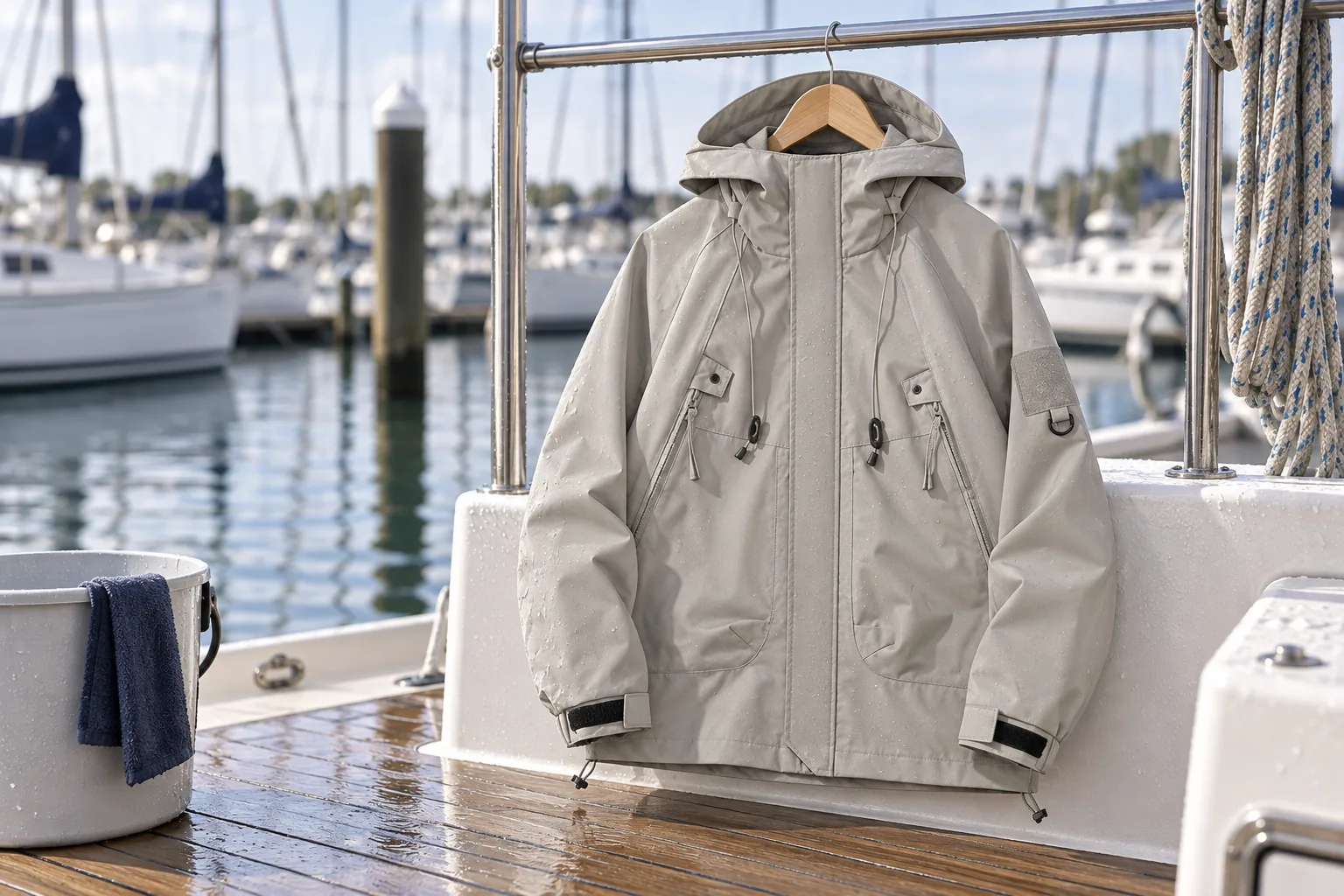
Do not make one construction serve three sales promises. Define an inshore program SKU, coastal core SKU, and offshore specialist SKU only where forecast demand supports each. Adjacent waterproof gear sourcing can share colors, care language, or material families, but jacket fit needs its own record.
| SKU role | Inventory emphasis | Approval evidence | Reorder control |
|---|---|---|---|
| Inshore entry or team program | Prioritize proven size coverage and simple option control over unnecessary technical variants | Movement, PFD fit, seam scope, care, and agreed rain/spray check | Track size returns separately from weather-performance complaints |
| Coastal core range | Place depth in sizes and colors supported by channel data; keep feature language consistent | Repeated-use interfaces, method-matched fabric reports, garment leak map, and post-care condition | Review wet-out, ingress, and fit as separate return codes |
| Offshore specialist range | Use forecast or preorder logic where demand is narrower; protect availability of critical sizes and repair parts | Longest-duty scenario, complete-kit trial, closure access, abrasion plan, and agreed retest | Do not substitute a coastal SKU when replenishment is late |
Keep one version-controlled master specification per SKU. State intended use without turning a zone name into a certification. Review sell-through, size availability, return reason, repair frequency, and lead time by program; blended totals can hide overbuilt inshore stock or underbuilt offshore protection.
Answer These Buyer Questions Before Approving the Range
Is a sailing jacket different from a regular rain jacket?
It can be, when the specification addresses wind-driven spray, moving deck work, hood visibility, glove-compatible closures, layering, and PFD or harness interfaces. A regular shell may suit short protected sessions, but the buyer should verify those functions before assigning a marine use label.
Is a 20,000 mm fabric result enough for offshore use?
No single fabric number is enough. Confirm the ISO 811 method details and specimen state, then evaluate seams, openings, wear zones, preconditioning, garment leakage, route duration, and recovery options. The buyer—not the standard—sets the relevant pass criterion.
How should breathability results be compared across suppliers?
Compare results only when method, edition, units, conditions, and specimen construction match. ISO 11092:2026 water-vapour resistance data should stay within that method; do not convert it casually into a different transmission score. If reports are incompatible, request aligned retesting.
How should the shell fit over layers, a PFD, and a harness?
It should preserve insulation loft, wrist and hem coverage, head rotation, tether access, and working reach without lifting the PFD or obscuring hardware. Approve representative sizes over the named layer stack and equipment, then retain finished measurements and movement records.
How many wash cycles should a waterproof claim cover?
There is no universal number in ISO 6330:2021. Set a cycle count that reflects the intended duty and claim, name the exact wash and drying procedure, and identify which fabric or garment checks must pass afterward. “Wash-tested” without these fields is incomplete.
How can a distributor reduce sizing and feature-mismatch returns?
Separate the range by exposure program, publish body and finished-garment measurements, and approve each size block through the same full-kit tasks. Code returns by fit, wet-out, true ingress, closure access, and expectation mismatch so the next forecast fixes the correct problem.
Primary Sources That Define the Test-Method Boundaries
- ISO 811:2018 — hydrostatic-pressure resistance to water penetration
- ISO 4920:2012 — resistance of textile fabrics to surface wetting
- ISO 11092:2026 — thermal and water-vapour resistance under steady-state conditions
- ISO 6330:2021 — domestic washing and drying procedures for textile testing
- World Sailing Offshore Special Regulations
The durable decision is not “inshore, coastal, or offshore” on a hangtag; it is the route evidence, fit record, and test boundary behind that label. For a coordinated chaqueta de navegación brief, Yuelei Sports can review the intended exposure, size block, interfaces, and evidence pack alongside related waterproof gear sourcing needs. Contact the team with the minimum RFQ fields above to begin a sample discussion.