 Xiamen Yuelei Sports Co., Ltd.

When a technical engineer in Qingdao encountered rapid chilling during an equipment trial, Li added the thickest available fleece garment beneath a test suit. Within minutes, restricted shoulder movement and unstable trim were visible. The shell had not failed; the selection had. Excess loft was being compressed, perspiration was accumulating, and the suit volume had never been validated around the complete clothing system.
Resumen: Para un diving dry suit, “best” means a moisture-managing base layer plus enough resilient insulation for the planned water, time, work and contingency—not the thickest garment. ISO 11092 distinguishes thermal resistance from water-vapour resistance. Buyers should compare both, then approve only after a fully dressed mobility, valve-access, buoyancy and moisture trial.

Define “Best” Around the Entire Dive Profile
A dry shell limits external water entry, but the clothing beneath moves perspiration and retains insulating gas. Divers Alert Network explains that an undergarment traps gas in its fibre matrix. These unsung heroes of dry-suit comfort still change behaviour with fit, pressure, movement and care.
Start the specification with eight inputs: water temperature, planned duration, depth, work rate, decompression or other stationary time, suit material, flooding contingency and diver physiology. A short working dive can create more perspiration than a longer low-effort dive, while an extended motionless stop can demand more insulation afterward. Cold tolerance and prior exposure vary, so one successful configuration is trial evidence—not a universal rating.
Shell construction also changes the starting point. Neoprene can contribute insulation, whereas a thin membrane depends more heavily on the clothing system; either design must provide space without allowing uncontrolled gas movement. Buyers comparing a diving dry suit should therefore specify the intended layers, body measurements, boots, gloves, harness and representative tasks together.
Separate Base-Layer and Insulation Roles
The layer next to skin and the insulating layer have different jobs. A close-fitting base layer should move perspiration, avoid bunching and preserve circulation. The one-piece undergarment or modular midlayer should retain useful gas, continue the moisture path and articulate at the shoulders, hips, knees and ankles. One-piece designs reduce gaps; separate pieces simplify adjustment. Neither is automatically warmer.
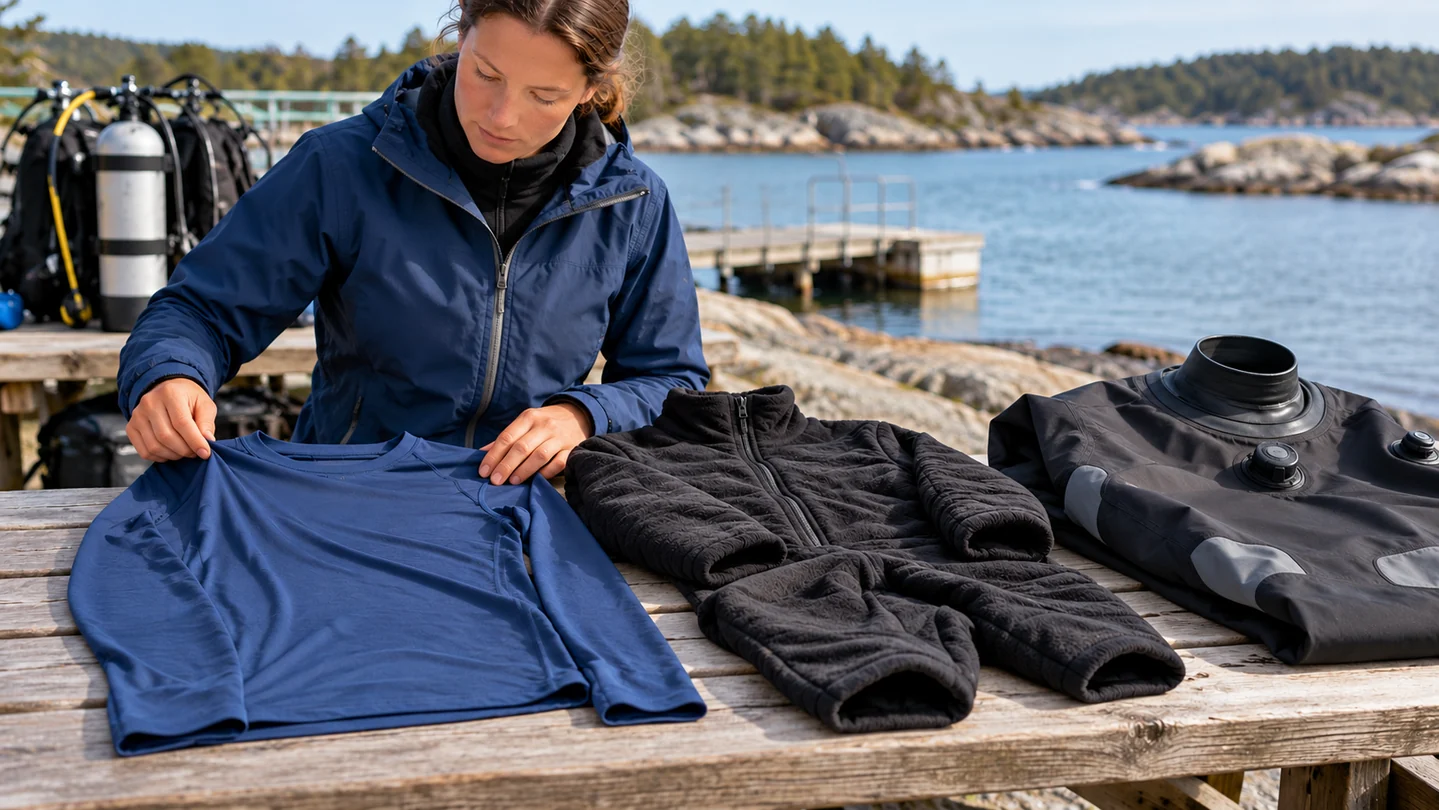
Cotton is unsuitable for a cold-water plan because it absorbs moisture and dries slowly. Once damp, it is difficult to manage during a long exposure or surface interval. Fast-drying synthetics and suitable wool blends are more practical candidates if seams, waistbands and cuffs remain comfortable. Their typical moisture and drying behaviour is not a temperature guarantee.
The best screening question is not “How warm does this feel in the warehouse?” but “Where will perspiration travel during the real work cycle?” Assess the base material, the insulation assembly and the complete outfit. A related guide to choosing a thermal layer can help frame textile questions, although paddling does not reproduce underwater compression, buoyancy or gas-management demands.
Compare Fleece, Synthetic Loft and Wool Blends Without False Ratings
Fleece creates air space through a raised knitted structure. It is easy to layer and familiar to many fleets, but bulk and compression vary by knit, density and construction. A thick fleece that is tight at the shoulders may retain less useful loft than a thinner, better-fitting option. Approval samples should follow the intended care route.
Synthetic microfibre-batting categories, including Thinsulate-type constructions, distribute loft in a dedicated insulating package. They can support a relatively thin profile, but the trademark or fibre label does not predict finished-garment performance. Quilting, shell and lining fabrics, seams and size allowance all matter. Ask for assembly evidence instead of turning a material name into a warmth claim.
Wool or wool-blend layers can be useful where moisture buffering, comfort and odour management matter, but fibre percentage, knit structure and drying logistics must be evaluated. Wool should not be marketed as immune to wetting or as a substitute for a flooding plan. Hybrid systems may place resilient synthetic insulation at the torso and lower-bulk panels at joints. Compare garment assemblies by intended use, not by assuming that fleece, batting or wool is universally superior.
Balance Thin Warmth Against Sweat and Post-Dive Chill
Buyers often ask for the thinnest warm option because reduced bulk can improve movement and simplify suit sizing. That is a valid goal, but “thin” and “warm” are not stand-alone specifications. A compact garment may offer efficient loft distribution, yet inadequate room can still compress it. Conversely, excessive insulation can cause sweating while carrying cylinders, walking to the entry or waiting fully dressed, leaving the diver damp before immersion.
Plan the pre-entry phase as part of thermal management. Where site procedures allow, reduce unnecessary exertion, stage equipment efficiently, delay final closure until appropriate and ventilate without compromising seals or contamination controls. The work cycle should include dressing, surface preparation, immersion, bottom work, stationary phases and recovery. Post-dive chill is particularly important: a damp diver exposed to wind or a cold deck may cool quickly even after an acceptable in-water phase.
ISO 11092 uses a sweating guarded-hotplate to measure thermal resistance and water-vapour resistance under steady-state conditions. It is valuable for comparing controlled specimens or assemblies, but it does not recreate suit squeeze, finning, harness pressure or a changing work rate. Use laboratory data to narrow candidates, then use controlled operational trials to decide.
Check Loft Compression, Fit and Valve Access as One System
Diving dry suit insulation depends on retaining relatively still gas. Compression under the suit, harness, cylinder bands and the diver’s own posture reduces the air space that fibres are meant to hold. Common pressure zones include the shoulders, elbows, lower back, hips, knees, calves and feet. A garment that looks generous on a hanger may become restrictive once cuffs, boots and equipment are loaded.
Conduct the fit check with the exact base and insulating pieces planned for issue. The diver should squat, reach both valves, cross the arms, raise the knees, simulate finning, operate the inflator and exhaust, and assume horizontal and head-up positions. Confirm that seals are not folded over fabric, zippers are unobstructed, circulation remains normal and the exhaust valve is not buried by excessive bulk. The suit must retain enough internal space for controlled gas addition without becoming so loose that migration is difficult to manage.
Document the approved size combination rather than relying only on the labels of separate garments. If the base layer, insulation or suit pattern changes, repeat the critical checks. Small construction changes at the crotch, torso or shoulder can alter reach and air space even when the nominal size is unchanged.
Revalidate Buoyancy, Weighting, Gas Migration and Trim
Changing insulation can change trapped gas volume, suit fit and the amount of suit gas required to prevent squeeze. That can affect starting ballast, horizontal trim, gas migration and ascent control. A thicker package may also shift where material gathers, changing the diver’s posture or ability to reach a valve. These are system effects, not reasons to prescribe a universal weight adjustment.
PADI’s Dry Suit Diver course places these issues in a training context: dry-suit use involves buoyancy skills, descents and ascents, and suit care. Training guidance is not approval of a particular garment. Every new assembly should be trialled by appropriately trained personnel in controlled conditions, beginning where the diver can stop safely and progressing only under the operation’s risk controls.
Record at least the diver, suit and garment sizes, cylinder and harness configuration, salinity, starting ballast, gas-distribution observations, task performance and post-dive comfort. Include the planned stationary or decompression phase instead of judging only active swimming. The record makes later comparisons meaningful and prevents an informal layer substitution from silently changing the buoyancy plan.
Compare Undergarment Categories by Operational Value
| System category | Performance and comfort | Compatibility and care | Cost and TCO tendency |
|---|---|---|---|
| Wicking base layer only | Lowest bulk and fastest handling; limited retained loft | Easy mobility and drying; consider only after exposure-risk review | Low unit-cost tendency, but a high consequence if under-specified |
| Base layer plus fleece | Adjustable and familiar; thickness and compression vary widely | Flexible for mixed rosters; verify drying time, pilling and joint bulk | Moderate inventory complexity; individual pieces can be replaced |
| Base layer plus synthetic loft garment | Purpose-designed loft distribution can reduce bulk; articulation is decisive | Can simplify issuing; requires assembly evidence and care control | Higher unit-cost tendency may be offset by repeatable fit and fewer mismatches |
| Modular synthetic or wool-blend system | Broad adjustment range; easiest category to over-layer | Useful across seasons; more SKUs, laundry routes and training | Potentially efficient across varied work, but administrative cost is higher |
Total cost of ownership includes purchase, size exchanges, sample trials, laundry labour, drying capacity, storage, spare sets, replacement frequency, retraining and disrupted-dive cost. An illustrative comparison can annualise those inputs for each fleet, but it should not invent prices or service life. The lowest-priced garment can become expensive if it dries slowly or creates repeated fit failures; a premium option does not create value unless its evidence and logistics match the operation.
Use a Risk-Based Layering Matrix, Not a Temperature Guarantee
This matrix defines exposure scenarios for sample trials; it is not a universal temperature chart or a promise of protection. Increase the risk tier when duration, depth, low work rate, decompression or other stationary time, surface exposure, suit compression, flooding consequence or individual susceptibility demands it. Competent dive leadership should set stop criteria, supervision and emergency arrangements.
| Exposure scenario | Candidate starting system | Critical trial question | Evidence to retain |
|---|---|---|---|
| Milder water, short duration, active work, controlled exit | Wicking base; add light insulation after risk review | Does moisture clear without chill during recovery? | Work cycle, time, post-dive dampness and mobility notes |
| Cool water, moderate duration or mixed activity | Wicking base plus light-to-moderate resilient insulation | Is loft retained at harness and joint pressure points? | Fit images, reach results and controlled-trial record |
| Cold water, long duration, low work or planned stationary time | Base plus higher-loft fleece, synthetic loft or validated hybrid | Can the diver remain functional while managing gas and valves? | Ballast, trim, gas movement, task and thermal feedback |
| Near-freezing, overhead, remote or high-consequence exposure | Operation-specific system selected within the formal dive plan | Are exposure, redundancy, flooding and rescue controls adequate? | Risk assessment, training status and approved trial protocol |
A trial should represent the complete system and remain conservative: begin with a known diver, controlled site, planned termination criteria and surface support. Do not deliberately create a flood to “prove” warmth. Instead, document the contingency assumptions, available protection, exit time and recovery resources, and use trained leadership to decide whether the residual risk is acceptable.
Use Standards and Training Sources Within Their Scope
- ISO 11092 is a textile test method for thermal and water-vapour resistance under steady-state conditions. It can compare specimens or assemblies; use of the method does not certify a finished diving product or establish a universal water-temperature rating.
- ISO 14225-2 covers requirements and test methods for dry suits. It should not be extended into an unsupported warmth claim for the clothing worn beneath the suit.
- PADI guidance provides training context for dry-suit skills and care. A course description is not a supplier approval, product test report or substitute for operation-specific instruction.
- DAN guidance explains how the suit and undergarment contribute to insulation and discusses inspection and leak considerations. It is safety information, not garment certification.
Applicability depends on destination market, intended use and the claims placed on product pages, packaging and tenders. Buyers should request current, identifiable test reports, test conditions, sample references, care instructions and authorised claim wording. Unsupported standards logos, certification language, service-life statements or temperature limits can create returns, tender disputes and safety exposure.
Approve the System and Its Fleet Plan Before Bulk Purchase
- Define the dive profile, surface phase and credible contingency before choosing fabric or loft.
- Shortlist two or three assemblies and compare moisture transport, compression, articulation, care and controlled test evidence.
- Fit the complete package with suit, seals, boots, gloves, harness and valves; reject binding, blocked access or unmanaged air space.
- Run controlled training trials with documented weighting, trim, gas movement, tasks, comfort and stop criteria.
- Freeze the bill of materials, approved size pairings, inspection points and allowed substitutions before production or fleet issue.
Fleet planning should be equally specific. Define hygiene and laundry procedures, ensure garments are fully dried before storage, and hold spare sets for wet turnarounds or unexpected contamination. Build the size inventory from the suit-and-layer pairing rather than body size alone. Replace or quarantine garments when there are damaged seams, failed fasteners, persistent contamination or odour, local thinning, matted insulation, distorted fit, or care-label limits that prevent safe reuse. Do not promise a fixed service life without evidence from the actual material, care cycle and operating environment.
Track issue frequency, wash and dry labour, turnaround delays, repairs, rejected items and trial failures to reveal the real TCO. For buyers developing a configurable dry suit undergarment interface, Yuelei Sports can support shell-sizing, layer-allowance, size-set and sample-development discussions as a China-based B2B outdoor sportswear solutions provider. Final suitability remains subject to the buyer’s risk assessment, training system and operational validation.
Answer Six Questions Before Selecting the Final System
What is the best undergarment for a diving dry suit?
The best choice is usually a moisture-wicking base garment combined with the minimum resilient insulation that passes the specific exposure trial. Fit, retained loft, moisture movement, suit volume and diver workload matter more than a generic “warmest” label. Validate the complete system in controlled conditions.
How warm should dry suit undergarments be?
They should maintain acceptable comfort and function for the planned dive plus a defined contingency without restricting circulation, movement or gas control. The correct level cannot be set from water temperature alone; include depth, time, work rate, stationary phases, shell material and physiology.
Can I wear cotton under a dry suit?
Cotton is a poor operational choice because it absorbs perspiration and dries slowly. A moisture-managing synthetic or suitable wool-blend base layer is generally more practical, but the complete assembly still requires a fit and exposure trial.
What base layer is best for cold-water diving?
A close-fitting, moisture-wicking base layer that does not bind beneath insulation is a sound starting point. It should pass moisture into the next thermal layer and be tested during the expected work cycle, not judged only while dry on the surface.
Do I need different undergarments for different water temperatures?
Often, yes; modular clothing lets an operator adjust insulation to exposure conditions and individual needs. Every change can alter bulk, mobility, buoyancy and drying logistics, so check the revised combination rather than assuming equivalence.
How do I prevent sweating inside a dry suit?
Use a moisture-wicking base, avoid excessive insulation, reduce unnecessary exertion before entry and ventilate safely where procedures allow. A controlled work-cycle trial should show whether moisture moves through the assembly or collects at a fabric boundary.
Consult Authoritative References Before Final Selection
- ISO 11092 — Measurement of thermal and water-vapour resistance under steady-state conditions
- ISO 14225-2 — Diving suits, Part 2: Dry suits, requirements and test methods
- PADI — Dry Suit Diver course overview
- Divers Alert Network — Tools for a Healthy Drysuit
The dependable principle is simple: specify clothing, shell and dive profile as one system, then trust recorded trials rather than thickness alone.
Procurement teams preparing a new programme can review Yuelei Sports dry-suit solutions and contact the team with their destination market, use conditions, size range and sample-test plan.