 Xiamen Yuelei Sports Co., Ltd.

When a technical engineer in Qingdao, Maya Chen, encountered restricted arm movement during a sample dive, she reached for the left-shoulder exhaust valve and immediately rolled off trim; within the first minute, her elbow stopped short and the team ended the drill. The reversal came during the sample review: the suit itself was not simply “bad.” It had been approved over a thin base layer, then tested with the program’s full undergarment and harness, revealing inadequate shoulder rotation and valve access in the intended configuration.
Resumen: Diagnose underwater restriction with the complete dive system, not from standing posture or size labels alone. ISO 14225-2 addresses requirements and test methods for dry diving suits, while ISO 8559-1 defines body-measurement terms; neither proves that one pattern supports every operational task. Buyers should run one task-based sample sequence, separate pattern restriction from suit squeeze, gas distribution, harness interference, and unfamiliar technique, then require supplier revision when safe reach remains blocked.
Why a Dry Suit Can Restrict Movement Underwater Even When It Fits on Land
Land fitting asks whether the diver can enter, close, and stand in the suit without obvious tension. Underwater work asks whether that diver can don fins, handle a mask, operate BCD and suit controls, hold trim, kick, and reach emergency equipment while insulation, harness, cylinder, hood, and gloves load the garment. Changed posture and equipment pressure can turn a land pass into a task failure.
The distinction matters because “tight” describes a sensation, not a root cause. A genuinely short torso may pull the crotch and shoulders at the same time; suit squeeze may press the shell against the body only as depth changes; excessive or migrating gas may make a limb feel awkward without a hard textile stop; an overtight harness may block the same shoulder arc that looked free before gearing up. A disciplined review treats mobility as a system outcome and changes one variable at a time.
ISO 14225-2 provides a product-level framework, but a buyer’s reach sequence is an application test, not an ISO certification test. PADI’s Dry Suit Diver course addresses buoyancy control, undergarments, air management, and practice. Keep product or compliance evidence separate from task evidence produced by a trained diver in the production-intent configuration.

Why Restriction May Come from Pattern, Squeeze, Gas, Harness, or Technique
Classify when restriction appears. A repeatable shoulder hard stop on land and in shallow controlled water points toward geometry, reinforcement, or equipment overlap. A depth-dependent shell that clings or pinches is more consistent with squeeze and demands trained, manufacturer-aligned response. Excess suit gas is not a pattern remedy; it changes trim and the volume the diver must manage.
Gas distribution has another signature. Gas shifts toward the highest part of the suit; accumulation toward the legs or feet may change trim or rotate the diver, but does not prove a leg-pattern fault. Record depth, orientation, weighting, equipment, layer, and failed task, then pause for review with a qualified professional rather than improvising a technique.
Harness configuration and unfamiliar operation can imitate garment failure. If reach disappears only after donning the BCD or backplate, repeat the comparison with approved routing. If there is no textile hard stop yet the diver misses a control, check familiarity and glove dexterity under supervision. This before/after comparison is more actionable than saying the dry suit scuba sample “feels difficult.”
Why Shoulder, Crotch, and Torso Geometry Block Critical Underwater Tasks
The shoulder often separates size from pattern. Tension across both upper arms suggests back width, armhole, sleeve pitch, or overall size; a one-sided hard stop suggests posture, reinforcement, zipper, valve, or harness contact. A flexible fabric insert reduces material resistance but cannot add back length or relocate an armhole. Compare the same movement with the layer, suit, and full harness.
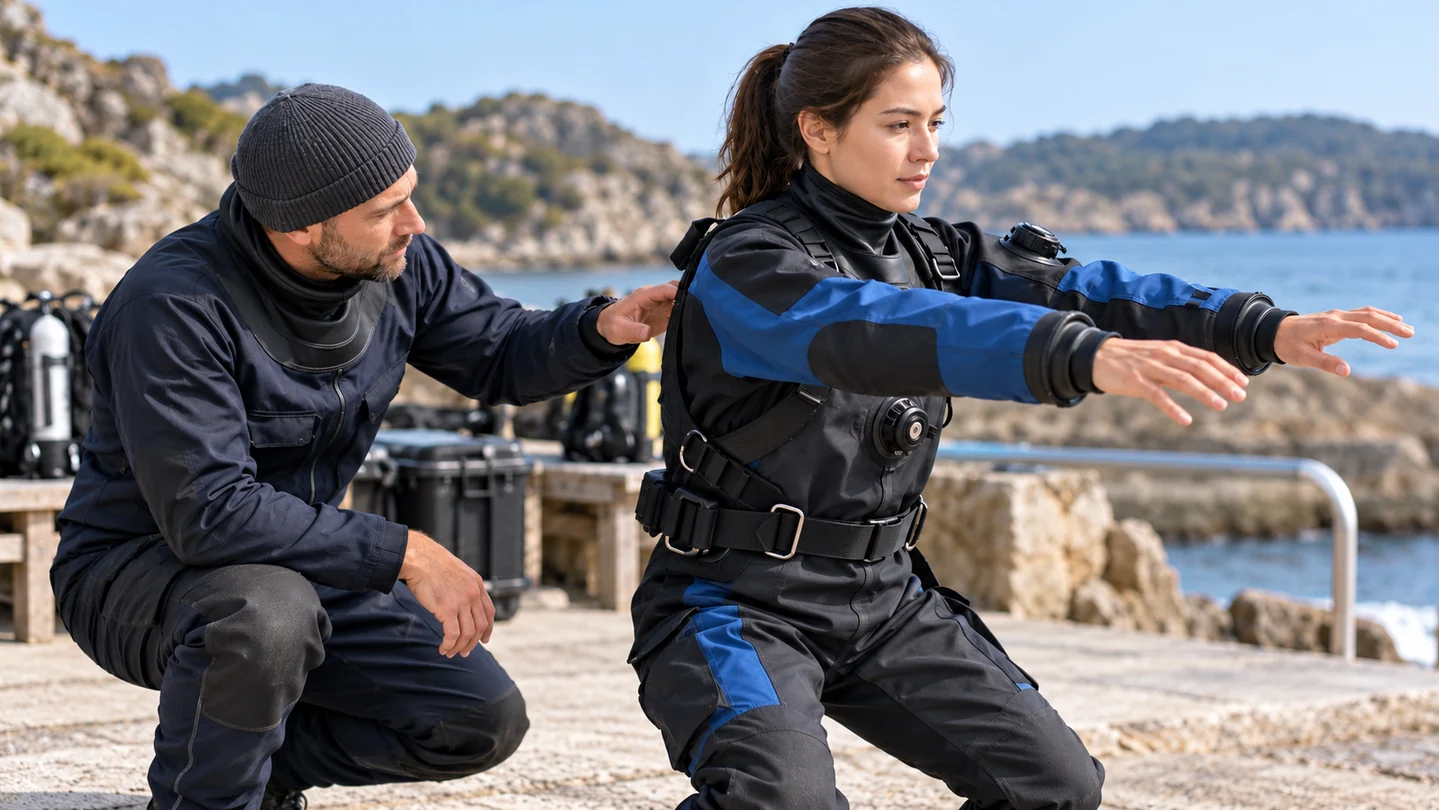
Read torso and crotch symptoms together. A short torso can pull the crotch during a squat and limit upper-body reach; a low crotch can impede hip flexion, fin donning, frog-kick recovery, and ladder movement. A larger size may only add leg volume. Use ISO 8559-1 measurement definitions plus the supplier’s garment measures and functional-ease locations.
Before water entry, don each fin in the planned posture, touch the mask and shoulders, operate BCD and drysuit controls, squat, and reproduce the frog-kick range without forcing a joint. Technical programs may add relevant shutdown or emergency reach. Straining is not a pass: pain, seam loading, imbalance, or a hard stop requires escalation.
Why Zippers, Valves, and Harness Hardware Can Create a False Size Problem
A zipper is a resistant line across the pattern. A front-entry route may support self-donning yet resist rotation if its length, angle, flap, or panels are poorly coordinated; a rear-entry route shifts the constraint toward the shoulders. Compare the same actions before and after harness installation, watching for buckling, shoulder pull, or endpoint load.
Evaluate valves in their working posture. An exhaust valve may rotate away under sleeve tension; an inflator may sit beneath webbing, and dry-glove connections or seals can reduce hand access. Watertight but unreachable hardware is an operational failure, yet a missed reachable valve needs supervised repetition before pattern alteration.
DAN describes inspection and manufacturer-appropriate pressure testing around zippers, valves, seals, seams, boots, and gloves. These checks address leakage, not reach. Separate service evidence from task evidence so a distributor does not keep servicing a sound valve whose real problem is its relationship to sleeve and harness.
Why Undergarment Bulk Changes Reach, Drag, Weighting, and Buoyancy
Thermal insulation consumes space unevenly. Loft at elbows, shoulders, hips, and knees narrows the joint envelope even when chest and waist remain acceptable. If a thin layer passes and the specified cold-water layer fails at the same joint, review the pattern allowance; crushing insulation to close the shell may undermine its intended thermal role.
Bulk also changes hydrodynamic shape. Folds, excess limb volume, projecting hoses or pockets, and an oversized shell can increase perceived drag. Effort alone is inconclusive because fins, current, trim, cylinder position, and weighting also affect fatigue. Hold the diver, equipment, route, and task constant while changing only the approved layer or sample.
Insulation also changes buoyancy and the system’s weighting review. Loft compresses with pressure while migrating gas changes trim, so a control problem may feel like restriction. Qualified drysuit training and manufacturer guidance—not a factory fit instruction—must govern weighting and gas management. Procurement should approve the layer, size, footwear, harness, BCD, cylinder setup, and weighting review together.
Why the Same Restriction Symptom Requires Different Safe Actions
| Observed symptom | Likely cause to isolate | Safe next action | Stop-dive or supplier-revision boundary | B2B cost exposure |
|---|---|---|---|---|
| Hard shoulder stop on land and in full equipment | Back width, armhole, sleeve pitch, reinforcement, or harness overlap | Repeat once without the harness, then with approved routing | Revise the pattern or component location if required reach remains blocked | Altered sample, approval delay, return freight |
| Restriction increases with depth and the shell clings or pinches | Drysuit squeeze or gas-management error | Use only trained procedures and manufacturer guidance | Stop the trial if the diver cannot manage the condition comfortably and safely | Failed training dive, instructor time, downtime |
| Feet become light or the diver is rotated as gas shifts | Gas migration, trim, weighting, leg volume, or unfamiliar technique | End the task and debrief with a qualified drysuit professional | Do not approve until technique and configuration are separated from pattern volume | Repeated trials, training, potential size-set changes |
| Only the thick layer blocks elbow, hip, or knee motion | Insulation bulk exceeds pattern allowance | Test an approved lower-bulk system or respecify garment allowance | Require pattern revision when the mandated thermal layer cannot perform the task | Layer replacement, seasonal stock mismatch, rework |
| Valve is reachable without equipment but hidden after gearing up | Harness or hose overlap, valve rotation, sleeve tension | Review compatible routing and repeat the exact task | Relocate hardware when approved setup cannot preserve access | Service labor, component rework, aborted dives |
| Larger size restores reach but adds excessive torso or leg volume | Body-to-pattern proportion mismatch rather than simple size | Request altered dimensions from controlled measurements | Supplier pattern revision is required before pilot approval | Multiple samples, returns, unusable inventory |
| Pain, numbness, loss of control, leak, or inability to operate a critical control | Potentially unsafe fit, equipment, or service condition | Terminate the trial and follow the dive plan and professional guidance | Do not resume until the cause is identified and corrected | Safety event, repair, investigation, operational downtime |
A size increase may solve global tension but worsen gas volume; training cannot add torso length, and valve service cannot correct poor placement. Code the task, configuration, failure, owner, correction, and retest result rather than recording only “poor fit.”
Why Stage-Gated Sample Approval Finds Movement Restriction Before Production
| Approval stage | Task-based check | Evidence to capture | Failure signal | Commercial decision |
|---|---|---|---|---|
| Use-case freeze | Define thermal layer, harness or BCD, cylinders, fins, gloves, controls, and required emergency tasks | One signed configuration list | Equipment or layer remains “to be decided” | Hold sampling until the intended system is clear |
| Measurement and pattern review | Map ISO 8559-1 body landmarks plus supplier garment measures | Measurer, method, layer plan, size mapping, exceptions | One size is expected to solve conflicting torso, limb, and girth needs | Agree altered dimensions before cutting |
| Dry shell and layer trial | Fin donning, cross-body reach, squat, mask touch, frog-kick range | Front, side, and rear video with task labels | Hard stop, pain, balance loss, or seam loading | Revise the pattern; do not advance a forced pass |
| Equipped dry trial | Reach BCD and drysuit controls; check zipper, valve, hose, pocket, and harness clearance | Pass/fail by control and by equipment setup | Access disappears only after gearing up | Correct compatible routing or relocate components |
| Controlled-water trial | Under qualified supervision, observe trim change, planned fin cycles, vent access, and relevant shutdown or emergency reach | Depth band, task, layer, weighting review, diver and supervisor notes | Squeeze, gas migration, loss of control, or failed critical reach | Stop, diagnose, correct, and retest the affected stage |
| Pilot size set | Repeat representative tasks across intended users and sizes | Failure code, alteration, return, service, and downtime reason | The same regional restriction appears across users | Correct grading before volume production |
Stage gates expose hidden cost. A failed training dive consumes diver, instructor, boat, gas, and schedule capacity; returns add inspection, cleaning, freight, and support; late pattern changes can invalidate samples, grading, labels, or documentation. Inadequate destination-market repair support also turns valve, seal, zipper, or boot service into downtime.
In an illustrative 100-suit order, each one-percentage-point rework rate equals one additional case to diagnose and process. This is not a forecast; it shows why “tight” is an inadequate code when the remedy could be training, a different layer, pattern revision, hardware relocation, or service.
Why Standards and Training Do Not Prove Underwater Movement by Themselves
ISO 14225-2 covers requirements and test methods for dry diving suits; ISO 8559-1 standardizes body-measurement definitions. Use of a method or vocabulary does not certify a product or supplier. Before repeating a claim, obtain the edition, scope, specimen, responsible laboratory or party, result, destination market, and intended-use connection.
Neither document replaces a task test: measurements do not show where ease is distributed, and product testing cannot guarantee reach through a specific harness. PADI addresses diver skills and DAN supports inspection, but neither validates an untested pattern or replaces manufacturer instructions and local requirements.
A supplier may document a named internal reach protocol without presenting it as ISO approval. Unsupported certification or suitability claims can cause tender rejection, relabeling, returns, disputes, or liability; a thin-layer pass also cannot represent an untested cold-water configuration.
How Buyers Should Specify a Dry Suit That Does Not Restrict Movement
- Freeze the operational profile. Record conditions, tasks, layer, harness or BCD, cylinders, fins, gloves, entry, valves, footwear, and users before sampling.
- Control pattern inputs. Use consistent body terms, identify the measurement method, and add supplier garment measures for task-critical regions.
- Approve function. Define passes for fin donning, mask and control access, frog kick, trim change, and relevant emergency reach; a dry suit fit review must name the configuration.
- Control changes. Reassess affected tasks after changes to material, reinforcement, seams, zipper, valves, seals, boots, pattern, or layer allowance.
- Plan service. Document inspection, repair routing, replaceable components, and responsibility without inventing service-life promises.
Yuelei Sports can support B2B teams by translating an approved use case into configurable materials, pattern measurements, valve and zipper options, and production-intent sample documentation. Buyers comparing an application-specific dry suit scuba platform with surface-water alternatives should preserve those configuration differences in the approval record. Where standard sizing cannot maintain reach without excess volume, a documented dry suit fit review is more defensible than repeated size swaps.
End with one controlled decision: approve the configuration, request targeted revision, or reject it for the task. “More room” may add volume in the wrong place; annotated evidence gives the pattern engineer a reproducible location, posture, layer, and failure.
Questions That Diagnose Why a Dry Suit Restricts Movement
Why does my scuba dry suit restrict movement underwater?
Common causes include pattern or size, bulky insulation, hardware or harness interference, squeeze, gas distribution, weighting, and unfamiliar technique. Compare the task across layer, suit, and full-equipment stages; end the trial for lost control, pain, or unreachable critical controls.
How should a scuba dry suit fit around the shoulders and hips?
It should permit cross-body reach, valve use, fin donning, a squat, and the planned kick without a hard stop while avoiding unnecessary gas volume. Judge it with specified insulation and harness; standing appearance cannot prove underwater function.
Can thick undergarments make a dry suit feel too tight?
Yes. Loft consumes joint space, while forcing insulation flat may compromise its thermal role. Recheck the approved layer and allowance before changing size; revise the pattern if the required system cannot complete defined tasks.
How do I improve mobility in a trilaminate dry suit?
First isolate pattern geometry, reinforcement, seam placement, insulation bulk, hardware, harness tension, squeeze, and gas control rather than assuming a flexible fabric will solve every restriction. Use qualified drysuit instruction for weighting and gas-management issues; request supplier review when safe valve access or finning remains blocked by a repeatable garment or component hard stop.
Should a dry suit feel loose or snug when standing?
Standing feel is not the acceptance criterion. The suit needs enough functional ease for the selected thermal layer and underwater tasks, but not so much uncontrolled volume that trim and gas management become more difficult. Confirm the balance through the documented dry sequence and a supervised controlled-water trial.
When does restricted movement mean a dry suit is the wrong size?
Size is suspect when overall tension appears across several regions and the next size restores all required actions without creating excessive torso or leg volume. If one joint, valve path, or body proportion fails across adjacent sizes, pattern geometry or component placement is the stronger diagnosis and should be revised before approval.
Evidence Sources for Diagnosing Why a Dry Suit Restricts Movement
- ISO 14225-2, Diving suits — Part 2: Dry suits — Requirements and test methods
- ISO 8559-1, Size designation of clothes — Part 1: Anthropometric definitions for body measurement
- PADI, Dry Suit Diver course
- Divers Alert Network, “Tools for a Healthy Drysuit”
The most useful suit is not the one that looks correct on a hanger; it is the one whose approved configuration lets the trained diver perform every required task without trading reach for buoyancy control.
For a production-intent sample review, explore Yuelei Sports’ dry-suit solutions for B2B programs and contact the team with the intended dive configuration, measurement set, and failed movement step.