 Xiamen Yuelei Sports Co., Ltd.
When a ski-wear buying team reviews a new women’s range, the first sample can look flattering on a static model and fail as soon as the wearer raises her arms, reaches for a binding, or sits on a chairlift. The visible problem may be tightness at the crotch, a lifted cuff, or a waist gap after a deep bend. The underlying cause is usually selection and specification: the pattern was approved for appearance before the body measurements, thermal layers, movement allowance, weather exposure, and care route were defined together. A reliable ski suit women program therefore starts with the complete use case, then proves warmth, fit, water resistance, and serviceability in the intended size range.
Quick answer: The warmest and most flattering women’s ski suit is the one whose pattern leaves controlled room for the declared base and midlayers while keeping the waist, cuffs, hood, and closures sealed during movement. Use four basic fit checks—arms overhead, torso rotation, binding reach, and a deep squat—rather than a standing photo alone. ISO 811 can compare a fabric’s resistance to water penetration, and ISO 11092 can compare thermal and water-vapour resistance under steady-state conditions; neither standard certifies a finished suit for every mountain day. Buyers should next verify the actual layer package, test method, size chart, and care label.
What Makes a Women’s Ski Suit Warm Enough?
Warmth is a system property, not a synonym for thick insulation. A ski suit female design must work with the base layer, midlayer, shell fabric, wind exposure, activity level, and time spent stationary. A skier may generate high heat on a descent and then cool rapidly on a lift. Insulation that feels comfortable while standing indoors can become clammy during effort, while a thin shell can feel cold if wind enters at the neck, cuff, hem, or waist.
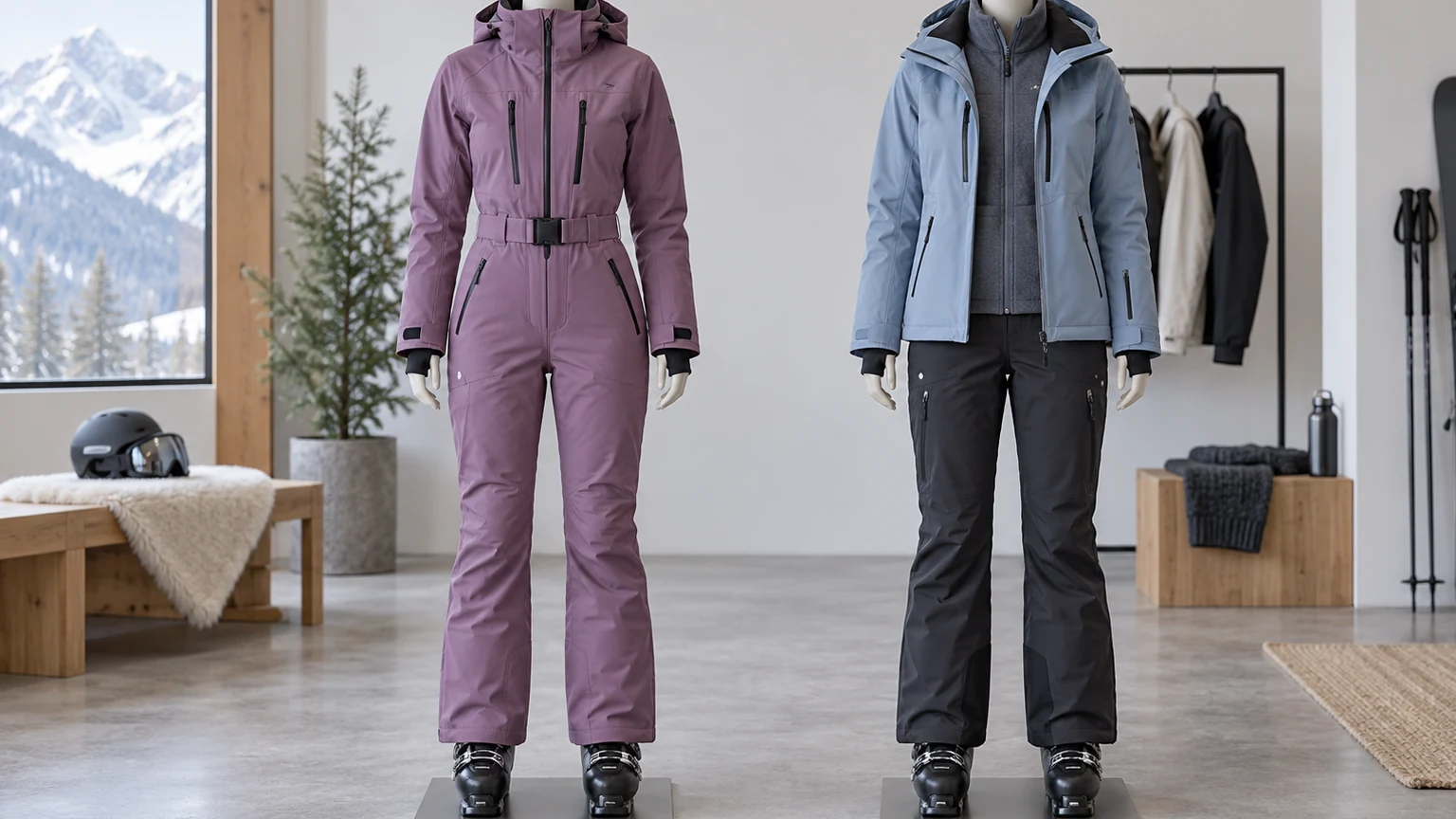
For a one-piece suit, continuous coverage removes the jacket-to-pant overlap decision and can reduce one route for snow and drafts. It does not automatically add insulation or breathability. Specify insulation location and loft, lining, vent placement, cuff and boot interfaces, hood adjustment, and the amount of ease reserved for the declared layers. For a two-piece system, evaluate jacket hem overlap and pant rise in the same positions; a gap that appears only during a squat is still a fit failure.
[Inline image placeholder: text-free comparison of an insulated women’s one-piece ski suit and a jacket-and-pants system on a neutral studio background]
How Should a Women’s Ski Suit Fit Over Thermal Layers?
A flattering fit is not simply a smaller fit. The critical measurements for a womens ski suit include bust, waist, hip, shoulder, back length, body rise, sleeve length, and inseam. In a one-piece, these dimensions interact: adding bust ease does not repair a short torso, and adding hip width does not solve insufficient rise. Ask for the body chart, garment measurements, grade rules, and tolerances behind every size rather than relying on S–XL labels.
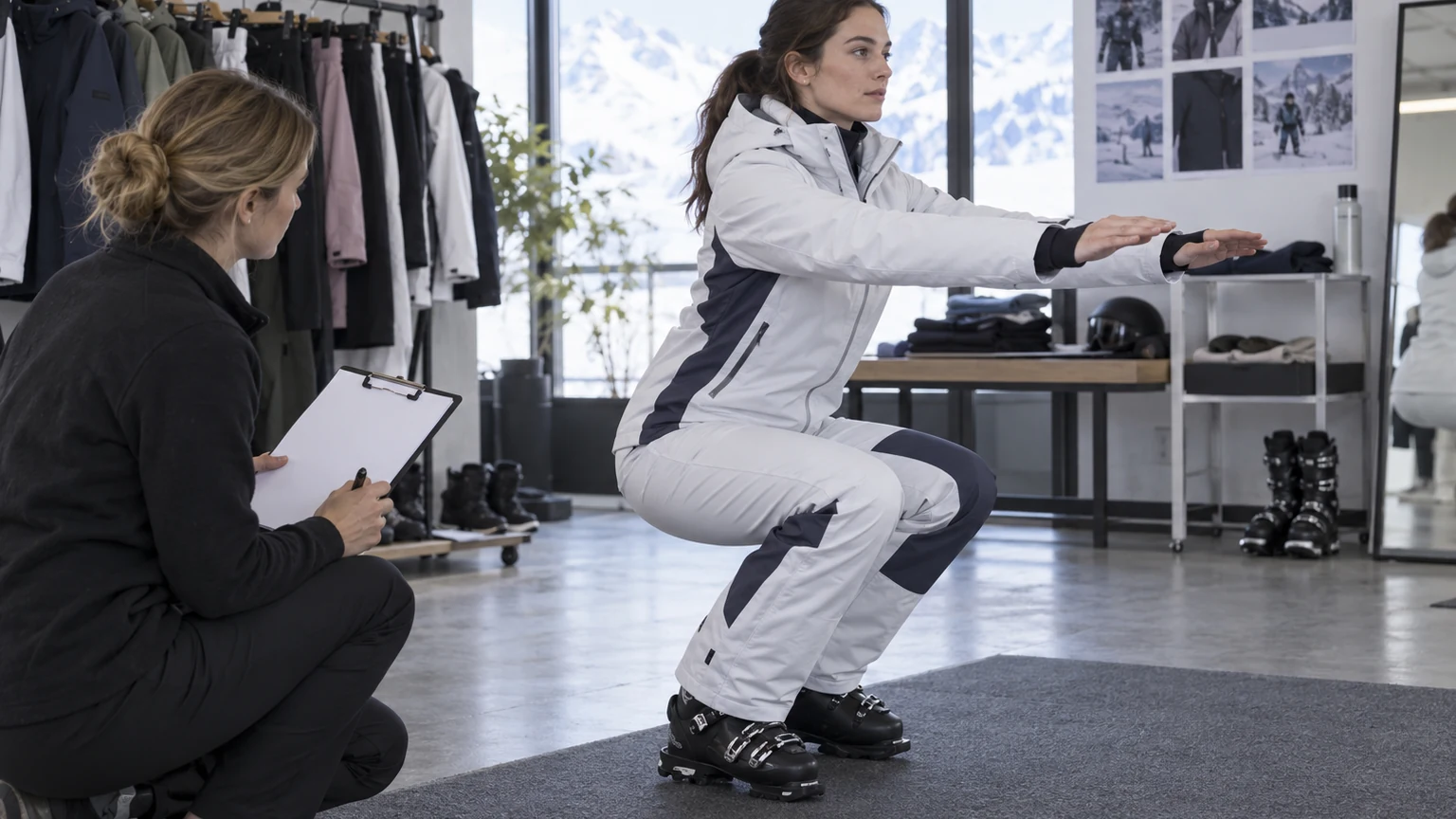
Fit the sample over the actual thermal base and midlayer that the product brief names. The wearer should be able to raise both arms, rotate, reach a binding, sit with knees lifted, and squat deeply without crotch pressure, collar lift, sleeve withdrawal, or hem exposure. Check the same movements in at least the smallest, middle, and largest planned sizes. A close silhouette can remain comfortable when ease is placed where the body moves; uncontrolled extra volume can bunch under a belt, pack, or harness.
Restroom access is part of fit usability. A long front zipper, rear opening, or internal braces may each solve a different problem, but the decision should be tested with gloves, base layers, and a wet-floor risk in mind. Record how the hood, sleeves, and upper body are managed when the garment is lowered. This practical check is especially important when a range is marketed as a ski suit for women rather than as a fashion-only item.
Which Waterproof and Breathability Ratings Should Buyers Compare?
Waterproof and breathability figures are meaningful only with their method, units, specimen, conditioning, and test date. ISO 811 uses hydrostatic pressure to determine a textile’s resistance to water penetration. A fabric result in millimetres of water column does not prove that a finished suit’s seams, zipper, pocket entry, hood, and cuff will remain dry. Those construction points need their own review and, where required, a finished-garment test plan.
ISO 11092 measures thermal resistance and water-vapour resistance under steady-state conditions with a sweating guarded hotplate. It can support a controlled comparison of shell materials or multilayer assemblies, but it does not reproduce changing exertion, wind, snow contact, fit, or individual comfort. Other reports may use moisture-vapour transmission rate rather than vapour resistance; the units are not interchangeable. A purchase order should preserve the exact method and acceptance threshold beside every claim.
No universal rating is “best” for every resort, climate, or skier. A lower-output consumer line may prioritize insulation and simple venting, while a high-output or spring range may need lighter insulation and more controllable ventilation. Marketing language should be no broader than the evidence. “Waterproof,” “breathable,” and “warm” each need a defined scope, not just a number copied from a fabric swatch.
One-Piece or Two-Piece: Which Format Works Better?
Both formats can be successful when the use case is explicit. A one-piece keeps the outfit visually coherent and maintains continuous torso coverage, but one size must accommodate upper- and lower-body proportions together. A jacket-and-pants set offers separate sizing, simpler indoor removal, independent ventilation, and easier component replacement; it also creates more color-size combinations and depends on overlap during movement.
| Factor de decisión | One-piece suit | Two-piece set | Verificación del comprador |
|---|---|---|---|
| Waist coverage | Continuous outer layer; no jacket hem separation | Depends on jacket length, pant rise, and overlap | Check deep bend, fall position, and seated lift posture |
| Fit flexibility | Torso, rise, bust, hip, and inseam must work together | Top and bottom sizes can be mixed | Review body-shape coverage and grade rules |
| Heat management | Needs usable vents because the upper garment stays connected | Jacket and pants can be adjusted or removed separately | Test vent access with gloves and intended layers |
| Mobility | Back length and rise strongly affect reach and squat | Pieces move independently; overlap must remain secure | Run four-movement full-kit trial |
| Restroom access | Opening path and garment handling need specific review | Usually simpler because the jacket stays separate | Conduct a clothed access trial |
| Repair and service | A local failure can remove the complete suit from use | A damaged component may be repaired or replaced alone | Define spare trims, repair limits, and turnaround |
| Inventory and returns | Fewer coordinated pieces but greater torso-fit sensitivity | More combinations but better split sizing | Model returns, markdowns, and SKU depth together |
For buyers comparing ski suit for womens search demand with a commercial range, the decision should be tied to target body data and channel economics. A rental or team program may value replaceable components. A fashion-led capsule may accept a narrower fit window if access and care are still usable. A broad distributor assortment may sample both formats before committing color and size depth.
The query best ski suit brands for women is not a testing method or a ranking by itself. A defensible comparison records the same fit protocol, weather evidence, care route, documentation, and service assumptions for every supplier; commercial relationships and comparison dates should also be disclosed.
| Caso de uso | Starting format to sample | First checks |
|---|---|---|
| Cold, lower-output resort days | Insulated one-piece or insulated two-piece | Layer room, waist coverage, lift comfort, and ventilation |
| High-output or changeable conditions | Shell with separate layers or a vented suit | Moisture escape, vent access, movement, and midlayer volume |
| Broad body-shape assortment | Two-piece set | Split sizing, jacket-pant overlap, and grade coverage |
| Fashion-led capsule | One-piece suit | Torso and rise fit, access usability, care, and return exposure |
How Should a Ski Suit Be Cared For Without Damaging Its Finish?
Care instructions must match the actual shell, membrane or coating, insulation, seam tape, closures, and trims. Close zippers and hook-and-loop tabs, remove only permitted detachable parts, use the detergent and temperature stated on the permanent label, rinse as directed, and dry by the validated route. Do not assume that bleach, softener, high heat, dry cleaning, or a generic “reproofing” treatment is safe for every construction. The product-specific care route takes priority over general internet advice.
ISO 6330 provides standardized domestic washing and drying procedures for textile testing; it is a repeatable test framework, not a universal consumer instruction. After defined care cycles, inspect dimensions, appearance, seam tape, delamination, closures, and relevant water-resistance evidence. Store the clean, fully dry suit uncompressed and away from prolonged heat or direct sunlight. These steps help control returns and service costs whether the garment is a ski suit for women or a two-piece set.
[Inline image placeholder: close, text-free care inspection showing a women’s ski suit being checked at zipper, cuff, seam-tape, and care-label areas]
What Should Buyers Check Before Selecting a Women’s Ski Suit?
- Define the wearer and conditions. Record resort or touring use, activity intensity, expected temperature and precipitation, lift exposure, base and midlayers, and whether snowboarding is also in scope.
- Freeze the fit block. Require body measurements, garment measurements, grading rules, tolerances, and a layer-specific movement protocol across the planned size range.
- Match evidence to claims. Identify the hydrostatic-pressure and vapour-resistance methods, specimens, conditioning, seam scope, and acceptance criteria before testing.
- Compare complete systems. Evaluate one-piece and two-piece samples for warmth management, waist coverage, ventilation, access, repair, packaging, and return exposure rather than silhouette alone.
- Audit care and service. Approve the final label against verified components, define post-care inspection, and document spare-part and repair expectations.
De la empresa Yuelei Sports’ ski-suit category y ski-jacket range provide starting points for a B2B specification discussion. The pages establish product scope, not a blanket performance certification. Buyers can also compare the existing women’s one-piece versus two-piece guide before sharing the target body chart, layer package, construction brief, and required evidence with the supplier.
Preguntas frecuentes
Is a women’s ski suit warm enough for cold and wet ski days?
It can be, when insulation, shell construction, base layers, ventilation, and closures match the exposure. A one-piece may reduce waist gaps, but it does not guarantee warmth or dryness by itself. Check the complete layer system and the scope of any material or garment test before making a performance claim.
How should a women’s ski suit fit over thermal base layers?
It should allow overhead reach, torso rotation, binding reach, seated posture, and a deep squat without crotch pressure, collar lift, sleeve withdrawal, or hem exposure. Fit samples over the intended base and midlayers and verify the smallest, middle, and largest planned sizes. Controlled ease is more useful than simply sizing up.
¿Qué valores de impermeabilidad y transpirabilidad son los mejores para esquiar?
There is no single best pair of ratings for every skier or climate. Compare results only when the method, units, specimen, conditioning, and acceptance criteria are comparable; ISO 811 and ISO 11092 address different material properties. Review seams, closures, vents, and wear conditions separately because fabric data alone does not certify the finished suit.
¿Debería elegir un traje de esquí aislado o un traje con capas separadas?
An insulated suit can simplify a consistently cold, lower-output resort setup. A shell with separate layers is more adjustable when activity and weather change, and it can reduce overheating during hard skiing. Choose after mapping the expected exertion, lift time, midlayer volume, venting, and care route.
¿Puedo usar un traje de esquí tanto para hacer snowboard como para esquiar?
Potentially, provided the pattern and construction support deeper flexion, frequent sitting, binding movement, abrasion exposure, and usable vents and pockets. Test the complete outfit with snowboard boots, gloves, and the intended base layers. A skiing label alone is not evidence that the fit transfers unchanged.
¿Cómo puedo lavar y secar un traje de esquí sin dañar el revestimiento impermeable?
Follow the permanent care label and the verified instructions for the exact shell, insulation, coating, seam tape, and trims. Close fasteners, use only permitted products, rinse thoroughly, and dry by the specified method; avoid assuming that high heat or a generic reproofing treatment is safe. Store the suit fully dry and inspect it after repeated care.
Referencias
- ISO 811:2018 — Textiles — Determination of resistance to water penetration — Hydrostatic pressure test
- ISO 11092:2026 — Textiles — Measurement of thermal and water-vapour resistance under steady-state conditions
- ISO 6330:2021 — Textiles — Domestic washing and drying procedures for textile testing
- U.S. Federal Trade Commission — Care Labeling Rule
Final Buying Rule for a Warm, Flattering Fit
The best women’s ski suit is not the smallest-looking sample or the one with the largest isolated waterproof number. The defensible sequence is to define the skier and weather, choose one-piece or two-piece architecture, build the pattern around the complete thermal layer package, and then verify movement, construction, claims, and care. Keep fabric tests separate from finished-garment promises, and treat access, repairs, returns, and size grading as part of warmth and comfort rather than afterthoughts. For a B2B development conversation, review Yuelei Sports’ ski-suit products and share the target market, size range, layer plan, test methods, and care requirements. The durable principle is simple: a flattering silhouette earns trust only when it still fits, protects, and functions in motion.