 Xiamen Yuelei Sports Co., Ltd.

When a technical engineer in Bergen named Elena encountered wet collars in an illustrative rental-fleet trial, she reordered one seal size and had every user fold the lip inward. Water tracks appeared during the next controlled pool entry. The latex was not simply defective: hair crossed some sealing surfaces, skin products contaminated others, several collars were reversed, and one unit had already been over-trimmed. The failure was a sizing and handling problem before it became a repair problem for the dry suit latex neck.
Résumé : Separate rolling from a true water path before changing the component. Inspect three zones—the skin interface, the latex body, and the suit bond—then use only the maker-approved low-pressure test. ISO 811 is a fabric hydrostatic-pressure test method, not certification of a complete suit or collar. Re-don a clean, correctly sized seal when the issue is handling; stop use and obtain qualified replacement for cracks, tears, permanent stretch, over-trimming, or bond separation.

How Do You Separate a Rolled Collar from a True Leak?
A rolled collar is a geometry problem: an edge turns, wrinkles, or migrates instead of maintaining smooth contact around the wearer. A leak is a water path. The two can coincide, but a wet shoulder can also result from trapped hair, clothing under the sealing surface, perspiration, condensation, a pinhole, a torn edge, or failure where latex is bonded to the suit. Diagnosis should therefore identify location, timing, wearer, movement, and repeatability before anyone cuts or glues.
Interface faults may disappear after correct donning, cleaning, or size selection; component faults remain on the same unit and location. If wetness follows one operator but not one suit, start with fit, hair, hood, clothing, and technique. If it follows one suit across different operators, prioritize the latex body, attachment, and adjacent fabric.
How Do You Confirm the Water Path Before Cutting?
Remove the suit from use and inspect it dry under diffuse light. Record timing, side, movement, wearer, and repeatability. A continuous damp ring suggests a poor skin interface; one narrow track points to hair, a fold, or a local defect; wetness below the attachment area directs attention to the bond or adjacent fabric.
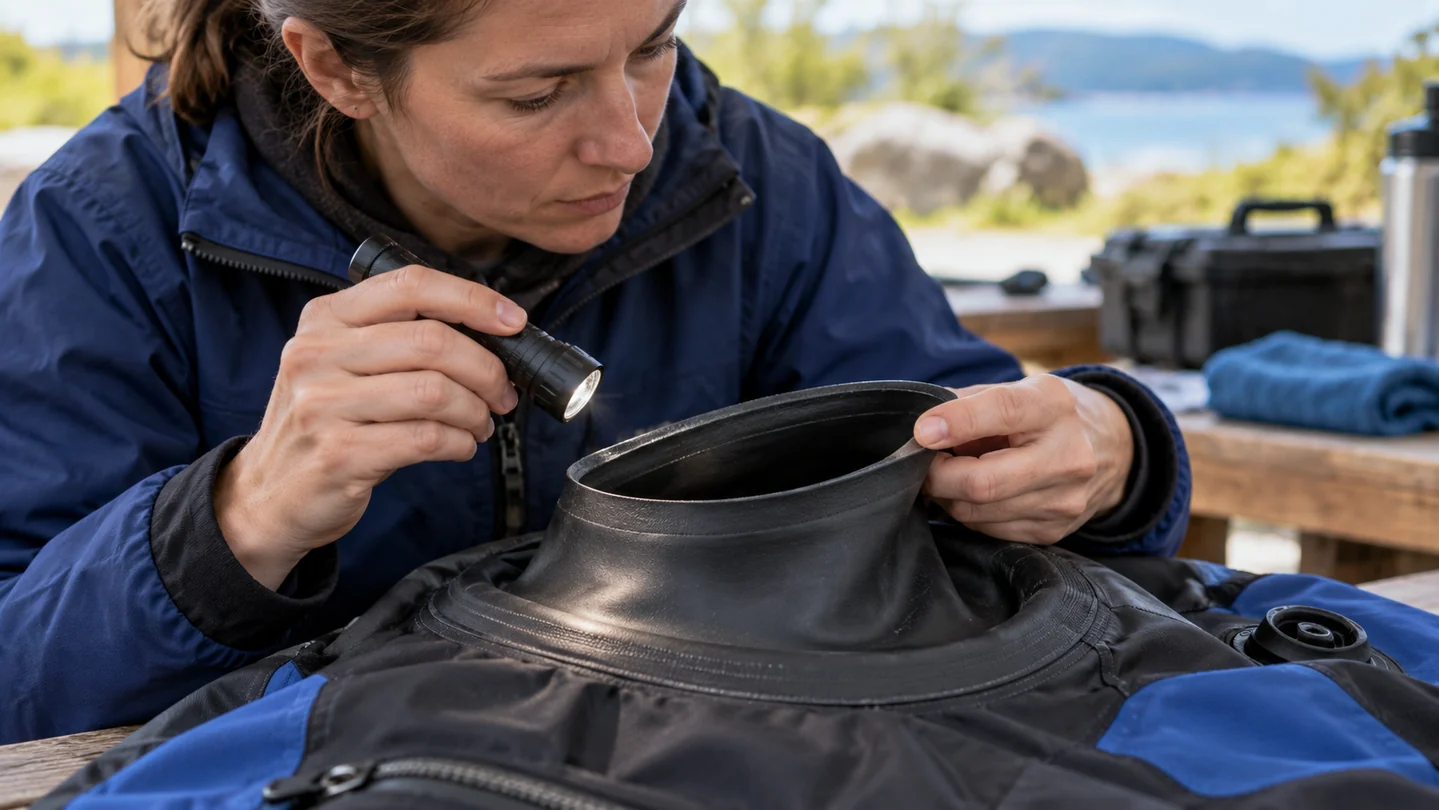
Examine the collar without aggressive stretching. Make a 360-degree visual pass for nicks, edge waves, discolouration, stickiness, lost recovery, and bond-line lifting. Then classify the suspected path: between skin and latex; through the latex; through the adhesive joint or adjacent suit. Check contamination, incorrect size, prior trimming, a hidden pinhole, age cracking, and a lifted bond as separate possibilities rather than calling all wetness a failed collar.
DAN notes that oxygen, ultraviolet light, ozone, and oils are unfriendly to latex. Inspection findings—not a universal calendar age—should control disposition. Do not pull hard to “open” a possible crack, use a sharp probe, apply solvent, or cut away an edge. Photograph the as-found condition and retain a replaced part when practical; it may reveal a recurring storage, sizing, or process problem.
How Can a Rolling Collar Be Corrected Without Damage?
Rolling usually begins when compression and friction are uneven. An opening that is too large may migrate during head movement; one that is too small may bunch as it is pulled over the head. A collar left folded, twisted, or sitting over hair, an underhood, or an undergarment loses continuous skin contact. Residue from sunscreen, cosmetics, conditioner, skin oil, or an incompatible dressing can further change friction and degrade the material.
The safe first action is reversible: remove jewellery, clear hair and clothing, confirm orientation, and re-don to the maker’s instructions. Support the opening with the hands as directed instead of pulling on a thin edge, and settle the material smoothly against bare skin without twisting. Do not assume every design is worn folded inward or outward; orientation is model-specific. A hood skirt or thermal layer should not cross the sealing surface unless the suit maker expressly designed the system that way.
Clean only with the method and products identified by the manufacturer, rinse away permitted residues, and let the component dry as instructed. Use talc, a donning aid, or a dressing only when the maker identifies it as compatible. Oils, petroleum products, unknown silicone lubricants, solvents, heat, and improvised powders can change friction, attack latex, or contaminate a future adhesive process. Stop use if breathing, swallowing, circulation, or skin condition is affected; comfort complaints are not a reason to cut before size and technique have been checked.
How Do You Locate Interface, Latex, or Bond Leakage?
Water at the shoulders should be traced through three possible paths. At the skin interface, causes include hair, wrinkles, incorrect orientation, contamination, a mismatch between neck circumference and opening, or irreversible over-trimming. Through the latex body, causes include a pinhole, edge nick, tear, age cracking, or material that has become soft, sticky, brittle, or permanently stretched. At the attachment, causes include adhesive separation, a lifted edge, or damage in nearby suit material.
A repeatable interface path may still be a specification fault rather than user error. Compare the unstrained opening and taper with the approved component, confirm that the collar sits at the intended height, and observe representative head movement during a dry fit. A leak through latex tends to remain at a fixed material location; attachment leakage follows the circumference or appears below a lifted edge. Do not let an apparent skin-interface track rule out a pinhole immediately above it, because water can travel along the outside before entering the suit.
Buyers should record collar size, taper, and compatible suit model rather than ordering a generic latex gasket. Sample fitting should cover the wearer range and representative head movement. Guide rings are reference features, not permission to alter every unit. Trimming is justified only where the maker authorizes it for the exact component and the measured fit calls for it; over-trimming permanently enlarges the opening, cannot be reversed with adhesive, and may leave too little sound material for an approved repair.
How Should Suspected Leakage Be Tested Without High Pressure?
A trained technician should follow the maker’s bench-test procedure at the lowest specified pressure. DAN describes low-pressure bubble observation with a 1:100 detergent solution; facilities should still use approved closures and inflation equipment, never an improvised pressure vessel. No wearer may be inside during the test.
Mark suspected locations without damaging latex, then rinse and dry as directed. Stop if the suit distorts, a closure shifts, a bond lifts, or the permitted pressure is unknown. Never improvise with a compressor, blocked valve, high-pressure gas, or pressure selected from a fabric-data sheet. ISO 811 measures hydrostatic resistance on a textile specimen; it does not supply an inflation pressure for a complete suit, collar, zipper, or repaired bond.
Post-service acceptance should repeat the manufacturer-approved leak check after the specified cure and conditioning period, then add visual inspection, gentle movement of the serviced zone, and confirmation that closures and valves still operate as intended. Record the procedure revision, result, technician, date, component identity, and disposition. A controlled water session may be part of an operator’s return-to-service process when the maker allows it, but it must not substitute for the bench inspection or become the first attempt to discover a serious defect.
When Is Field Correction, Patching, or Full Replacement Appropriate?
Re-donning a clean collar, correcting orientation, clearing hair, or fitting the correct approved size is a field correction. A small localized defect may be serviceable only when the manufacturer authorizes the exact material, adhesive, surface preparation, cure conditions, technician competence, and post-repair test. Generic tape, household glue, aggressive cleaning, and an improvised leak repair are not a return-to-service basis.
A temporary field action should remove the unit from exposure, keep it dry, label the condition, and preserve evidence until an authorized decision is made. It is not a hidden patch followed by continued diving or paddling. A patch may be acceptable for a limited, localized defect only within published maker instructions; damage at a highly stretched edge, an advancing crack, or uncertain bond condition usually exceeds that boundary. Full component replacement resets the service baseline, while bond or nearby fabric damage may require a qualified suit-service facility rather than a component-only change.
Replace for cracks, stretched-edge tears, widespread degradation, permanent set, unknown chemical exposure, excessive trimming, repeated failure, or out-of-scope bond separation. An illustrative TCO review should compare qualified intervention with replacement, including parts, labour, cure time, testing, freight, downtime, rework risk, warranty effect, lost rental or course capacity, and operational consequence. A low-cost intervention is not economical when it returns the same unit to quarantine twice.
Which Repair-or-Replace Path Fits Each Condition?
| Option | Suitable condition | Control and acceptance evidence | Cost and TCO boundary |
|---|---|---|---|
| Re-don and clean as instructed | Roll or intermittent track; no material defect | Visual pass, correct technique, dry movement check | Lowest intervention; investigate repeats |
| Select another approved size | Opening and wearer geometry are mismatched | Approved component identity and representative fit record | May reduce complaints and alterations |
| Qualified localized service | Maker explicitly permits the defect and process | Authorized materials, cure record, inspection, and retest | Viable only when total service risk is acceptable |
| Qualified replacement | Cracking, tear, set, over-trimming, or out-of-scope bond failure | Component traceability plus full post-service acceptance | Higher input may lower repeat and outage cost |
The matrix is a gate, not a substitute for the service manual. If a defect falls between categories, quarantine and escalate it. Whether service affects warranty or the declared configuration must be answered by the responsible manufacturer or service provider.
What Does Each Roll or Leak Pattern Require Next?
| Symptôme observé | Most useful cause checks | Permitted immediate action | Evidence to retain | Stop-use boundary |
|---|---|---|---|---|
| Edge rolls during head movement | Orientation, size, hair, garment interference, residue | Re-don clean; verify approved size | Unit, wearer, size, orientation, movement | Persistent roll, pain, or damage |
| One narrow water track | Hair, crease, nick, pinhole, local bond lift | Quarantine; run approved bench test | Marked location, image, test method and result | Defect confirmed or test limits unavailable |
| Leak after previous trimming | Opening dimension, edge quality, wearer range | Quarantine and compare with maker’s specification | Opening measurement, prior-service record, component ID | Oversize opening or torn edge |
| Sticky, cracked, brittle, or slow-recovering latex | Ageing, UV, ozone, oils, chemicals, storage | Isolate unit; inspect related stock | Storage and chemical-exposure history | Replace through the approved service route |
| Wetness below attachment area | Bond line and adjacent fabric | Qualified assessment only | Bond photographs, adjacent-fabric condition, service history | Any separation, migration, or uncertain structural condition |
Which Standards Can Support a Collar-Leak Decision?
EN 14225-2:2017 covers requirements and test methods for dry diving suits; it is a European product standard, not a universal instruction for repairing every paddling or surface-water suit. Relevance depends on intended use, destination market, evaluated configuration, and claims. Citation alone does not establish certification or compliance, and a replaced collar or changed adhesive can matter if it alters the evaluated configuration. Buyers should request the standard edition, test scope, sample identity, laboratory information, and current supporting documentation.
ISO 811:2018 is a test method for determining textile resistance to water penetration under hydrostatic pressure. It can compare suitable fabric specimens but does not reproduce a moving skin interface, qualify an adhesive joint, establish a complete-suit inflation pressure, or certify a finished product. DAN offers practical maintenance guidance; PADI training addresses buoyancy control, common problems, and basic maintenance. Neither is product certification or a repair authorization. Unsupported claims create tender, warranty, return, and liability exposure, so marketing language should follow the evidence for the exact product and destination.
How Can Buyers Prevent Repeat Rolling and Leakage?
- Specify the interface. Record wearer range, material, sizes, taper, attachment, intended use, and approved care products.
- Approve samples. Use one documented fit-and-movement protocol; retain the accepted configuration and change record.
- Define service authority. State which field corrections operators may perform and which findings require the manufacturer or a qualified repair service.
- Control spares. Match components, authorized adhesives, instructions, technician competence, cure records, and acceptance checks; hold appropriate spare sizes for critical fleets.
- Review fleet evidence. Trend symptoms by unit, size, wearer, storage, care, and service history instead of inventing a universal replacement interval.
Storage control is part of reliability. Keep clean, dry components away from direct sunlight, heat, ozone-generating equipment, exhaust, fuel, oils, and incompatible chemicals, following the maker’s instructions. Avoid loads that leave a persistent crease. Rotate stock by traceable receipt and condition rather than promising an undocumented service life.
For a rental, training, rescue, or expedition fleet, the service log should connect unit ID, component batch or source, fitting size, inspection findings, cleaning products, storage location, field complaints, repair disposition, cure and test records, and return-to-service approval. Trending repeat failures by cause can justify better training, a different size mix, or more spares. This condition-based approach reduces downtime and total cost without inventing a fixed replacement interval.
For B2B programs, Yuelei Sports can discuss configurable interfaces, sample validation, documentation, and sourcing support around the dry suit latex neck. Final decisions remain tied to the agreed specification and intended application.
How Should Common Rolling and Leakage Questions Be Resolved?
Why does my dry suit latex neck seal roll?
Uneven friction or compression from orientation, size, trapped material, residue, or permanent stretch can turn the edge. Re-don as instructed; stop if rolling persists or damage is visible.
How do I stop a latex neck gasket from leaking?
Locate the water path first. Clear trapped material, inspect the interface, latex, and bond, and use a trained technician for the approved low-pressure test; confirmed damage requires authorized service or replacement.
Can I trim a dry suit neck seal?
Only when the manufacturer permits it for that model and provides limits. Cutting is irreversible; uncertain size, missing instructions, a damaged guide, or prior alteration requires manufacturer or qualified-service advice.
How tight should a latex neck seal be?
It should maintain skin contact through movement without impairing breathing, swallowing, circulation, or skin condition. No universal circumference or pressure applies; use the maker’s size system and representative fitting.
When should a dry suit latex neck seal be replaced?
Replace it for cracking, tearing, permanent stretch, stickiness, brittleness, excessive trimming, repeated leakage, or an out-of-scope bond problem. No universal life span overrides inspection, history, exposure, and manufacturer criteria.
Can lubricant or talc help prevent a neck seal from rolling?
A manufacturer-approved dry powder or dressing may reduce donning friction, but it cannot correct wrong sizing, a fold, degradation, or trapped material. Never substitute oil, petroleum products, unknown silicone products, solvents, or other unapproved chemicals.
Which Sources Support Safe Collar-Leak Diagnosis?
- BSI, BS EN 14225-2:2017, Diving suits — Dry suits — Requirements and test methods
- ISO 811:2018, Textiles — Détermination de la résistance à l’infiltration d’eau — Essai de pression hydrostatique
- Divers Alert Network, Tools for a Healthy Drysuit
- PADI, Dry Suit Diver course overview
The durable rule is simple: correct a handling cause, document a testable defect, and replace anything whose safe service boundary is uncertain.
Procurement teams, distributors, operators, and repair coordinators can review Yuelei Sports’ vêtements de plongée à capuchon and contact the team to align collar sizing, sample checks, service documentation, and replacement planning with the intended program.