 Xiamen Yuelei Sports Co., Ltd.
A wholesale dry-suit enquiry often begins with a photograph and a request for the same design in several sizes. Consider a hypothetical paddling operator whose sample fits standing but pulls across the shoulders in a kayak; a larger size fixes the reach but leaves the boots loose. The purchasing problem is the relationship between pattern, equipment and use, rather than the colour of the shell.
Résumé : Custom dry suits should be specified for their intended activity before materials, branding or price are agreed. Diving, surface paddling and professional rescue are different briefs. Buyers need a layered fitting, documented closure and seam checks, and a service plan; neither a fabric report nor a supplier badge establishes finished-suit suitability.
Choose the application before the fabric
A paddling suit must accommodate seated hip flexion, repeated torso rotation and the intended personal flotation device. A diving suit has a different operating environment, including changing pressure and trained management of suit gas. Professional rescue procurement adds the organisation’s operating procedures, equipment interfaces and destination-market requirements. A garment described simply as “technical” does not resolve these differences.
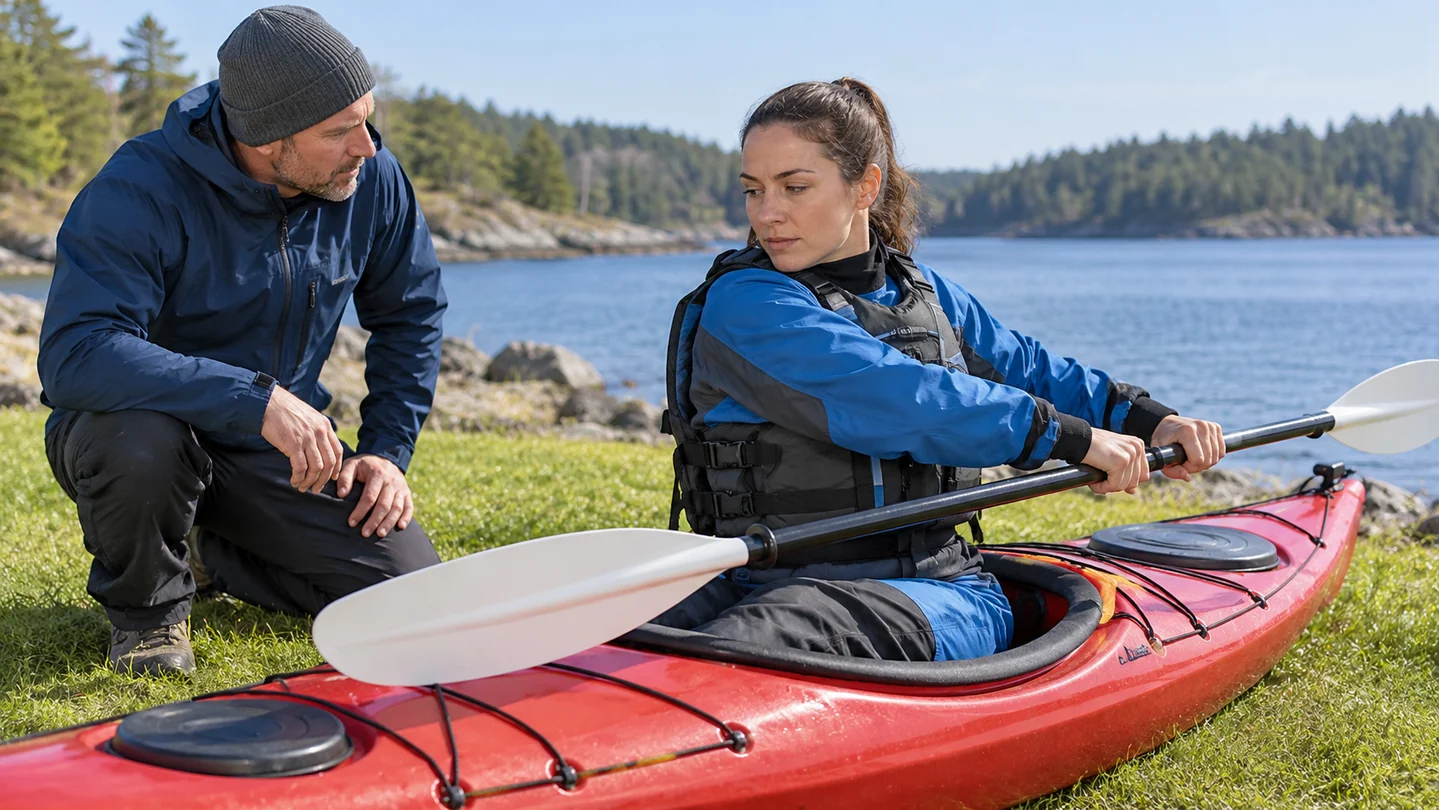
The first enquiry should record activity, water exposure, expected duration, workload, footwear and the equipment worn over the suit. Cold-water planning also needs a credible recovery scenario. RNLI guidance explains why cold-water shock matters; a comfortable dockside fitting does not establish protection during an unplanned immersion.
Where a buyer is comparing surface and underwater applications, the existing scuba dry suit versus paddling drysuit guide helps separate those design questions before samples are requested. A shared colour scheme is possible; shared suitability must be demonstrated independently.
Separate water protection from thermal insulation
A shell dry suit limits external water entry when its fabric, seams, seals and closures work together. Clothing beneath the shell supplies much of the insulation. Neoprene constructions can contribute material insulation, but their behaviour still depends on thickness, compression, fit and the complete garment. No photograph establishes a temperature limit.
The material request should name the shell construction and the evidence required for its intended claim. ISO 811 describes a textile hydrostatic-pressure test; it does not assess every zipper, neck seal, sock or completed garment. A fabric result therefore belongs alongside a separate finished-suit inspection procedure, rather than standing in for one.
| Construction decision | Potential advantage | Approval question |
|---|---|---|
| Membrane shell | Adaptable clothing beneath the shell | Is there room for the intended insulation and movement? |
| Neoprene construction | Material insulation and stretch | Are bulk, compression and care acceptable for the activity? |
| Local reinforcement | Coverage at repeated contact points | Does the added stiffness obstruct the working posture? |
| Integrated socks | Continuous garment coverage into footwear | Do socks fit the issued boots without folds or pressure? |
Check the suit with the complete equipment system
Record body dimensions using the supplier’s measurement instructions, chart revision and units. Ask whether the chart describes body dimensions or finished garment dimensions, and whether it already allows for underlayers. Automatically ordering one size larger can trade shoulder restriction for poor boot control or misplaced knee panels.
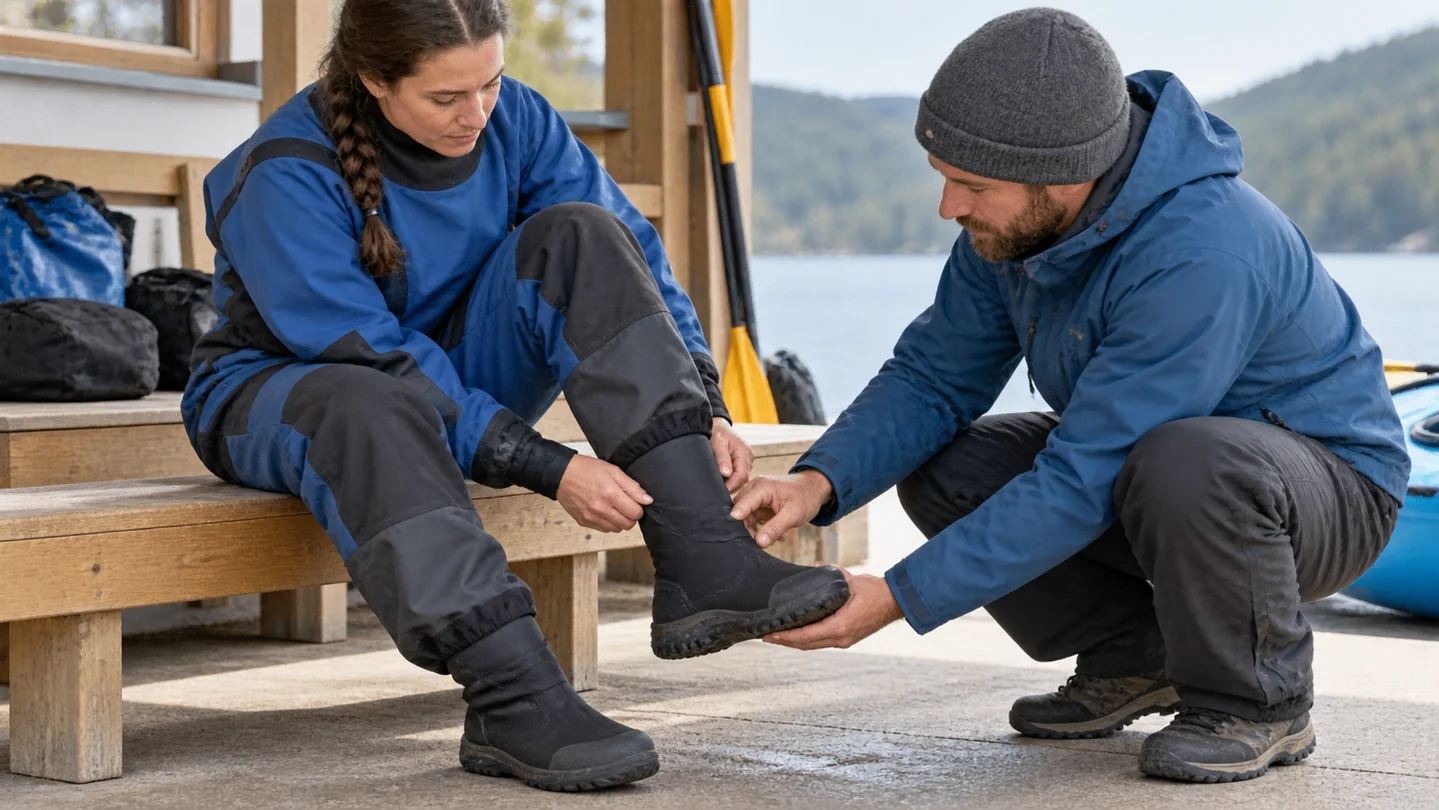
Fit samples with the lightest and bulkiest planned clothing sets. The wearer should sit, reach forward, bend the knees and operate accessible closures without forcing them. Include the actual PFD or harness and protective footwear. Seal discomfort, restricted breathing, zipper strain or inability to perform a necessary task should stop approval.
Boot fit deserves its own record: a shell that fits the torso can still leave integrated socks too large for footwear. Buyers reviewing a Veste sèche pour kayak should reproduce the cockpit posture; diving samples need the equipment and assessment appropriate to diving, with competent supervision.
Turn the sample into a repeatable production specification
An accepted sample needs an accompanying specification. Record materials, seam locations, sealing method, zipper identity, seal sizes, sock arrangement, tolerances, care instructions and approved branding positions. A later component substitution should trigger review where it changes fit, water entry, handling or repair.
| Approval stage | Record to retain | Motif |
|---|---|---|
| Design sample | Pattern and component revision | Prevents discussion around different versions |
| Layered fitting | Wearer, equipment and movement observations | Connects the size decision to actual use |
| Pre-production review | Approved construction and branding sample | Checks changes introduced after initial fitting |
| Shipment inspection | Agreed checks and disposition of defects | Creates a consistent release decision |
Testing should follow the garment and component makers’ procedures. Improvised high-pressure inflation, uncontrolled immersion or testing with a person inside an inflated suit can create hazards. The inspection brief should identify who is qualified to perform each check and what happens when a suspect suit is found.
Include maintenance and evidence in the purchase decision
The useful cost comparison includes samples, inspection, replacement seals, zipper service, drying space, freight and time out of use. Ask which components can be serviced locally, which require factory work and how a returned item should be assessed. A low unit price can be outweighed by an unavailable replacement component.
Care instructions must be specific to the supplied materials. Rinsing, drying and storage should follow the maker’s instructions; seal treatments and zipper lubricants are not interchangeable. DAN’s maintenance guidance is a useful background reference, while the actual component instructions govern the purchased suit.
For regulated protective uses, establish the applicable conformity route before approving promotional wording. A supplier verification or quality-system certificate is different from a product-specific assessment. Professional rescue suitability, universal waterproofness and fixed-temperature claims require evidence covering the particular garment and intended use.
Prepare an enquiry that can be quoted accurately
Yuelei Sports lists dry-suit options for B2B enquiries. Buyers can use the neoprene dry suit for water sports listing as a starting point, then request written confirmation of construction, sizing and documentation for the proposed order. Listed options should not be assumed to include every possible accessory.
- Describe the activity and operating environment.
- Provide the size distribution, underlayers and equipment interfaces.
- Identify branding locations and quantities by colour and size.
- Agree sample acceptance, inspection, care and service responsibilities.
Foire aux questions
Can one custom dry suit cover diving and kayaking?
Only if the actual design and documentation support both applications. A surface paddling garment must not be assumed suitable for scuba diving.
Does a dry suit keep the wearer warm by itself?
Not necessarily. A shell mainly manages external water entry; underlayers, fit, exposure and workload remain central to thermal planning.
Should a buyer order one size larger?
The supplier’s chart and layered fitting should decide. Extra nominal size can create poor proportions without resolving the original restriction.
What should accompany a dry-suit sample?
The construction specification, size chart, component details, care instructions and relevant evidence should identify the same sample version.
Is a waterproof fabric report enough?
No. It does not establish finished seams, seals, closures, footwear fit or suitability for the proposed activity.
What belongs in a wholesale service agreement?
Include inspection, repair boundaries, component availability, returns assessment and responsibility for approved production changes.
Références
The strongest dry-suit specification describes what the wearer must do, then checks whether the complete system permits it. For a custom order, contact Yuelei Sports through its dry suits range with the use profile, sample requirements and size distribution.