 Xiamen Yuelei Sports Co., Ltd.
Consider a hypothetical resort buyer who approves a ski-suit sample over a T-shirt, then discovers that the same size pulls at the knees over winter layers and boots. The larger size leaves too much fabric around the ankles. The correction starts with the fitting conditions and pattern, rather than a heavier insulation specification.
Résumé : Custom ski suits should be selected as a complete clothing system. One-piece and jacket-and-trousers formats change fit, access and replacement decisions; insulation, shell construction and moisture management remain separate choices. Buyers need a layered movement trial, a finished branded sample, and documentation for the destination market before approving a wholesale order.
Choose the suit format before specifying insulation
A one-piece suit joins torso and leg fit in one pattern. It can simplify coverage at the waist, but torso length, seated movement and bathroom access need careful review. A two-piece outfit allows jacket and trouser sizes to be selected separately and individual garments to be replaced. Neither format is automatically warmer or better for every skier.
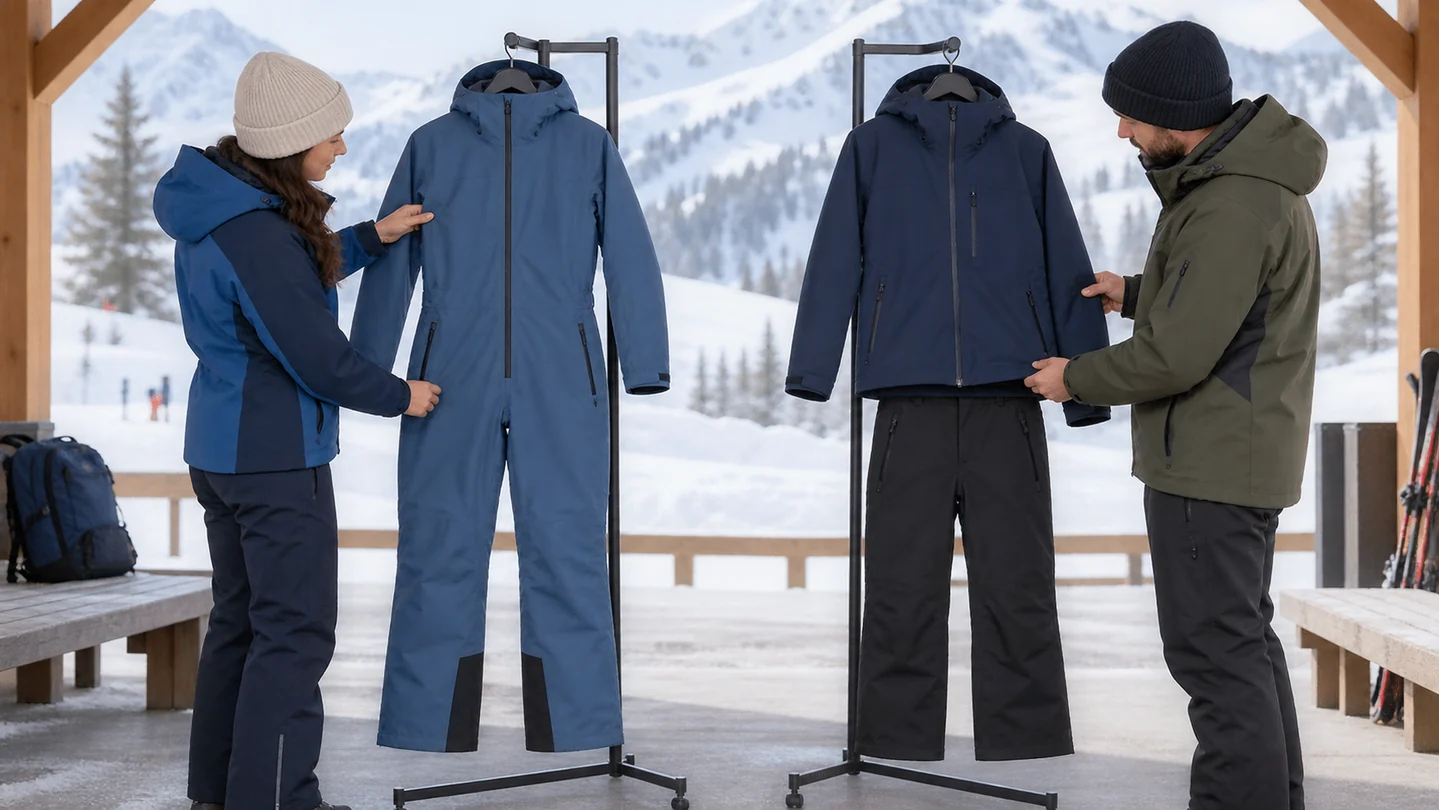
The initial brief should identify resort skiing, snowboarding, rental use, team uniforms or another defined application. Record workload, expected weather, layering and equipment. A rental operator may prioritise clear sizes, drying and repair, while a retail collection may place more emphasis on silhouette and colour continuity.
Le one-piece ski suit versus two-piece comparison provides a useful starting point for format decisions. The sample should then be fitted to the intended wearers; conclusions from one model or size cannot simply be transferred across a range.
Specify the shell and insulation as separate systems
The shell manages external weather exposure; insulation manages heat loss within the clothing system. Fill weight alone does not establish warmth, because distribution, compression, fit, moisture and activity affect the result. A universal temperature promise should not be attached to an untested custom design.
For waterproof claims, request the named method and tested material identity. ISO 811 addresses textile resistance to water penetration, while finished seams, closures and openings need their own evaluation. Surface water repellency is another property and should not be presented as proof that every part of the garment is waterproof.
Ventilation and access also need a practical brief. A pocket useful without gloves may become awkward with them; a hood should be tested with the specified helmet if that combination is part of the design. A photograph cannot establish that all helmet sizes or glove styles are compatible.
| Décision | Combinaison unie | Separate jacket and trousers |
|---|---|---|
| Size selection | Torso and leg proportions must work together | Upper and lower sizes can differ |
| Access | Main opening and bathroom arrangement need review | Individual layers can be removed separately |
| Repair or replacement | One damaged area can affect the whole outfit | A single garment may be replaced |
| Sample fitting | Check torso pull during bent-knee movement | Check waist overlap and jacket-to-trouser coverage |
Fit the sample with boots, gloves and the planned layers
Use the supplier’s current size chart and measurement instructions. Establish whether the chart describes the body or finished garment, then record the insulation assumed in the pattern. Sizing up by habit can leave displaced knee shaping and an overly long hem while the actual restrictive area remains unchanged.
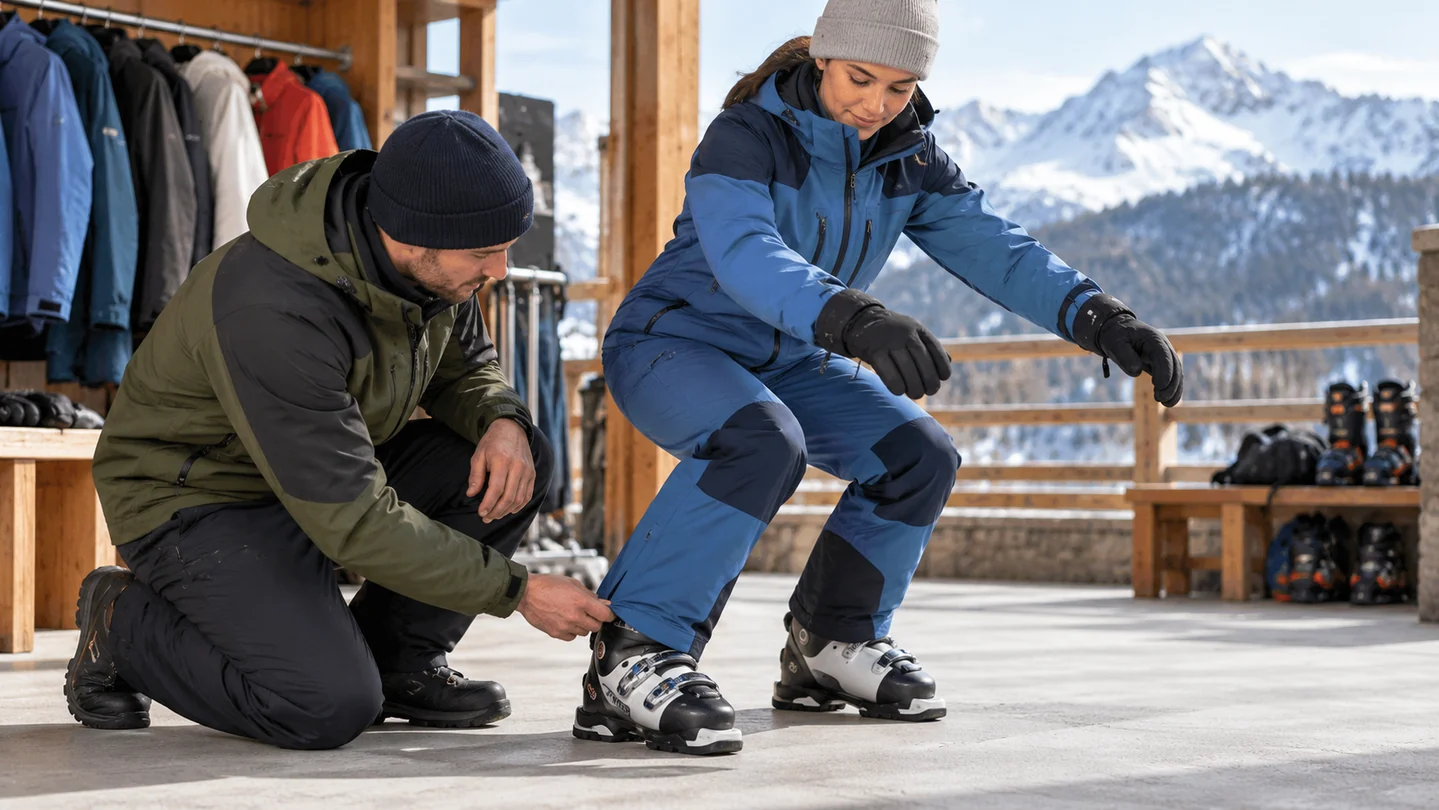
Conduct a fitting in the planned base and midlayers, with the intended boots and gloves. Ask the wearer to bend the knees, sit, reach forward and operate the main closures. Assess whether fabric pulls across the seat, the cuffs expose a gap, or the trouser hem interferes with the boot area.
For a range of sizes, repeat the review with representative wearer proportions rather than relying on one attractive sample. Record where the restriction occurs and whether it changes with posture. A pattern adjustment may be more appropriate than changing the nominal size or adding stretch fabric indiscriminately.
Approve branding and care before freezing the specification
Colour blocking, prints, badges and embroidery can alter a garment’s materials or attachment details. Identify their locations and methods in the sample specification. Confirm the final construction after branding, especially where stitching or adhesive affects an area associated with weather protection.
Agree care instructions that match the entire garment, including trims, insulation and printed elements. Review dimensions, appearance and agreed performance checks after the specified treatment. ISO 6330 provides domestic washing and drying procedures for textile testing; it is not a universal guarantee of wash life.
| Buyer | Priority to validate | Cost often missed |
|---|---|---|
| Rental operator | Size recognition, drying and service access | Time out of stock during repair |
| Retail brand | Consistent fit and final branded appearance | Returns from uneven grading |
| Ski team | Movement with issued layers and equipment | Replacement sizes late in the season |
| Children’s collection | Age-appropriate design and destination rules | Redesign after late compliance review |
Keep compliance and price comparisons model-specific
US apparel orders may need review under the FTC Care Labeling Rule and applicable clothing-textile flammability requirements. Children’s clothing requires particular attention to age, design and applicable safety rules, including drawstrings where relevant. EU chemical requirements and protective-equipment obligations depend on destination and intended claims.
A supplier audit or verification does not establish the performance of every ski suit. Request reports and declarations that identify the actual material or product, scope and date. Avoid treating an unrelated certificate as evidence for waterproofness, insulation or a children’s design.
Compare development charges, sample revisions, branding setup, quantities by size and colour, inspection, freight and replacement arrangements. A lower unit quote may exclude a required feature or spread setup costs differently. The bill of materials and approved sample should make those differences visible before price negotiation.
Submit a brief that a factory can turn into a sample
Yuelei Sports lists factory custom ski suits et custom-design waterproof ski suits for enquiry. Buyers should confirm the proposed construction, options, quantities and evidence rather than assuming every listed image shows the same supplied configuration.
- Specify the activity, wearer group and suit format.
- Provide the size distribution, layers and equipment.
- Identify mandatory materials, closures and branding positions.
- Agree sample checks, care, inspection and changes before production.
Foire aux questions
Are one-piece ski suits warmer than separates?
Not automatically. Coverage is only part of the comparison; insulation, fit, wind exposure, moisture and activity also matter.
Should ski suits fit tightly?
They should permit the required layered movement without uncontrolled excess fabric. The intended posture is more useful than a universal “tight” or “loose” rule.
Does heavier insulation always improve a ski suit?
No. Excess bulk can restrict movement or increase sweating during activity. Specify insulation around the use profile and fitting results.
Can a sample be approved before the logo is added?
It can support early fitting, but the final branded construction should also be reviewed before production approval.
What should a ski-wear quotation include?
The complete configuration, size and colour quantities, branding, sample work, inspection, packaging and delivery terms should be explicit.
Do children’s ski suits need a separate review?
Yes. Adult proportions and requirements should not be transferred to children’s designs; the destination’s applicable rules need their own assessment.
Références
- 16 CFR Part 423: FTC Care Labeling Rule
- CPSC: clothing textiles
- CPSC: drawstrings in children’s upper outerwear
A ski-suit sample is useful when it proves that the chosen format works with the wearer’s layers and equipment. Contact Yuelei Sports through the ski suits range with the intended use and sample-approval brief.