 Xiamen Yuelei Sports Co., Ltd.

When a technical engineer in Halifax encountered a sizing problem for a cold-water dive program, he reviewed a video, accepted a loose sample, and entered confined water convinced that ordinary scuba experience would be enough. Within 15 minutes, gas had migrated into the legs, the boots lifted, and the instructor ended the exercise. The garment had not failed—the team had treated a pressure-changing buoyancy envelope as waterproof clothing. That reversal answers the real question: how should a diver use a dry diving suit safely?
Résumé : Dry-suit diving is learnable, but it requires qualified instruction, correct fit, deliberate weighting, controlled inflation and exhaust, and rehearsed emergency responses. At 10 m of seawater, absolute pressure is about 2 bar, so suit gas volume changes materially with depth. ISO 14225-2 covers diving dry-suit requirements; it does not certify diver competence. Buyers should specify the whole system—suit, insulation, valves, seals, footwear, training, inspection, and service parts.
A diving drysuit keeps liquid water away from insulation while allowing the diver to add gas against squeeze and vent expanding gas during ascent. A scuba diving dry suit therefore differs from a surface paddling garment: valves, depth-rated components, fit, gas control, and training are essential rather than optional accessories.

1. What Is a Dry Suit for Diving?
A diving suit creates a dry air space around the body; thermal protection comes from neoprene, an undergarment, or both. Pressure rises by roughly 1 bar for every 10 m of seawater. During descent the gas compresses and may cause suit squeeze; during ascent it expands and must be released through the exhaust valve.
- The low-pressure inflator adds short, controlled bursts of gas;
- The adjustable exhaust is normally positioned near the upper arm;
- The BCD remains the primary buoyancy device under many training systems;
- Only enough suit gas should be added to remove squeeze and preserve mobility;
- Procedures must follow the instructor, training agency, and equipment manufacturer.
ISO 14225-2 specifies requirements and test methods for diving dry suits. A buyer should request the exact model report—not a certificate from a different shell, valve, zipper, or production version.
2. How Should Fit and Weighting Be Checked?
ISO 8559-1 supplies consistent body-measurement definitions, but task fit must be verified with the actual undergarment, BCD, cylinders, gloves, fins, and hood. A blanket “one size larger” rule can create excess leg volume and unstable gas migration.
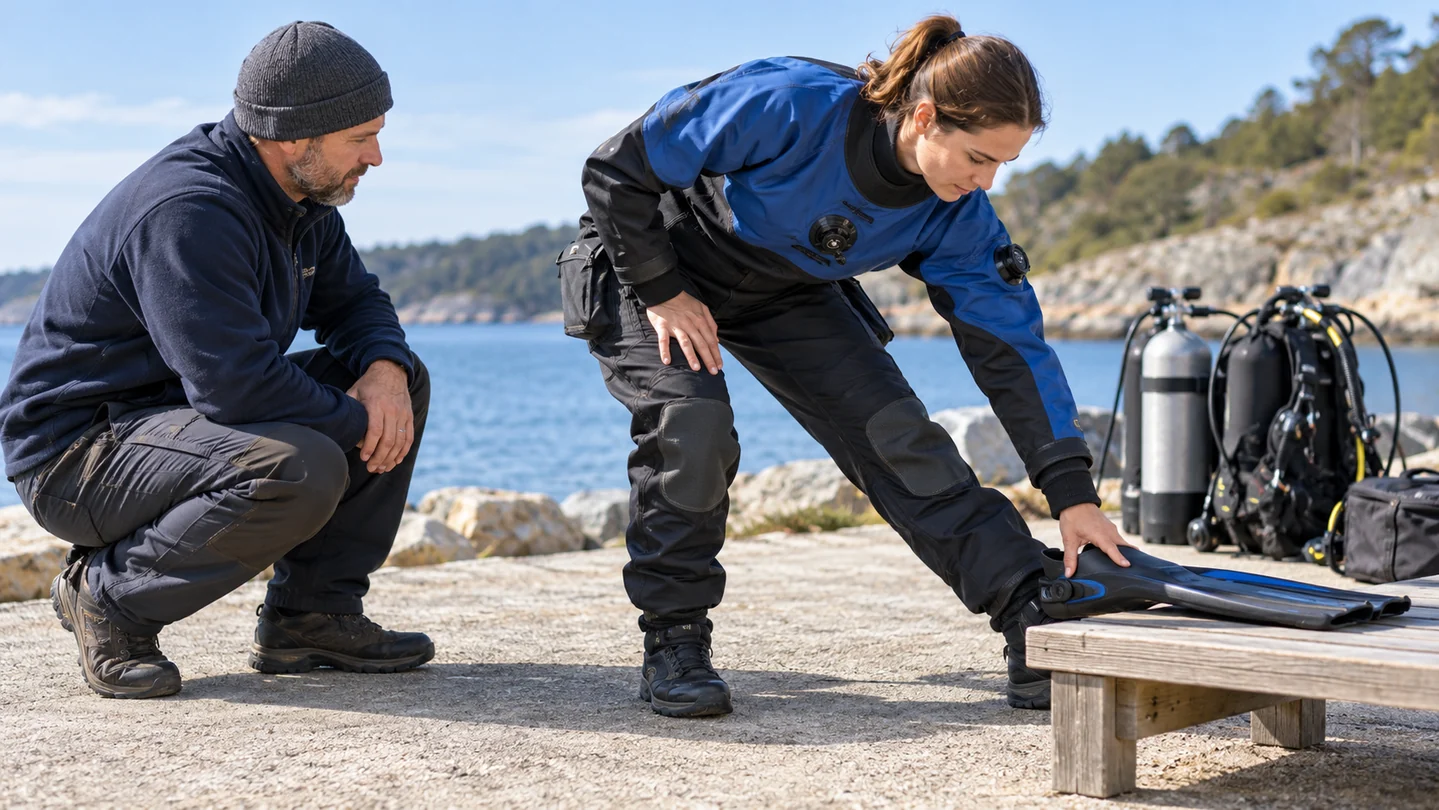
| Check | Acceptable result | Warning sign |
|---|---|---|
| Shoulder reach | Both valves reachable | Torso pulls or valve is blocked |
| Squat and fin | Crotch stays in position | Boots slip or legs balloon |
| Undergarment loft | Warmth without compression | Boot or wrist restricts insulation |
| Weight check | Controlled stop with near-empty cylinder | Overweighting requires a large gas volume |
| Horizontal trim | Stable with small corrections | Feet repeatedly rise or sink |
3. What Skills Must Be Practiced?
Training should move from dry checks to confined water and only then to open water. PADI’s Dry Suit Diver course includes knowledge development and two open-water dives; agency details differ, but supervised repetition is the common safety principle.
- Inspect and close the zipper with a second-person check;
- Connect and test the inflator and exhaust;
- Descend while adding minimal gas against squeeze;
- Maintain horizontal trim and vent during ascent;
- Recover from feet-up gas migration under supervision;
- Respond to a stuck inflator, blocked exhaust, or lost gas supply.
Reading instructions is not a substitute for dry diving suit training. Emergency techniques should be learned from a qualified instructor in controlled water, not improvised from an article.
4. Dive Dry Suit vs. Wetsuit
| Dimension | Dive dry suit | Wetsuit |
|---|---|---|
| Water entry | Designed to remain dry | Allows a thin water layer |
| Buoyancy change | Gas must be added and vented | Neoprene compresses with depth |
| Thermal system | Shell plus undergarment or neoprene | Neoprene thickness |
| Training load | Higher; valves and inversion recovery | Lower but still condition-dependent |
| Service cost | Zipper, seals, valves, leak tests | Seams and material damage |
5. Application and Total-Cost Matrix
| Program | Preferred platform | Hidden cost control |
|---|---|---|
| Training center | Durable membrane or neoprene fleet | Fit range, spares, instructor time |
| Recreational cold water | Serviceable valve-equipped model | User course and annual inspection |
| Technical diving | Mission-rated configuration | Redundancy and specialized procedures |
| Rental operation | Replaceable seals and robust zipper | Turnaround time and misuse damage |
For an illustrative 30-suit fleet, avoiding only three cancelled sessions at $200 of boat and staff cost protects $600; the larger ROI comes from predictable fit, fewer leaks, faster servicing, and lower incident exposure.
The qualification package should include a sealed reference sample, graded measurement chart, approved component list, leak-test method, valve and zipper instructions, and a defect map that distinguishes cosmetic marks from safety-critical faults. After salt-water use, the suit should be rinsed inside and outside, the valves flushed with fresh water, and the zipper cleaned and stored exactly as its manufacturer directs. Heat, direct sunlight, fuel, solvent, and ozone exposure can shorten the life of seals and adhesives. Fleet managers should record each use, complaint, repair, and pressure test so recurring failures can be traced to a size, user practice, component batch, or production lot.
6. Standards, Inspection, and Compliance
- ISO 14225-2 : diving dry-suit requirements and tests;
- ISO 811 : textile resistance to water penetration;
- ISO 8559-1 : apparel body-measurement definitions;
- Règlement de l’UE 2016/425 : PPE conformity duties for relevant EU products;
- Instructions du fabricant : model-specific limits and maintenance.
Unsupported CE, depth, thermal, or survival claims can cause relabeling, customs holds, distributor delisting, recall costs, and liability. Compliance documentation must identify the exact bill of materials and production model.
7. How Should a Buyer Specify the System?
- Define water temperature, depth, user skill, and exposure time;
- Specify shell, valves, seals, zipper, boots, and undergarment compatibility;
- Run size trials across the lower, median, and upper fit boundary;
- Agree incoming leak tests and ISO 2859-1 sampling before the PO;
- Provide training, service parts, inspection logs, and repair limits.
Yuelei Sports propose des services d'OEM/ODM diving dry-suit platforms with buyer-defined materials, component layouts, sizing, and test plans. Claims and certification should always be confirmed for the exact destination and model.
FAQ
Can a beginner use a dive dry suit?
Yes—with qualified instruction, correctly fitted equipment, controlled-water practice, and gradual progression.
Do you use the drysuit or BCD for buoyancy?
Many programs use the BCD as the primary control and add only enough suit gas to remove squeeze; the instructor’s procedure takes priority.
What should be worn under a scuba diving dry suit?
A moisture-managing base layer and an undergarment selected for water temperature, activity, suit type, and boot volume.
Is diving with a dry suit difficult?
It adds skills, but it becomes manageable through supervised practice, stable equipment, and disciplined ascent control.
How often should a drysuit be serviced?
Inspection is required before every dive; zipper, valve, seal, and full-service intervals must follow each component manufacturer.
Références
- ISO 14225-2 — Vêtements de plongée : Vêtements à sec
- PADI — Cours de plongée en combinaison sèche
- EUR-Lex — Règlement (UE) 2016/425
- Divers Alert Network — Considérations concernant les combinaisons de plongée à membrane
A drysuit does not make cold water simple; it makes exposure manageable when product, fit, maintenance, and training operate as one system.
Yuelei Sports builds every dry diving suit program for that system boundary. Buyers can contact the team to translate depth, climate, user profiles, and compliance needs into a repeatable production brief.