 Xiamen Yuelei Sports Co., Ltd.

When a technical engineer in Cairns received a new scuba diving suit with a tight latex neck, he trimmed a large ring in one cut and went straight to a training dive. The seal leaked and could not be replaced under warranty because guide marks were removed. The product was not necessarily defective; the adjustment method was wrong.
Résumé : Trim a latex seal only in small, even steps, following maker guidance; never cut neoprene or a glued seam as if it were a disposable collar. A dry-suit program should define seal sizing, user training, leak tests, warranty boundaries, and replacement parts before delivery.
The search term scuba diving suit includes wetsuits, dry suits, and specialized immersion equipment. A dry-suit seal must contact the skin without restricting breathing, swallowing, circulation, or movement. ISO 811 and ISO 13688 help frame material and information controls, while diving standards and training define safe use. Buyers should document scuba diving suit in the specification so that sampling, testing, and replenishment use the same acceptance criteria. Buyers should document scuba diving suit in the specification so that sampling, testing, and replenishment use the same acceptance criteria. Buyers should document scuba diving suit in the specification so that sampling, testing, and replenishment use the same acceptance criteria. Buyers should document scuba diving suit in the specification so that sampling, testing, and replenishment use the same acceptance criteria. Buyers should document scuba diving suit in the specification so that sampling, testing, and replenishment use the same acceptance criteria. Buyers should document scuba diving suit in the specification so that sampling, testing, and replenishment use the same acceptance criteria. Buyers should document scuba diving suit in the specification so that sampling, testing, and replenishment use the same acceptance criteria. Buyers should document scuba diving suit in the specification so that sampling, testing, and replenishment use the same acceptance criteria.

1. What Does This Search Term Really Cover?
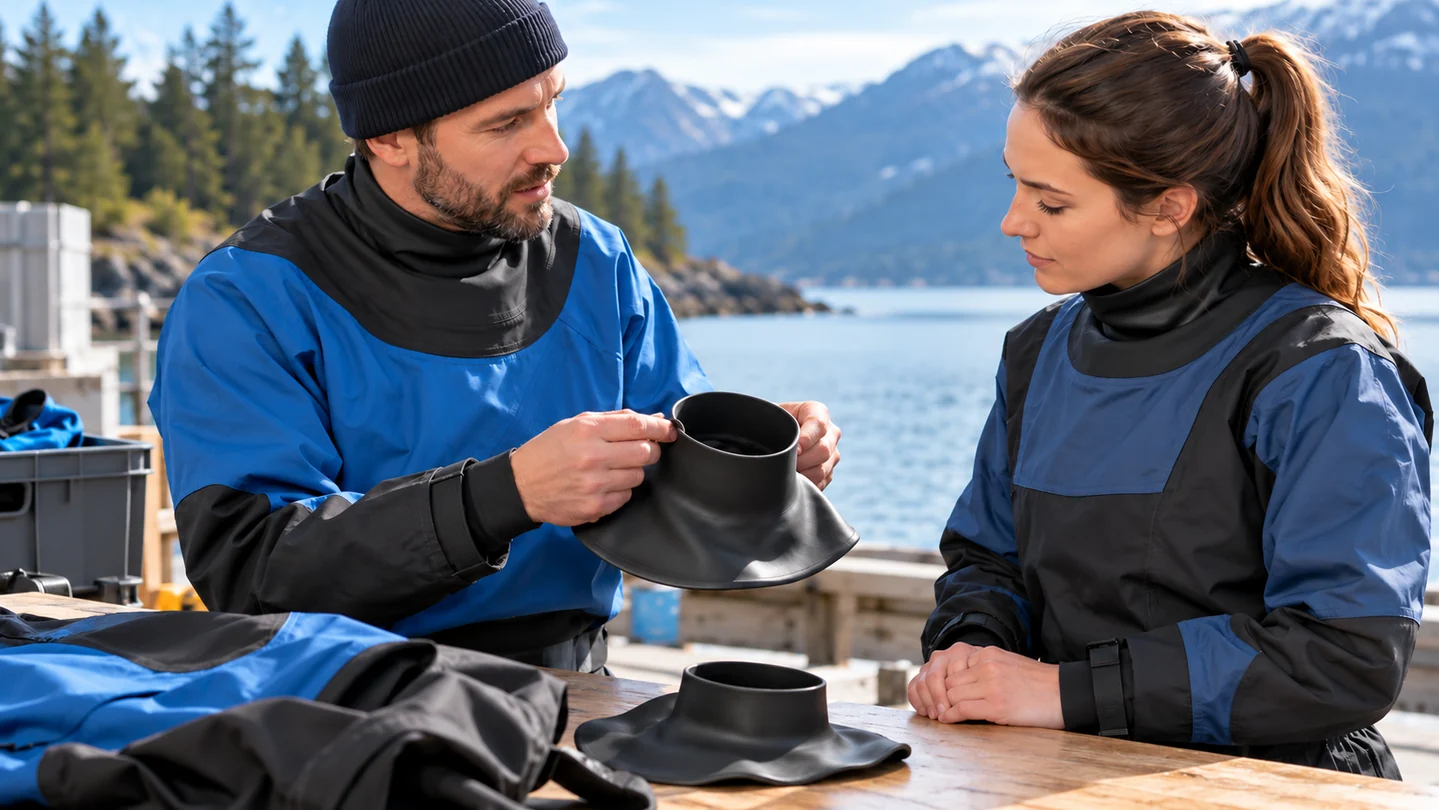
Latex seals often have trimming rings or guide lines. Check neck or wrist circumference, mark the intended ring, cut with sharp rounded scissors, inspect the edge, and test in shallow controlled conditions. Small steps protect comfort and warranty; an over-cut seal cannot be repaired by stretching.
The honest answer is that a buyer is comparing a complete supply system, not a logo or a single fabric swatch. A credible brief separates design intent, material behavior, factory process, testing evidence, order economics, and post-delivery support; this prevents a low sample price from hiding a high total cost.
2. Which Technical Variables Decide the Result?
- Seal size: Neck or wrist circumference plus movement allowance
- Cut geometry: Even ring with no nicks or notches
- Material: Latex, neoprene, gasket, or replacement
- Test boundary: Shallow test, buddy, and emergency plan
For a technical clothing program, we recommend setting an acceptance range before the first sample. ISO 13688:2013 provides a useful general framework for protective-clothing ergonomics and labeling, while ISO 9001 controls the quality-management process; neither standard replaces product-specific testing.
3. How Should Buyers Measure Performance?
Use a small, repeatable scorecard rather than a subjective “looks premium” review. The numbers below are starting controls, not universal pass/fail limits; the buyer should adjust them for end use, target market, and risk.
| Contrôle | Practical starting point | Pourquoi c'est important |
|---|---|---|
| Trim increment | One guide ring or less | Prevents over-cutting |
| Edge check | No nick, notch, or stretch mark | Reduces tear risk |
| Fit test | Breathing and movement check | Separates tight from unsafe |
| Leak test | Controlled shallow test | Confirms change |
Testing at least three sizes and two production lots exposes grading, seam, and trim variation earlier than a single showroom sample. A 30-minute wear trial, a wash-and-dry cycle, and a documented measurement sheet are inexpensive compared with a relabeling or rework campaign.
4. Where Do Hidden Costs and ROI Appear?
Unit price is only one line in the business case. Buyers should model development samples, pattern changes, minimum order quantities, inspection, freight, duty, care-label revisions, claims, and the cost of tying cash in slow-moving sizes. The useful ROI question is: how many avoidable returns or production hours does a better specification remove?
| Cost or value lever | Low-control approach | Controlled approach | |
|---|---|---|---|
| Latex | Light and replaceable | Ozone and sharp-edge sensitivity | Scuba and paddling |
| Neoprene | Comfort and warmth | Bulk and fit variation | Cold-water users |
| Adjustable gasket | User replaceability | Part and training cost | Professional fleets |
A practical example: in a 1,000-piece order, reducing a 4% fit-related return rate to 2% prevents 20 returns. At a conservative USD 35 handling, inspection, and markdown cost per return, the direct saving is USD 700 before the value of customer trust and repeat orders. The same logic applies when comparing scuba diving suit suppliers.
5. How Do Common Options Compare?
Procurement teams often compare options that serve different jobs. The table keeps the trade-offs visible and helps the engineering, merchandising, and finance teams approve the same decision.
| Option | Strength | Trade-off | Typical buyer |
|---|---|---|---|
| Untrimmed | Maximum material | May feel tight | New sample |
| Small-ring trim | Controlled comfort | Needs testing | Trained user |
| Replacement seal | Restores damaged part | Service downtime | Réparer |
| Neoprene | Warmth and comfort | Different bulk | Cold water |
There is no universal winner. The correct choice is the one whose performance, documentation, capacity, and replenishment plan match the user scenario and the commercial forecast.
6. Which Market or Application Matrix Fits?
Regional rules, climate, labor requirements, and channel expectations change the specification. A matrix is more reliable than copying a factory brief from one market into another.
| Market or use case | Specification emphasis | Commercial checkpoint |
|---|---|---|
| Scuba training | Buddy and shallow test | Instructor sign-off |
| Kayak | Neck comfort under hood and PFD | Rescue plan |
| Cold water | Neoprene and circulation | Thermal layers |
| Flotte de location | Size coding and spare seals | Inspection |
Where a retailer sells across borders, the technical file should identify the country of origin, fiber content, care symbols, restricted substances position, and responsible economic operator. This is also where a responsive supplier earns its value: the same base pattern can be adapted without losing traceability.
7. Which Standards and Compliance Checks Apply?
Standards do not make an untested product safe by themselves, but they give buyers a common language for risk and evidence.
- ISO 811:2018 for water penetration resistance where applicable.
- ISO 13688:2013 for protective-clothing general requirements.
- EN 14225-2 for diving suits where applicable.
- Manufacturer care and warranty instructions for seals and storage.
Non-compliance can lead to customs holds, marketplace delisting, forced relabeling, recalls, contract penalties, or insurance disputes. We recommend keeping a technical file with the bill of materials, approved sample, test reports, size chart, care label, packaging marks, and change-control record; every revision should have an owner and date.
8. How Should a Buyer Select a Supplier and Avoid Mistakes?
- Confirm seal material and whether factory trimming is offered.
- Measure neck or wrist and compare the maker’s chart.
- Trim one small ring with rounded scissors and record the change.
- Test shallow with a buddy or instructor before remote exposure.
- Use the dry-suit range to specify replacement seals and warranty boundaries.
Yuelei Sports provides B2B outdoor clothing programs with configurable fabrics, patterns, trims, waterproof constructions, and inspection checkpoints; the buyer should request the finished-model evidence and target-market labeling before approving a purchase order. For outdoor programs, a relevant starting point is the ski-jacket collection or the dry-suit platform, depending on the brief.
9. FAQ and References
Can I trim a latex seal on a scuba diving suit?
Only with maker guidance; trim small increments and test before exposure.
How tight should a dry-suit neck seal be?
It should seal without impairing breathing, swallowing, circulation, or movement.
Can I trim neoprene the same way?
No; neoprene construction needs a different approved procedure.
How do I know a seal is damaged?
Look for nicks, cracks, tackiness, thinning, or a narrow wet path.
Does trimming void warranty?
It may; obtain written confirmation before an irreversible cut.
Références
A seal is small but consequential; careful measurement is cheaper than an irreversible cut.
When a purchasing team treats this product phrase as a measurable system rather than a buzzword, every later decision becomes easier to audit. Yuelei Sports builds that complete B2B specification around the real use case; buyers can review the product range or contact the team to convert performance, sizing, compliance, and delivery requirements into a repeatable program.