 Xiamen Yuelei Sports Co., Ltd.
When a technical engineer in Sheffield encounters a damp shirt beneath a new rain shell, the first assumption is a leak. In this illustrative example, he selected a close-fitting size over office clothing, then added a fleece for a steep walk. The jacket becomes clammy within the climb; the likely problem is excess heat and restricted moisture management, not automatically a failed waterproof barrier.
Résumé : Yes, a men’s breathable waterproof jacket can resist liquid water while allowing water vapour to transfer. That transfer has limits. ISO 11092:2026 measures water-vapour resistance under controlled conditions and explicitly does not define specific real-world comfort. Compare like-for-like test results, then assess ventilation, layers, fit and care.
REI’s rainwear guide explains why both precipitation and perspiration can leave clothing wet. A breathable shell helps with one route out for moisture; it is not an active cooling system. Buyers comparing breathable waterproof jackets should ask how the garment will be used before treating a laboratory figure as the deciding feature.
Can a waterproof jacket be breathable?
Waterproof breathable fabrics use a membrane or coating that resists liquid-water penetration while permitting water-vapour transfer through an appropriate mechanism. Different materials achieve that transfer differently. It is misleading to explain every waterproof fabric as a mesh of identical microscopic holes.
The transfer depends on conditions on both sides of the fabric, as well as the fabric itself. A warm, humid interior and a cooler, drier exterior can support vapour movement. Warm humid weather, heavy exertion and wet outer fabric can reduce the practical comfort advantage. A garment can meet its stated test result and still feel uncomfortable in those circumstances.
Air permeability is another property. A fabric that allows water vapour to transfer need not allow a noticeable breeze through it. A wind-blocking shell and a freely ventilated shirt therefore cannot be compared simply by calling both “breathable.” Check what the claim actually measures.
What is the difference between RET and MVTR?
RET expresses resistance to water-vapour transfer; lower values indicate less resistance within comparable tests. ISO 11092 uses the sweating guarded-hotplate method under steady-state conditions. Its current 2026 edition is the third edition, published in May 2026; the standard’s abstract cautions that its conditions do not represent specific comfort situations.
MVTR, often reported in g/m²/24 h, describes a moisture-vapour transmission rate. Higher values generally indicate more transfer within the same test procedure and conditions. The “24 h” is part of the reporting basis, not a promise that a jacket can manage a wearer’s sweat for an entire day.
There is no universal conversion that turns a marketing MVTR number into a reliable RET ranking. Procedures, specimen orientation, temperature, humidity and sample assembly can differ. A supplier offering only “20,000 breathability” has not supplied enough information to support a fair comparison.
- Request the named method and edition, not just a number.
- Identify whether the specimen was fabric, a laminate or a multilayer assembly.
- Confirm conditioning and whether results relate to new or treated material.
- Compare only results with an equivalent basis; treat unmatched figures as unresolved.
Why does a breathable jacket still feel sweaty?
Moisture production can exceed the rate at which the clothing system releases it. A thick fleece, a tightly closed collar, backpack contact and high effort can all contribute. Liquid sweat on the skin must be managed by the whole clothing system; the shell cannot instantly remove it.
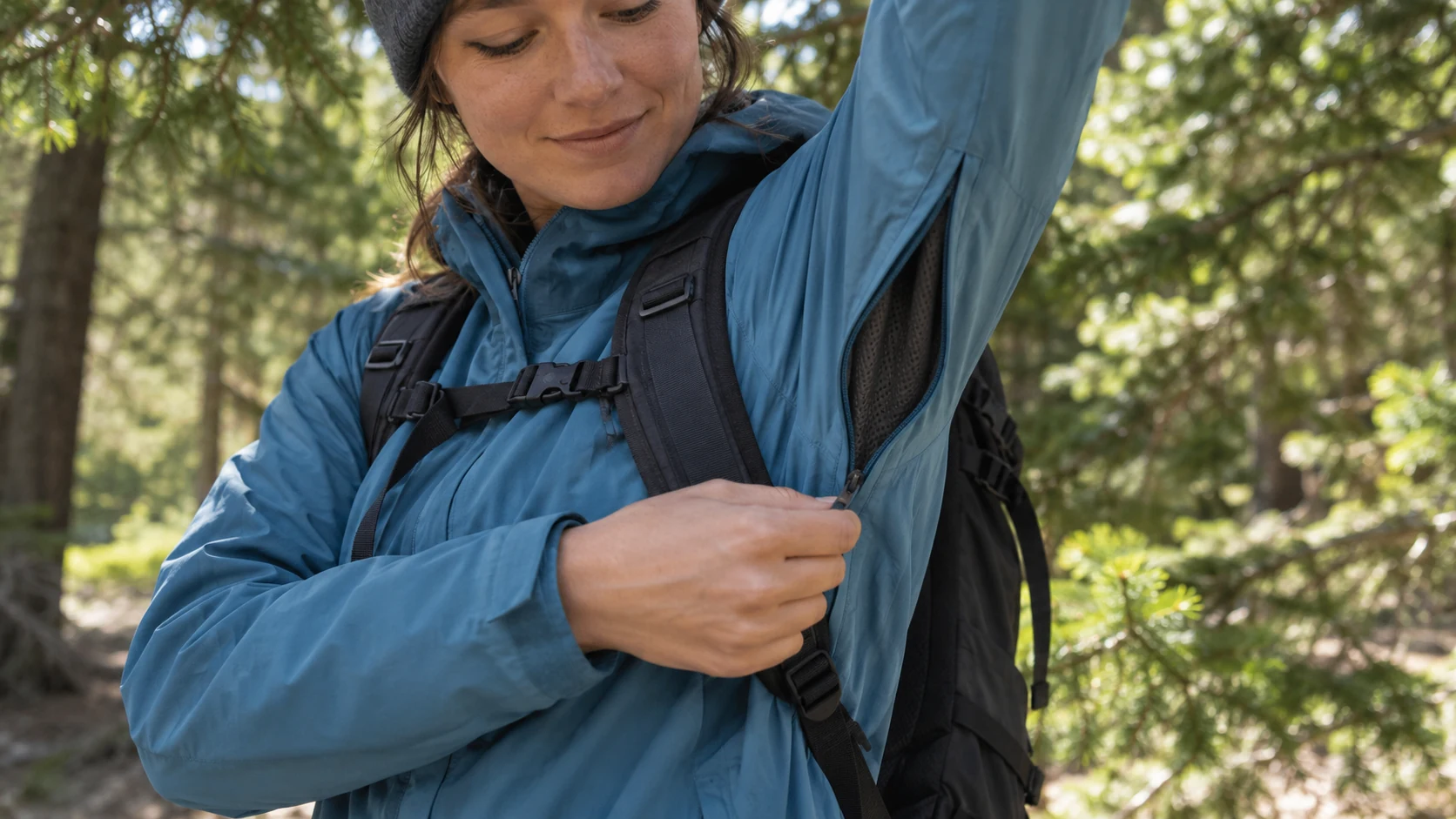
Vent before overheating rather than waiting until the base layer is soaked. Reduce insulation when conditions allow, slow the pace if necessary and use suitable openings. Underarm vents or an adjusted front zipper can move warm humid air directly, but their exposure to rain needs checking.
A shell’s fit should allow movement and the intended layers without excessive volume. A close cut that compresses clothing or blocks useful openings can feel different from the same fabric in a more suitable garment. A very loose fit is not a guaranteed cure; it may let the hood move unpredictably and require tighter closures.
Is the jacket leaking, or is the outer fabric wetting out?
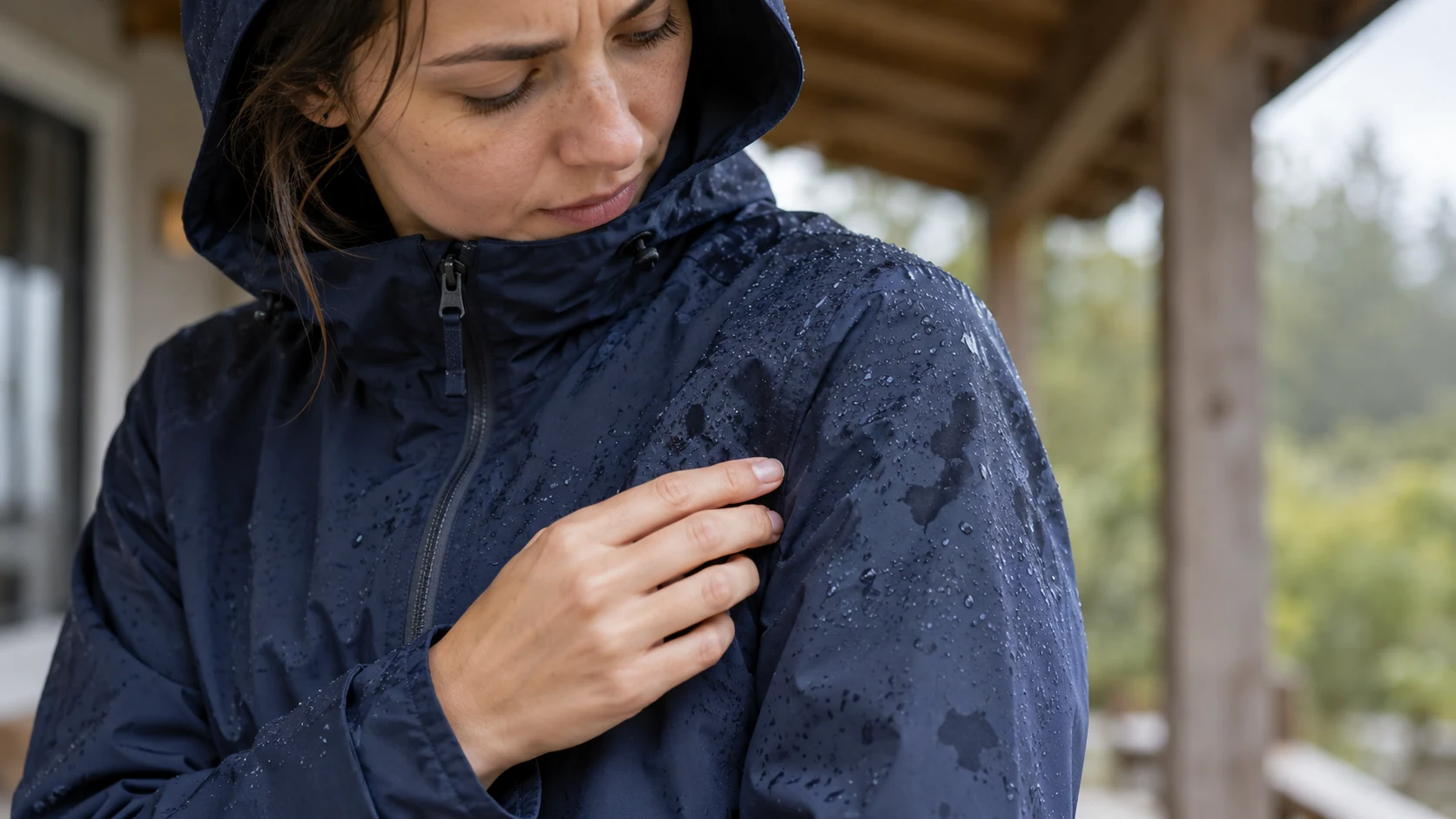
Wetting out describes the outer face becoming saturated rather than shedding water effectively. REI explains that a worn or contaminated water-repellent finish can cause this, even while the underlying waterproof barrier remains intact. The cold, damp outer surface can make the jacket feel clammy and reduce effective moisture transfer.
Local wetness near a closure, seam or cuff suggests a different investigation from widespread interior dampness after a hard climb. Neither pattern is a conclusive diagnosis on its own. Note the weather, activity, entry points and garment condition before deciding whether care, repair or a warranty assessment is appropriate.
Follow the garment’s cleaning and finish-maintenance instructions. Remove dirt and residues using the recommended method, and reapply a suitable finish when needed. Heat activation is appropriate only where the care label permits it. Washing cannot repair delamination, damaged seam tape or a physical puncture.
How do breathable shells compare with other rainwear?
| Garment | Moisture-management advantage | Limit to remember |
|---|---|---|
| Waterproof breathable shell | Permits vapour transfer while resisting rain | Transfer depends on conditions and has finite capacity |
| Nonbreathable raincoat | Can provide straightforward rain coverage | Interior heat and moisture can build during activity |
| Water-resistant windbreaker | Often light and comfortable during exertion | May not protect through prolonged rain |
| Gilet imperméable et isolant | Combines weather protection and warmth | Insulation may be excessive when effort or temperature rises |
For a retailer or uniform buyer, the hidden cost is often a mismatch between product and activity. Returns labelled “not waterproof” may include condensation, wet-out or water entering at a cuff. Clear descriptions and care guidance help distinguish those issues without dismissing genuine defects.
Which comfort checks matter for each activity?
| Utilisation | Check on a sample | Useful purchasing evidence |
|---|---|---|
| Brisk commute | Collar, front-zip access and fit over office layers | Construction and comparable vapour-resistance data |
| Loaded walking | Vents and pockets beneath straps | Fabric identification and relevant durability results |
| Warm wet climate | Comfort without an unnecessary liner | Honest limits, not an all-weather cooling promise |
| Cold low-activity use | Room for insulation without restricted movement | Thermal and vapour data for the stated assembly |
Le waterproof running jacket guide considers high-output use where ventilation and heat management are especially important. Its activity principles are relevant across wearers, while sizing and garment cut still need their own checks.
Which standards support waterproof and breathable claims?
ISO 811 addresses water penetration under hydrostatic pressure; ISO 11092 addresses thermal and water-vapour resistance. One does not replace the other. A report should identify the specimen, procedure and condition, and a fabric test should not be promoted as a complete-jacket guarantee.
For occupational rain protection, EN 343 has additional requirements and classifications, as explained by SATRA. Private-use leisure rainwear is not automatically PPE under EU Regulation 2016/425. Buyers should request the evidence relevant to the intended claim rather than seek an unrelated certificate for reassurance.
What should a buyer ask before choosing a breathable shell?
- Describe the activity, temperature range, pack use and layers.
- Request the exact waterproof and breathability test methods and sample identities.
- Compare the garment’s vents and movement in a controlled wear trial.
- Agree cleaning guidance and a process for investigating moisture complaints.
Yuelei Sports lists a coque imperméable légère et respirante. Buyers should confirm its current specification and available reports for the proposed order. A men’s breathable waterproof jacket should be selected for a defined activity, not on an unsupported claim that the wearer will never sweat.
Foire aux questions
What features should a men’s breathable waterproof jacket have for active outdoor use?
Look for suitable waterproof construction, documented breathability, accessible vents and unrestricted movement. Hood stability and pocket access should also work with the actual backpack and layers.
Is a men’s breathable waterproof jacket better than an insulated one for daily use?
A breathable shell without fixed insulation offers flexibility during active or changeable days. An insulated jacket can also be breathable and may suit colder, lower-activity use. Warmth and vapour transfer should be assessed separately.
What waterproof rating is enough for commuting and weekend activities?
A documented 10,000 mm water-head target can start a comparison, but does not predict breathability or complete-garment dryness. Match construction and condition to exposure rather than selecting by the largest number.
How should a men’s breathable waterproof jacket fit over a shirt, fleece or midlayer?
It should allow normal reaching and leave the intended layers uncompressed. Check collar and vent access with the full outfit; unnecessary insulation can overwhelm comfort even when the shell fits correctly.
Which pockets, vents and hood adjustments are genuinely useful?
Choose vents reachable beneath straps, pockets that remain accessible and a hood that follows head movement. Openings should be easy to close when rain direction or intensity changes.
How does a men’s breathable waterproof jacket compare with a non-breathable raincoat?
It provides a vapour-transfer route that a nonbreathable barrier lacks. This can improve active comfort, but weather, exertion, insulation and ventilation still determine how dry the wearer feels.
Références
- ISO 11092:2026: thermal and water-vapour resistance
- ISO 811: water-penetration resistance
- REI: breathability, construction and DWR care
- SATRA: EN 343 rainwear testing
Comfort comes from a workable clothing system, not a breathability number in isolation. Contact Yuelei Sports with the expected activity and climate to compare waterproof shell options and request the evidence needed for a sample decision.