 Xiamen Yuelei Sports Co., Ltd.

When a technical engineer in Vancouver encountered a sizing decision for a cold-water equipment program, he reviewed a paddling suit quotation, received the sample, and confidently wore it during a shallow scuba trial. Within 20 minutes, trapped air migrated into the legs, the shoulders restricted valve reach, and the diver aborted the exercise. The suit was not simply “too small”—the specification had confused a surface-survival garment with an underwater buoyancy system. That failure reveals the real search question: how is a Veste en caoutchouc pour plongée sous-marine different from a paddling drysuit?
Résumé : A scuba model is engineered for controlled underwater gas, depth-related squeeze, inflation and exhaust valves, while a paddling model prioritizes lightweight mobility, spray protection, seat reinforcement, and compatibility with a PFD and spray deck. ISO 14225-2 addresses diving dry suits; ISO 15027-1 addresses constant-wear immersion suits. Buyers should never substitute one solely because both are waterproof—use, training, fit, valves, seams, and thermal layers determine safety and total cost.
Both systems keep liquid water away from the base layers, yet their risk models differ. A dry diving suit must manage gas volume as ambient pressure changes; a Veste sèche pour kayak normally works near the surface and should not become the diver’s buoyancy envelope. For procurement teams, the distinction changes component specifications, user training, warranty exposure, and product claims.

1. Why Do Scuba Drysuits Need Valves?
At 10 m seawater depth, absolute pressure is roughly 2 bar; without added gas, the suit compresses against the body and can restrict movement. A dive dry suit therefore uses a low-pressure inflator—commonly mounted near the chest—and an adjustable exhaust valve, often on the upper arm. ISO 14225-2 sets performance and safety requirements for diving dry suits.
Underwater gas management
- Inflation gas reduces suit squeeze; it is not a substitute for correct weighting.
- An automatic or manually operated exhaust releases expanding gas during ascent.
- Valve reach must be verified while wearing the intended BCD, cylinders, gloves, and thermal undergarment.
- Formal dry-suit training is essential because uncontrolled gas migration can accelerate an ascent.
A paddling suit typically has no inflation valve because the user remains at surface pressure. Adding scuba valves to an otherwise unsuitable garment does not convert it into a verified diving system.
2. How Do Fabric, Seals, and Zippers Differ?
Membrane scuba systems are often trilaminate or coated textiles; compressed or crushed neoprene models add inherent thermal resistance and abrasion tolerance. Paddling suits commonly use lighter 3-layer breathable laminates to reduce heat and arm fatigue. ISO 811 can measure resistance to water penetration, while ISO 11092 measures thermal and water-vapor resistance.
| Technical dimension | Scuba dry suit | Paddling drysuit |
|---|---|---|
| Pressure environment | Surface to rated diving depth | Primarily surface and accidental immersion |
| Gas controls | Inflation and exhaust valves | Normally none |
| Typical shell | Trilaminate, coated fabric, or neoprene | Light 3-layer breathable laminate |
| Reinforcement | Knees, seat, boots, valve zones | Seat, knees, socks, spray-deck tunnel |
| Zipper priority | Pressure-compatible entry and serviceability | Paddling reach, flexibility, deck comfort |
| Standards pathway | ISO 14225-2 / market PPE rules | ISO 15027-1 where sold as immersion PPE |
Latex seals are light and close-fitting but can tear; neoprene seals are warmer and more tolerant of rough handling but bulkier. Metal-tooth and polymer waterproof zippers also require different storage and lubrication instructions. A sample approval should include at least 20 full zipper cycles and a leakage inspection—not just a showroom fit check.
3. Why Is Paddling Mobility a Different Engineering Problem?
A paddler may repeat thousands of shoulder rotations during one trip, sit with hips flexed near 90 degrees, and wear a PFD over the torso. A Veste sèche pour kayak therefore needs articulated shoulders, a seat pattern that does not pull at the crotch, and a double waist tunnel compatible with the spray deck. A diving pattern instead prioritizes finning, valve reach, boot fit, and streamlined gas management.
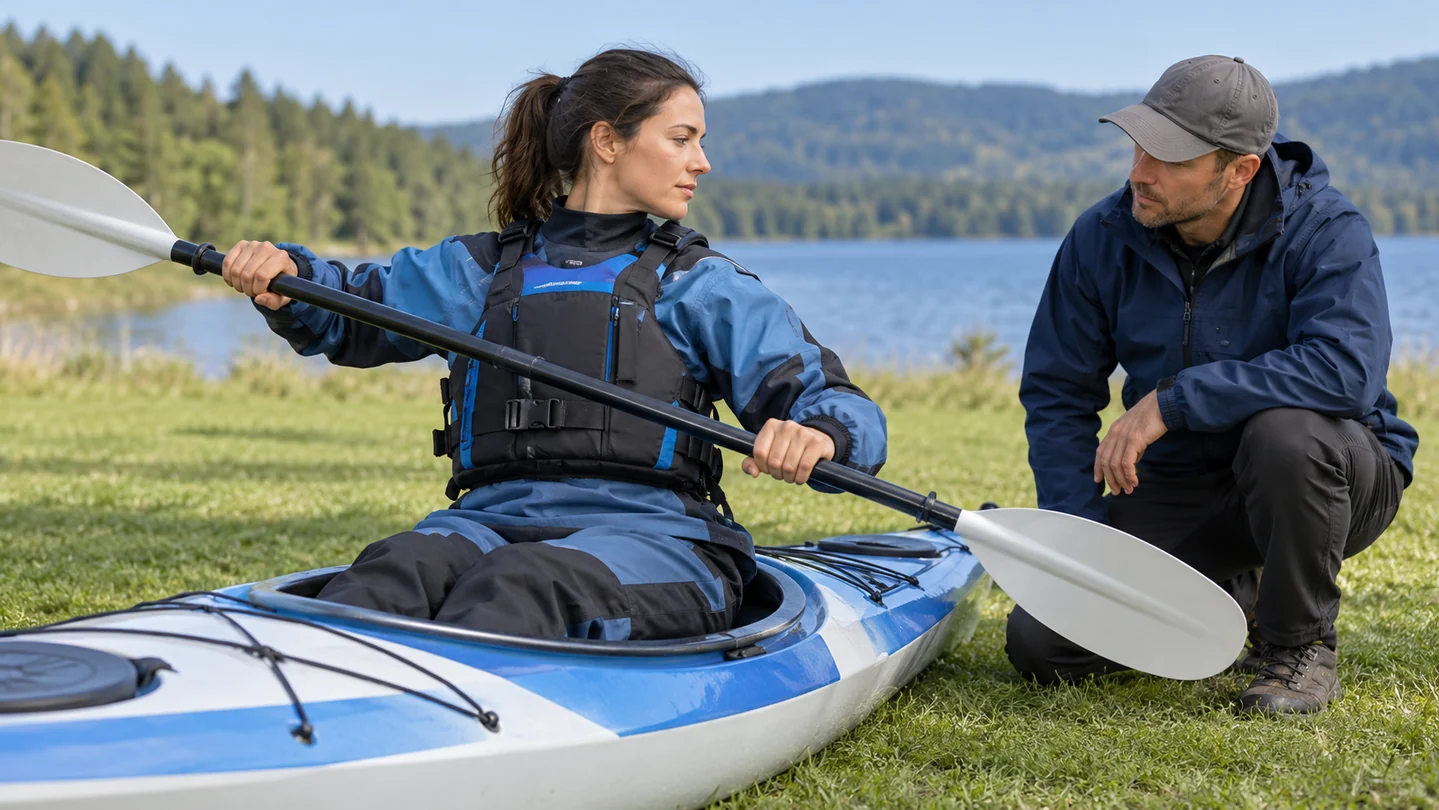
ISO 8559-1 provides consistent body-measurement definitions, but garment ease must be tested in the actual task. We recommend three wear-trial profiles per size: the 5th-percentile user, target median, and upper fit boundary. Each subject should reach overhead, rotate the shoulders, squat, sit for 30 minutes, and operate every closure.
4. Which Suit Has the Better B2B Total Cost?
| Faisant office de conducteur de coûts | Diving program | Paddling program | Buyer control |
|---|---|---|---|
| Components | Valves, boots, heavier zipper | Breathable shell, socks, waist tunnel | Lock approved BOM |
| Training | High; buoyancy and emergency skills | Moderate; cold-water and self-rescue skills | Document user boundary |
| Service | Valve and zipper maintenance | Seam, sock, and zipper repair | Stock replaceable parts |
| Returns | Fit, squeeze, valve placement | Heat, mobility, cockpit snagging | Run task-based wear trials |
In an illustrative 500-unit program, reducing returns from 6% to 3% prevents 15 cases. At a hypothetical $80 landed service cost per technical dry suit, that protects $1,200 before reputation loss. The honest ROI formula is unit cost + qualification tests + training + returns + service parts.
5. Application Matrix: Which Construction Fits the Job?
| Utilisation | Recommended platform | Critical checkpoint |
|---|---|---|
| Recreational scuba | Valve-equipped scuba dry suit | ISO 14225-2 evidence and trained diver |
| Technical/deeper diving | Purpose-rated dive dry suit | Redundant gas and mission-specific procedures |
| Sea kayaking | Breathable paddling suit | PFD, deck tunnel, shoulder mobility |
| Whitewater | Reinforced paddling suit | Abrasion zones and swimming mobility |
| Surface rescue support | Role-specific immersion PPE | ISO 15027 pathway and employer risk assessment |
6. Standards and Compliance Evidence
- ISO 14225-2 : diving suits—dry-suit requirements and test methods.
- ISO 15027-1: constant-wear immersion suits, including safety requirements.
- ISO 811 : hydrostatic water-penetration testing for textiles.
- ISO 11092 : thermal and water-vapor resistance.
- Règlement de l’UE 2016/425 : conformity obligations when marketed as PPE in the EU.
Standards are not interchangeable badges. The technical file must name the model, edition, laboratory, conditioning, pass criteria, and production change controls; unsupported depth, thermal, CE, or survival claims can trigger customs holds, recall costs, or distributor delisting.
7. How Should a Buyer Specify the Right Suit?
- Define whether the user will descend underwater or remain at the surface.
- Specify temperature, depth, activity, PFD/BCD, footwear, gloves, and undergarments.
- Conduct task-based fit trials rather than adding a blanket size.
- Agree leakage, seam, valve, zipper, and inspection criteria before the PO.
- Provide training and care instructions that match the certified use.
Yuelei Sports propose des services d'OEM/ODM dry suit platforms with buyer-defined shells, patterns, seals, zipper locations, and test plans. A neoprene dry suit can support cold-water programs, while a kayak-specific design supports surface mobility; claims must be verified for the exact model and destination.
FAQ
Can a paddling drysuit be used for scuba diving?
No, not unless it was specifically designed, tested, and approved for diving. A surface suit normally lacks inflation/exhaust valves and underwater pressure controls.
Why does a Veste en caoutchouc pour plongée sous-marine have valves?
The inflator reduces suit squeeze during descent; the exhaust releases expanding gas during ascent. Correct use requires training.
Is a dry diving suit warmer than a kayak dry suit?
Not automatically. Neoprene adds insulation, but membrane suits depend on undergarments. Warmth must match water temperature, activity, and exposure time.
What should be worn under a dive dry suit?
A moisture-managing base layer plus a diving undergarment selected for water temperature and suit type; the system must not restrict valve reach.
Do drysuits keep a person completely dry?
A correctly fitted and maintained suit should prevent liquid-water entry, but condensation and sweat may feel damp. Seals, zippers, seams, and care determine performance.
Références
- ISO 14225-2 — Vêtements de plongée : Vêtements à sec
- ISO 15027-1 — Constant-wear immersion suits
- PADI — Cours de plongée en combinaison sèche
- EUR-Lex — Règlement (UE) 2016/425
Two garments can both stop water, yet only the right system manages the pressure, motion, and human behavior of its real environment.
Yuelei Sports fabrique chaque Veste en caoutchouc pour plongée sous-marine or paddling program for that exact boundary. Buyers can contact the team to translate depth, activity, sizing, and compliance needs into a repeatable production brief.