 Xiamen Yuelei Sports Co., Ltd.

When Maya, a technical engineer in Rotterdam, encountered a substitution request for an illustrative dive-school order, she mounted a surface-paddling prototype on the operator’s acceptance rig. Within minutes, the low-pressure hose had nowhere to connect, the shoulder had no controllable exhaust, and the entry zipper conflicted with the harness. The reversal was immediate: the laminate was not defective; the selection brief had treated “waterproof” as if it also meant pressure-compatible, equipment-compatible, and approved for underwater use.
Résumé : A dive dry suit manages suit gas as pressure changes, whereas a kayaking suit is a surface barrier designed around active paddling, a PFD, and often a spray-skirt tunnel. EN 14225-2:2017 covers requirements and test methods for diving dry suits; ISO 15027-1 addresses constant-wear immersion suits, not scuba equipment. Buyers should freeze the use boundary, valve package, zipper map, and equipment interfaces before comparing samples or unit cost.
The Design Brief Splits at Underwater Pressure Versus Surface Activity
The shared feature is a waterproof barrier, but the design problems are different. Underwater, ambient pressure rises by approximately 1 bar for every 10 metres of seawater depth. Gas inside a diving suit therefore compresses on descent and expands on ascent; the operator must add and release gas in a controlled way while coordinating the suit with other buoyancy systems.
A kayaking garment normally sees atmospheric pressure while it manages rain, spray, waves, short swims, and accidental immersion. The paddler produces heat through repeated upper-body work, sits at a cockpit interface, and relies on a separate personal flotation device.
Neither problem is solved by fabric waterproofness alone. A Veste en caoutchouc pour plongée sous-marine is a garment, gas space, valve system, and trained operating procedure; a kayaking suit is a garment within a PFD, spray skirt, cockpit, and rescue system. Buyers should specify the complete activity system before asking whether one waterproof suit can replace the other.

Valve Systems Separate Diving Gas Control from Surface Immersion Protection
A typical dive dry suit uses a low-pressure inflation valve and an adjustable exhaust valve. Inflation helps reduce suit squeeze and preserve undergarment loft during descent. Exhaust releases expanding gas during ascent, but it does not eliminate the need to manage the BCD, depth, trim, and ascent rate as a coordinated system.
For procurement, dry suit valves need a named inlet connection and hose, size-based placement, reinforcement, exhaust adjustment, replaceable parts, cleaning instructions, and a service route. A watertight valve can still fail acceptance if the hose does not connect, the harness blocks access, or the wearer cannot position the exhaust effectively.
A kayaking suit usually omits pressure-control hardware because the activity does not require underwater suit-gas management. Retrofitting valves does not convert a surface garment into approved diving equipment; the construction, valve attachment, pressure behavior, interfaces, documentation, and intended-use assessment remain unresolved.
This boundary is also a training boundary. PADI’s Dry Suit Diver course describes learning buoyancy control, descents and ascents, and emergency procedures. That course page is evidence that operating skills matter, not evidence that any particular garment conforms to EN 14225-2:2017.
Laminate and Neoprene Constructions Trade Bulk, Abrasion, and Work-Rate Comfort Differently
Trilaminate and other membrane constructions provide a thin waterproof shell with little inherent insulation, so thermal performance comes mainly from the undergarment and trapped gas. Puncture resistance, abrasion behavior, seams, and repairability depend on the specific textile stack and reinforcements—not the generic word “laminate.”
Compressed-neoprene diving constructions retain some material insulation and can be robust at contact zones, yet they are typically bulkier and less breathable than light paddling laminates. Neoprene thickness, compression process, face fabrics, seam type, and local reinforcement all alter the result. No material family is universally warmer, tougher, or longer-lasting across every model and activity.
Pour un dry suit for kayaking, moisture-vapour transfer can matter during sustained strokes and portages, but a fabric value does not predict whole-garment comfort. ISO 11092 measures steady-state thermal resistance and water-vapour resistance with a sweating guarded hotplate; it is a specimen or assembly test method, not a finished-suit certification. Buyers should request the reported layer configuration and then run a task trial with the intended base layers, PFD, air temperature range, and work rate.
Torso Cut, Zippers, and Relief Layouts Follow Different Body Positions
Diving patterns must allow undergarment loft, finning, squatting, valve reach, and operation beneath a BCD or harness. A telescoping torso and suspenders can control extra length, but surplus fabric may bunch in a narrow cockpit.
Paddling patterns prioritize forward reach, torso rotation, hip flexion, and a stable seated rise. A double-waist tunnel can overlap a spray skirt to manage water at the deck interface, although it does not make the cockpit watertight. Evaluate it with the actual PFD, skirt, deck height, and rescue movements because overlap changes when seated.
Entry layouts trade self-donning, flexibility, sealing length, and abrasion exposure. A relief zipper can reduce equipment removal during long shifts, but adds stiffness and inspection work. A full-size sample should confirm entry, closure, relief, rotation, and safety-equipment access.
Seals, Integrated Socks, and Boots Must Match Different Equipment Loads
Latex, silicone, and neoprene seals differ in stretch, replacement options, sensitivity, comfort, and maintenance. Choose against the actual replacement system and wearer policy, then check seal sizing, attachment, finish, and compatibility with gloves, hoods, and instruments.
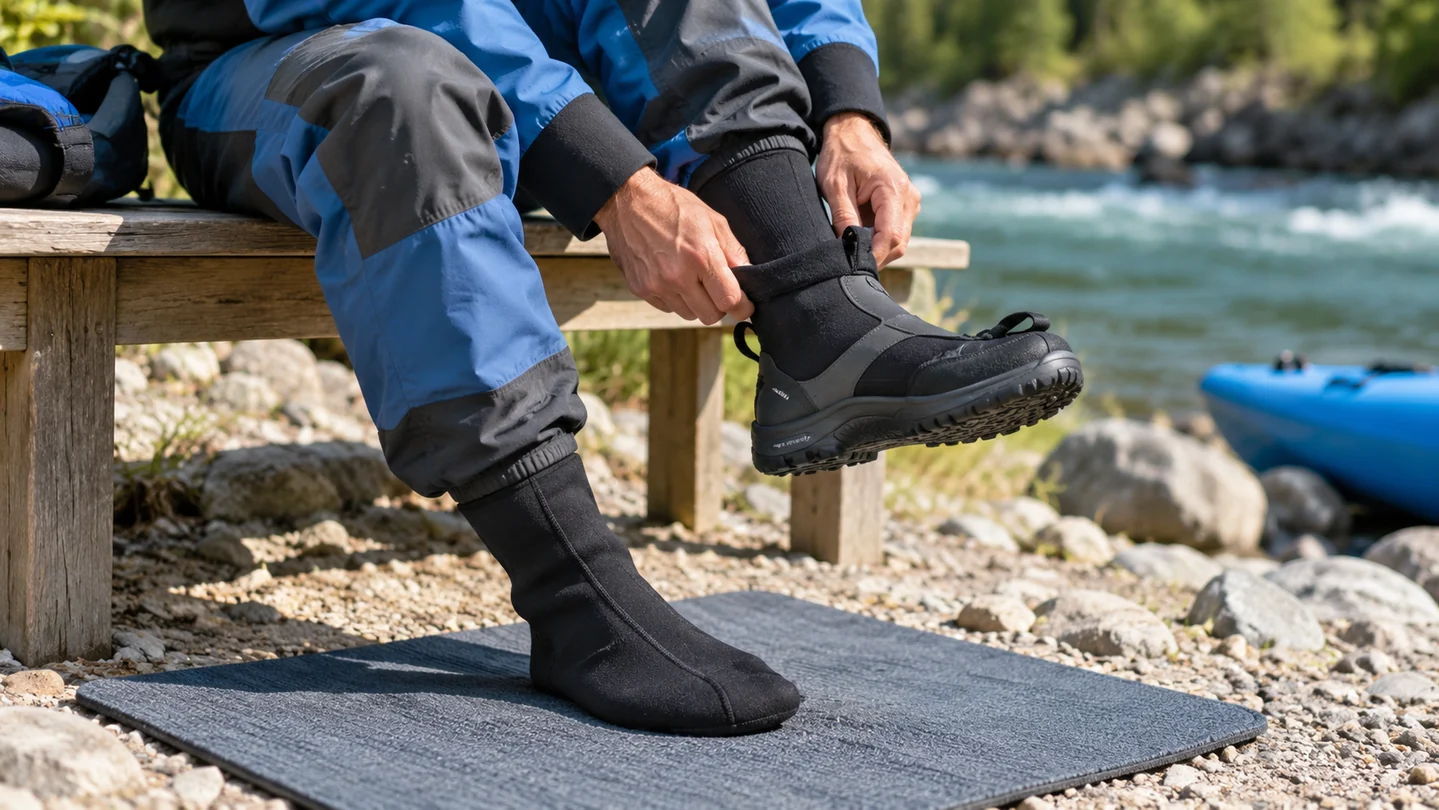
Integrated fabric socks can work with separate paddling footwear; seam placement and abrasion protection matter at the heel and launching area. Integrated diving boots can simplify fin and seabed interfaces, yet sole stiffness and volume may conflict with a cockpit or footrests.
Confirm diving fit with the ordered undergarment, fins, and overboots; confirm paddling fit with the intended shoe, footrest, and exit path. Attached footwear can change both fin security and cockpit clearance.
The Component Comparison Shows Why the Two Suit Systems Are Not Equivalent
| Component or performance dimension | Diving configuration | Kayaking configuration | Buyer acceptance focus |
|---|---|---|---|
| Design pressure | Changing ambient pressure and controlled internal gas volume | Surface splash, weather, swimming, and accidental immersion | Declared intended use and matching evidence |
| Inflation and exhaust | Specified low-pressure inlet and adjustable exhaust system | Normally omitted; no submerged gas-management role | Hose interface, placement, reinforcement, service route |
| Buoyancy interfaces | BCD, regulator hose, weights, harness, cylinder, and trained procedure | PFD and rescue system; garment is not the flotation-control system | Full equipment mock-up and operator procedure |
| Construction tendency | Membrane or compressed-neoprene options selected with underlayers and pressure behavior | Often lighter laminates selected around active work and surface exposure | Exact textile stack, seams, reinforcement, and repair method |
| Torso geometry | Underlayer volume, finning, trim, squatting, and valve reach | Forward reach, rotation, hip flexion, and seated articulation | Activity-specific movement protocol by size |
| Waist interface | Must lie correctly beneath harness and weight equipment | May use a double tunnel with the spray skirt and PFD | Check bunching, overlap, access, and rescue movement |
| Zipper and relief layout | Avoids harness, cylinder, and weight-system load paths | Avoids PFD, seat, skirt, and repeated stroke zones | Donning, closure, relief access, flex, and abrasion trial |
| Socks or boots | Compatible with fins, overboots, thermal layers, and underwater footing | Compatible with cockpit, footrests, shore shoes, and exits | Order-size footwear trial; do not approve by garment size alone |
| Maintenance tendency | Valves, hose, zipper, seals, seams, boots, and pressure-system parts | Zipper, seals, seams, socks, tunnel, and abrasion zones | Separate inspection schedule, spares, skills, and records |
The Use-Case Matrix Makes the Substitution Decision Explicit
| Intended operation | Kayaking configuration | Diving configuration | Procurement decision |
|---|---|---|---|
| Compressed-gas scuba below the surface | Not acceptable by default: pressure-control interfaces and diving evidence may be absent | Potentially suitable when the exact model, equipment, fit, documentation, and training match | Never substitute the kayaking model unless specifically designed, tested, documented, and approved for diving |
| Surface kayaking with PFD and spray deck | Purpose-aligned when mobility, thermal plan, tunnel, cockpit, and rescue checks pass | May be waterproof, but valves, bulk, boot shape, zipper, heat burden, and cut can interfere | Use the paddling configuration unless a full seated trial establishes a justified exception |
| Commercial paddling instruction or rental | Can align with repeated strokes and PFD use; needs robust sizing, inspection, and repair planning | Specialized diving features can increase service inventory and user instruction | Compare fleet TCO and operator error risk, not only shell durability |
| Surface support on a dive boat | May suit deck activity when exposure and flotation requirements are met | May suit personnel who must transition to diving, subject to the complete task risk assessment | Do not let “dive operation” replace a role-by-role activity definition |
| Mixed fleet with occasional crossover | One model should not be assumed to cover both activities because waterproofness is only one requirement | Maintain separate specifications unless one exact model has credible evidence, interfaces, and approval for both declared uses | |
The asymmetry matters. Using a surface suit underwater can remove essential gas-management and conformity evidence, creating a safety-critical gap. Using a diving suit for kayaking is not automatically the same hazard, but it can restrict stroke mechanics, overheat the wearer, interfere with the PFD or spray deck, trap bulk in the cockpit, and raise operating cost. “Possible to wear” is therefore not the same as “compatible, approved, and economical.”
Acceptance and Service Inventories Create Different Total-Cost Profiles
An illustrative TCO model should separate at least nine buckets: acquisition, size exchanges, sample rework, zipper and dry suit valves servicing, replacement seals or socks, staff training, spare-part inventory, repair freight and downtime, and retirement losses. The calculation is illustrative; buyers should insert their own labor, failure, utilization, and freight data rather than adopt a generic service-life or cost-saving claim.
A diving fleet may need compatible hoses, approved valve service, component parts, zipper care, undergarment sizing, and suit-level records. A paddling fleet may need seal and sock repair capability, tunnel checks, user-sizing guidance, and seasonal turnaround. Shared inventory still has to support different zippers, seals, footwear, and inspection criteria.
A complete handover should include the approved specification, bill of materials revision, size chart, component identifiers, care and storage instructions, inspection criteria, repair restrictions, spare-parts list, training boundary, and evidence supporting intended-use claims.
Standards Evidence Must Match Diving or Surface-Immersion Claims
- EN 14225-2:2017: a European standard for diving suits, specifically construction and performance requirements and test methods for dry suits. It must not be described as an ISO standard. Quoting the number is not proof that the ordered model, sizes, valves, and component configuration were assessed.
- ISO 15027-1:2012: requirements including safety for constant-wear immersion suits used on or near water, covering dry and wet forms. The official ISO page marks this edition withdrawn; its scope is not compressed-gas scuba diving.
- ISO 15027-3: test methods for immersion suits. A test method tells a laboratory how to evaluate defined properties; it is not, by itself, a certification or a marketing authorization.
- ISO 11092 : a sweating guarded-hotplate method for thermal and water-vapour resistance under steady-state conditions. The official ISO page marks the 2014 edition withdrawn and replaced by ISO 11092:2026; neither edition certifies finished-suit waterproofness, mobility, or suitability for diving.
- PADI Dry Suit Diver: a training reference that illustrates the skills boundary around suit air, buoyancy, descents, ascents, and emergency procedures. It is not a product standard or third-party conformity document.
Unsupported claims can cause rejected tenders, relabelling, extra testing, or delayed delivery. Confirm destination market, intended use, current edition, assessment route, model identity, component configuration, laboratory status, and document validity before release. Supplier declarations, fabric reports, test reports, and third-party certificates are not interchangeable evidence.
Sample Acceptance Must Recreate the Diver or Paddler System
- Freeze the use statement. Record activity, depth or surface exposure, conditions, tasks, destination market, users, and prohibited uses.
- Approve the component schedule. Identify fabric stack, seam method, seals, socks or boots, entry and relief zippers, reinforcements, tunnel, valves, hose connection, labels, and replaceable parts.
- Build the interface rig. Include underlayers, BCD or harness, weights, hose, fins, and instruments for diving; include PFD, skirt, cockpit, footrests, footwear, and rescue equipment for paddling.
- Run the size-set protocol. Record donning, closure, squat, reach, rotation, seated flexion, valve access, finning or stroke motion, cockpit exit, seal comfort, footwear retention, and interference points by size.
- Audit lifecycle support. Match reports to the ordered revision, then approve inspection, cleaning, storage, training, repair authority, spares, traceability, and retirement criteria.
Yuelei Sports, a China-based B2B outdoor sportswear solutions provider, can support configurable briefs, component schedules, and samples, while the buyer retains responsibility for defining the activity boundary and required evidence. Its broader Veste en caoutchouc pour plongée sous-marine comparison supplies application-level context; this component review should be used to decide whether a sample can pass the exact equipment and substitution gate. A buyer specifying a dry suit for kayaking should therefore send the PFD, spray-deck, cockpit, footwear, and movement requirements—not merely a fabric reference.
The Six Buyer Questions Below Resolve the Most Common Substitution Confusion
What is the difference between a dive dry suit and a kayaking dry suit?
The diving product manages gas under changing ambient pressure and interfaces with scuba equipment. The kayaking product prioritizes surface mobility, PFD and spray-skirt compatibility, and accidental-immersion protection. Shared waterproof materials do not erase those system differences, so compare the intended-use evidence and complete equipment interface rather than the shell description.
Can a scuba dry suit be used for kayaking?
It may keep a paddler dry, but valves, bulk, boot design, zipper position, thermal burden, and diving cut can interfere with the cockpit, skirt, stroke, or PFD. An operator should approve it through a seated equipment and rescue trial and should not assume it is the lowest-TCO option.
Why do scuba dry suits have inflation valves?
The inlet allows controlled gas addition to reduce squeeze and help preserve undergarment loft as pressure increases. The diver must also manage gas release and overall buoyancy through training and the complete equipment system. The presence of an inlet alone does not establish that the full garment is suitable or approved for scuba.
Do kayaking dry suits need a relief zipper?
Not universally. It can improve convenience during long shifts, but it adds cost, stiffness, care requirements, and another potential leakage path. The decision should follow wearer access needs, PFD and tunnel overlap, seated flexion, and the inspection plan.
Which dry suit offers better mobility for paddling?
A paddling-specific pattern usually offers the more appropriate shoulder reach, torso rotation, and seated articulation. Actual performance still depends on size, underlayers, PFD, tunnel, skirt, footwear, and cockpit, so a task-based fitting remains necessary.
Can a kayaking dry suit be used for scuba diving?
No, not by default. It should never be used for scuba unless the exact model is explicitly designed, tested, documented, and approved for diving, with the necessary pressure-management interfaces and user training. Waterproofness, an added valve, or a successful shallow-water leak check alone is insufficient.
Authoritative References Support the Final Application Decision
- European Commission: harmonized standards listing including EN 14225-2:2017
- ISO 15027-1:2012 — Constant wear immersion suits
- ISO 11092:2014 — Sweating guarded-hotplate test method
- PADI Dry Suit Diver course overview
Closing principle: waterproof construction defines the barrier, but pressure, interfaces, evidence, and training define the safe application. Procurement teams can review configurable dry suit sourcing options and contact Yuelei Sports with the activity, equipment map, target market, size range, and evidence requirements for a focused technical discussion.