 Сямыньская спортивная компания с ограниченной ответственностью «Юэлей»
A ski base layer can feel warm in a showroom and still fail its real job after the wearer begins climbing, queuing, or skiing hard. The procurement risk is rarely “wool versus polyester” in isolation. It is a mismatch among sweat rate, fabric construction, garment fit, outer-layer ventilation, care instructions, and the amount of time spent moving or standing still. That mismatch can produce dampness, chill on lifts, odor complaints, premature pilling, shrinkage, or returns across an otherwise acceptable range. Buyers therefore need to choose both fiber and weight for a defined use case, then verify the claims and care route. This guide compares merino and synthetic base layers, explains cold-day layering, and converts the decision into a practical B2B specification.
Quick answer: The best thermal clothes for skiing are the ones that keep moisture from remaining against the skin while fitting comfortably under the complete ski system. Merino is often favored for next-to-skin comfort and odor moderation over repeated wear; synthetic fabrics generally dry faster, tolerate routine care more easily, and tend to cost less. Neither fiber guarantees warmth or dryness. Specify fabric mass, knit structure, fit, drying expectations, and wash procedure, then evaluate the full base-mid-shell assembly. ISO 11092:2026 can compare thermal and water-vapor resistance under steady-state laboratory conditions, but it does not predict comfort in a particular ski day.
Which Base Layer Handles Moisture Better: Merino or Synthetic?
Merino wool is hygroscopic: its fibers can absorb and release water vapor within their structure. This can buffer humidity near the skin, but it does not make a saturated garment dry. After heavy sweating, merino may dry more slowly than a comparable lightweight synthetic and feel heavier.
Most synthetic ski base layers use polyester or a polyester-rich blend. The fiber absorbs little moisture, while yarn shape, knit channels, finishes, and garment contact help spread liquid for evaporation. This usually supports faster drying. “Wicking” is not a complete specification; polyester fabrics can behave differently because their yarn, knit density, finish, and fit differ.
| Фактор решения | Merino tendency | Synthetic tendency | B2B check |
|---|---|---|---|
| Moisture management | Buffers water vapor; can remain damp longer after heavy sweating | Usually spreads liquid and dries faster when construction supports it | Compare finished fabrics under the same method and conditioning |
| Odor over repeated wear | Often retains less noticeable odor | Can retain odor unless yarn, finish, or laundering strategy addresses it | Do not convert a general fiber tendency into an unsupported guarantee |
| Next-to-skin feel | Soft grades can feel comfortable, but sensitivity varies | Smooth and consistent; hand feel depends on yarn and finishing | Approve the actual fabric against the target wearer profile |
| Drying and care | May require gentler washing, reshaping, and controlled drying | Often supports simpler washing and faster turnaround | Run the intended wash-and-dry sequence before bulk approval |
| Abrasion and shape retention | Fine fibers may need reinforcement or blending in high-wear zones | Generally robust, though pilling and snagging depend on construction | Test seams, surface change, and dimensions after care |
| Unit-cost tendency | Usually higher, especially for fine or high-merino-content fabric | Usually lower and easier to standardize at volume | Model returns, care burden, and replacement—not unit price alone |
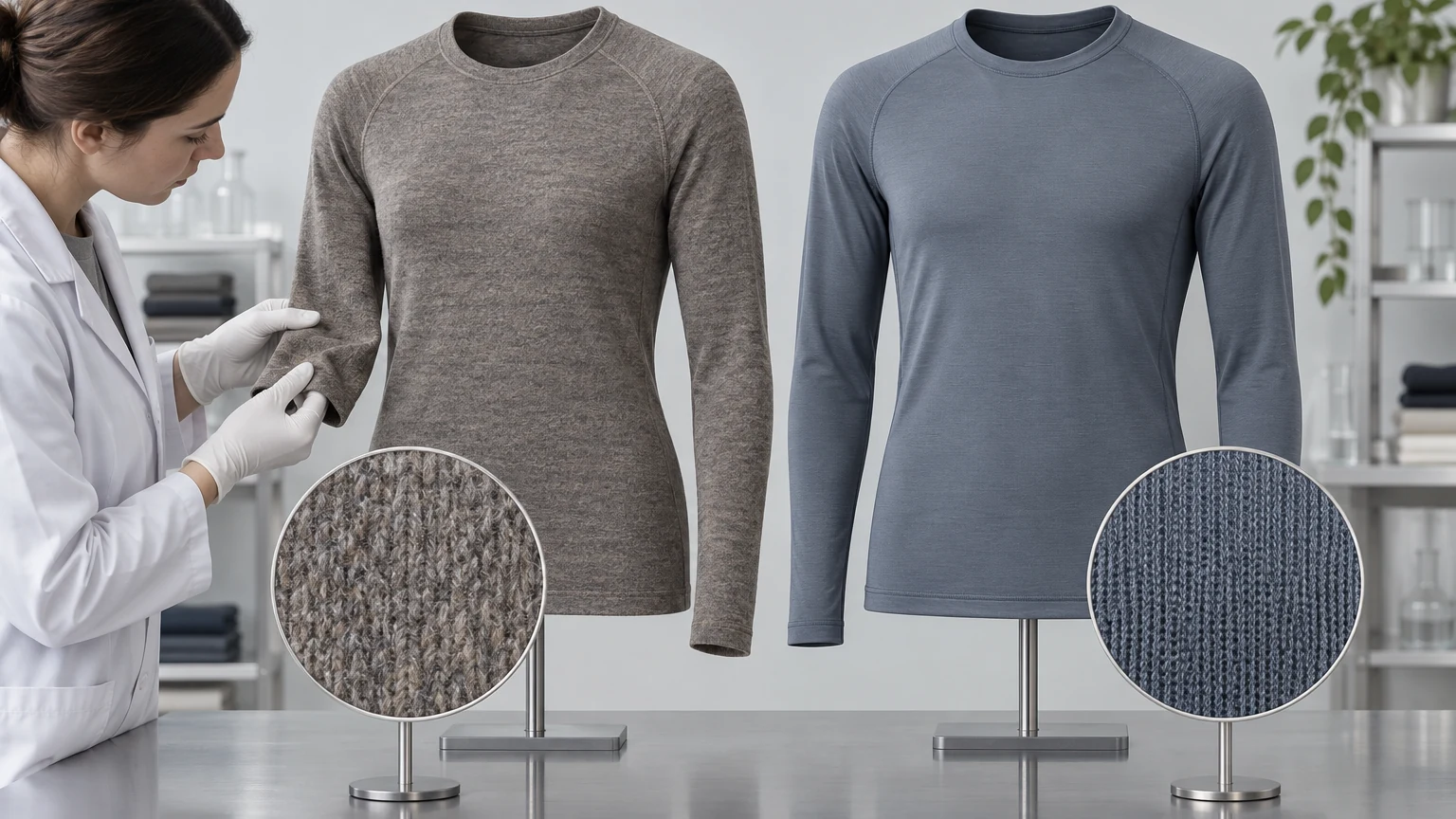
Blends can occupy a useful middle ground. A merino-synthetic fabric may improve durability or drying while preserving some wool hand feel and odor behavior. The blend percentage alone does not predict performance; fiber placement, yarn construction, mass, stretch, and finishing matter. For a distributor planning a skiing clothes sale, a blend can reduce price and care friction only when production matches the approved sample.
How Heavy Should a Ski Base Layer Be?
“Lightweight,” “midweight,” and “heavyweight” are not universal performance classes. A specification should record grams per square meter, fiber content, knit type, stretch composition, and the test specimen. Fabric mass remains a proxy because knit density, brushing, and channel structure can change air retention and drying.
Activity pattern is the better starting point. A high-output skier can generate enough heat that a thick base layer becomes a moisture problem, even on a cold day. A lower-output learner, lift operator, or spectator may benefit from more insulation, but adding a breathable midlayer is often more adaptable than making the next-to-skin layer excessively heavy. The best thermal clothes for skiing keep the base layer focused on moisture control and use removable layers to manage changing exposure.
| Потребность в использовании | Base-layer direction | Outer-system direction | Specification risk to control |
|---|---|---|---|
| High-output piste or touring use | Lightweight synthetic or light merino blend with close, non-restrictive fit | Highly adjustable insulation and effective shell ventilation | Overheating caused by excess base-layer mass |
| Stop-start resort skiing | Light-to-midweight merino, synthetic, or blend | Removable midlayer; shell or moderate insulated jacket | Dampness during effort followed by chill on lifts |
| Very cold, lower-output use | Midweight fabric that remains comfortable under added insulation | More midlayer loft or insulated outerwear with weather protection | Compression, restricted movement, and trapped moisture |
| Rental, staff, or frequent laundering | Durable synthetic or robust blend with clear care route | Easy-to-inspect modular pieces | Shrinkage, odor retention, pilling, and slow turnaround |
| Multi-day travel with limited washing | Merino-rich or odor-managed blend, subject to wearer tolerance | Packable modular layers | Care errors and inadequate drying between uses |
How Should Base, Mid, and Shell Layers Work Together?
A base layer cannot keep a skier dry if warm, moist air has nowhere to go. A shell offers the greatest control when activity and weather change because insulation can be adjusted separately. An insulated jacket simplifies the outfit and may suit cold, lower-output resort use, but it offers less flexibility when the skier works hard. The choice should consider vents, lining, cuff and hem interfaces, and room for the intended midlayer—not just a waterproof or warmth label.
When a skier feels damp, the first action is usually to reduce heat buildup before adding clothing: open vents, slow the pace briefly, remove an unnecessary midlayer, and avoid letting sweat accumulate. At a stop, replace or dry a wet layer when practical and add insulation before the body cools. Public cold-weather guidance also emphasizes layered clothing, staying dry, and wind protection; no single garment should be marketed as safe for every temperature or exposure period.
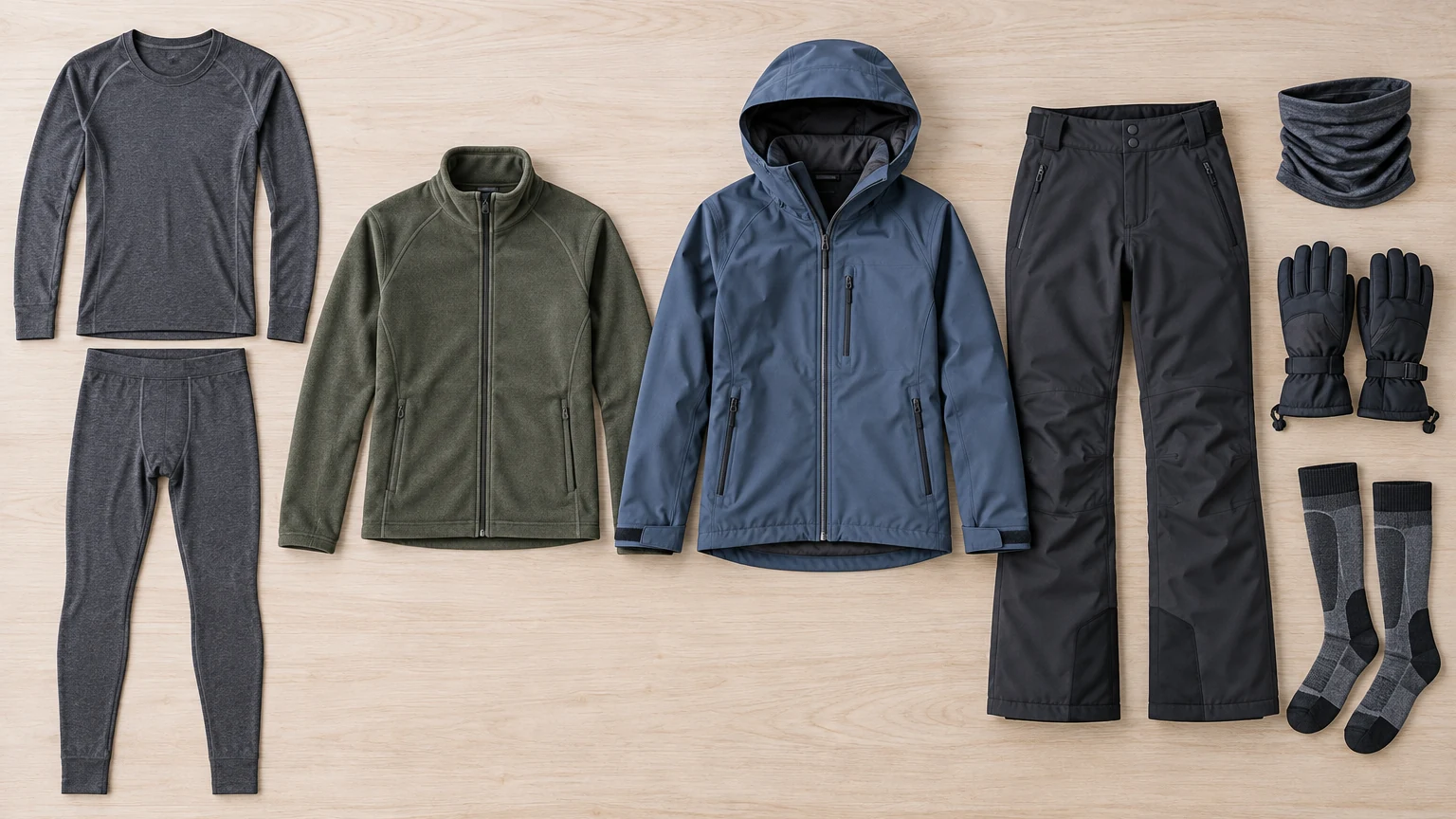
Accessories close the remaining gaps. Ski socks should fit without bunching and leave boot volume for circulation; doubling thick socks can increase pressure. Gloves or mittens should work with jacket cuffs, and a spare dry pair helps in wet conditions. Neckwear should cover exposed skin without blocking breathing or interfering with a helmet.
What Can Fabric Tests and Care Labels Actually Prove?
ISO 11092:2026 measures thermal resistance and water-vapor resistance of textiles and multilayer assemblies under steady-state conditions using a sweating guarded hotplate. Its scope supports controlled material comparison. It does not reproduce wind, changing exertion, garment pumping, fit, or a specific person’s comfort, and it is a test method rather than a product certification. Buyers should state the method, specimen, conditioning, and layer assembly behind any reported value.
ISO 6330:2021 specifies domestic washing and drying procedures for textile testing, including defined machine types, detergents, ballast, and drying routes. It can support dimensional-stability, appearance, and repeat-care evaluations when paired with the relevant assessment method. It does not prove that a garment will survive every consumer laundry practice. A purchase specification should define cycle count, wash program, drying route, and acceptance criteria for shrinkage, twisting, pilling, seam condition, and label legibility.
For garments sold in the United States, the FTC Care Labeling Rule requires manufacturers and importers within its scope to attach care instructions. Fiber identification and origin obligations may arise under separate U.S. textile labeling rules. Destination market, product classification, and claim wording determine the applicable requirements, so buyers should obtain market-specific review rather than copying one label globally.
The commercial consequence is broader than compliance. A care symbol that conflicts with fabric behavior can create shrinkage, returns, and chargebacks. A low-cost base layer damaged through its stated care route may cost more than a pricier fabric with validated care. Before approving a skiing clothes sale assortment, price sampling, testing, instructions, returns, and replacement stock alongside the garment.
What Should Buyers Specify Before Ordering Thermal Ski Wear?
- Define the wearer and activity. Record resort, touring, staff, rental, or travel use; likely exertion; climate range; and time spent stationary. Avoid one “cold weather” brief for every channel.
- Specify the finished fabric. Include fiber percentages, mass, knit construction, stretch, finish, color, hand-feel standard, and change-control requirement. Approve production against a retained reference sample.
- Validate the complete outfit. Conduct movement and moisture-management trials with the intended midlayer, jacket, pants, socks, gloves, and neckwear. Check pressure points at shoulders, waist, cuffs, and boot tops.
- Align evidence and claims. Request reports that identify the method, specimen, date, and result; make marketing language no broader than that evidence. Confirm care labels against the destination market.
- Model service-life cost. Compare unit cost with laundering, drying time, odor complaints, pilling, size returns, replacements, and continuity of the approved fabric.
At this selection stage, Yuelei Sports can be assessed as a China-based B2B outdoor sportswear supplier. Its official product pages show that it supplies ski jackets, wholesale ski clothing, and ski suits. Those pages establish product scope, not a base-layer performance certification. A sourcing discussion should therefore begin with the buyer’s fiber, weight, fit, care, labeling, test, and change-control requirements.
Часто задаваемые вопросы
What is the best layering system for thermal clothes for skiing?
Use a moisture-managing base layer, an adjustable insulating midlayer, and a weather-protective shell. The exact weights depend on exertion, wind, moisture, and time spent stationary. Test all three together because excessive bulk or a tight shell can reduce movement and trap sweat.
What should I wear under thermal clothes for skiing in very cold ski days?
Avoid stacking multiple tight base layers. Start with one well-fitting merino, synthetic, or blended base layer, then add insulation above it while preserving movement and ventilation. For the best thermal clothes for skiing, keep dry spare socks and gloves available rather than relying only on torso thickness.
Do I need an insulated jacket or a shell for very cold ski days?
An insulated jacket is simpler for consistently cold, lower-output resort use. A shell with separate insulation is more adjustable for changing weather or high-output activity. Whichever system is chosen, confirm wind and precipitation protection, ventilation, and enough room for the full layer stack.
How can I avoid feeling damp after sweating while skiing?
Use a close but non-compressive base layer, reduce insulation before hard effort, and open shell vents early. At stops, remove wet items or add a dry layer before cooling begins. Fiber choice helps, but overheating and blocked vapor escape are frequent system-level causes.
Are ski clothes and snowboard clothes interchangeable?
They can be, if fit, weather protection, mobility, and interfaces work for the activity. Snowboard cuts may be roomier, while ski garments may use different pocket, cuff, or reinforcement layouts. Even during a skiing clothes sale, buyers should compare the actual pattern and use case rather than relying on the category name.
How should ski clothing fit so it is warm but still easy to move in?
The base layer should contact the body without restricting breathing or joint movement; midlayers should retain loft; the outer layer should allow reaching, crouching, and rotating without lifting hems or opening cuff gaps. Evaluate the complete size set in motion, not each garment separately.
Ссылки
- ISO 11092:2026, Textiles — Physiological effects — Measurement of thermal and water-vapour resistance under steady-state conditions.
- ISO 6330:2021, Textiles — Domestic washing and drying procedures for textile testing.
- U.S. Federal Trade Commission, Care Labeling of Textile Wearing Apparel & Certain Piece Goods.
- U.S. National Weather Service, During Extremely Cold Weather.
Final Buying Rule for Thermal Ski Wear
Merino is a strong candidate when next-to-skin comfort, humidity buffering, and repeated wear matter; synthetic is often the practical choice when rapid drying, frequent laundering, durability, and price control dominate. The defensible sequence is to define activity and exposure, choose base-layer weight and construction, build compatible insulation and weather protection around it, and then verify care and claims with methods that match the intended market. No fiber name replaces a complete specification. A successful skiing clothes sale depends on fewer mismatches, not a louder warmth promise. Buyers developing an outerwear program can review Yuelei Sports’ ski suit category and contact the supplier with the target market, layer plan, size range, documentation needs, and test brief.