 Сямыньская спортивная компания с ограниченной ответственностью «Юэлей»
When a children’s ski-wear buyer in Innsbruck reviews a size set, the standing sample can look roomy and warm until the child reaches for a binding, squats and sits. Sleeves then ride above the gloves, the crotch pulls, or extra fabric bunches inside the boots. The quick fix—ordering one or two sizes larger—can create a different failure: poor control, blocked movement and more returns. This is a representative approval scenario, not a product test. It shows why ski suit kids ranges should be sized around body measurements and the planned layer system, with controlled growth room rather than a blanket “size up” rule.
Резюме: Leave enough ease for the specified base layer and mid-layer, but approve the garment only when the child can reach, squat, sit and step without pressure or interference. Request finished-garment measurements by size, insulation construction, seam and closure details, and the test method behind any waterproof or breathability rating. ISO 811 evaluates resistance to water penetration, while ISO 11092 evaluates thermal and water-vapour resistance under stated laboratory conditions; neither is a finished-garment comfort guarantee. Growth allowance is useful only when sleeves, hems, hood and crotch remain controlled. Test the complete outfit with gloves, boots and helmet before placing a production order.
How Much Room Should a Kids Ski Suit Leave for Layers?
Layer allowance is the difference between the child’s body measurements and the finished garment measurements needed for the intended base and mid-layers. It is not a universal percentage because insulation thickness, pattern balance, activity level and the child’s proportions change the result. A shell intended for a thermal base layer and fleece needs a different internal volume from an insulated one-piece suit designed to be worn over a thin base layer.
For a B2B size set, record the layer package before approving the pattern: base-layer fabric and thickness, mid-layer type, sock height, boot profile and whether the child will wear a protective vest or other required equipment. Then compare chest, waist, hip, sleeve, body rise, inseam and back length in the garment measurement chart. Ask the supplier to identify the measurement points and tolerances so that a “roomy” sample can be reproduced consistently across the grade.
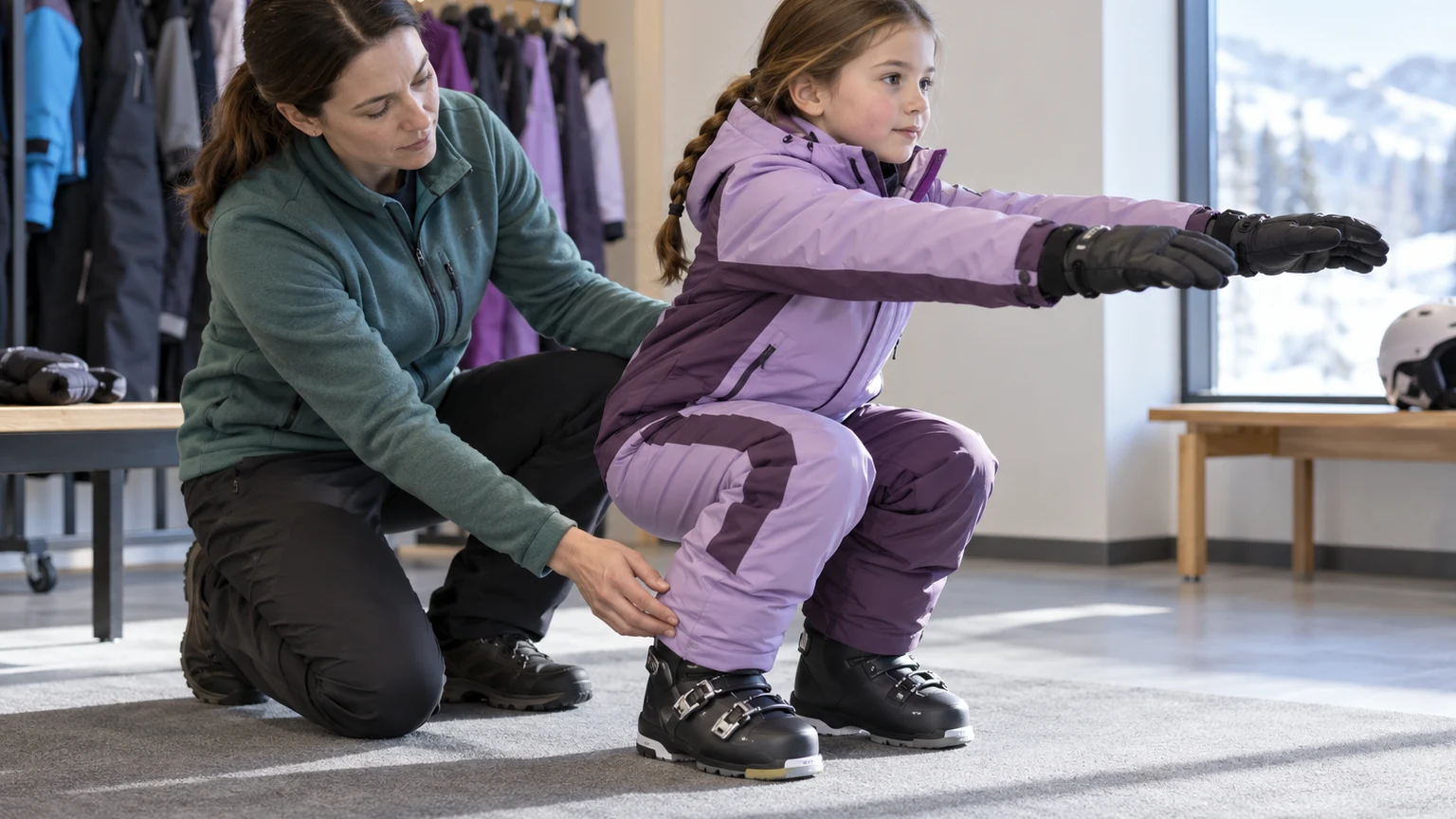
Use movement to validate the allowance. The child should reach forward and overhead, bend at the hip, squat, sit, step up and lift one knee as an adult observes safely indoors. Check whether the base layer remains flat, whether insulation shifts, and whether the outer fabric catches on boots or bindings. A larger chest measurement does not compensate for a short torso, a low crotch or sleeves that end above the glove interface.
What Is Controlled Growth Room, and When Does It Become Too Much?
Controlled growth room is extra capacity that remains usable as the child grows without compromising present-day mobility, coverage or equipment interfaces. It may come from documented sleeve or hem adjusters, a waist adjustment, a carefully graded torso or a layer-compatible pattern. It should not mean long hems, a dropped crotch or sleeves that cover the hands.
A procurement team can classify each size check as acceptable, too small or too large. “Too small” signs include shoulder-to-crotch tension, sleeves that expose the wrist during reach, a tight seat in a squat and knees that cannot flex freely. “Too large” signs include a low swinging crotch, excess fabric under the boot, cuffs that enter bindings, a hood that shifts over the eyes or a body length that makes walking unsafe. Growth room fails when the child cannot control the garment today.
| Checkpoint | Usable ease | Too small | Too large | Buyer action |
|---|---|---|---|---|
| Reach and overhead movement | Shoulders and sleeves move with the base layer covered | Sleeves ride up or shoulders pull | Hands disappear inside loose cuffs | Retest the adjacent size over the same layers |
| Squat, sit and knee lift | Seat and knees flex without hard tension | Crotch or seat binds | Low crotch catches on boots or equipment | Review rise and body length, not just waist width |
| Cuffs, gloves and boots | Coverage stays continuous without compression | Wrist or lower leg is exposed in motion | Fabric bunches inside gloves or boots | Approve with the actual accessories |
| Hood and helmet | Head turns freely and vision stays clear | Hood pulls at neck or shoulders | Loose hood shifts over the eyes | Test the destination-market helmet and adjusters |
Age labels can support merchandising, but they should not replace body measurements. For a growing-child program, buyers can ask for adjustable features and a documented tolerance range, then decide how much of that capacity is acceptable for the intended sales season. If an adjustment is not confirmed on the physical sample, do not assume it exists from a product name or sketch.
How Do Warmth and Layering Affect the Fit Decision?
A ski suit is an outer layer in a system. The base layer moves moisture away from the skin, a mid-layer supplies adjustable insulation, and the outer suit limits wind and wet-snow exposure. More insulation can help during low-activity periods, but it also takes up volume and may restrict joint flexion. Active children can become damp inside an over-insulated garment, while a thin shell can leave them cold if the layer plan is incomplete.
For comparable samples, request the insulation type, placement, lining arrangement and intended layer package. ISO 11092:2026 uses a sweating guarded-hotplate method to measure thermal resistance and water-vapour resistance under steady-state conditions for textiles and multilayer assemblies. The method can support a like-for-like material or assembly comparison when the edition, specimen and test conditions match. It does not predict a particular child’s comfort in wind, sun, lift queues or active movement.
For waterproofing, ISO 811:2018 describes a hydrostatic-pressure method for resistance to water penetration. A fabric result does not establish how seams, zippers, hood edges, cuffs or boot interfaces behave. Buyers should inspect those construction points on the sample and ask whether the report covers the fabric, a panel, a seam or a finished garment. Ratings from different methods should not be treated as interchangeable.
One-Piece or Two-Piece: Which System Gives Better Sizing Control?
A one-piece ski suit removes a separate waist junction and can simplify issuing, tracking and snow coverage. Its fit depends heavily on torso length, body rise and the main opening, and one pattern must serve the upper and lower body together. Restroom access, drying time and a repair to any major panel can also affect the operating cost.
A jacket-and-pants system allows independent sizing and can make it easier to replace one damaged component. It adds a waist interface and a second item to issue, wash and track. For a mixed-size rental or school program, that flexibility may outweigh the extra inventory work. Neither architecture is automatically warmer or more waterproof; shell, insulation, seam construction and fit remain the controlling variables.
| Фактор решения | One-piece | Жакет и брюки | Evidence to confirm |
|---|---|---|---|
| Snow-gap control | No separate waist junction | Depends on hem, waistband, bib and overlap | Bending, sitting and fall-position checks |
| Growth and fit | Torso, rise and inseam must work together | Top and bottom sizes can be mixed | Graded measurements over the planned layers |
| Restroom and assistance | Depends on a verified opening and fastening path | Upper garment can often remain on | Physical sample access and adult-assistance check |
| Repair and stock | One damaged area can remove the full unit | One component may be isolated or replaced | Spare-component plan and cleaning workflow |
| Lifecycle cost | Fit returns and full-unit downtime matter | Pairing, mixed wear rates and two-item inventory matter | Model returns, handling, repair and replacement per 100 units |
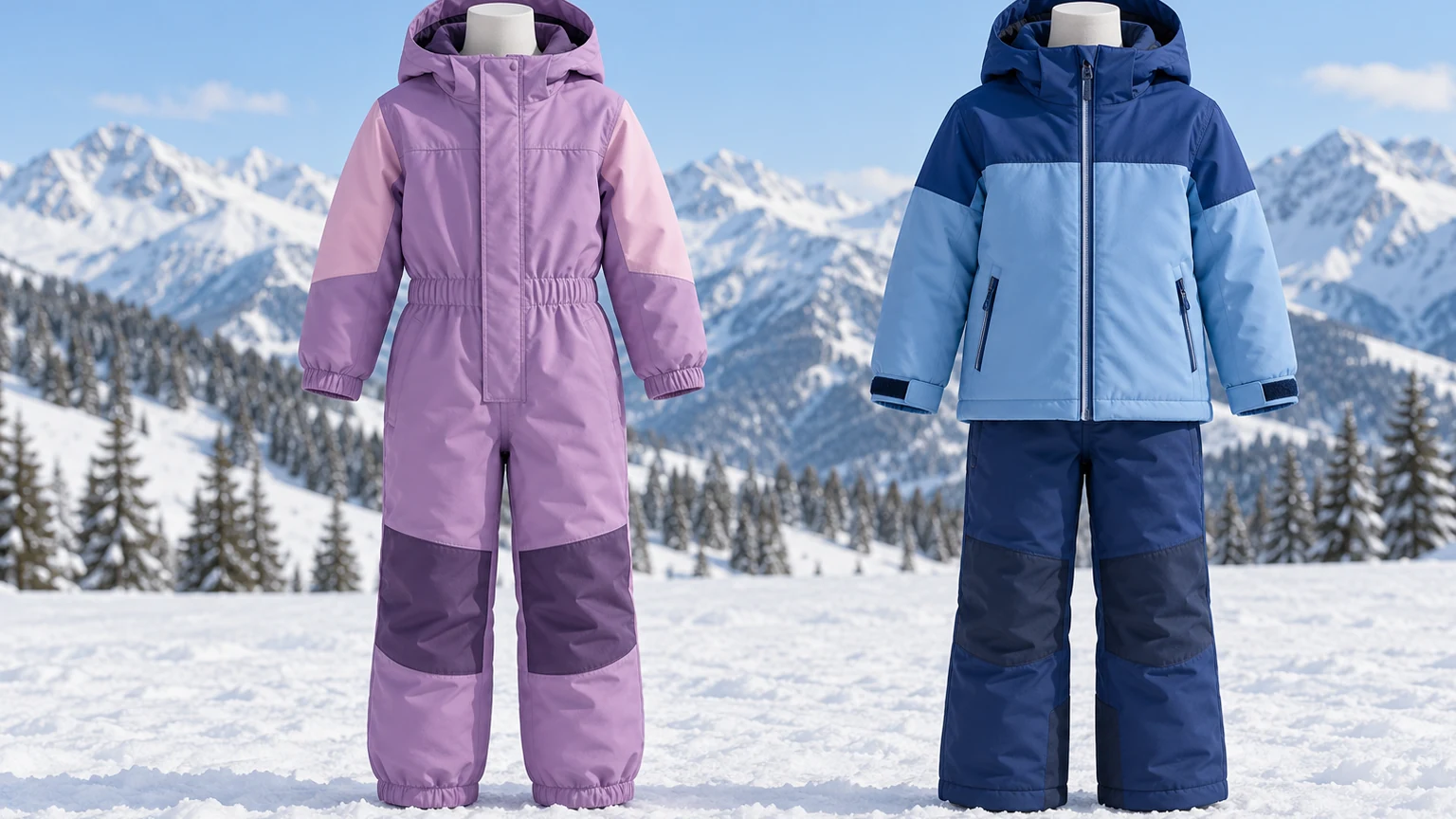
Buyers can compare a children’s ski clothing set with a one-piece sample when deciding whether independent sizing is valuable. A configurable boys’ and girls’ ski suit brief should state the body range, layer allowance, closures, target activity and destination market before final sampling.
What Waterproof and Breathability Evidence Should Be Requested?
Performance language should identify the measured property and test method. ISO 811:2018 is a resistance-to-water-penetration method; it is not a universal waterproof product certification. ISO 11092:2026 measures thermal and water-vapour resistance under steady-state conditions; it is not a guarantee of comfort or a complete finished-garment rating. Ask for the specimen description, test edition, conditioning, units and whether the result applies to a fabric, laminate, seam or finished assembly.
Then check the construction that the report cannot cover by itself: seam sealing, zipper protection, pocket openings, hood adjustment, wrist closures, snow cuffs and the boot interface. A fabric can pass a laboratory method while a poorly protected opening leaks in use. Claims should be limited to what the evidence supports and reviewed for the destination market’s labeling and advertising requirements.
How Should a Buyer Wash and Dry a Kids Ski Suit?
Care decisions begin with the actual shell, membrane or coating, insulation, seam tape, trims and print system. Follow the sewn-in care label and the supplier’s validated instructions for the garment. Close fasteners as directed, use only the specified detergent, avoid unapproved softeners and apply only the stated drying temperature or method. Do not copy a generic “reproofing” or high-heat recipe from another fabric.
ISO 6330:2021 defines domestic washing and drying procedures for textile testing. It can help a buyer design a controlled evaluation, but it is not a consumer care label or a durability certification. In the United States, the FTC Care Labeling Rule, 16 CFR Part 423, addresses regular care instructions for covered textile apparel; other destination markets can impose different requirements. After cleaning, dry the garment fully, store it clean and uncompressed in a ventilated place, and inspect coating, seam tape, zippers, cuffs and adjusters before reissue.
What Should Be in the Size-Approval Checklist?
- Определите профиль использования. Record skiing versus snowboarding, activity level, expected weather, lift time, falls, equipment and whether the garments are personal, team or rental stock.
- Freeze the layer package. Name the base layer and mid-layer thickness before comparing finished measurements or insulation volume.
- Approve graded sizes in motion. Repeat reach, squat, seated, knee-lift, glove, boot and helmet checks in representative sizes and body shapes.
- Request traceable evidence. Tie every water, vapour or thermal result to a named method, edition, specimen and unit. Do not turn a fabric report into a finished-suit promise.
- Model service cost. Include returns, inspection, cleaning, repairs, spare parts, downtime and end-of-season loss, not only the quoted unit cost.
Yuelei Sports can be considered at this stage when a buyer needs a configurable сезонный ассортимент костюмов для катания на лыжах or a coordinated сезонная коллекция куртки для сноубордистов. The supplier brief should carry the target body range, layer plan, construction choice, test evidence, care-label requirements and acceptance tolerances. A category page is a starting point for a sourcing conversation, not evidence that every style has the same construction or performance.
Часто задаваемые вопросы
Is a kids ski suit warm enough for growing children?
It can be, when the suit and the base-and-mid-layer system match the expected activity and weather. Warmth should be assessed through insulation construction, wind and wet-snow coverage, moisture management and the child’s ability to move, not by bulk or age label. Validate the complete outfit and keep growth room controlled at the sleeves, hems, hood and crotch.
How should a kids ski suit fit over thermal base layers?
A ski suit kids wear over thermal layers should permit forward and overhead reach, squatting, sitting and stepping without pulling at the shoulders, crotch, seat or knees. Sleeves and legs should keep glove and boot coverage without bunching into equipment. Use body measurements and finished-garment measurements over the exact layers instead of assuming that sizing up solves the fit.
Какие классы водонепроницаемости и воздухопроницаемости лучше всего подходят для катания на лыжах?
There is no universal best rating because climate, activity, session length and test methods differ. Ask whether the stated result comes from ISO 811 for water penetration resistance or ISO 11092 for thermal and water-vapour resistance, and whether it covers fabric, seam or finished garment. Confirm zippers, cuffs, hood and seams separately before using the number in product copy.
Мне стоит выбрать утеплённый костюм для сноубординга или комбинезон с отдельными слоями?
Choose an insulated suit when a predictable warmth package and simpler dressing process matter; choose a shell with separate layers when activity and weather vary enough to justify adjustment. A shell requires enough internal volume for the intended mid-layer and a clear moisture-management plan. Compare the full system, including ventilation, care, repair and replacement work.
Можно ли носить костюм для сноубординга и катания на лыжах?
Potentially, if the garment supports a snowboard stance, repeated sitting or kneeling, binding reach and fall movements. Test the seat, knees, cuffs, hems and boot interface with the actual equipment and layers. A skiing label alone does not prove that the pattern is comfortable or controllable for snowboarding.
How do I wash and dry a kids ski suit without harming the waterproof coating?
Follow the permanent care label and the supplier’s instructions for the actual shell, coating, insulation and trims. Close fasteners as directed, use only permitted products and drying conditions, and avoid softener or extra heat unless the verified instructions allow it. ISO 6330 is a controlled textile-testing procedure, not a replacement for the garment’s care label.
Ссылки
- ISO 811:2018 — Текстиль — Определение устойчивости к проникновению воды — испытание гидростатическим давлением – test method for resistance to water penetration.
- ISO 11092:2026 – Textiles – Measurement of thermal and water-vapour resistance under steady-state conditions – test method for thermal and vapour resistance.
- ISO 6330:2021 — Текстиль — Процедуры домашнего стирки и сушки для тестирования текстиля – controlled laundering procedures for textile evaluation.
- U.S. Consumer Product Safety Commission – Drawstrings in Children’s Upper Outerwear – U.S. drawstring hazard guidance for covered children’s outerwear.
- Федеральная торговая комиссия США — маркировка товаров для ношения и некоторых изделий из текстиля – the U.S. care-labeling rule page.
The durable sizing rule is simple: define the layer system first, prove movement second and add growth room only where adjustability preserves present-day control. A larger size is not automatically a warmer or safer size.
For a children’s ski suit kids range or rental program, review Yuelei Sports’ каталог продукции and send the team the target market, body range, layer plan, use case, test methods and care-label brief before requesting a final quotation.