 Сямыньская спортивная компания с ограниченной ответственностью «Юэлей»
When a children’s ski-wear buyer in Munich evaluates a sample over the intended base and mid layers, the first squat can expose the real problem: the knees pull, the sleeves ride above the gloves and the hood crowds the helmet. Adding more insulation would make the suit warmer on paper but worsen the visible failure. This is a representative procurement scenario, not a product test; it shows why the root cause is often specification and sizing rather than a defective garment. Buyers must balance thermal resistance, weather protection, mobility, safe detailing and operational convenience before approving a size set.
Summary — Quick answer: Choose a one piece ski suit kids can move in after the complete layer system is added, not the bulkiest sample. Ask for the insulation construction, fabric test method, seam strategy and finished-garment measurements by size. ISO 811 assesses fabric resistance to water penetration, while ISO 11092 assesses thermal and water-vapour resistance; neither is a product certification or a guarantee of on-slope comfort. Approve the suit only after reach, squat, seated, boot and glove checks, then validate care labeling and destination-market drawstring requirements. The right result is controlled warmth with enough ease for movement—not uncontrolled growth allowance.
How Does the Layering System Affect a Child’s Warmth?
A children’s one-piece ski suit does not create warmth in isolation. The base layer manages moisture next to the skin, the mid layer adds adjustable insulation and the outer suit reduces heat loss from wind and wet snow. More fill can help in cold, low-activity use, but it can also restrict joint flexion, trap moisture during active skiing and make size grading less predictable. Buyers should therefore specify the intended climate, activity level and layer package before comparing samples.
Request construction details that can be compared consistently: insulation type and distribution, lining arrangement, shell construction, ventilation options if offered, and whether critical seams are sealed. ISO 11092:2026 uses a sweating guarded-hotplate method to measure thermal resistance and water-vapour resistance under steady-state conditions for fabrics and multilayer assemblies. It is useful for comparing submitted materials under the same method, but its conditions do not reproduce a particular child, weather pattern or comfort outcome.
For waterproof claims, ask which method produced the stated value. ISO 811:2018 measures a fabric’s resistance to water penetration by hydrostatic pressure. A fabric result does not describe leakage at seams, zippers or openings, so sample approval should also examine seam construction, zipper protection, hood coverage, cuffs and the boot interface. Ratings reported under different methods or laboratory conditions should not be treated as directly interchangeable.
How Should a Kids’ One-Piece Ski Suit Fit Over Layers?
Start from body measurements and the supplier’s finished-garment chart, then fit the exact base and mid layers planned for use. Standing appearance is not enough. The child should be able to reach forward and overhead, squat, sit, step up and bend at the hip without pressure at the shoulders, crotch, knees or seat. An adult should observe the check in a safe indoor area; this is a garment-fit assessment, not a skiing trial.
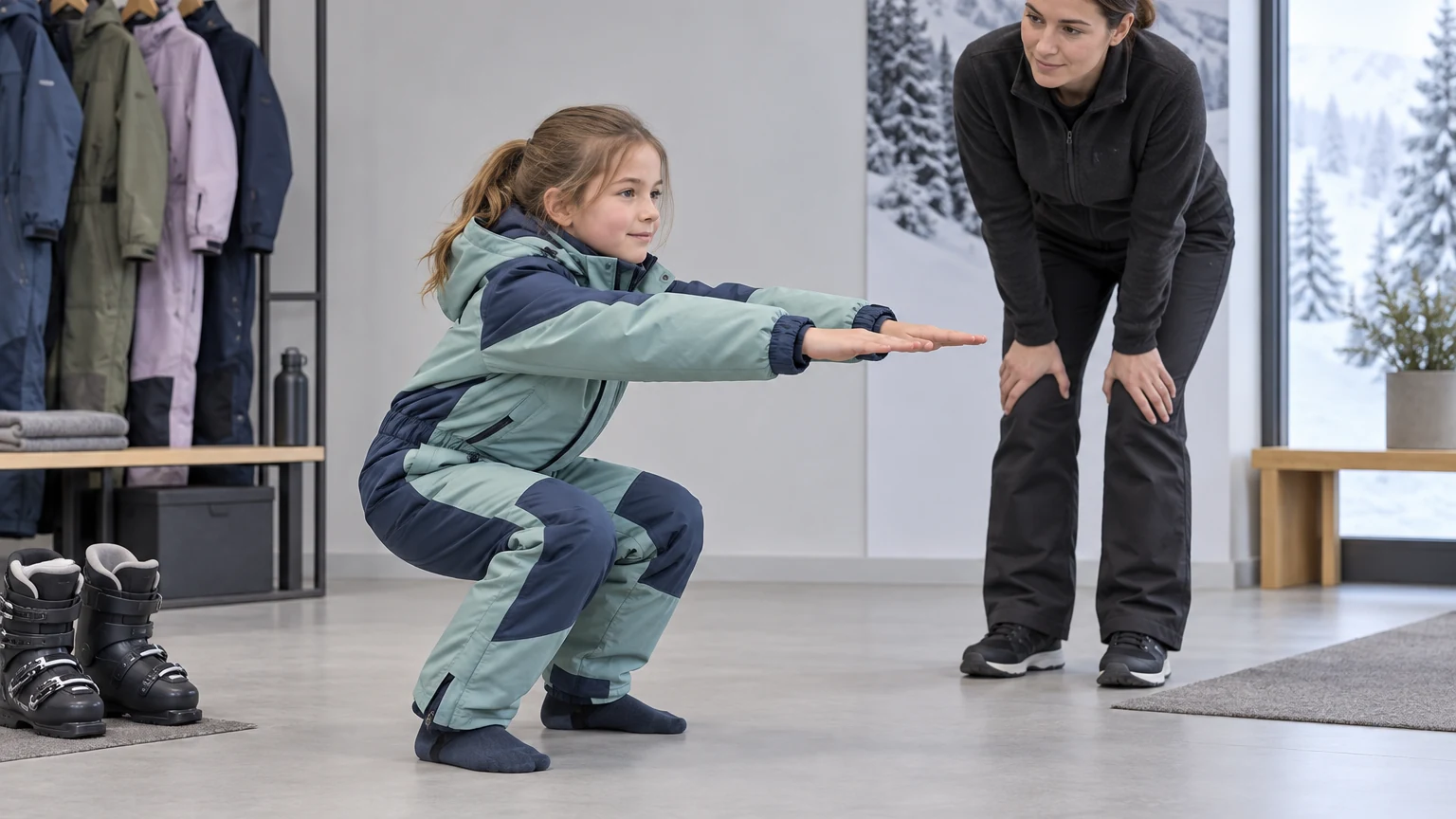
Growth room has a boundary. Extra torso and limb length may support seasonal use only if the design has documented adjustment and the excess does not drop the crotch, cover the hands, bunch inside boots or interfere with walking. Do not size up by age label alone. Age ranges are merchandising guides; body dimensions, layer thickness and finished measurements are the procurement controls.
| Checkpoint | Acceptable observation | Too small | Too large | Buyer action |
|---|---|---|---|---|
| Reach and squat | Joints move without hard pulling | Sleeves ride up; seat or knees bind | Excess fabric obstructs hands or feet | Retest adjacent size over the same layers |
| Torso and crotch | Enough vertical ease for sitting | Shoulder-to-crotch tension | Low, swinging crotch | Review torso grading, not just chest width |
| Cuffs, gloves and boots | Continuous coverage without compression | Wrist or lower leg exposed in motion | Fabric or cuff bulk trapped inside equipment | Approve interfaces with intended accessories |
| Hood and helmet | Head turns freely; vision remains clear | Hood pulls at neck or shoulders | Loose volume shifts or blocks peripheral view | Test the specified helmet and verify adjusters |
Visibility should be designed into the color blocking and trim placement, but bright colors or reflective-looking materials must not be described as safety performance unless the claim has relevant evidence. Hood adjusters, cords and attachments also deserve a destination-market review. For the United States, CPSC guidance identifies hood and neck drawstrings on children’s upper outerwear in sizes 2T to 12 as a substantial product hazard and places specific limits on waist and bottom drawstrings in sizes 2T to 16.
One-Piece vs. Two-Piece: Which Is Easier for Children’s Programs?
A one-piece design reduces the waist gap where snow can enter and keeps the jacket and lower body together in rental or school-program handling. Its trade-offs are restroom access, longer drying paths and a larger fit dependency on torso length. Buyers should inspect how the main opening works and whether a drop-seat or other access solution is actually included; do not infer a feature from a sketch or product category. Check reach, fastening security, modesty, zipper guards and whether an adult can assist where appropriate.
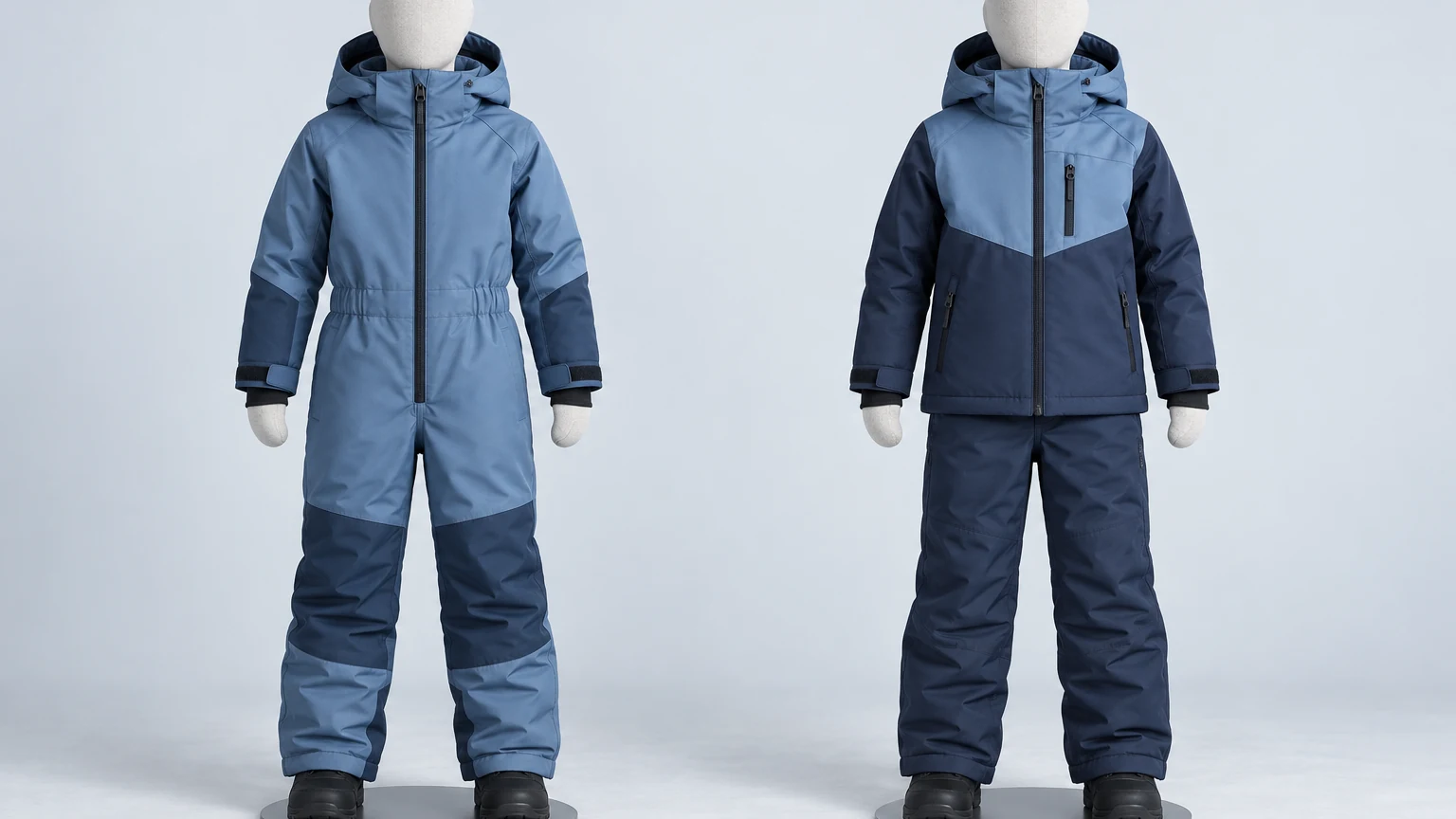
| Фактор решения | One-piece suit | Жакет и брюки |
|---|---|---|
| Snow-gap control | No separate waist junction | Depends on jacket length, bib height and interfaces |
| Movement and fit | Torso length and rise are critical | Top and bottom sizes may be selected separately |
| Restroom use | Depends on the verified opening or access design | Usually allows the upper garment to remain on |
| Rental handling | One asset to issue, track and return | Two assets; damaged pieces may be replaced separately |
| Drying and repair | Whole garment may be unavailable during service | One component can sometimes remain in service |
| Unit-cost tendency | Highly dependent on construction and components | Highly dependent on whether pieces are sold as a set |
| Lifecycle-cost driver | Fit returns, opening repairs and full-unit downtime | Lost pairing, mixed wear rates and two-item inventory |
For buyers comparing architectures, review a children’s ski clothing set alongside the one-piece sample rather than assuming either format is universally more practical. A сезонная коллекция куртки для сноубордистов also helps separate shell decisions from lower-body fit.
What Do Fabric Tests and Care Labels Actually Prove?
Commercial specifications should name the test method, sample condition and acceptance value rather than saying only “waterproof” or “breathable.” ISO 811 covers hydrostatic-pressure resistance to water penetration. ISO 11092 covers thermal and water-vapour resistance, commonly including Ret; lower Ret indicates lower resistance to water-vapour transfer within that method. These are laboratory test methods, not product certifications. Finished-garment construction, conditioning, laundering and test-house procedures can affect what a result means.
Cleaning instructions should be based on the actual shell, membrane or coating, insulation, seam tape, trims and print system. Avoid generic advice to use heat, bleach, fabric softener or a water-repellent treatment unless the supplier’s verified care instructions permit it. ISO 6330:2021 defines domestic washing and drying procedures for textile testing; it helps buyers plan controlled evaluation but is not itself a care label or durability certification.
For U.S. sale, the FTC Care Labeling Rule, 16 CFR Part 423, requires manufacturers and importers of covered textile wearing apparel to provide regular care instructions. Destination-market obligations vary, so the purchase specification should assign responsibility for label text, language, fiber information, traceability and claim review. After cleaning, garments should be fully dry before storage, kept clean and uncompressed in a ventilated place, and inspected for seam-tape lift, coating damage, zipper issues, cuff wear and missing components.
How Can Buyers Reduce Size Returns and Repair Costs?
Yuelei Sports can enter the discussion at the selection stage, when buyers need to align a size set, layer allowance and configurable construction with the sales channel. A sourcing team evaluating a custom boys’ and girls’ ski suit should request a measurement table with tolerances, graded sample measurements, component details, test reports tied to the supplied materials, packaging information and care-label artwork before bulk approval.
Returns should be analyzed by reason—not only counted. Separate wrong body size, insufficient layer allowance, excessive torso length, hard-to-use opening, boot or glove mismatch, and workmanship defects. In a 100-unit order, each one-percentage-point return-rate change represents one additional unit to receive, inspect, restock, repair or replace. That arithmetic is illustrative, but it shows why a lower quoted unit cost can lose its advantage when fit uncertainty and service time rise.
Use a lifecycle-cost model: landed garment cost + inspection + return handling + cleaning + repair parts + labor + downtime + end-of-service loss. For rental fleets, record every issued size and repair location. Standardize replaceable components where feasible, retain approved fabric and trim references, and define when a repair remains acceptable versus when the garment leaves service.
- Approve sizes over the exact planned thermal layers and equipment interfaces.
- Confirm hood, cuff, boot, glove and restroom-access details on the physical sample.
- Link every performance claim to a named method, specimen and current report.
- Review child-garment details and labeling for the destination market before production.
- Track return and repair reasons by size so the next order corrects the real cost driver.
Часто задаваемые вопросы
Is a kids one piece ski suit warm enough for snowy school holidays?
It can be, provided the suit, base layer and mid layer are specified as a system for the expected weather and activity. Do not use bulk as a proxy for warmth; compare documented materials, coverage, weather-protection construction and the child’s mobility over the intended layers.
How should a kids one piece ski suit fit over thermal base layers?
A one piece ski suit kids wear over thermal layers should allow full reach, squat, sitting and stepping without pulling at the shoulders, crotch, knees or seat. Sleeves and legs must retain useful glove and boot coverage without bunching into equipment; if a larger size creates interference, revise the pattern or layer allowance instead of accepting uncontrolled growth room.
Какие классы водонепроницаемости и воздухопроницаемости лучше всего подходят для катания на лыжах?
There is no universal best number because climate, session length, activity and test method differ. Ask for the exact method and conditions—such as ISO 811 for water penetration resistance or ISO 11092 for water-vapour resistance—and evaluate seams, zippers and openings separately from the fabric result.
Is a one-piece ski suit more practical than a jacket and pants?
A one piece ski suit kids use in snow can simplify issue tracking and remove the separate waist junction. A two-piece system can simplify mixed sizing, restroom use and component replacement, so practicality depends on the user group and operator workflow.
Можно ли носить костюм для сноубординга и катания на лыжах?
Potentially, if the fit supports the intended stance, repeated flexion and equipment interfaces. Validate reach, squat, seated movement, cuffs, boots and helmet compatibility for the actual activity rather than assuming that a skiing label confirms snowboarding suitability.
Как стирать и сушить костюм для сноубординга, не повреждая водонепроницаемый слой?
Follow the sewn-in care label and the supplier’s instructions for the specific materials and trims. Close fasteners as directed, use only permitted products and drying conditions, and inspect the garment after cleaning; do not add heat, softener or a treatment unless the verified instructions allow it.
Ссылки
- U.S. Consumer Product Safety Commission: Drawstrings in Children’s Upper Outerwear — U.S. hazard and drawstring guidance for the specified children’s size ranges.
- ISO 811:2018: Textiles — Determination of resistance to water penetration — Hydrostatic pressure test — a fabric test method, not a garment certification.
- ISO 11092:2026: Measurement of thermal and water-vapour resistance — a steady-state material or assembly test method, not a comfort guarantee.
- ISO 6330:2021: Domestic washing and drying procedures for textile testing — controlled textile test procedures, not consumer care instructions.
- Federal Trade Commission: Care Labeling of Textile Wearing Apparel & Certain Piece Goods — the U.S. rule page for 16 CFR Part 423.
The durable buying principle is simple: specify the layer system first, prove movement second and add growth room only where control features preserve fit.
To review configurable options for your next range or rental program, explore Yuelei Sports’ ski suit category and contact the team with your target market, size range, layer plan, use case and testing requirements.