 Сямыньская спортивная компания с ограниченной ответственностью «Юэлей»

When a ski-wear buyer in Munich reviews a retro capsule, the first sample may look convincing on the rail: a high collar, a defined waist, and bold contrast panels. Within minutes of fitting, however, the model raises both arms, squats, and tries the main closure; the torso pulls, the seat binds, and a restroom visit becomes a complicated exercise. The visible failure is rapid, but the root cause is not necessarily a bad product—or proof that the one-piece silhouette is impractical. It is usually a selection and specification problem: vintage visual cues were approved before layering allowance, mobility, ventilation, closure access, weather testing, and size grading were engineered as one system.
Quick Answer: The one piece ski suit is regaining visible design and retail interest because its uninterrupted silhouette, strong color blocking, and nostalgic slope identity photograph clearly and differentiate a winter assortment. That is an observation about styling visibility, not evidence of a quantified market-growth rate. A viable modern program should preserve the visual language while independently specifying fabric, seam construction, ventilation, articulation, closures, and fit. ISO 811 can compare a fabric’s resistance to water penetration, but it does not certify a finished garment. Buyers should therefore approve an original design, a layered fit block, and verified test reports before confirming the assortment.
What Does “Retro” Mean in One-Piece Ski Suit Design?
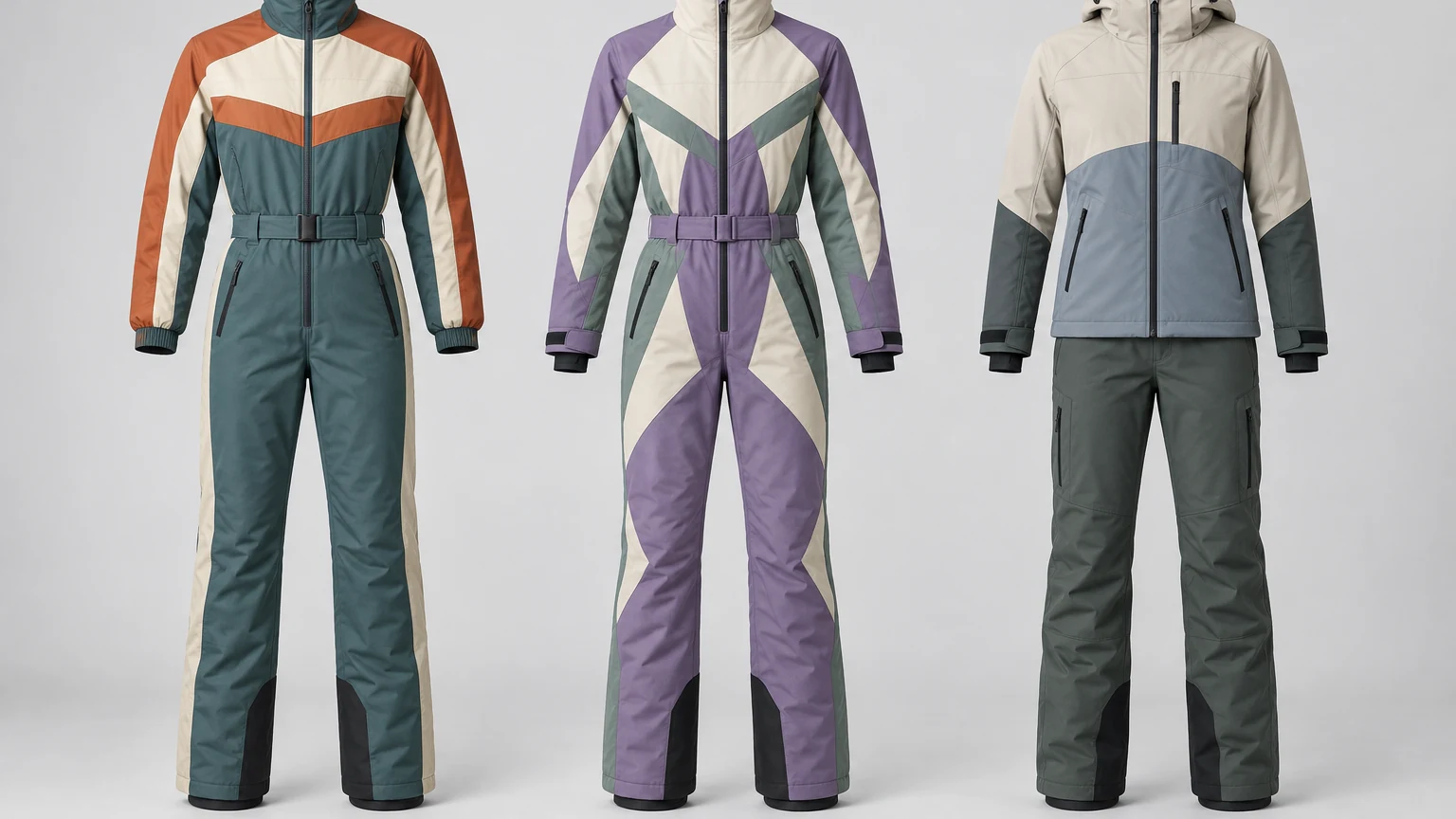
The renewed appeal is easy to recognize in product presentations and winter styling: uninterrupted head-to-toe color stories, shaped waists, contrast yokes, diagonal panels, piping, higher collars, and brighter palettes associated with earlier slope wear. A ski suit one piece silhouette also creates a single focal product for campaign imagery. None of this proves that every region, price tier, or consumer group is moving in the same direction; it simply explains why the form has become a useful creative option again.
Retro inspiration should be translated into a design brief, not copied from an archive image or recognizable branded garment. Teams can document abstract cues—such as “two broad diagonal panels” or “high-waist proportion”—then create new geometry, pockets, trims, and color relationships. Rights vary by market and fact pattern, so keep dated development records and seek qualified counsel when a proposal resembles an identifiable product.
Terminology also needs discipline. “onesie ski suit” often signals a casual or fashion-led product, while “ski jumpsuit” can suit a more technical or tailored presentation. The phrase “ski jump suit” may also be misunderstood as clothing for the sport of ski jumping. Product names should match the intended use and should not imply a performance level the specification has not established.
How Can a Retro Look Keep Modern Function?
A credible one piece ski suit does not become technical because it looks substantial or carries a large waterproof number. ISO 811 measures a textile’s resistance to water penetration under hydrostatic pressure; the result applies to the tested specimen and conditions. It does not automatically account for seams, zippers, pocket openings, abrasion, laundering, or the whole garment. Buyers should define whether claims refer to the face fabric, laminate, seam-sealed assembly, or completed garment protocol.
Warmth is equally system-dependent. Insulation weight, lining, air permeability, moisture management, wind exposure, activity level, and base layers all affect comfort. ISO 11092 measures thermal resistance and water-vapor resistance under controlled conditions, but a single material result cannot predict every skier’s comfort. For a ski suit one piece program, request test conditions and specimen descriptions alongside results rather than comparing isolated supplier numbers.
Mobility should be proven on the intended layered body. Check overhead reach, pole-plant posture, deep knee flexion, seated lift position, boot adjustment, and torso rotation. Articulated knees, gussets, sufficient back length, and sleeve pitch may help, but the pattern must resolve them. Vents should open with gloves and avoid backpack straps and pockets.
Restroom practicality deserves the same attention as weather protection. A two-way front zip, extended opening, or drop-seat solution can improve access, yet every extra closure adds bulk, cost, and a potential ingress point. A onesie ski suit for broad consumer use may prioritize simple operation; a fashion capsule may accept more complexity. State that priority in the specification.
One-Piece vs. Two-Piece: Which Format Fits the Product Brief?
| Фактор решения | Retro-inspired modern one-piece | Original vintage garment | Contemporary two-piece |
|---|---|---|---|
| Design value | Strong uninterrupted silhouette with newly developed color blocking | Authentic period appearance, but condition and construction vary | Flexible jacket-and-pant combinations across collections |
| Weather interface | No waist gap; performance still depends on tested materials, seams, and closures | Aged coatings, seam tapes, or elastics may no longer perform as originally intended | Waist interface must be managed with overlap, bib, gaiter, or compatible geometry |
| Fit and mobility | Torso, rise, limb length, and layering allowance are interdependent | Period blocks may not suit current layering or size expectations | Top and bottom sizing can be selected separately |
| Practical access | Requires deliberate vent and restroom-closure design | Often limited by older closure layouts | Generally simpler to remove or adjust one component |
| Assortment and TCO tendency | Distinctive SKU, but fit returns can rise if torso grading is weak | Unsuitable as a repeatable production benchmark without technical redevelopment | More mix-and-match SKUs, with possible inventory imbalance between tops and bottoms |
The two-piece remains lower risk where customers need separate jacket and pant sizes, component replacement matters, or the range has a strong ski-jacket architecture. The ski jumpsuit earns its place when distinction, continuous coverage, and one-SKU storytelling outweigh added fit work. Treat a true vintage garment as visual research, not an untested production specification.
How Should Designers Turn Retro Ideas Into an Original Product?
Begin with original line work. Change panel number, angle, scale, and meeting points; develop a proprietary palette; and position pockets by use rather than a reference photo. For a custom one-piece ski-suit design, compare flat artwork, pattern pieces, a dressed form, and a moving fit model before freezing color blocking. This is easier to document than tracing a familiar garment.
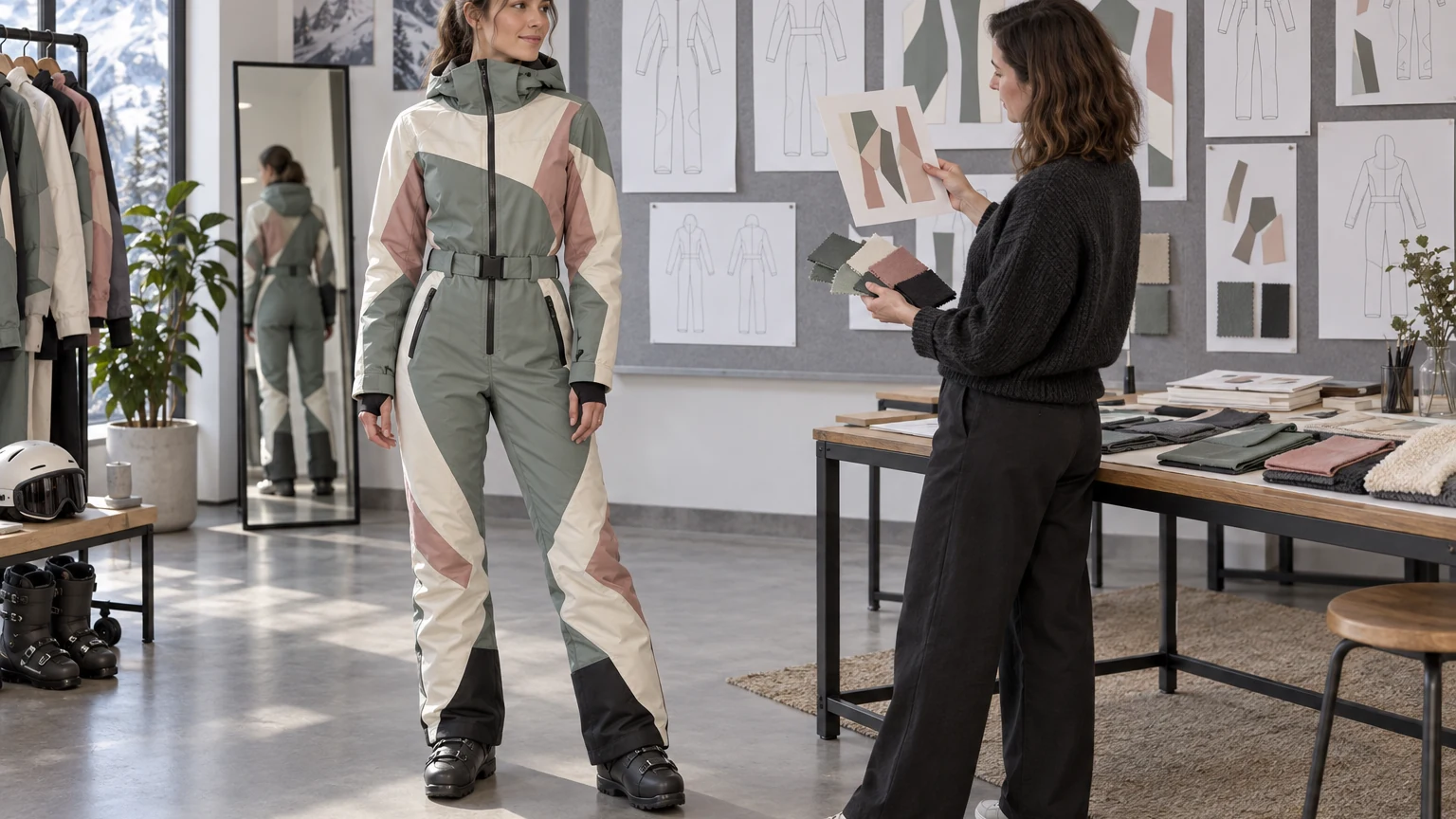
A practical approval sequence is artwork, material shortlist, first pattern, layered fit and movement review, pre-production sample, and agreed testing. It is a product-development control, not an ISO requirement. For a waterproof ski-jumpsuit construction, identify the test method, specimen, acceptance criterion, seam treatment, and conditioning rather than relying on the word “waterproof.”
How Do Design Identity, Fit Risk, and Cost Affect the Range?
One design does not need to serve every channel. A narrow fashion capsule may use more assertive geometry, while a core resort program may favor easier grading, simpler closures, and restrained colors. The matrix below is a planning framework, not a claim about demand or pricing.
| Program role | Design direction | Fit and function emphasis | Assortment control | Key approval evidence |
|---|---|---|---|---|
| Image-led capsule | Original high-contrast panels and defined silhouette | Layered mobility without over-compressing the waist | Fewer colors; controlled size depth | Artwork ownership trail, fit video, approved color standard |
| Core all-mountain offer | Moderate retro cues with durable visual relevance | Vent access, articulation, glove-friendly operation, weather specification | Concentrate depth in validated core sizes | Layered fit record, material and seam test reports |
| Entry fashion offer | Simplified blocking and trim package | Easy dressing and clear care instructions | Limit complexity that adds return or service risk | Wear trial, closure review, care-label validation |
| Extended-size test | Preserve design proportions across grades | Recheck torso length, rise, reach, and knee position at size extremes | Pilot before expanding depth | Multi-size fit set and measurement audit |
Return risk is not captured by landed unit cost. An illustrative total-cost model is: landed cost + inspection and rework + return handling + markdown exposure + customer-service cost + replacement or warranty administration. A ski suit one piece may reduce outfit coordination for the consumer, yet create more fit sensitivity because torso length and rise cannot be separated from jacket and pant size. Track return reasons by size and body-area complaint, then revise the block or product description before adding colors.
Buyers should also avoid over-ranging near-identical options. A focused onesie ski suit capsule with distinct price, use, and color roles is easier to explain than multiple styles differentiated only by trim. For a configurable ski-jumpsuit manufacturing program, request a costed bill of materials and identify which features drive construction time, testing, or minimum material commitments before final SKU selection.
Which Standards and Labels Should Buyers Check?
Standards must be cited by scope. ISO 811 covers hydrostatic-pressure resistance of textile fabrics; ISO 11092 addresses thermal and water-vapor resistance under steady-state conditions. ISO 6330 provides domestic washing and drying procedures for textile testing, not proof of long-term durability. In the United States, the FTC Care Labeling Rule addresses instructions for covered textile wearing apparel. Applicability depends on market, use, materials, and claim evidence.
For supplier selection, freeze the end-use brief; approve original artwork and review intellectual property where appropriate; define a layered fit block; state methods, specimens, conditions, and criteria; and compare total cost. Yuelei Sports can support a ski jumpsuit program through configurable development and sourcing discussion, while buyer and supplier agree the documentation and tests required for each market.
Care instructions must match verified materials and components. As a conservative development baseline, close zippers and hook-and-loop tabs, remove detachable items, wash at the labeled temperature with the specified detergent type, avoid unapproved softeners or bleach, rinse adequately, and dry only by the validated method. Do not promise that heat will “reactivate” a finish unless the material supplier’s instructions support that treatment. Store the clean, fully dry garment uncompressed, away from prolonged heat, moisture, and direct sunlight.
Часто задаваемые вопросы
Is a one piece ski suit warm enough for skiing in variable weather?
It can be, but the silhouette alone does not determine warmth. Evaluate insulation, wind resistance, ventilation, base-layer strategy, activity level, and the conditions in which the garment will be used; ISO 11092 data can help compare tested material assemblies, not guarantee whole-garment comfort for every skier.
How should a one piece ski suit fit over thermal base layers?
It should allow overhead reach, a deep knee bend, seated posture, and torso rotation without pulling at the crotch, seat, shoulders, or collar. Fit samples over the intended base and mid layers, then check that added ease does not create excessive bulk around closures or the waist.
Какие классы водонепроницаемости и воздухопроницаемости лучше всего подходят для катания на лыжах?
There is no universal best pair of ratings because climate, exposure, activity, construction, and test method differ. Specify the method and tested specimen—ISO 811 for fabric water-penetration resistance and ISO 11092 for water-vapor resistance are relevant examples—then verify seams, closures, conditioning, and garment design separately.
Is a one-piece ski suit more practical than a jacket and pants?
It can provide continuous coverage and a clear single-garment look, while a two-piece allows separate sizing and easier component replacement. The practical choice depends on fit range, restroom access, ventilation, inventory strategy, and whether customers value mix-and-match flexibility.
Можно ли носить костюм для сноубординга и катания на лыжах?
Potentially, provided the fit, articulation, durability, venting, boot interface, and pocket layout support snowboarding movements and equipment. Validate deeper flexion and seated snow contact rather than assuming a ski-oriented pattern transfers unchanged.
Как стирать и сушить костюм для сноубординга, не повреждая водонепроницаемый слой?
Follow the garment’s care label and the verified fabric or membrane instructions; close fasteners, use only permitted products, rinse thoroughly, and apply the specified drying method. ISO 6330 supplies standardized laundering procedures for textile tests, while the finished product’s validated care process should determine the consumer instruction.
Ссылки
- ISO 811:2018 — Textile fabrics: Determination of resistance to water penetration—Hydrostatic pressure test
- ISO 11092:2014 — Physiological effects: Measurement of thermal and water-vapour resistance
- ISO 6330:2021 — Domestic washing and drying procedures for textile testing
- U.S. Federal Trade Commission — Care Labeling Rule
- World Intellectual Property Organization — Industrial designs
The durable lesson is simple: borrow the era’s energy, not another brand’s identity, and make every performance decision traceable to a fit check, specification, or test.
To scope an original program, review Yuelei Sports’ ski suit category and contact the team with your target user, destination market, size range, design direction, and required test methods.