 Сямыньская спортивная компания с ограниченной ответственностью «Юэлей»
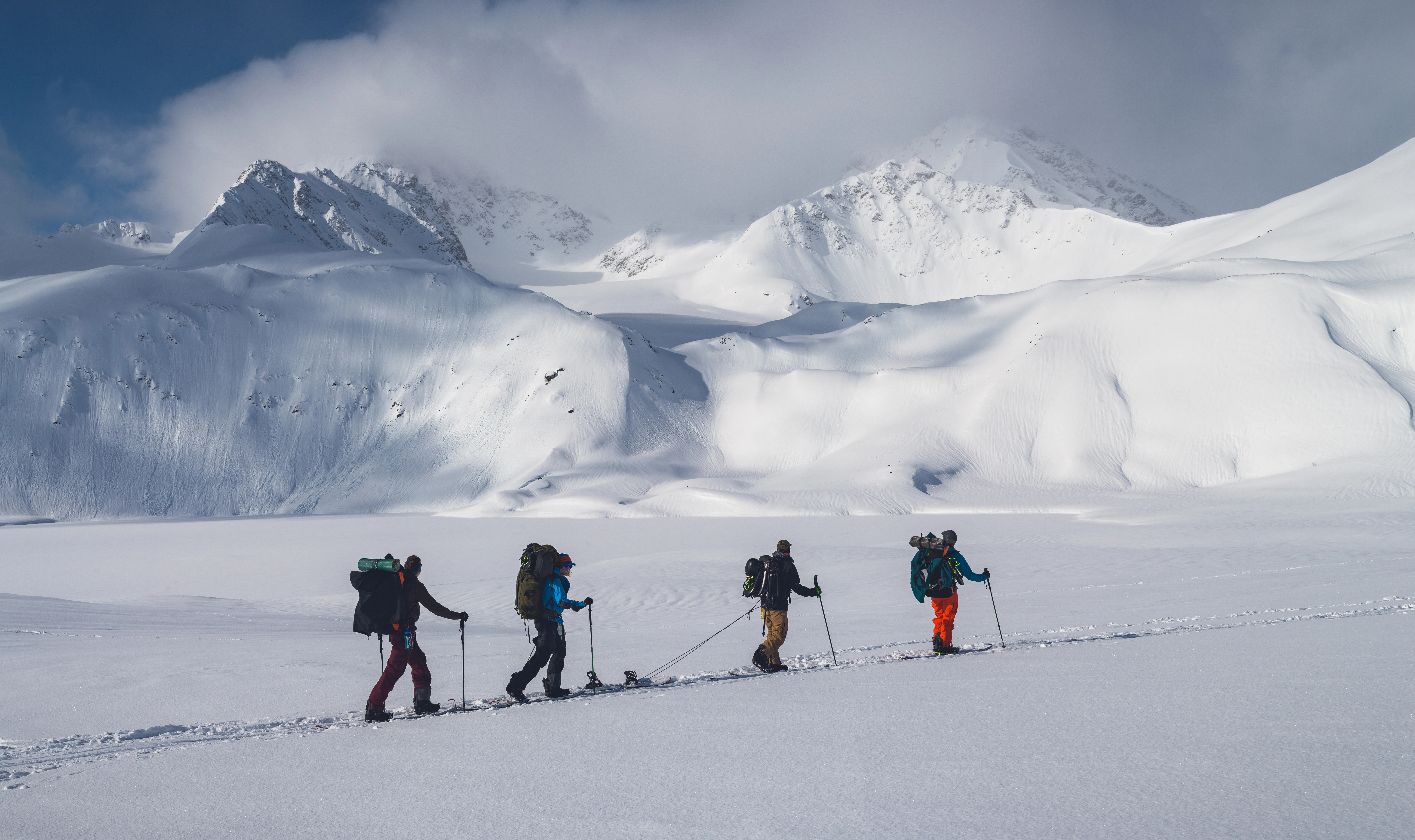
When a beginner-program coordinator in Sapporo sent a new group from their first drills onto a chairlift, several participants developed damp backs, cold hands, and visible shivering within 20 minutes. The jackets were blamed first. A kit review reversed that conclusion: cotton undershirts held moisture, tight cuffs left gaps at the gloves, and undersized outerwear compressed the midlayers. The failure was a system-specification and fit problem, not simply a bad jacket.
Summary: The right snow skiing clothes keep a beginner warm by working as a complete system, not by relying on one jacket specification. Activity level, wind, moisture, rest duration, personal physiology, fit, extremity protection, and garment interfaces all change heat balance. ISO 11092:2026 can measure thermal and water-vapour resistance under steady-state conditions, but it is not a comfort rating. Buyers should therefore specify the whole kit, trial its size set, and review documented test conditions before committing to volume.
A beginner often alternates between high-effort walking or repeated falls and low-effort instruction, lift queues, and chairlift exposure. That cycle makes “warm enough” a moving target. The procurement question is not which single garment is warmest; it is whether the system can release moisture during work, resist wind and surface wetting, retain useful insulation during rest, and preserve coverage while the wearer bends, reaches, or sits.
A cold-and-windy layering system must handle both work and waiting
OSHA illustrates wind’s effect with 40°F (about 4.4°C) air and a 35 mph wind, producing a 28°F wind-chill effect on exposed skin. This is not a garment rating, but it explains why a calm-weather outfit can fail on an open lift. Wind resistance and coverage at the hood, cuffs, waist, and boot top are system requirements.
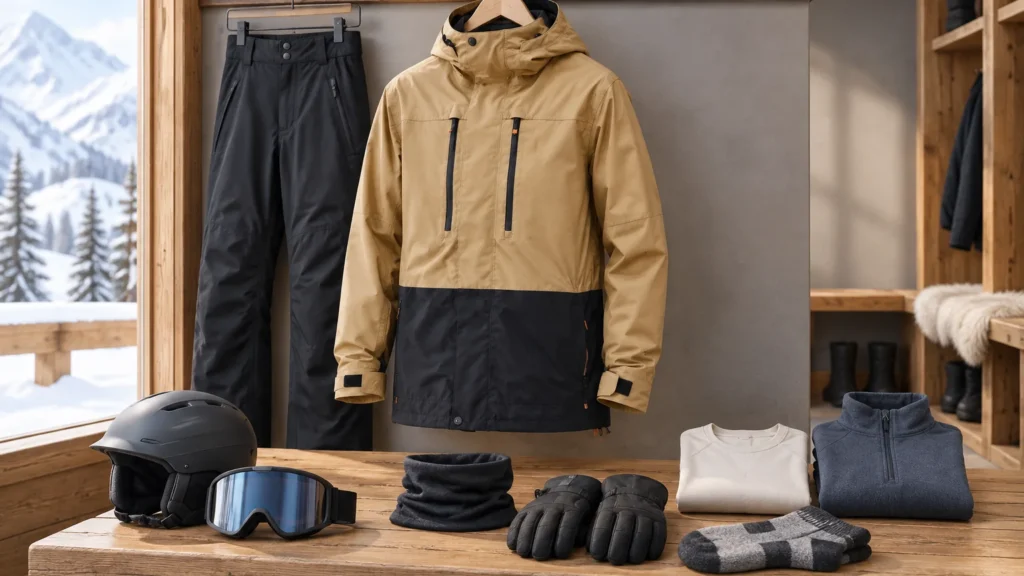
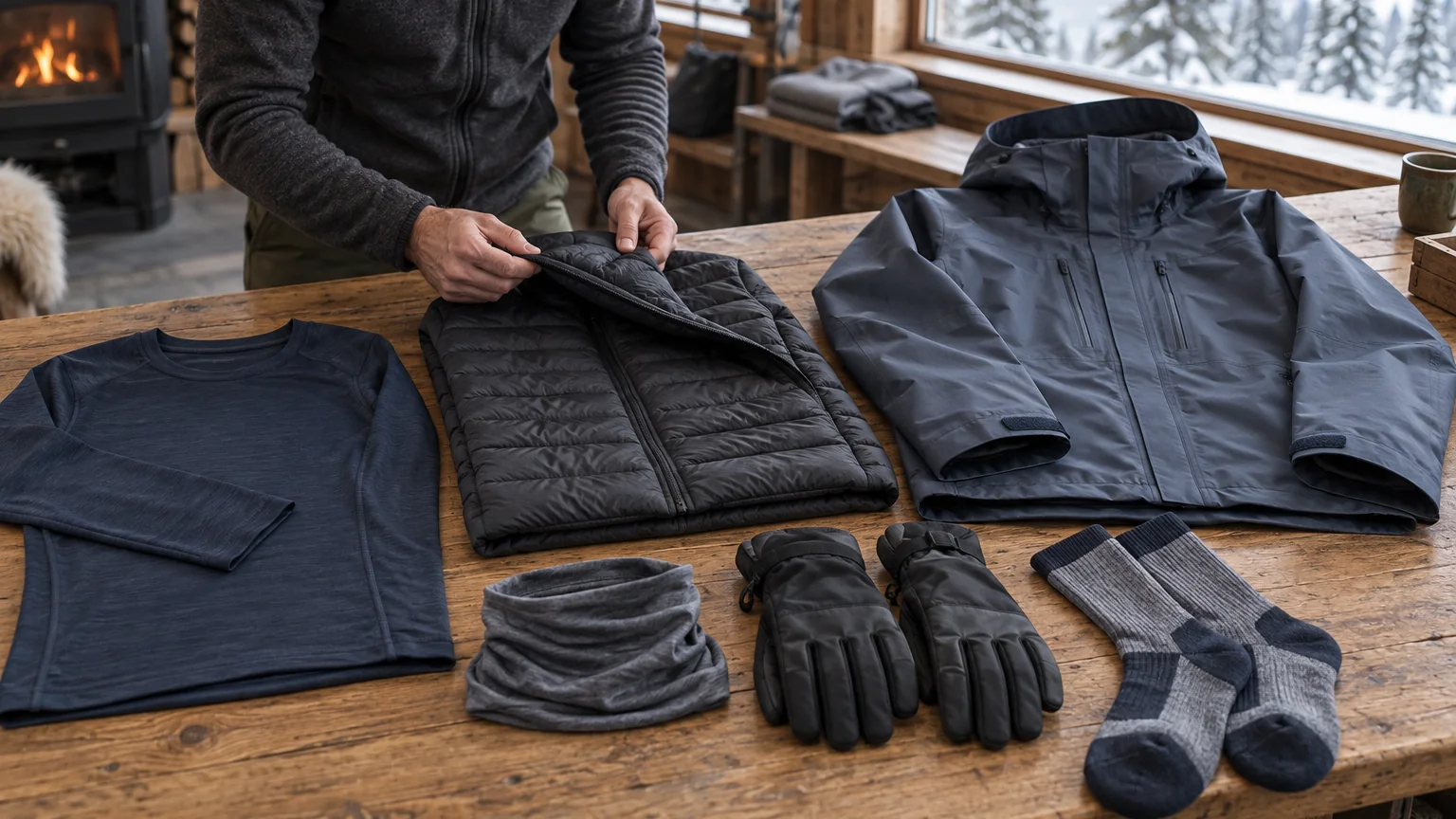
Three functions must remain clear even when two share one garment: a base layer manages moisture, a midlayer provides adjustable insulation, and an outer layer limits wind and precipitation. A buyer assessing snow skiing clothes should specify changes between active lessons and lift travel. Removable insulation reduces overheating during drills; a secure hood, powder skirt, and compatible cuffs limit gaps during rest.
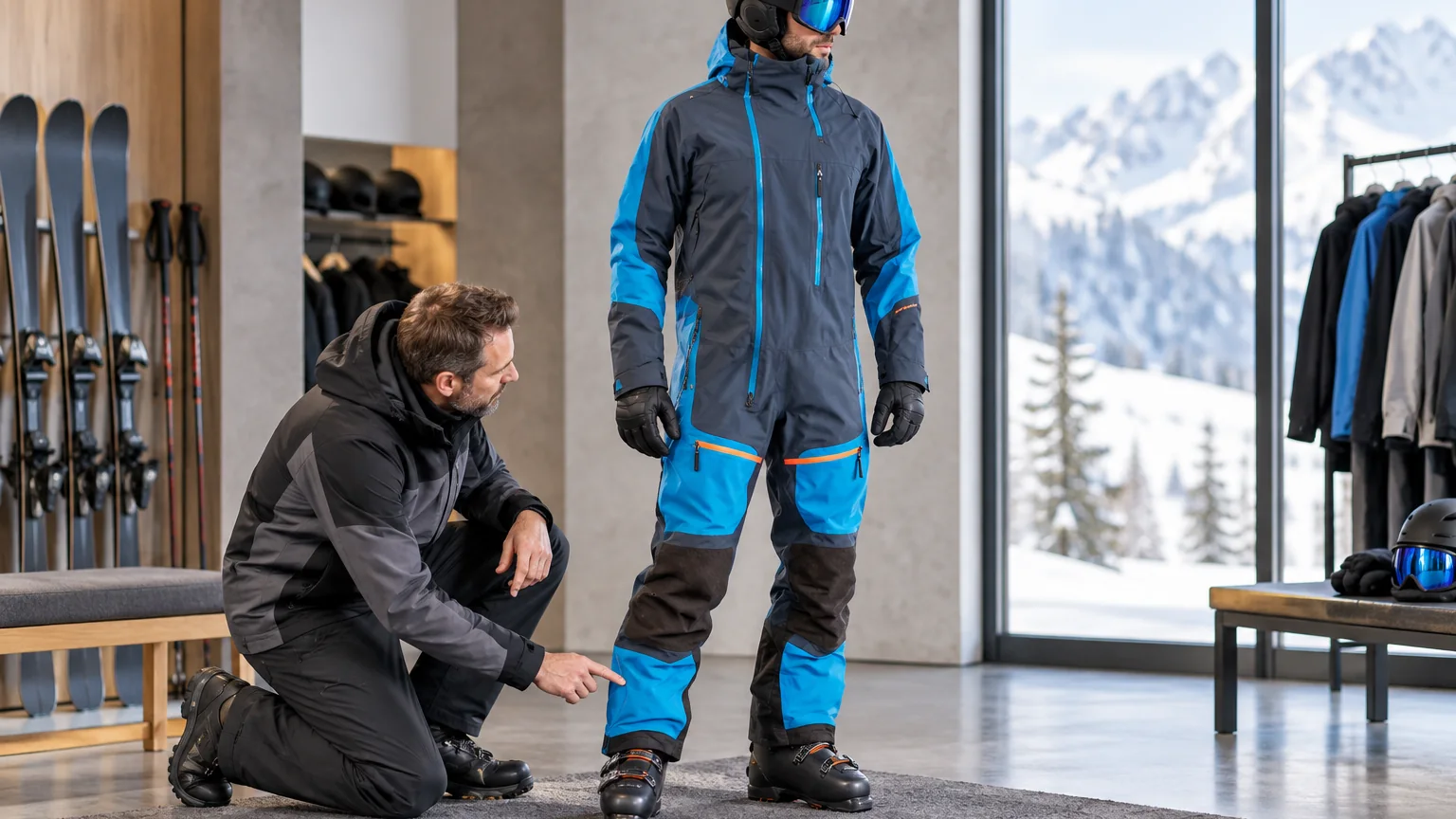
Fit controls whether those functions survive movement. A size trial should include squatting, reaching, rotating, fastening boots, and sitting as on a lift. The system needs ease for loft and circulation without excess volume that pumps air out. NIOSH notes that several loose layers improve insulation and restrictive clothing may impede movement, supporting tests of complete size combinations.
An all-day adjustment loop should start before anyone leaves the lodge
At lodge departure, begin dry rather than maximally insulated. Confirm that the midlayer is removable and vents work with gloves. Check five interfaces: hood with helmet and goggles without breaking the seal or blocking vision; neckwear with collar; sleeve with glove; jacket with pants or bib at the waist; and gaiter over boot. One gap can negate a thick jacket, while pinched boots or compressed layers impair circulation or loft.
Active lessons call for early venting rather than waiting for sweat
Walking, recovering from falls, and repeated drills raise heat production quickly. Staff should cue wearers to open vents or remove one midlayer before the back becomes damp, then brush snow from cuffs, collars, seats, and gloves before it melts. A dry layer can be restored later; wet insulation is harder to recover outdoors.
Queues and chairlifts require coverage to be restored before cooling begins
Before the lift queue, close vents, restore the midlayer if needed, secure the neck, and overlap gloves and cuffs. On the chairlift, movement falls while wind exposure may rise, so check for a hood or goggle gap, exposed waist, displaced gaiter, or snow-filled gloves. The trigger is the change in activity, not a universal temperature number.
Indoor breaks should reset moisture and spares for the next outdoor cycle
Indoors, open outerwear and separate damp neckwear, socks, and gloves from dry items. Dry the skin before using spare socks or gloves, then check boot volume, folds, and circulation. Put wet accessories in a ventilated drying area or separate wet-items bag, never beside the next dry pair. Repeat all five interface checks before returning outside.
Cold-prone wearers and hot runners need different first adjustments
A dry, cold-prone person with normal circulation may need compatible insulation, warmer hand protection, or shorter stationary periods. A hot runner should vent or reduce insulation earlier, then restore coverage before the queue; sweating into extra insulation can make the chairlift colder. Numbness, confusion, uncontrolled shivering, unusual fatigue, or persistent symptoms require the operator’s cold-stress procedure and appropriate help. Physiology, exertion, wind, moisture, health, and fit make fixed comfort-temperature promises unsuitable.
Base-layer fabric choice determines whether insulation stays useful
A base layer’s first job is to reduce prolonged skin contact with perspiration. Hydrophobic synthetics can move moisture and dry relatively quickly; wool-rich blends can balance moisture buffering, odour control, and a less clammy feel. Cotton-rich garments retain absorbed moisture and are difficult to justify when drying opportunities are limited.
ISO 11092:2026 measures two relevant properties—thermal and water-vapour resistance of fabrics or multilayer assemblies—with a sweating guarded hotplate under steady-state conditions. It does not reproduce changing work rate, wind, body shape, or rest. Results should identify the tested stack, conditioning, method edition, units, and result, not become unsupported temperature promises.
Hidden cost appears when a saturated base layer prompts more bulk or a replacement garment. For beginner programs, snow skiing clothes should be evaluated after an activity-and-rest cycle: does fabric bunch, do seams chafe, and can the midlayer be removed easily? Warm clothes for skiing manage perspiration before trapping more heat.
Shells and insulated outerwear solve different operating problems
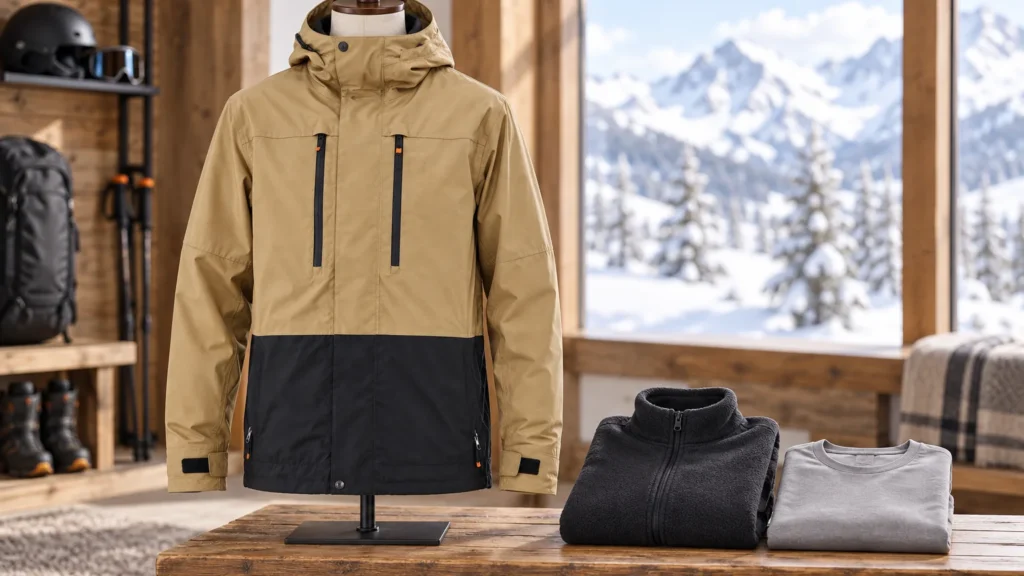
An uninsulated shell offers high adjustability because the user can change the midlayer. An insulated jacket simplifies issue and dressing, but offers fewer adjustment steps and may retain too much heat during repeated practice. A lightly insulated hybrid sits between them. None is universally warmer across a full day.
ISO 4920:2012 evaluates resistance to surface wetting by spray; it does not measure water penetration through fabric. Buyers comparing snow skiing clothes should separate surface repellency, hydrostatic testing, seam construction, and whole-garment design rather than treat one spray rating as complete protection.
Insulated outerwear may reduce training and missing-layer errors; a shell-plus-midlayer system broadens adjustment. Total cost includes size returns, SKU count, drying time, repairability, replaceable layers, and claim-related complaints. The same logic applies to skiing and snowboarding clothes, although snowboard fits may allow different seat, knee, and torso movement.
Heat loss often begins at wet accessories and open garment interfaces
NIOSH advises protecting the ears, face, hands, and feet, using waterproof insulated boots, and carrying spare socks, gloves, a hat, and a jacket. OSHA notes that constantly wet feet may lose heat 25 times faster than dry feet. The specification is therefore one appropriate sock, adequate boot volume, moisture control, and a dry replacement process—not simply thickness.
Two sock layers or an overly thick sock can restrict circulation and create folds. Gloves need finger room and must overlap the cuff as designed. Neckwear should close the collar gap without obstructing vision or becoming wet enough to chill. Programs should carry dry gloves and socks in suitable sizes, assign replenishment responsibility, and separate damp returns until fully dried.
OSHA describes hypothermia as core body temperature below 95°F (35°C); concerning symptoms require established safety procedures and prompt help, not another layer alone. A check of snow skiing clothes should cover hood and helmet, collar and neckwear, sleeve and glove, jacket and bib, and gaiter and boot. This makes the kit a connected barrier, while dry spares keep snow clothes for skiing functional after falls.
Comparing complete systems reveals both value and hidden costs
The best clothes for snow skiing depend on the operating scenario. This comparison avoids a universal temperature scale and instead shows where cost and performance trade-offs usually arise.
| System option | Weather barrier | Thermal adjustability | Moisture control | Mobility and fit | Unit-cost tendency | Returns and maintenance | Total-cost implication |
|---|---|---|---|---|---|---|---|
| Insulated jacket and bib | Depends on fabric, seams, and interfaces | Moderate; vents and base layers matter | Depends on inner layers and venting | Simple to issue; requires size trials | Moderate to higher | Fewer pieces; whole outer garment may need service | Can reduce training and missing-layer errors |
| Shell plus removable midlayer | Shell carries the wind and wet-weather role | High; insulation can be added or removed | High potential with compatible layers | Layer compatibility and combined bulk require testing | Higher as a complete set | More tracking; layers can be replaced separately | Can suit changing weather and users |
| Lightly insulated hybrid | Depends on mapped materials and seam design | Moderate to high with removable insulation | Can balance activity and rest | Test movement at material transitions | Moderate | Construction complexity can affect repair decisions | Can reduce changes in a defined use range |
Modelling the operating cycle before purchase improves application decisions
Illustrative decision worksheet: the formulas below use buyer-supplied quantities and rates; they are not price claims or industry benchmarks. Even when evaluating snow skiing clothes on sale, procurement teams should compare the handled cost of the complete system, not the discount on one garment.
| Application | Preferred decision emphasis | Buyer inputs | Illustrative cost logic | Decision gate |
|---|---|---|---|---|
| Beginner lesson program | Simple issue and broad sizing | Users, exchanges, fitting time | Issue cost + fitting labour + exchanges + wet-accessory replacements | Pass movement and rest-cycle trials |
| Cold, windy lift-served use | Wind coverage, controllable insulation, dry spares | Rest duration, interfaces, spare ratio | System + spares + drying + interruptions | Verify seated coverage with helmet and gloves |
| Variable-weather retail assortment | Clear insulation and fit choices | SKUs, returns, evidence, season mix | Inventory + returns + markdowns + support | Descriptions match documented evidence |
| Rental or multi-season fleet | Durability, care, repair, replaceable parts | Uses, wash cycles, repairs, downtime | (Purchase + care + repairs + downtime) divided by completed uses | Inspect samples after the intended care cycle |
Standards support comparison, but they do not create a universal warmth claim
- ISO 11092:2026 is a sweating guarded-hotplate test method for thermal resistance and water-vapour resistance of fabrics and multilayer assemblies under steady-state conditions. The standard explicitly does not establish test conditions for specific comfort situations or physiological comfort performance specifications.
- ISO 4920:2012 tests textile-fabric resistance to surface wetting by a spray method. It does not predict rain penetration and should not be presented as a complete waterproof-performance result.
- ISO 811 is a hydrostatic-pressure water-penetration test method. Request the edition, conditioning, tested material or assembly, result, and units before comparing claims.
- EN 343 may be relevant to garments intended and claimed as protection against rain. Applicability depends on intended protective use, destination market, product classification, and the claims made; it should not be assumed for ordinary sportswear or cited without supporting conformity documentation.
These are test or classification frameworks, not proof that any garment here is certified. Unsupported warmth, waterproof, or compliance language can create returns, relabelling, and destination-market risk. Documents should state what was tested, by which method and edition, under what conditions, and with what result.
Four procurement checks reduce avoidable beginner-system failures
Yuelei Sports is a China-based B2B sportswear solutions supplier offering configurable ski apparel and sourcing support. It can translate a use case into samples and documentation, while buyers retain responsibility for test scope, fit, claims, and destination-market review.
- Define the operating cycle. Record lodge departure, active lesson, lift queue, chairlift, and indoor-break stages alongside likely wind and wet exposure, accessory policy, drying resources, and the range of user experience. Specify which adjustments staff will cue at each transition, and avoid approving a universal temperature label.
- Request traceable evidence. For a configurable ski-suit sample, ask for material specifications, seam and closure construction, applicable test reports, method editions, conditions, results, and laundering evidence.
- Trial a complete size set. Evaluate base and midlayers under outerwear, then test movement, seated coverage, glove-cuff overlap, neck closure, boot-gaiter compatibility, circulation, and adjustment usability. A jacket construction sample should be reviewed as part of that system rather than in isolation.
- Review claims for the destination market. Separate verified test results from marketing language, confirm whether protective-use rules apply, and resolve label, care, and documentation gaps before production.
These six questions resolve the most common beginner-clothing decisions
What is the best layering system for snow skiing clothes?
A practical system uses a moisture-managing base, adjustable insulation, and a wind- and wet-weather outer barrier. The exact weights depend on activity, wind, moisture, rest duration, physiology, and fit, so buyers should validate the full stack in the intended use cycle.
What should I wear under snow skiing clothes in cold and windy conditions?
Start with a close-fitting synthetic or wool-rich base layer, then add a midlayer that retains loft without restricting movement. Avoid cotton-rich next-to-skin layers for long cold exposure, and adjust insulation before sweating heavily.
Do I need an insulated jacket or a shell for cold and windy conditions?
An insulated jacket simplifies dressing, while a shell with removable midlayers offers more adjustment across activity and weather changes. The better choice depends on the operating cycle, user skill, available spares, and how reliably wearers can manage layers.
How can I avoid losing warmth while skiing?
Keep inner layers dry, close interface gaps, vent before overheating, and replace wet gloves or socks promptly. Check that clothing is not so tight that it compresses insulation or restricts circulation, especially at boots and cuffs.
Are ski clothes and snowboard clothes interchangeable?
They can share weather-barrier and insulation functions, but fit and reinforcement priorities may differ. Confirm torso length, seat and knee articulation, cuff interfaces, and movement ease for the intended sport rather than assuming interchangeability.
How should ski clothing fit so it is warm but still easy to move in?
It should allow the intended base and midlayers to retain loft while supporting a squat, reach, torso rotation, and seated lift posture. Cuffs, hem, hood, and gaiters should maintain coverage without restricting circulation or vision.
These primary sources define the limits of warmth and weather claims
- OSHA: Cold Stress Guide
- CDC/NIOSH: Cold and Work
- ISO 11092:2026
- ISO 4920:2012
- National Weather Service: Understanding Wind Chill
The durable lesson is simple: all-day warmth comes from coordinated layers, correct fit, moisture management, continuous coverage, and dry accessories—not one jacket number. Buyers developing a beginner range can ask Yuelei Sports to discuss configurable samples, size-set review, and the documentation needed for an evidence-led decision through the contact team.