 Xiamen Yuelei Sports Co., Ltd.
Consider a hypothetical technical engineer in Anchorage, Alaska, who approves a wader sample one size up for “extra room.” During a movement trial, excess leg fabric catches on equipment while the seat still restricts bending. The size label has solved neither problem; the pattern, layers and intended task need to be assessed together. That raises the buyer’s question: PVC chest wader vs. outbound neoprene chest wader—which construction fits the proposed use?
Resumen: PVC can be a lower-cost option for short-duration muddy work and straightforward cleaning, but chemical protection requires separate evidence; neoprene is warmer and more flexible for cold water, but it is heavier and less comfortable in summer. A breathable chest wader is the better option for high-output walking or warm-weather use, when the quoted shell has suitable water-resistance and vapour-resistance evidence under named methods such as ISO 811 and ISO 11092. Neither method alone certifies the finished wader. Buyers should size around actual base layers, set a measurable test plan, and compare landed returns—not only FOB price.
A wader is a system, not a single fabric. The shell, seams, suspenders, belt, footwear and care instructions work together. The search phrase “outbound neoprene chest wader” should be checked against the exact retail model; “Outbound” is not a generic material specification. Without that model’s current specifications, this comparison addresses construction-level trade-offs rather than claiming a particular retail product’s thickness, rating or performance.

1. How Do PVC and Neoprene Waders Actually Differ?
PVC is a coated polymer film or fabric system; neoprene is a closed-cell synthetic rubber foam laminated to textile faces. Their physical logic is different.
PVC construction
- Specify the coating and backing separately; the supplier’s stated thickness must identify what has actually been measured.
- The smooth surface sheds mud and many water-based contaminants; welded or heat-sealed seams can reduce needle-hole risk.
- PVC has very low vapor permeability, so sweat management is limited even when the garment is fully waterproof.
ASTM D751 lists hydrostatic resistance, coating adhesion, low-temperature bend, and seam-strength procedures for coated fabrics, including rainwear and similar products. A PVC chest wader specification should name the exact D751 procedure, conditioning temperature, and pass value rather than simply state “heavy duty.”
Neoprene construction
- Compare the thickness and construction of the actual samples; a thickness label alone does not establish finished-garment warmth.
- Stretch improves kneeling, climbing, and casting movement; compression at the knees and seat still needs pattern testing.
- Closed-cell foam provides thermal resistance, but punctures and poorly bonded seams can compromise waterproofing.
ISO 811 evaluates resistance to water penetration through hydrostatic pressure. It can compare finished materials, but it does not claim that every neoprene product is equally waterproof; seam tape, adhesive, and production quality remain decisive.
2. Is a PVC Chest Wader Better for Durability and Cost?
For users who clean gear repeatedly, a smooth PVC-coated surface can simplify mud removal. Abrasion performance and low-temperature flexibility still need evidence for the actual formulation and backing; thickness alone cannot predict service life. ASTM D751 includes relevant coated-fabric methods. Agree the procedure, conditioning and acceptance criteria with a qualified laboratory.
| Procurement dimension | PVC chest wader | Outbound neoprene chest wader |
|---|---|---|
| Waterproof barrier | Assess coating, seams and boot attachment | Assess foam assembly, seams and boot attachment |
| Warmth | Plan separate insulation layers | Foam contributes insulation; assess the complete outfit |
| Flexibility | Low-temperature flexibility depends on the formulation and construction | Stretchier; easier to squat and climb |
| Cleaning | Smooth surface rinses quickly | Textured face may hold sand and salt |
| Unit-cost tendency | Lower material and assembly cost | Higher foam, lamination, and freight cost |
| Return risk | Heat and stiffness complaints | Overheating, weight, or incorrect layering |
The hidden cost is channel-specific. In a 1,000-unit order, a 2-percentage-point reduction in returns prevents 20 cases. At an illustrative $35 per reverse-logistics and handling case, that protects $700 before the cost of lost shelf space or negative reviews. We recommend calculating total cost of ownership as unit price + inspection + returns + warranty + care support.
3. When Is Neoprene Too Hot, and When Is Breathable Better?
Neoprene stores heat; this is valuable when water is cold and the wearer is standing still, but it becomes a liability when air temperatures rise or the user walks long distances. A 5 mm suit can feel excessively warm in summer marsh work even when the water remains cool. A 3 mm version reduces bulk but cannot replace a proper cold-weather layering plan.
ISO 11092 measures thermal resistance and water-vapour resistance under steady-state conditions. Buyers should request the reported quantities and units; they should not rank a resistance result alongside a moisture-transfer rate as though both used the same scale. A practical brief for a breathable chest wader might specify:
- 3-layer shell for active walking;
- a documented seam-sealing system covering the seams intended to resist water entry;
- an agreed moisture-vapor result under ISO 11092;
- room for a base layer without compressing the seat or crotch.
Breathability does not equal waterproofness. ISO 811 addresses liquid-water penetration; ISO 11092 addresses vapor and thermal transfer. Both should appear in a technical file when a buyer is comparing a breathable chest wader against PVC or neoprene.
4. Which Material Fits Each Application?
| Application | Preferred construction | Reason and measurable checkpoint |
|---|---|---|
| Cold stationary fishing | Neoprene candidate with planned underlayers | Verify layered fit; assess fabric water resistance and finished seams separately |
| Warm-weather walking | Breathable 3-layer shell | Lower heat load; request ISO 11092 vapor data |
| Muddy maintenance or utility work | PVC-coated textile candidate | Review cleanability; agree relevant coated-fabric and finished-seam checks |
| Mixed-season retail range | Segment PVC, neoprene, and breathable SKUs | Reduce misuse; maintain at least 3 size profiles in wear trials |
| Long-distance river access | Light breathable shell with stockingfoot | Mobility; validate a 90-degree knee bend and boot compatibility |
For size planning, do not add a blanket “one size up.” The chest wader size guide explains how body dimensions and footwear need to be assessed together. Measure chest, waist, hip, inseam, and foot length; then test the exact socks and base layers used in the target market. ISO 8559-1 provides a consistent vocabulary for body measurements, while ISO 2859-1 can structure lot-by-lot inspection and AQL decisions.
5. Standards, Compliance, and Commercial Risk
Waders may be recreational apparel or, depending on claims and use, part of a protective-equipment program. The compliance path must follow the claim, destination, and hazard—not the fabric name.
- ISO 811: resistance to water penetration; record pressure, duration, specimen condition, and result.
- ISO 11092: thermal resistance and water-vapour resistance under defined laboratory conditions.
- ASTM D751: coated-fabric hydrostatic, adhesion, low-temperature, and seam-related methods.
- ISO 2859-1: sampling plans for production acceptance; define critical, major, and minor defects.
- EU REACH (EC) No 1907/2006: chemical restrictions for articles and components entering the EU.
- EU PPE Regulation 2016/425: assess only when the product is marketed as personal protective equipment; avoid unsupported CE marks.
Failure to align claims and evidence can cause customs holds, relabeling, recalls, chargebacks, and distributor delisting. A laboratory report is not a blanket certification for every color, thickness, or production lot.
6. How Should Buyers Choose and Size the Range?
- Define the water temperature, air temperature, activity level, and expected immersion time.
- Choose material by use: PVC for cleanability and cost control, neoprene for cold-water warmth, and breathable laminate for active movement.
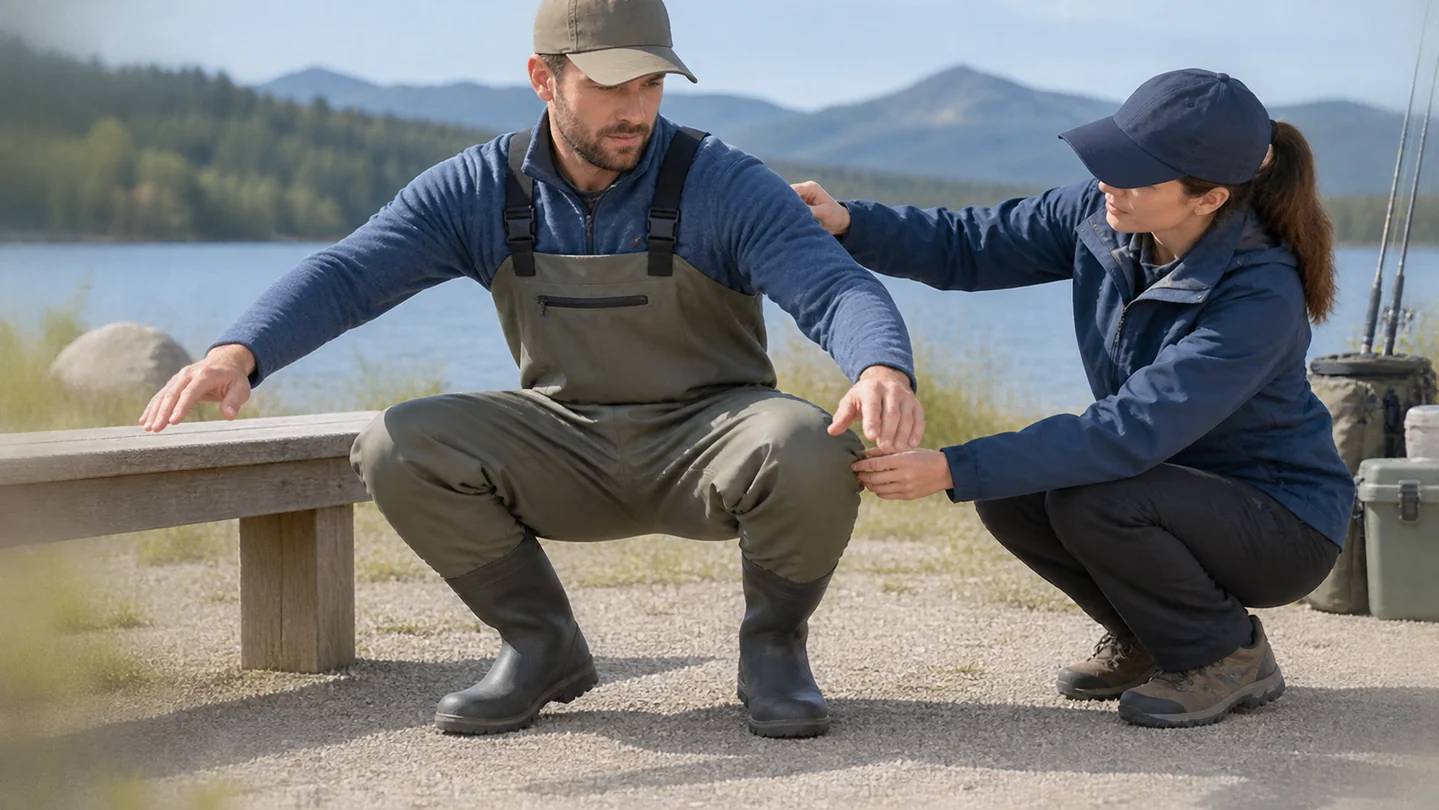
- Run a size-set trial on at least three body profiles; squat, climb, kneel, and reach before approving bulk.
- Specify bootfoot or stockingfoot separately; record outsole, boot volume, and sock thickness.
- Agree test methods, AQL levels, care labels, and replacement policy in the purchase contract.
At this decision point, Yuelei Sports provides OEM/ODM chest wader programs with material, color, size-grading, and testing variables specified by the buyer. The product category also includes custom breathable fishing waders for active-use briefs; certification and test claims should be verified by model and destination market.
7. Mandatory Care and Field Inspection
After each trip, rinse salt and mud with cool fresh water; dry inside and outside in shade; inspect seam tape, crotch panels, suspenders, belt, and boot joints. Never store neoprene compressed for long periods, and never use bleach or fabric softener unless the care label explicitly permits it.
ISO 3758 establishes textile care-label symbols; where a wash claim is made, buyers can agree an ISO 6330 domestic-laundering procedure. A five-minute rinse is cheaper than a warranty claim caused by dried salt crystals, trapped grit, or mildew.
FAQ
Are neoprene waders too hot for summer?
Often, yes—especially at 5 mm or during long walks. A 3 mm build may suit cool water, but a breathable shell is usually more comfortable for active summer use.
Do you wear clothes under neoprene waders?
Yes. Wear a moisture-managing base layer and size the wader around it; avoid cotton and avoid compressing the neoprene, because compression reduces insulation.
Are neoprene waders actually waterproof?
They can be waterproof when foam, lamination, seam tape, and closures are produced correctly. Request relevant textile water-resistance evidence and a separate finished-garment inspection procedure; ISO 811 addresses textile specimens rather than every seam and opening of a complete wader.
What’s better, neoprene or PVC waders?
Neoprene is usually better for cold-water warmth and flexibility; PVC is usually better for low cost, easy cleaning, and short-duration utility work. The application decides.
Are breathable waders really breathable?
Some are; the claim should be supported by ISO 11092 vapor-permeability data. Breathability also depends on base layers, humidity, activity, and seam-tape coverage.
What are breathable waders?
They are waterproof garments made with a membrane or microporous laminate that allows water vapor to escape while resisting liquid water. They are not designed to provide the insulation of thick neoprene.
Referencias
- ISO 811:2018 — Textiles: Determination of resistance to water penetration
- ISO 11092:2014 — Textiles: Physiological effects, thermal and water-vapour resistance
- ASTM D751 — Standard Test Methods for Coated Fabrics
- EUR-Lex — Regulation (EC) No 1907/2006 (REACH)
- EUR-Lex — Regulation (EU) 2016/425 on personal protective equipment
The best wader is not the thickest or cheapest one; it is the construction whose warmth, mobility, waterproofing, and service plan match the actual waterline.
Yuelei Sports lists gafas de pecho for B2B enquiry. Contact the team with the activity, footwear and size requirements, then request confirmation of available materials and model-specific evidence. A retail product name should not be treated as an OEM specification.