 Сямыньская спортивная компания с ограниченной ответственностью «Юэлей»

When a technical engineer in Rotterdam encountered sizing trouble, Mark, the product engineer for a marina uniform program, approved a larger chest and longer sleeves. During a 20-minute dock trial in cold spray, water pooled at the collar, the cuffs wicked moisture into the midlayer, and the wearer lost reach while clipping a tether. The quick reversal mattered: this was not simply a bad garment. A general rainwear block had been selected before the team defined exposure, shelter, watch duration, and worn equipment.
Summary: Choose a sailing jacket through four route questions: how severe and continuous the exposure is, how quickly the wearer can reach shelter or port, how long each watch lasts, and how the shell works with a PFD, harness, gloves, layers, and salopettes. ISO 811:2018 and ISO 11092:2026 provide method-specific fabric evidence; neither assigns an inshore, coastal, or offshore category. Record those four inputs, approve a full-kit fit sample, and attach measurable pass criteria to the RFQ before comparing price.
This sailing jacket guide is the buyer’s decision page, not another feature comparison. Search labels such as sailing jackets, jacket sailing, jackets for sailing, tribord sailing jacket, sailing jackets men, Sailboat jacket, and Sailor jacket do not define technical classes; they may indicate category, word-order, retailer, or fit intent. Buyers should translate each into route, fit, evidence, and inventory requirements.
Use Four Route Questions to Choose Inshore, Coastal, or Offshore Protection
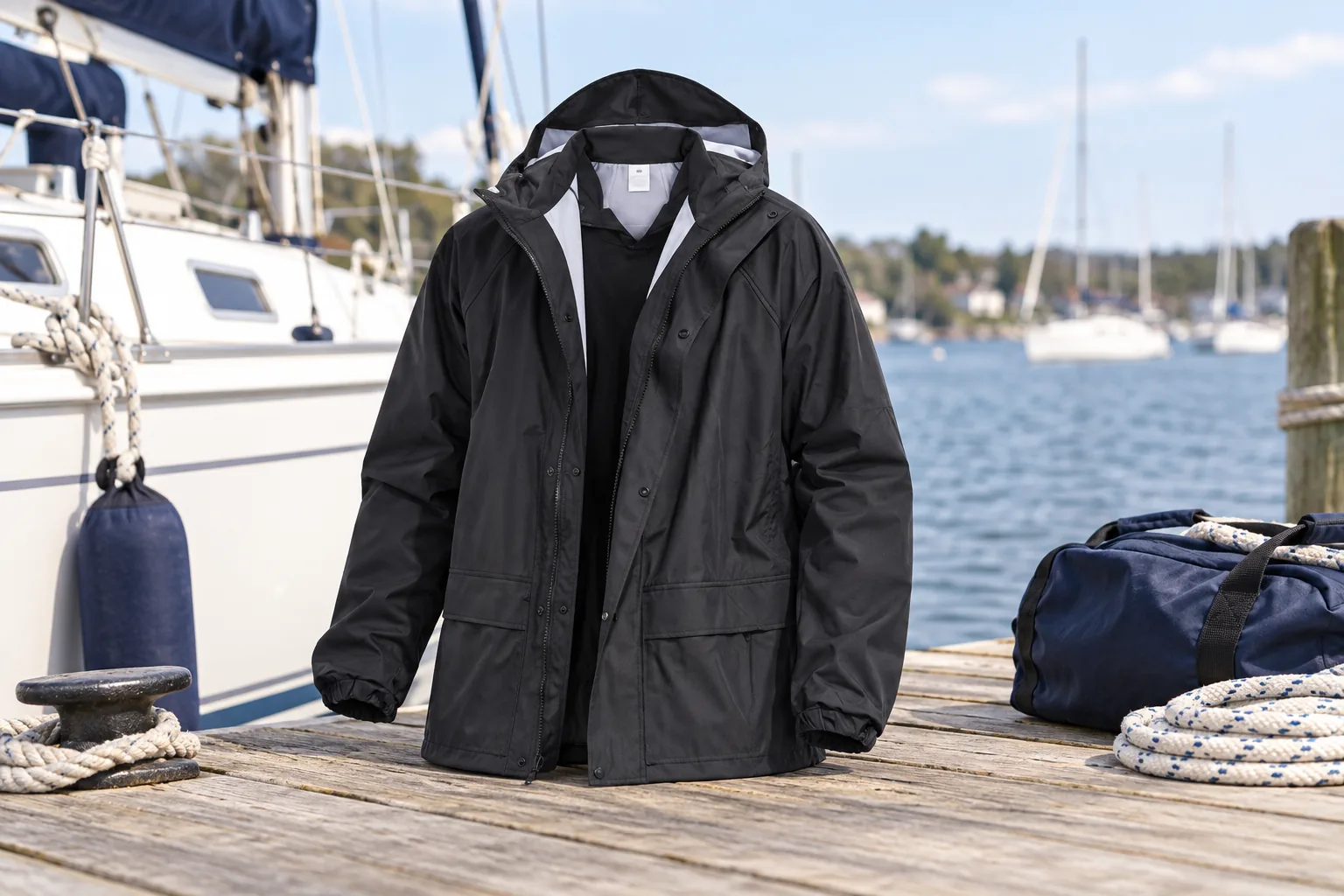
An inshore, coastal, or offshore label is a starting hypothesis, not a certification. Begin with the longest credible duty period. A short lesson beside a marina, a full-day charter with intermittent shelter, and a night watch on an exposed passage create different consequences even when all three forecasts mention rain.
First decide how much wind-driven water and deck exposure the crew must absorb
Record rain, repeated spray, deck water, wind, temperature, contact with wet surfaces, and hardware abrasion. Escalate when water loading is sustained, contact pressure is common, or drying is unlikely. A hydrostatic value cannot describe openings, seams, wear zones, or the duration of those combined loads.
Then decide whether a wet wearer can recover promptly or must remain on duty
Define the escape condition: shore access, a sheltered cockpit, a support vessel, a diversion window, or no practical return. Add the longest watch, time below deck, and chance to change layers. Short exposure with rapid recovery supports an inshore brief; repeated exposure with delay points to coastal; overnight exposure without a reliable reset path points to offshore.
Finally test whether safety and work equipment raises the required category
A moderate route may require more protection when the wearer works in a PFD, clips a harness and tether, handles lines in gloves, or needs salopette overlap. If an interface blocks vision, reach, closure, drainage, or safety hardware, the lower category has failed before a rain test.
- Choose an inshore starting point for brief exposure, dependable shelter, short watches, and high packability or mobility needs.
- Choose a coastal starting point for repeated spray, delayed return, multi-hour watches, and routine hood, collar, cuff, and lower-body protection.
- Choose an offshore starting point for overnight exposure, no rapid shelter, limited gear recovery, and stable coverage with a harness, tether, gloves, and salopettes.
- Escalate to the highest credible risk. Do not average one offshore route and several protected sessions into a coastal compromise. Split the program if the consequences and recovery options are materially different.
| Decision input | Inshore tendency | Coastal tendency | Offshore tendency |
|---|---|---|---|
| Exposure | Intermittent rain or splash | Repeated spray and full-day weather | Prolonged rain, spray, deck contact, and abrasion |
| Shelter or return | Prompt and dependable | Available but delayed | No rapid or reliable recovery path |
| Watch duration | Short session with easy reset | Several hours with limited reset | Repeated, night, or extended watches |
| Equipment interfaces | Layers and PFD checked for mobility | PFD, gloves, and salopettes used routinely | Full kit plus harness and tether used under sustained load |
Translate the Route Decision into Coverage, Construction, and Lifecycle Value
The route classification should change the specification, but it does not dictate one material. A 2-layer shell normally uses a separate lining; a 3-layer laminate bonds face, waterproof layer, and backer. Layer count alone does not prove durability, comfort, or offshore suitability. Compare representative constructions with the same methods after agreed care treatment.
| Buyer outcome | Inshore program | Coastal program | Offshore program |
|---|---|---|---|
| Performance priority | Reliable rain and splash exclusion with low restriction | Repeated spray protection, ventilation, and secure openings | Sustained coverage, robust closures, and abrasion-aware construction |
| Comfort and fit | Packability and easy movement over light layers | Movement over changing layers during longer use | Coverage and mobility over the complete cold-weather kit |
| Compatibility | PFD position and basic pocket access | PFD, gloves, hood, and salopette overlap | PFD, harness, tether, gloves, salopettes, and safety access |
| Maintenance | Simple care and rapid turnaround | Documented care plus inspection of high-use openings | Planned inspection, repair pathway, and post-care verification |
| Unit-cost tendency | Lower complexity may reduce quoted cost | Added adjustment and protection may raise cost | More robust materials and components may raise cost further |
| Return and TCO risk | Fit mismatch and overbuying features | Wet-out confusion, opening leakage, and size mismatch | High consequence from under-specification or slow replacement |
Total cost includes sampling, testing, landed cost, stock holding, care communication, repair, returns, replacements, and discounted resale. One illustrative metric is program TCO divided by accepted wear occasions, using the buyer’s data. It exposes both overbuying offshore complexity and absorbing returns when a lighter product enters longer, colder, or less sheltered use.
Approve Fit Only After the Complete Sailing Kit Passes a Movement Check
A body-measurement chart cannot approve a marine shell by itself. Request finished-garment measurements and test representative sizes over the exact base layer and midlayer intended for use. Then add the specified PFD, harness, tether, gloves, and salopettes. The purpose is not to make every size looser; it is to preserve coverage and access without excess material snagging on deck hardware.
| Full-kit action | What must remain functional | What the approval record should capture |
|---|---|---|
| Zip the collar and turn the head fully | Hood tracks the head; brim and collar do not obscure sightlines or push the PFD | Photos from front and side, adjustment range, and contact points |
| Reach forward, overhead, and across the body | Sleeves cover the wrists; hem and salopette overlap remain stable; shoulders do not bind | Cuff and hem movement by approval size |
| Clip and unclip the tether while gloved | Harness point stays visible; pulls and closures remain operable; loose parts do not snag | Access failures, glove type, and task completion notes |
| Crouch, grind, steer, and sit | PFD stays correctly positioned; pockets remain usable; jacket does not bunch into the chin | Blocked pockets, pressure areas, and coverage loss |
| Spray the representative garment | Openings, seams, and overlaps resist the agreed exposure | Conditions, duration, specimen state, and an internal leak map by zone |
Have the smallest, middle, and largest sampled sizes complete the same sequence. Store the body chart, finished measurements, layer stack, equipment models, and failure notes. This separates grading problems from feature problems and creates a repeatable basis for later orders.
Make Every RFQ Field State What the Test Can and Cannot Prove
Minimum RFQ fields are route and duty cycle; shell construction and seam-taping scope; opening and closure requirements; finished measurements and grading tolerances; full-kit fit procedure; fabric and garment evidence; preconditioning; labeling; inspection; repair handling; and approved claim wording. Each report needs the method edition, units, conditions, specimen, preconditioning, laboratory, result, and buyer-defined pass criterion.
- ISO 811:2018 measures textile resistance to water penetration under hydrostatic pressure. It does not evaluate every seam, zipper, cuff, hood opening, or worn area, so it cannot certify an offshore product.
- ISO 4920:2012 grades resistance of textile fabrics to surface wetting by a spray test. Its scope states that it does not predict resistance to rain penetration. Use it to discuss face wetting, not as proof that water cannot enter the garment.
- ISO 11092:2026 measures thermal and water-vapour resistance under steady-state conditions using a sweating guarded hotplate. Compare like methods, conditions, constructions, and units; do not rank Ret against an unrelated WVTR figure or present either as a comfort guarantee.
- ISO 6330:2021 supplies domestic washing and drying procedures for textile testing. It does not choose a cycle count, create a durability class, or prove reproofing performance. The buyer must state the procedure, number of cycles, specimen state, and tests to repeat afterward.
- World Sailing Offshore Special Regulations provide safety and event context for offshore racing. They do not certify waterproof jackets. Check the edition and event category that actually apply, then keep race compliance language separate from textile results and supplier marketing.
A garment-level spray or rain procedure can complement these methods, but define water delivery, duration, posture, closures, preconditioning, observation points, and the leak-map rule. Avoid “offshore certified” unless a verified scheme, product scope, issuer, and current document support the claim.
Yuelei Sports is a China-based B2B outdoor sportswear solutions supplier. Buyers can use its custom sailing jacket OEM options, men’s sailing jacket design options, and windproof waterproof outdoor jacket construction as starting points for a method-matched sample brief; product-page descriptions still need to be converted into the buyer’s own route, fit, test, and claim requirements.
Build Separate SKU and Inventory Rules for Each Exposure Program
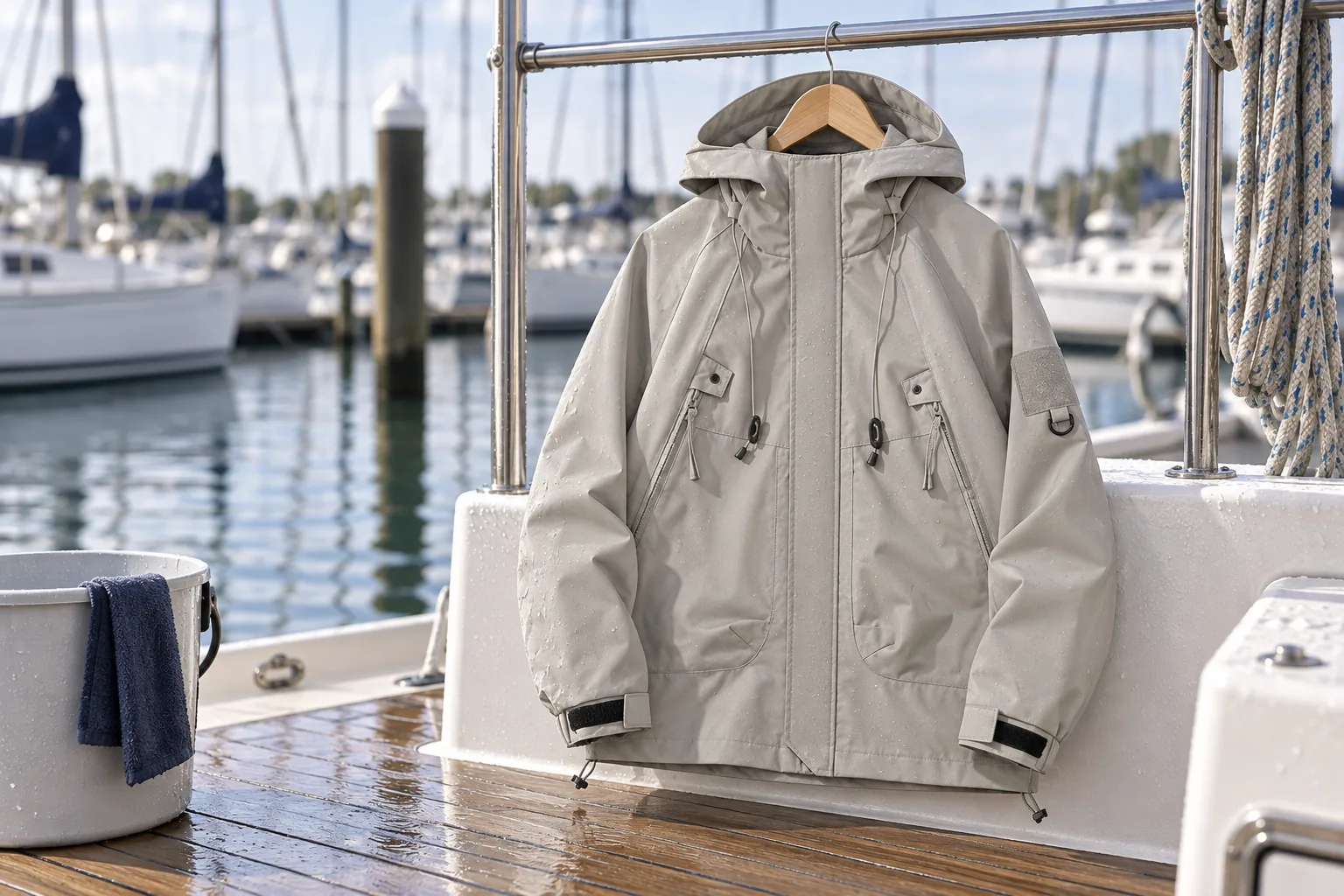
Do not make one construction serve three sales promises. Define an inshore program SKU, coastal core SKU, and offshore specialist SKU only where forecast demand supports each. Adjacent waterproof gear sourcing can share colors, care language, or material families, but jacket fit needs its own record.
| SKU role | Inventory emphasis | Approval evidence | Reorder control |
|---|---|---|---|
| Inshore entry or team program | Prioritize proven size coverage and simple option control over unnecessary technical variants | Movement, PFD fit, seam scope, care, and agreed rain/spray check | Track size returns separately from weather-performance complaints |
| Coastal core range | Place depth in sizes and colors supported by channel data; keep feature language consistent | Repeated-use interfaces, method-matched fabric reports, garment leak map, and post-care condition | Review wet-out, ingress, and fit as separate return codes |
| Offshore specialist range | Use forecast or preorder logic where demand is narrower; protect availability of critical sizes and repair parts | Longest-duty scenario, complete-kit trial, closure access, abrasion plan, and agreed retest | Do not substitute a coastal SKU when replenishment is late |
Keep one version-controlled master specification per SKU. State intended use without turning a zone name into a certification. Review sell-through, size availability, return reason, repair frequency, and lead time by program; blended totals can hide overbuilt inshore stock or underbuilt offshore protection.
Answer These Buyer Questions Before Approving the Range
Is a sailing jacket different from a regular rain jacket?
It can be, when the specification addresses wind-driven spray, moving deck work, hood visibility, glove-compatible closures, layering, and PFD or harness interfaces. A regular shell may suit short protected sessions, but the buyer should verify those functions before assigning a marine use label.
Is a 20,000 mm fabric result enough for offshore use?
No single fabric number is enough. Confirm the ISO 811 method details and specimen state, then evaluate seams, openings, wear zones, preconditioning, garment leakage, route duration, and recovery options. The buyer—not the standard—sets the relevant pass criterion.
How should breathability results be compared across suppliers?
Compare results only when method, edition, units, conditions, and specimen construction match. ISO 11092:2026 water-vapour resistance data should stay within that method; do not convert it casually into a different transmission score. If reports are incompatible, request aligned retesting.
How should the shell fit over layers, a PFD, and a harness?
It should preserve insulation loft, wrist and hem coverage, head rotation, tether access, and working reach without lifting the PFD or obscuring hardware. Approve representative sizes over the named layer stack and equipment, then retain finished measurements and movement records.
How many wash cycles should a waterproof claim cover?
There is no universal number in ISO 6330:2021. Set a cycle count that reflects the intended duty and claim, name the exact wash and drying procedure, and identify which fabric or garment checks must pass afterward. “Wash-tested” without these fields is incomplete.
How can a distributor reduce sizing and feature-mismatch returns?
Separate the range by exposure program, publish body and finished-garment measurements, and approve each size block through the same full-kit tasks. Code returns by fit, wet-out, true ingress, closure access, and expectation mismatch so the next forecast fixes the correct problem.
Primary Sources That Define the Test-Method Boundaries
- ISO 811:2018 — hydrostatic-pressure resistance to water penetration
- ISO 4920:2012 — resistance of textile fabrics to surface wetting
- ISO 11092:2026 — thermal and water-vapour resistance under steady-state conditions
- ISO 6330:2021 — domestic washing and drying procedures for textile testing
- World Sailing Offshore Special Regulations
The durable decision is not “inshore, coastal, or offshore” on a hangtag; it is the route evidence, fit record, and test boundary behind that label. For a coordinated sailing jacket brief, Yuelei Sports can review the intended exposure, size block, interfaces, and evidence pack alongside related waterproof gear sourcing needs. Contact the team with the minimum RFQ fields above to begin a sample discussion.