 Сямыньская спортивная компания с ограниченной ответственностью «Юэлей»

When a hypothetical technical buyer in Portsmouth tested a medium jacket for a weekend club program, he added the intended fleece and PFD, reached forward as if trimming a line, and saw the hem lift and cuff seal open within minutes. The shell looked waterproof on paper. The useful reversal was that the selection process, size block, and layer allowance had failed before the fabric did.
Summary: The best sailing jackets for weekend sailors match short, repeated trips rather than maximum offshore specifications. Start with a dynamic fit gate over the real layers and PFD, compare water resistance under ISO 811:2018 and breathability under ISO 11092:2026 only when methods and units match, then calculate an illustrative cost per usable trip. A jacket that is easy to issue, care for, and return to service can create more value than a higher-specification shell that sits unused.
Weekend use combines rain, spray, cold surfaces, and repeated movement with long periods in a club locker, rental bin, or stockroom. Buyers therefore have to balance protection with size clarity, shared use, care effort, and actual service availability.
Why Weekend Exposure and Trip Frequency Should Set the Jacket Brief
Rankings of sailing jacket brands often use inshore, coastal, and offshore tiers. Treat these as navigation, not proof. Record trip duration, shelter, driven spray, temperature, cockpit contact, and return-to-port options. World Sailing’s Offshore Special Regulations show why exposure categories change consequences, but they do not certify a recreational jacket.
For a sheltered day sail, adjustment, movement, packability, and simple care may matter more than offshore features. A longer estuary trip with cold spray can justify a higher collar, stable hood, protected closures, and more abrasion margin. Let the route and operating pattern drive the choice.
When Easy Care Creates More Value Than Maximum Performance
Weekend users may not own the jacket or follow specialist instructions without prompting. Garments lose usable trips when they wait for cleaning or return to storage salty and wet. Visible care labels, a documented wash and dry route, DWR guidance, and a short inspection checklist are therefore commercial features.
Maximum performance matters when exposure justifies it, but the brief must include its maintenance system. ISO 6330:2021 provides washing and drying procedures for textile testing; it is a test method, not certification or a universal care label. State the procedure and cycle count in the RFQ and request before-and-after results.
Why Layered Movement Is the First Return-Risk Test
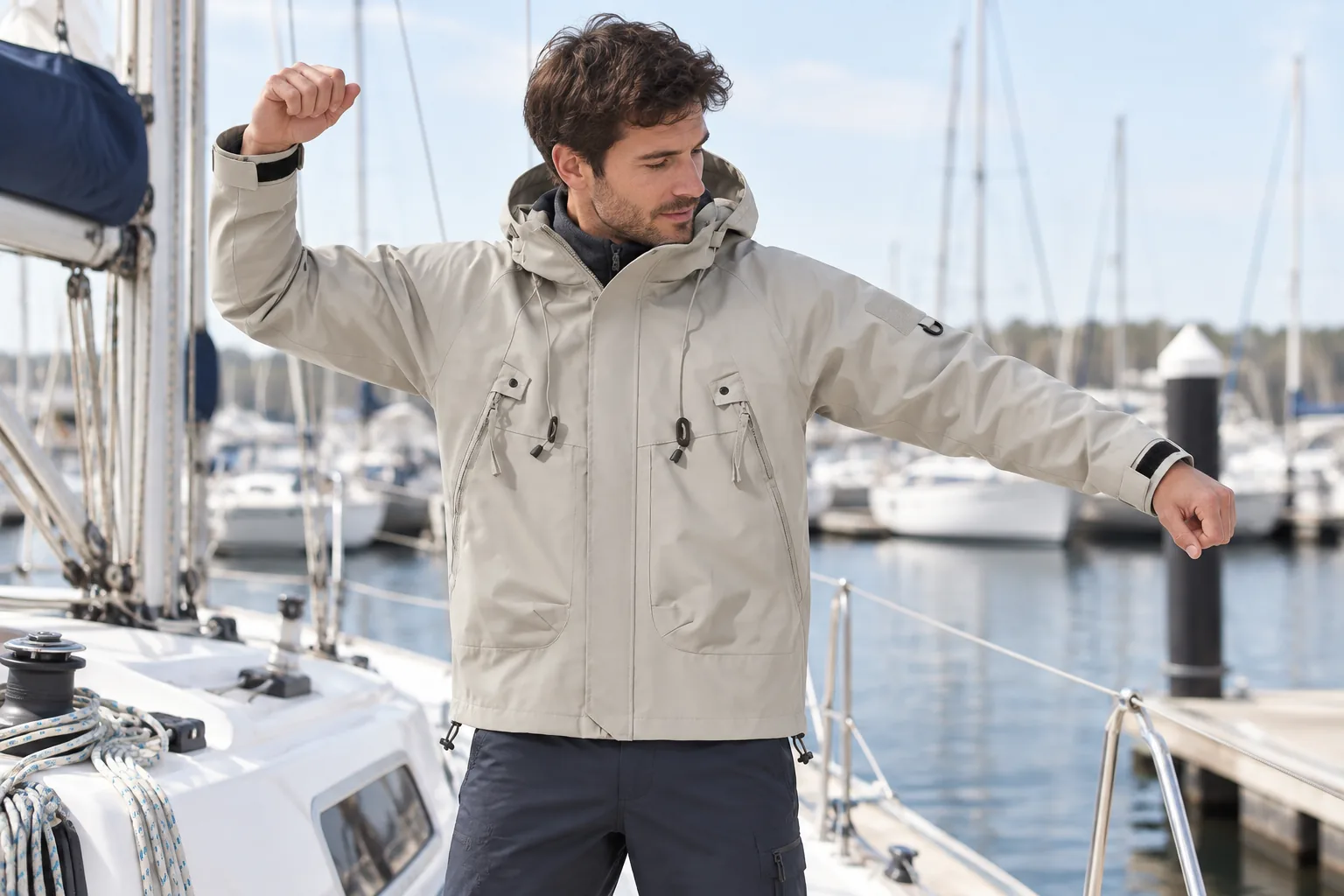
A static fit does not reproduce sailing. Add the planned base layer, midlayer, PFD, and gloves; then raise both arms, reach across, crouch, sit, turn the head, and operate every adjustment. Record hem and wrist coverage, collar closure, hood rotation, and pocket access.
This is a pass/fail gate. If the PFD blocks a pocket, the hood compromises side vision, or arm reach opens a cuff, a larger hydrostatic-head number cannot correct the interface. Evaluate the finished jacket as part of the worn system.
How Buyers Can Control Size-Related Returns Before Bulk Production
Require a body chart, finished-garment measurements by size, and a dynamic fit record. Identify measuring points and tolerances, plus the wearer’s measurements, sample size, layers, PFD, and failed motions. Returns can then be diagnosed as selection, grading, tolerance, or use-case errors.
Do not copy a casual rainwear size curve into technical sailing jackets online without evidence. Use authorized sales history, customer measurements, or a documented wearer sample. Otherwise label the initial curve as an assumption, run a smaller pilot, and revise it from actual fit feedback.
How Shared Fleets Can Reduce SKUs Without Creating One Oversized Compromise
Shared club, charter, and training fleets need adjustment range. Fewer size bands simplify labeling, lockers, laundering, and replacement, but one oversized block creates long sleeves, unstable hoods, PFD bulk, and poor cuff seals. Select the smallest size set that passes dynamic fit across the verified wearer sample.
Use visible size identification, wearer or locker assignment, and check-in inspection of closures, seam tape, cuffs, hood, and contamination. Personal issue supports a precise size curve; shared fleets prioritize adjustment and condition control. The SKU strategies differ even with identical fabric.
How to Compare Waterproof Evidence Without Treating Test Methods as Certifications
ISO 811:2018 measures textile resistance to water penetration under hydrostatic pressure. It is a test method, not certification of an offshore jacket. Record whether the value covers fabric, laminate, seam-sealed material, or a garment, plus its conditioning. Seams, zippers, pockets, cuffs, collar, and hood still need garment-level checks.
ISO 4920:2012 is a surface-wetting spray test, not product certification; its scope says the result is not intended to predict rain penetration. A face can wet out while the barrier remains intact, while good beading does not prove seams or openings resist ingress.
ISO 11092:2026 measures thermal and water-vapour resistance under steady-state conditions. Compare breathability only when method, specimen, conditions, and units match. ISO 811, ISO 4920, and ISO 11092 answer different questions; do not collapse them into one undefined score.
When a Three-Layer Shell Lowers Cost per Usable Trip and When It Does Not
A 2-layer construction normally uses a separate lining to protect the waterproof layer, while a 3-layer laminate combines face fabric, waterproof layer, and backer. Layer count alone does not determine the right weekend SKU. Compare abrasion points, drying workflow, repair route, packing pattern, expected service frequency, and the test evidence for the exact material and garment.
Use a cost-per-usable-trip formula rather than comparing invoice prices alone: acquisition cost plus allocated inspection, care, return handling, repair, replacement, and markdown cost, divided by the recorded trips on which the jacket was serviceable. Count actual or pilot-program trips; do not substitute an unverified lifespan claim.
Illustrative only: assume Jacket A costs USD 80, receives USD 8 of allocated care and return handling, and completes 12 usable trips; its cost is USD 7.33 per usable trip. Assume Jacket B costs USD 110, receives USD 10 of allocated support, and completes 24 usable trips; its cost is USD 5.00 per usable trip. These assumptions are not market prices or durability promises. Replace every input with supplier quotations and your own service records.
| Weekend decision | Two-layer or lighter construction may fit when | Three-layer construction may fit when | TCO evidence to collect |
|---|---|---|---|
| Trip pattern | Exposure is shorter and shelter is close | Spray, packing, and abrasion recur | Usable trips by jacket ID |
| Care workflow | The lining and care route suit the operator | The laminate and instructions fit the care team | Labor, drying time, and downtime |
| Commercial risk | Price acceptance matters more than unused capability | Longer service could offset higher acquisition cost | Returns, repairs, replacements, markdowns |
| Decision rule | Pass only with fit and claim evidence | Pass only with fit and claim evidence | Cost per usable trip, not list price alone |
How a Weekend Procurement Scorecard Turns Samples into a Defensible SKU Decision
This weekend scorecard is not a generic offshore ranking. First gate dynamic fit, claim scope, and care feasibility; a failure cannot be rescued by points. Then set buyer-specific weights, score each line from 1 to 5 using consistent evidence, and record the source.
| Weekend scorecard line | Question the evidence must answer | Buyer-entered weight | Proof to retain |
|---|---|---|---|
| Usable-trip fit | Does it pass movement over the actual layers and PFD? | Set for your program | Dynamic fit record and photos |
| Shared-fleet simplicity | Can verified wearers be covered without an excessive size set? | Set for your program | Wearer matrix and proposed size curve |
| Care-to-service time | Can staff inspect, wash, dry, and reissue it reliably? | Set for your program | Care procedure and pilot timing |
| Weather evidence | Do named methods and garment details match the declared route? | Set for your program | Reports, seam details, and claim sheet |
| Return containment | Can size, use, and condition failures be diagnosed consistently? | Set for your program | Return reason codes and inspection form |
| Cost per usable trip | Does the total cost remain competitive using recorded service data? | Set for your program | Quotation and fleet service log |
Multiply each score by its weight and sum one agreed scale. The arithmetic is a decision aid, not laboratory evidence. It keeps a sailing jacket sale discount, logo, or fabric number from overruling fit, availability, and return risk. Use the same discipline when screening sailing jackets online.
What Standards Language Belongs in the RFQ and Product Page
Name the edition, method, specimen, conditioning, units, and result. ISO 6330:2021 can define washing and drying before retesting but does not certify durability. ISO 811:2018 and ISO 4920:2012 support defined penetration and wetting statements, not “offshore certified” claims. ISO 11092:2026 replaces the withdrawn 2014 edition.
Unsupported certification language can create disputes, corrections, and service work. Identify the tested material or garment, method, and preconditioning. Distinguish jackets from waterproof fishing chest waders; similar materials do not make their use cases interchangeable.
How to Shortlist Weekend Jackets Before Placing the Order
- Write a weekend operating brief covering trip duration, shelter, spray, temperature, wearer model, layers, PFD, care route, and expected reissue pattern.
- Reject samples that fail dynamic fit or hide the scope of waterproof and breathability evidence.
- Build the size curve from authorized measurements, order history, or a controlled wearer trial; separate personal-issue and shared-fleet logic.
- Pilot the inspection, wash, dry, storage, and return process before assuming a premium construction will deliver lower TCO.
- Compare quotations with the same cost-per-usable-trip fields and keep assumptions visibly labeled.
Yuelei Sports is a China-based B2B outdoor sportswear solutions supplier. Buyers can apply the brief and scorecard when discussing custom sailing jackets or a waterproof sailing jacket. The women’s sailing jacket buying guide adds fit and spray context.
That process turns the best sailing jackets from a top list into a documented choice. It shows whether custom sailing jackets need shared adjustment, personal sizing, simplified care, or higher-exposure construction before bulk quantities are fixed. It also keeps a sailing jacket sale plan tied to a defensible SKU role.
Which Weekend Jacket Questions Should Buyers Answer Before Ordering?
Which Features Separate the Best Sailing Jackets from Regular Rain Jackets?
Deck-specific jackets should manage reach, head rotation, spray at openings, glove use, and pocket access under a PFD. Verify those interfaces on the finished sample; a regular rain shell may have suitable fabric but still fail the movement and opening checks required by the weekend brief.
How Should Waterproof Ratings Be Compared for Weekend Sailing?
Start with the method, edition, specimen, conditioning, units, and scope. ISO 811 data can compare resistance to water penetration under its stated conditions, but the result does not certify the whole jacket or cover seams, zippers, cuffs, hood, and collar automatically.
Is a Three-Layer Sailing Jacket Worth the Extra Cost?
It may be when repeated abrasion, packing, and exposure produce more recorded usable trips or less downtime. A lighter construction may be better for sheltered, lower-frequency use. Compare both with the same fit gates and replace hypothetical TCO inputs with pilot records.
How Should a Sailing Jacket Fit Over Layers and a PFD?
It should retain hem and wrist coverage through reach, crouch, seated movement, and head rotation without blocking PFD function or pocket access. Record the wearer’s measurements, layers, PFD, sample size, and failed motion so the supplier can adjust the correct pattern area.
How Can a Shared Fleet Reduce Size Exchanges?
Use a verified wearer matrix to choose the smallest size set that still passes dynamic fit, then label sizes visibly and record jacket assignment and condition. Do not rely on one oversized shell; excess volume can create new hood, cuff, sleeve, and PFD problems.
How Should a Weekend Fleet Maintain Waterproof Jackets?
Follow the garment-specific wash, dry, DWR, and storage instructions, and inspect salt, dirt, closures, seam tape, cuffs, and hood adjustments before reissue. If post-care performance is claimed, the RFQ should name the agreed ISO 6330 procedure and cycle count rather than treating the method as certification.
Which Sources Support the Testing and Care Framework?
- ISO 811:2018 — Textiles — Determination of resistance to water penetration — Hydrostatic pressure test
- ISO 4920:2012 — Textile fabrics — Determination of resistance to surface wetting (spray test)
- ISO 11092:2026 — Textiles — Physiological effects — Measurement of thermal and water-vapour resistance
- ISO 6330:2021 — Textiles — Domestic washing and drying procedures for textile testing
- World Sailing Offshore Special Regulations
The strongest weekend jacket program is the one whose fit, evidence, care route, and sales promise keep the garment available for the next real trip.
For B2B buyers comparing jacket SKUs alongside related waterproof gear, Yuelei Sports can support sample review, configurable waterproof outerwear, and adjacent category planning, including waterproof chest waders. Contact the team with your target market, route exposure, wearer model, size evidence, and care plan to build a cleaner shortlist before the next season opens.