 Сямыньская спортивная компания с ограниченной ответственностью «Юэлей»

When a technical engineer in Vancouver encountered sizing selection confusion on a coastal-club uniform program, he ordered a sample run of sailing rain jackets one size tighter to reduce bulk under PFDs. During a dockside hose test, the first wearer raised both arms to clip a halyard, the hem lifted, and spray ran up the lower back within minutes. The fast failure looked like poor waterproofing, but the reversal was more useful: the fabric had not failed first. The test expectation, layering allowance, and fit specification were wrong.
Summary: Buyers should test sailing rain jackets as systems, not just fabrics. ISO 811 measures resistance to water penetration under hydrostatic pressure, while ISO 4920 assesses surface wetting from a spray test; neither approves seams, zippers, cuffs, hood openings, or layered fit. Specify separate fabric and finished-garment checks, record every internal wet point on a leak map, and repeat agreed checks after a stated ISO 6330 wash-and-dry procedure.
A sailing jacket is a waterproof outer shell designed for wind, rain, salt spray, arm movement, and contact with deck hardware. Buyers often compare a single rating, then receive complaints about wet cuffs, a damp neck, condensation, or DWR wet-out described as “leaking.” The useful question is not whether sailing rain jackets are waterproof in a laboratory; it is which failure mode each result can rule in or rule out.
Why a dry fabric specimen cannot approve finished sailing rain jackets
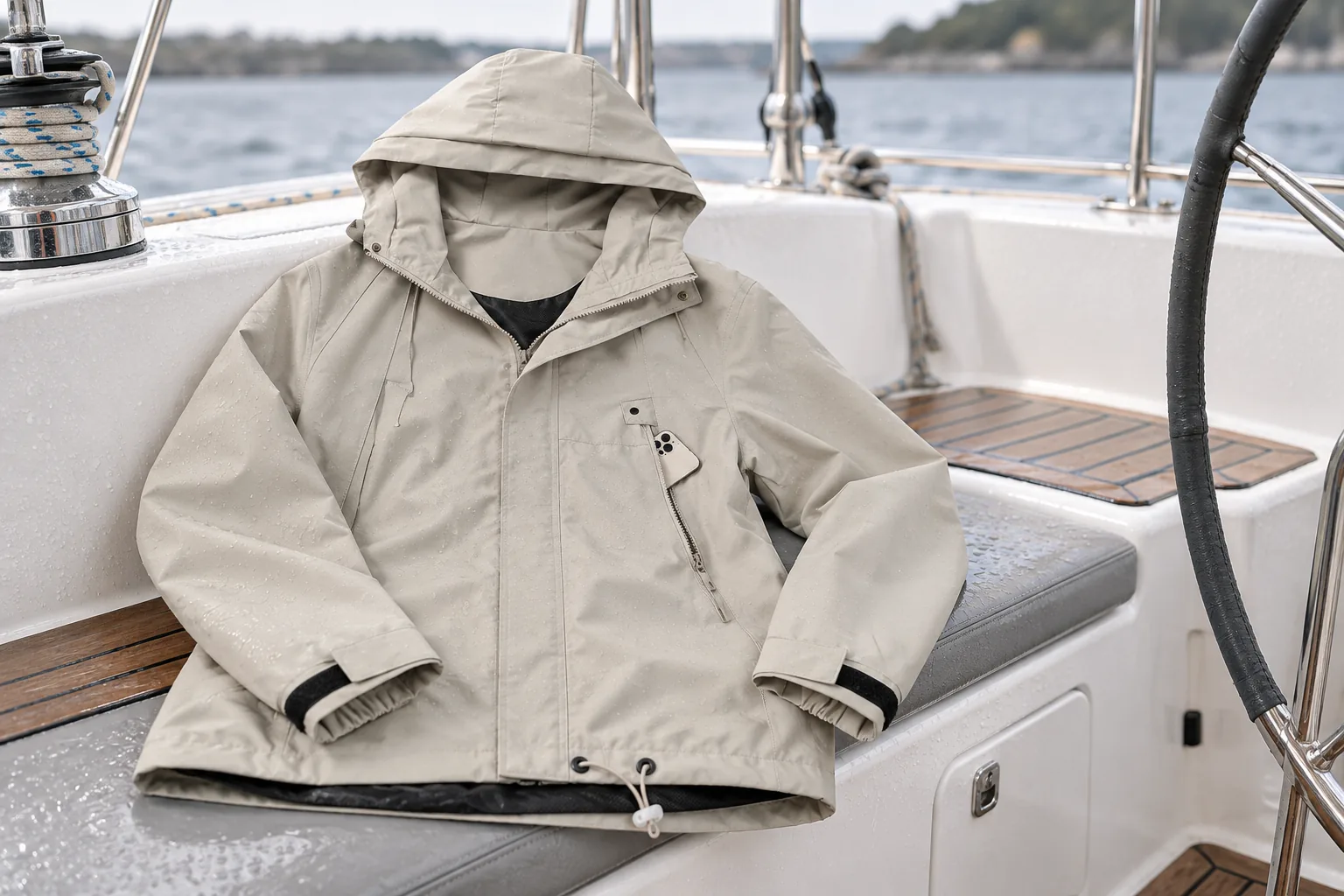
The boundary starts with the specimen. ISO 811 applies steadily increasing water pressure to a textile and records resistance to penetration. A hydrostatic head result can support a fabric specification, provided the report identifies the laminate, face material, color or treatment, test direction, conditioning, and method edition. It does not include the needle holes, tape junctions, zipper ends, pocket bags, cuff closures, hood aperture, or hem geometry found in a sewn jacket.
That distinction matters when a buyer sets a hydrostatic head target such as 15,000 or 20,000 mm. The chosen value should reflect the intended claim and exposure, but a high hydrostatic head number cannot show that water will stay out during a raised-arm reach, a head turn into spray, or pressure against a wet cockpit. For sailing rain jackets, approve the relevant fabric report and a representative finished garment as two separate evidence items.
ISO 4920 answers a different question. Its spray test visually grades how much the textile surface wets; the ISO scope explicitly says the result is not intended to predict resistance to rain penetration. It is therefore useful for tracking face-fabric repellency and the DWR finish, especially before and after care, but it cannot replace ISO 811. A shell may wet out while its waterproof barrier remains intact, or it may bead water well while an untaped seam admits spray.
How sailing rain jackets should be spray-checked to produce a usable leak map
A dockside hose demonstration can reveal an obvious weakness, but it is not repeatable unless both parties fix the conditions. State the spray equipment, delivery setting, nozzle pattern, distance, angle, duration, jacket size, layer stack, body positions, and hood, cuff, and closure settings. These are buyer-agreed garment conditions, not provisions supplied by ISO 4920 or ISO 811.
Preconditioning must be equally controlled. Identify the sample by lot, color, size, and production stage; photograph it dry, condition it in the agreed atmosphere, and run the initial checks. For durability work, name the ISO 6330:2021 wash and dry procedure, detergent, cycle count, loading details, and permitted aftercare, then recondition and repeat the same checks. ISO 6330 does not set a universal cycle count or jacket pass grade, so the buyer must state both. Keep initial and post-care results separate.
A practical leak map turns the inside of the jacket into named zones. Use a dry, light-colored base layer or other agreed witness layer, then mark the first visible wet point, its time of appearance, area, and path after each exposure. Divide the record into hood opening, collar, shoulders, upper sleeves, cuff interfaces, front zipper, pocket entries, torso seams, hem, and any reinforcement panels. Photograph the outside and inside with the same zone labels. The map lets a factory investigate one seam intersection or closure instead of treating the whole laminate as defective.
Inspect in a fixed sequence. Before spraying, check tape continuity, lifting, wrinkles, skipped coverage, seam intersections, zipper ends, pocket openings, cuff range, hood exits, and collar drainage. Use only the movements written into the protocol, with the intended PFD and gloves. Afterward, open the jacket without transferring exterior water inside, map the evidence, and retain the sample for confirmation.
Wet-out, condensation, and true ingress require different corrective actions
The word “leak” is too broad for useful corrective action. Wet-out occurs when the face fabric becomes saturated and stops beading efficiently. Condensation occurs when moisture generated by the wearer reaches a cooler inner surface faster than it can escape. True ingress is outside water crossing the fabric, a seam, a closure, or an opening. All three can feel damp, but their patterns and remedies differ.
| Observed symptom | Likely cause to investigate | Next evidence or action |
|---|---|---|
| Face darkens or stops beading, while the witness layer remains dry | Surface wet-out | Compare ISO 4920 results before and after the declared care procedure; review cleaning, drying, and permitted reproofing |
| Diffuse inner dampness is strongest near warm torso zones after exertion, with no directional water track | Condensation or insufficient ventilation | Confirm vents and use conditions; compare water-vapour resistance only under the same ISO 11092:2026 method and units |
| A localized line begins at a seam, tape edge, zipper end, or pocket entry | Construction ingress | Mark the leak-map zone, inspect the exact assembly, correct it, and repeat the same garment exposure |
| Water appears at the wrist, face, neck, or lifted hem during a specific movement | Opening entry or fit/interface problem | Repeat with the intended layers, PFD, gloves, hood setting, and movement; adjust pattern or closure range |
| A discrete wet spot appears through an abraded or pressure-contact panel | Possible barrier damage or fabric penetration | Isolate the location, inspect for damage, and request an appropriate material-level confirmation rather than guessing from appearance |
Breathability claims need similar discipline. ISO 11092:2026 measures thermal resistance and water-vapour resistance under steady-state conditions with a sweating guarded hotplate; the standard does not define a particular comfort situation. Do not rank unlike methods, units, or specimen constructions. A report can help compare matched laminates, while a wearer trial checks whether vents, pockets, cuffs, fit, and work rate manage moisture in the intended use.
Layer construction changes durability and inspection, not the test boundary
A 2-layer shell uses a separate lining to protect the membrane; it can suit lighter programs, but retained moisture may slow diagnosis. A 2.5-layer shell replaces that lining with an interior protective print, reducing bulk but making abrasion review important.
A 3-layer shell bonds face, membrane, and backer into one laminate, giving a cleaner interior for inspection but usually raising material and construction cost. For sailing rain jackets used frequently in spray, compare repairability, drying, wear, and return handling; layer count alone does not guarantee service life.
| Construction | Likely program fit | Inspection focus | B2B cost logic |
|---|---|---|---|
| 2-layer shell with lining | Club, school, promotional, or lighter coastal use | Retained moisture and seam access | Lower unit-cost tendency; slower diagnosis may add service cost |
| 2.5-layer shell | Packable backup or lower-frequency use | Interior print wear and tape compatibility | Compact; abrasion risk matters in repeated use |
| 3-layer shell | Frequent spray, technical crews, or exposed helms | Laminate, tape junctions, and repair route | Higher first cost may support easier inspection |
Total cost includes return handling. Illustratively, a 1,000-piece program with a 6% return rate and USD 18 handling cost per return incurs USD 1,080 before replacement product. These are not test results or a benchmark; substitute actual volume, return, labor, and warranty data.
Procurement acceptance fields must be fixed before the sample gets wet
The acceptance sheet should connect each claim to the specimen, method, preconditioning, and pass criterion. Use it for development, pre-production, and production-lot checks, while distinguishing laboratory methods from buyer-supplier garment procedures.
| Acceptance field | What the record should state | Why it controls risk |
|---|---|---|
| Specimen identity and scope | Style, size, color, lot, component version, production stage, and sample quantity | Stops one result being applied to a different configuration |
| Material penetration and surface wetting | ISO 811 and ISO 4920 editions, specimen, units or grade, and initial/post-care targets | Separates barrier resistance from face-fabric repellency |
| Garment exposure setup | Equipment, settings, distance, angle, duration, closures, layers, PFD, gloves, and movements | Makes the finished-jacket check repeatable |
| Preconditioning and retest | ISO 6330 procedure, detergent, load, cycles, aftercare, reconditioning, and retests | Defines what “after wash” means |
| Pass, fail, and leak-map rules | Allowed wet zones, timing, image format, responsibility, correction, and retest route | Turns observations into an approval decision |
Fit is an acceptance field because spray often enters through openings first. For sailing rain jackets, test the planned layers, PFD, gloves, overhead reach, seated posture, crouch, and head rotation. Confirm hem coverage, cuff adjustment, collar seal, hood vision, and access to pockets and zipper pulls.
Procurement teams can then reduce mismatched returns with a compact action set:
- Separate fabric, component, and garment evidence.
- Attach initial and post-wash leak maps.
- Approve body and garment measurements with the dynamic fit sample.
- Train distributors to triage wet-out, condensation, ingress, and opening entry.
- Align related specifications, including waterproof gear sourcing, when jackets and other wet-weather products serve the same retail, rental, or workwear channel.
Yuelei Sports supports B2B outerwear programs where buyers need configurable materials, pattern grading, waterproof construction, and sample-approval documentation. A buyer comparing marine outerwear can review the waterproof jackets range and compare sailing rain jackets with technical dry suits to keep specimen scope, test wording, and equipment interfaces consistent across wet-weather lines.
Test reports should name scope and method without implying certification
ISO 811, ISO 4920, ISO 11092:2026, and ISO 6330 are test methods or textile-testing procedures; they are not automatic product certifications. Evidence should say “tested according to” the named edition and identify the exact specimen and result. Phrases such as “ISO-certified waterproof jacket” are unsafe when no applicable product-certification scheme, certificate holder, and scope have been verified.
World Sailing Offshore Special Regulations provide safety context for offshore programs, but they do not replace textile or garment testing. Likewise, “offshore” is a use-case label rather than a test result. Marketing and RFQ language must match the destination market, intended exposure, care claim, and available reports; unsupported wording creates claim, return, and distributor-training risk even when the base fabric is capable.
Buyer questions that should be settled before approval
Is a sailing rain jacket different from a regular rain jacket?
Yes. A sailing shell must manage spray, wind, raised-arm movement, PFD interaction, wet seating, and deck abrasion. Hood, collar, cuffs, hem, seams, and fit allowance can matter more than the membrane alone.
What waterproof rating is suitable for heavy spray and rain?
No universal hydrostatic head value guarantees a dry garment. Set the fabric target for the claim, exposure, and method, then confirm seams, closures, openings, and fit on a representative jacket.
How breathable should a sailing rain jacket be for active sailing?
Request the method, units, specimen, conditioning, and report. If ISO 11092:2026 is used, compare matched water-vapour-resistance results, then check vents and moisture management during movement.
Should I choose a 2-layer or 3-layer jacket for heavy spray and rain?
Choose by exposure, abrasion, drying, inspection, repair, and total cost. A 3-layer shell may suit frequent use; a controlled 2-layer program can suit lighter use when its seams, care, and garment evidence meet the brief.
How should a sailing rain jacket fit over base layers and a midlayer?
It should preserve reach, sleeve coverage, hem overlap, head rotation, and closure access over the intended layers and PFD. Approve body and garment measurements with the movement sample.
How do I wash and reproof sailing rain jacket without damaging DWR finish?
Follow the care label, close zippers and tabs, avoid unapproved additives, and use only permitted drying or heat activation. If beading declines, apply compatible reproofing only when allowed, record the cycle, and retest the claimed property.
Use current source editions and send a complete testing brief
- ISO 811:2018, hydrostatic-pressure method for textile resistance to water penetration; confirmed current by ISO in 2025.
- ISO 4920:2012, spray test for textile-fabric resistance to surface wetting.
- ISO 11092:2026, sweating guarded-hotplate method for thermal and water-vapour resistance.
- ISO 6330:2021, domestic washing and drying procedures for textile testing.
- World Sailing Offshore Special Regulations, offshore safety and equipment context.
The principle is simple: approve the material, assembly, fit, and care claim at their correct levels, then use the leak map to fix what actually failed. For buyers who source sailing rain jackets alongside related waterproof categories, Yuelei Sports can help translate the testing brief into samples, sizing notes, and production checkpoints. Explore related waterproof gear sourcing and contact the team with the destination market, exposure scenario, target methods, layer system, preconditioning procedure, and acceptance fields.