 Xiamen Yuelei Sports Co., Ltd
When a technical engineer in Manchester encounters a child’s rain jacket with sleeves covering the hands, the apparent bargain becomes awkward at the playground. In this illustrative family fitting scenario, he bought an extra size for growth without checking movement. The jacket is not necessarily defective; the sizing decision traded useful growing room for poor control and visibility.
Summary: The best kids waterproof jacket passes five checks: layered fit, waterproof construction, safe hood design, suitable warmth and manageable care. Safety needs its own review: US CPSC guidance identifies hood and neck drawstrings on children’s upper outerwear in sizes 2T–12 as a substantial product hazard. A high waterproof number cannot compensate for unsafe details.
Children’s rainwear listings cover lightweight shells, lined coats, windbreakers and winter jackets. These are different solutions, even when they appear in the same search results. Parents and distributors comparing waterproof rain jackets should begin with the child’s activity, clothing and market requirements rather than select by colour or age label alone.
How should a kids waterproof jacket fit over warm layers?
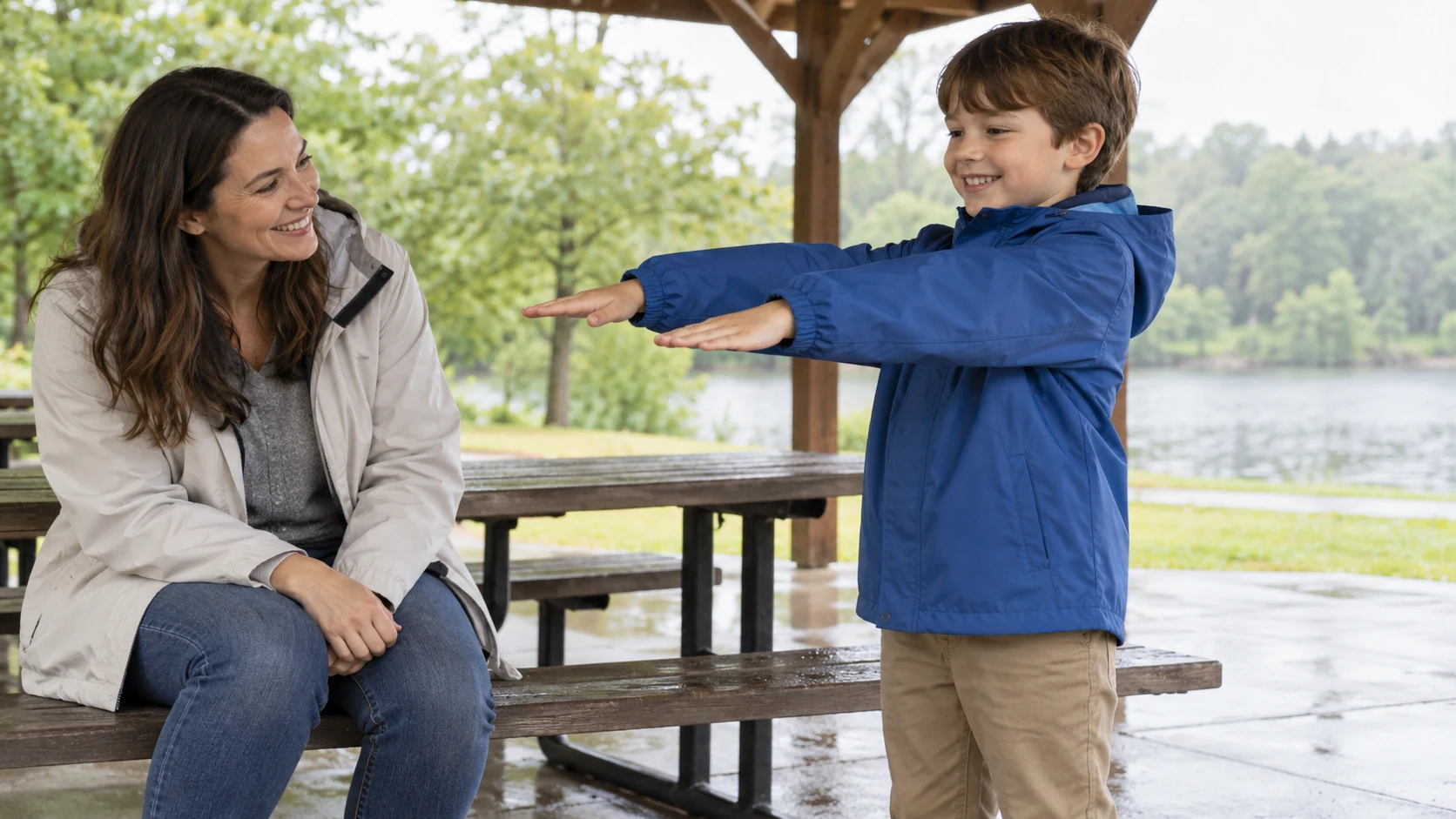
The first check is useful space, not maximum space. Try the jacket over the layer normally worn to school or outdoors. It should close without strain, leave the hands free and retain coverage when the child reaches or bends. An oversized body can pull the hood backward or make the front difficult to manage.
Use the manufacturer’s body-measurement chart and compare it with the actual child. Age labels are a starting point, not a guarantee of proportions. Record height, chest and any other measurements required by that chart; do not mix body measurements with garment dimensions as if they were interchangeable.
- Ask the child to reach forward and upward, checking wrists and waist coverage.
- Have the child squat or sit; the front should not bunch into the face.
- Check that sleeves do not swallow the hands or require bulky repeated folding.
- Try the jacket with the usual school bag and intended warm layer.
These practical checks are not a laboratory protocol. They show whether the garment is usable now, while leaving sensible room for growth. For a retailer ordering a size range, review more than one sample size; grading problems may appear at the smallest or largest sizes.
Are taped seams more important than a water-repellent finish?
The second check separates three things: the main fabric’s waterproof barrier, the seam construction and the outer water-repellent finish. A finish helps water bead at the surface. It does not seal needle holes or prove that the underlying material resists prolonged water pressure.
Taped seams can protect stitched construction; welded seams may be used on suitable coated materials. The appropriate method depends on the garment. Ask whether the relevant seams are sealed rather than assuming all waterproof jackets must show the same tape. A coat with attractive beading can still admit water through poorly protected joints.
ISO 811:2018 specifies a hydrostatic-pressure method for fabrics. A 10,000 mm result describes a water-head equivalent of 10 metres under the stated conditions, not the amount of rain a child can play in. For comparison, a documented figure is useful only alongside seam and opening details.
There is no universal children’s minimum that guarantees dryness during every activity. Sitting on wet surfaces, kneeling, backpack contact and repeated washing make use different from a brief walk. A jacket also cannot protect trousers and footwear; outdoor programmes should consider the clothing combination without adding unnecessary bulk.
Should a child’s rain jacket have a fixed or detachable hood?
The third check is safety and clear vision. A detachable hood is not automatically safer, and a fixed hood is not automatically unsuitable. Attachment strength, small components, cords, fit and the intended age group all matter. Check the actual design against the rules of the destination market.
US CPSC guidance identifies hood and neck drawstrings on children’s upper outerwear in sizes 2T through 12, or equivalent, as a substantial product hazard. It also sets requirements for waist and bottom drawstrings in sizes 2T through 16. For those drawstrings, the guidance limits exposed length to 3 inches when the garment is fully expanded and addresses toggles, knots and anchoring.
For a straightforward buying choice, avoid hood and neck drawstrings on children’s rainwear and request documentation for any other cord or attachment design. A decorative cord can still create an entanglement hazard. Adult-style toggles should not be carried into a children’s pattern without a safety review.
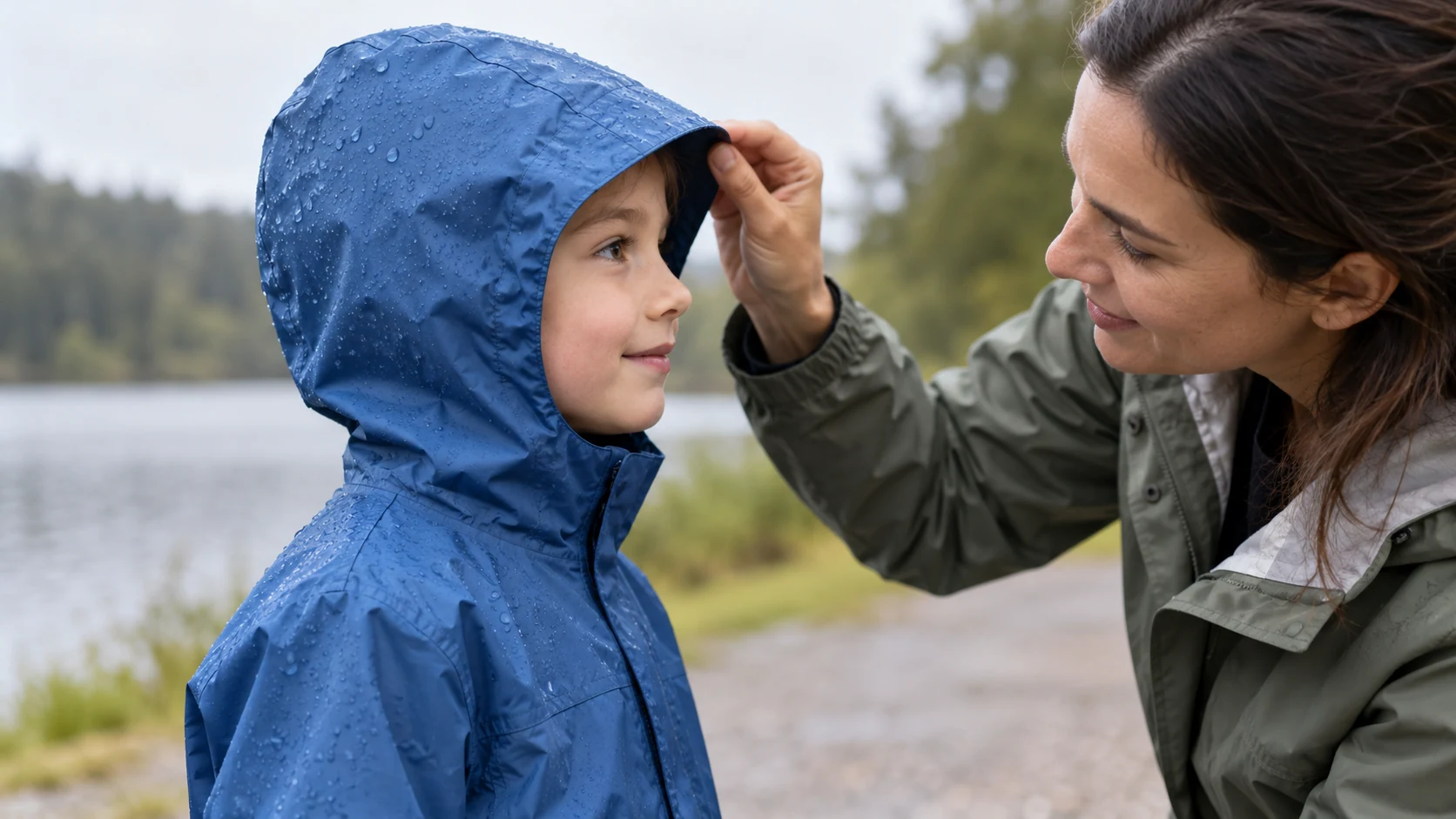
Try the hood with the child looking left, right and down. The edge should not fall across the eyes, and the opening should not require unsafe tightening to stay in place. A retailer should review small parts and destination-market requirements with an appropriately qualified testing or compliance partner.
When should a child wear an insulated rain jacket?
The fourth check is warmth relative to activity. A child walking to school, running during outdoor play and standing at a sports sideline may need different insulation on the same day. A waterproof shell supplies weather protection; it does not automatically provide adequate warmth.
A removable midlayer gives flexibility and can dry separately. A lined or insulated jacket may simplify dressing in consistently cold conditions. Neither is universally best. Check the complete outfit and avoid excessive insulation during active play, while providing appropriate warmth for colder, less active periods.
Breathability matters too, but no shell guarantees a sweat-free child. REI’s rainwear guide explains the difference between waterproof breathable and nonbreathable construction. Vapour transfer, ventilation, clothing underneath and activity all affect comfort; a waterproof rating alone says little about those factors.
How should a kids waterproof jacket be washed and stored?
The fifth check is whether the family or organisation can follow the care instructions. Mud, oils and residues can affect the outer finish, but aggressive cleaning can also damage coatings or other components. Read the actual label rather than applying one wash temperature or detergent rule to every jacket.
Use the recommended cleaning product and cycle, close or secure components as directed, and dry according to the label. Avoid fabric softener where the manufacturer prohibits it. Reapply a compatible water-repellent treatment when appropriate; use heat only if explicitly permitted by the garment instructions.
Hang a wet jacket where air can circulate instead of leaving it compressed in a school bag. Before reuse, inspect closures, seams and detachable parts. Washing and reproofing do not repair torn fabric, lifting seam tape or a broken hood attachment. Those problems need an appropriate repair or replacement decision.
How do lightweight and insulated children’s jackets compare?
| Decision | Lightweight waterproof shell | Lined or insulated waterproof jacket |
|---|---|---|
| Changing temperatures | Warmth can be varied with separate layers | Less flexible when permanent insulation is too warm |
| Getting dressed | May require a separate midlayer | Can simplify a cold-weather outfit |
| Bag space | Often easier to carry as backup | Usually bulkier, depending on construction |
| Drying | Separate layers can dry independently | Follow instructions for the whole assembly |
| Fit | Allow room for the intended warm layer | Check movement with the insulation already included |
A children’s waterproof jacket should be judged by usable days, not an assumed number of seasons. Growth, damage, cleaning and changing activities affect value. For a distributor, clear sizing information and realistic care instructions may reduce avoidable returns more effectively than adding another decorative feature.
Which features suit school, play and family walks?
| Use | Prioritise | Check on the child |
|---|---|---|
| School commute | Easy closures and bag-compatible fit | Can the child fasten it without trapped fabric? |
| Active outdoor play | Free movement and appropriate warmth | Do sleeves and hem stay controlled when reaching? |
| Family walking | Layering space and stable hood | Is side vision clear with the hood up? |
| Cold sidelines | Enough insulation for low activity | Does the complete outfit remain comfortable? |
What safety and labelling evidence should a buyer request?
For US sales, CPSC’s drawstring guidance and the applicable requirements for children’s products should be reviewed for the exact garment. EU sales involve general product-safety obligations and textile fibre-composition labelling under Regulation 1007/2011. Required testing and documentation depend on the product, materials, components and market; a generic “safe for kids” statement is insufficient.
Keep fabric reports, component information, size specifications and safety assessments tied to the approved sample. ISO 811 supports a textile water-resistance statement; it is not a children’s safety certificate. Unresolved cord or attachment hazards can make an otherwise attractive order unsuitable for sale.
What should be approved before a children’s range is ordered?
- Define age groups, destination markets, activity and climate.
- Review a size set over realistic layers and check movement.
- Confirm seam construction, hood safety, components and required documentation.
- Approve care labels and instructions that families can follow.
Yuelei Sports lists custom waterproof rain jacket options. Buyers considering a children’s range should confirm available sizes, development scope and market-specific safety evidence; an adult product listing does not establish children’s suitability. The custom jacket design guide helps organise the sampling brief.
Frequently asked questions
How should a kids waterproof jacket fit to allow room for warm layers?
It should close over the intended layer while leaving hands free and allowing reaching, sitting and bending. Use body measurements and a movement check rather than buying an arbitrary extra size.
What waterproof rating is good for children playing outside in rain?
No single number guarantees suitability. A documented rating, appropriate waterproof construction and sealed seams are useful; activity, wet-surface contact, openings and care also matter.
Are taped seams more important than a water-repellent finish for kids?
Both serve different roles. The finish helps surface water shed; seam sealing addresses water entry through construction joints. A suitable waterproof barrier and appropriate seam treatment are needed together.
Should a children’s rain jacket have a detachable or fixed hood?
Either can be suitable if properly designed and assessed. Check vision, attachments, cords and age-related safety requirements. The hood’s attachment type alone does not prove safety.
How do I wash a kids waterproof jacket without reducing its performance?
Follow its own care label and recommended cleaning method, then dry as directed. Avoid prohibited additives or heat and renew the outer finish only with a compatible treatment.
When should I choose an insulated kids jacket instead of a lightweight shell?
Insulation can suit consistently cold conditions and lower activity. A shell with separate warm layers offers more adjustment for changing temperatures and energetic play.
References
- CPSC: drawstrings in children’s upper outerwear
- ISO 811: textile water-penetration testing
- REI: rainwear construction and care principles
- EU textile fibre-composition labelling
A good children’s rain jacket leaves room to move, see and play. Contact Yuelei Sports with the age range, destination market and activity requirements to discuss a waterproof jacket development brief and the sample evidence needed before ordering.